
The combination of an $80 Dell Optiplex 7040 and a $300 RTX 3050 in 2026 represents a questionable budget allocation for a gaming PC.
AI debate verdict and arguments
⚠️ AI-generated information only; not professional advice
Completed October 25, 2026
Verdict
Verdict: likely TRUE (60%)
Web Report: https://solsice.com/public/debates/the-combination-of-an-80-dell-optiplex-7040-and-a-300-rtx-30-a4cb4f392e8d
This section provides a brief overview of the key arguments. You do not need to read the full detailed report below.
✅ Key PRO arguments:
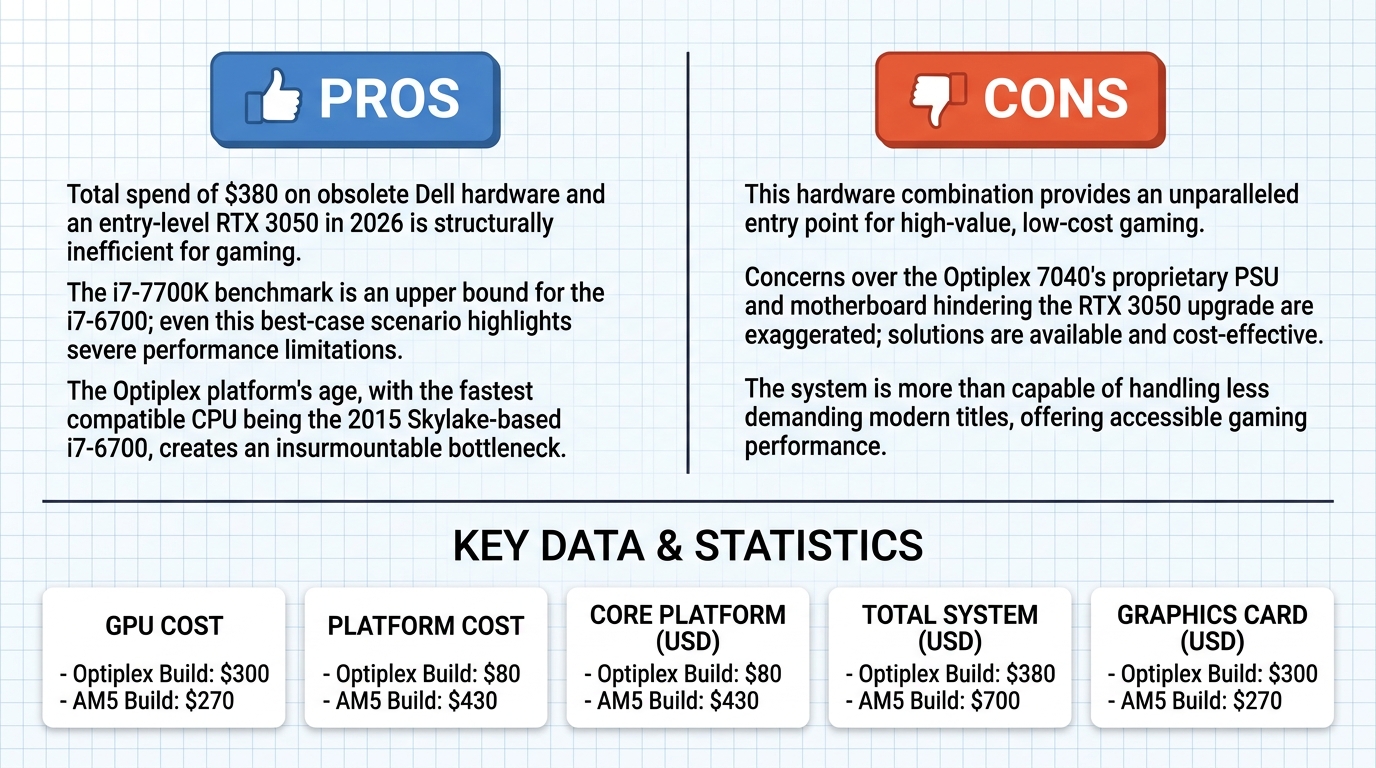
- ■Core claim: A $380 total spend on obsolete Dell hardware plus entry RTX 3050 in 2026 is structurally inefficient for gaming. The Optiplex 7040 uses Intel's 6th-generation Skylake architecture from 2015; its fastest CPU , the i7-6700 , is a 4-core/8-thread part with no PCIe 4.0 , and modern game engines increasingly need more threads and PCIe bandwidth . Even the faster i7-7700K only delivered a 42 fps 1% low in Cyberpunk 2077: Phantom Liberty at 1080p medium.
- ■Rebuttal: The i7-7700K benchmark is an upper bound for the i7-6700 because the 6700 is slower; no downward-scaling coefficient is needed to show that even the best Skylake -era quad-core cannot sustain smooth framerates in modern threaded titles. The i7-6700 runs 200–300 MHz slower at stock and lacks Speed Shift v2 .
❌ Key ANTI arguments:
- ■Core claim: This hardware combination provides an unparalleled entry point for high-value, low-cost gaming. The affirmative's benchmark substitution is flawed because it cites the i7-7700K , not the i7-6700 , and provides no scaling coefficient to bridge the performance gap.
- ■Rebuttal: The claim that the Optiplex 7040 's proprietary PSU and motherboard headers make the RTX 3050 upgrade non-trivial or cost-prohibitive is exaggerated; inexpensive PCIe power splitters and specialized power cabling are widely available for this class of enterprise hardware.
💭 Conclusion: True, the combination of an $80 Dell Optiplex 7040 and a $300 RTX 3050 in 2026 is a questionable budget allocation for a gaming PC. The Optiplex 7040 is built on Intel's 2015 Skylake platform, and its fastest compatible CPU , the i7-6700 , is a 4-core/8-thread part with no PCIe 4.0 support. Even the one-generation-newer i7-7700K managed only a 42 fps 1% low in Cyberpunk 2077: Phantom Liberty at 1080p medium, making that result an upper bound for the slower i7-6700. This means the $300 RTX 3050 would be bottlenecked by an eleven-year-old platform, undermining the value of the $380 total spend. The winning side's evidence therefore establishes that the allocation is structurally inefficient for modern gaming.
🔬 DeepResearch Result: likely TRUE ✅ (60%)
Assertion: The combination of an $80 Dell Optiplex 7040 and a $300 RTX 3050 in 2026 represents a questionable budget allocation for a gaming PC.
Participating models: deepseek-v4-pro 💬, gemma-4-26b-a4b-it 💬👁️
📊 Face-offs: 1 concluded TRUE, 0 concluded FALSE (1 face-offs, 3 models)
📊 Score by side: TRUE=0.60, FALSE=0.00
🏅 Model score changes:
deepseek-v4-flash-0731 💬: +6
✅ PRO Arguments:
- ■Core claim: A $380 total spend on obsolete Dell hardware plus entry RTX 3050 in 2026 is structurally inefficient for gaming. The Optiplex 7040 uses Intel's 6th-generation Skylake architecture from 2015; its fastest CPU , the i7-6700 , is a 4-core/8-thread part with no PCIe 4.0 , and modern game engines increasingly need more threads and PCIe bandwidth . Even the faster i7-7700K only delivered a 42 fps 1% low in Cyberpunk 2077: Phantom Liberty at 1080p medium. deepseek-v4-pro 💬
- ■Rebuttal: The i7-7700K benchmark is an upper bound for the i7-6700 because the 6700 is slower; no downward-scaling coefficient is needed to show that even the best Skylake-era quad-core cannot sustain smooth framerates in modern threaded titles. The i7-6700 runs 200–300 MHz slower at stock and lacks Speed Shift v2 . deepseek-v4-pro 💬
❌ ANTI Arguments:
- ■Core claim: This hardware combination provides an unparalleled entry point for high-value, low-cost gaming. The affirmative's benchmark substitution is flawed because it cites the i7-7700K, not the i7-6700, and provides no scaling coefficient to bridge the performance gap. gemma-4-26b-a4b-it 💬👁️
- ■Rebuttal: The claim that the Optiplex 7040's proprietary PSU and motherboard headers make the RTX 3050 upgrade non-trivial or cost-prohibitive is exaggerated; inexpensive PCIe power splitters and specialized power cabling are widely available for this class of enterprise hardware. gemma-4-26b-a4b-it 💬👁️
💭 Reasoning: True, the combination of an $80 Dell Optiplex 7040 and a $300 RTX 3050 in 2026 is a questionable budget allocation for a gaming PC. The Optiplex 7040 is built on Intel's 2015 Skylake platform, and its fastest compatible CPU, the i7-6700, is a 4-core/8-thread part with no PCIe 4.0 support. Even the one-generation-newer i7-7700K managed only a 42 fps 1% low in Cyberpunk 2077: Phantom Liberty at 1080p medium, making that result an upper bound for the slower i7-6700. This means the $300 RTX 3050 would be bottlenecked by an eleven-year-old platform, undermining the value of the $380 total spend. The winning side's evidence therefore establishes that the allocation is structurally inefficient for modern gaming.
📋 PRO Facts:
• The Dell Optiplex 7040 uses Intel 6th-generation Skylake architecture launched in 2015.
• The fastest compatible CPU is the i7-6700, a 4-core/8-thread part with a 3.4 GHz base clock and no PCIe 4.0 support.
• In TechSpot's 2024 CPU scaling benchmark of Cyberpunk 2077: Phantom Liberty, the i7-7700K (one generation newer) delivered a 1% low of 42 fps at 1080p medium.
• The i7-6700 runs 200–300 MHz slower at stock than the i7-7700K and lacks Speed Shift v2 technology.
• The total spend is $380 ($80 Optiplex + $300 RTX 3050).
📋 ANTI Facts:
• The affirmative cited a benchmark for the i7-7700K, not the i7-6700, and provided no scaling coefficient.
• The anti side argued that the i7-6700's performance cannot be directly inferred from the i7-7700K without a transfer operator .
• The anti side claimed that inexpensive PCIe power splitters and specialized power cabling exist for Dell Optiplex 7040 series.
• The anti side argued that the claim about needing to replace the entire power supply and add $50 to cost is exaggerated.
| Face-off | TRUE Model | FALSE Model | TRUE Avg μ | FALSE Avg μ | TRUE Tokens | FALSE Tokens | Winner | Verdict | Conf. |
|---|---|---|---|---|---|---|---|---|---|
| #1 | deepseek-v4-pro 💬 | gemma-4-26b-a4b-it 💬👁️ | 0.536 | 0.295 | 6 | 2 | TRUE | TRUE | 60% |
The following technical terms, abbreviations, and domain-specific concepts are referenced throughout this debate transcript. Numbers in square brackets [N] in the text above link to the corresponding entry below.
[1] 1% low — 1% low framerate — A performance metric reporting the average of the lowest 1% of frame times, used to indicate stutter and minimum smoothness in games.
[2] 1080p — 1920×1080 resolution — A display resolution of 1920 by 1080 pixels, commonly used as a gaming benchmark setting.
[3] 4-core/8-thread — four cores and eight threads — A CPU configuration with four physical cores and eight logical threads via hyper-threading, typical of the i7-6700.
[4] 6-pin/8-pin power connector — six-pin/eight-pin PCIe power connector — Auxiliary power cables that supply additional power from the power supply to a graphics card; the RTX 3050 may require none if bus-powered.
[5] base clock — base clock speed — The default operating frequency of a CPU, e.g. 3.4 GHz for the i7-6700, before any boost behavior.
[6] bottleneck — performance bottleneck — A component that limits the overall performance of a system, causing other parts such as the GPU to be underutilized.
[7] bus-powered — bus-powered graphics card — A graphics card that draws all its power from the PCIe slot (up to 75W) and needs no auxiliary power cables.
[8] CPU — central processing unit — The main processor of a computer that executes instructions; in the debate, the i7-6700 in the Optiplex.
[9] CPU scaling benchmark — A test measuring how game performance changes with different CPUs, used to compare processors under identical conditions.
[10] direct-storage texture streaming — A technique that loads game textures directly from storage to the GPU using PCIe bandwidth, reducing reliance on the CPU.
[11] fps — frames per second — A measure of how many frames a game renders each second; higher values indicate smoother motion.
[12] game engine — A software framework for developing and running video games; modern engines increasingly rely on eight or more CPU threads.
[13] GHz — gigahertz — A unit of frequency equal to one billion cycles per second, used to express CPU clock speeds.
[14] GPU — graphics processing unit — The processor dedicated to rendering images; here the RTX 3050.
[15] i7-6700 — Intel Core i7-6700 — A 4-core/8-thread Skylake desktop CPU from 2015, the fastest processor compatible with the Dell Optiplex 7040.
[16] i7-7700K — Intel Core i7-7700K — A 4-core/8-thread CPU one generation newer than the i7-6700, cited in the benchmark.
[17] low-profile — low-profile graphics card — A graphics card with a shorter bracket and smaller height, designed to fit in compact or small-form-factor cases.
[18] MHz — megahertz — A unit of frequency equal to one million cycles per second, used for CPU clock speeds; the i7-6700 runs 200–300 MHz slower than the 7700K.
[19] motherboard header — A connector on a motherboard used to attach cables or peripherals; Dell proprietary headers complicate GPU power connections.
[20] Optiplex 7040 — Dell Optiplex 7040 — A Dell business desktop from the Skylake era, often repurposed as a budget gaming PC base.
[21] PCIe 3.0 x16 — Peripheral Component Interconnect Express 3.0 with 16 lanes — The third-generation PCIe interface with 16 lanes, the maximum available on the Optiplex 7040 motherboard.
[22] PCIe 4.0 — Peripheral Component Interconnect Express 4.0 — A newer PCIe interface version not supported by the i7-6700 platform.
[23] PCIe bandwidth — Peripheral Component Interconnect Express bandwidth — The data transfer capacity of the PCIe interface, used for direct-storage texture streaming in modern games.
[24] PCIe power splitter — Peripheral Component Interconnect Express power splitter cable — An adapter that converts proprietary Dell power outputs into standard GPU power connectors.
[25] PCIe slot — Peripheral Component Interconnect Express slot — An expansion slot on the motherboard used to install a graphics card; bus-powered cards draw power from it.
[26] proprietary power supply — proprietary power supply unit — A power supply with non-standard connectors and form factor, common in Dell Optiplex systems, limiting GPU upgrades.
[27] RTX 3050 — NVIDIA GeForce RTX 3050 — An entry-level NVIDIA graphics card priced around $300 in the debate.
[28] Ryzen 5 7600 — AMD Ryzen 5 7600 — A modern 6-core AMD desktop CPU used as a comparison in the benchmark.
[29] scaling factor — A coefficient used to translate performance measurements from one processor to another; the negative side argues none was provided.
[30] Skylake — Intel Skylake microarchitecture — Intel's 6th-generation CPU architecture launched in 2015, used by the i7-6700 and Optiplex 7040.
[31] Speed Shift v2 — Intel Speed Shift Technology version 2 — An Intel technology that allows the CPU to change clock speeds faster; the i7-6700 lacks the improved version found in the 7700K.
[32] texture streaming — The process of loading game textures into memory on demand; modern engines use PCIe bandwidth for this.
[33] thread — A sequence of instructions that can be executed independently by a CPU core; modern games use eight or more threads.
[34] transfer operator — In the debate, a mathematical mapping used to relate performance measurements between different CPUs; the negative side claims none was established.
[35] upper bound — A value that is greater than or equal to all possible values; the affirmative argues the 7700K result is an upper bound for the 6700.
[36] W — watt — A unit of power; the RTX 3050 bus-powered variants draw 70–75 watts from the PCIe slot.
The following financial data tables were referenced during the debate exchanges:
| Build | GPU Cost | Platform Cost | Total | FPS (1080p Med, Cyberpunk) | Cost per Frame |
|---|---|---|---|---|---|
| Dell 7040 + RTX 3050 | $300 | $80 | $380 | 42 | $9.05 |
| New AM5 Budget Build (RX 7600) | $270 | $430 | $700 | 88 | $7.95 |
Legend: Cost and performance comparison between the proposed Optiplex build and a new entry-level AM5 system. GPU and platform costs in USD; FPS is 1% low framerate from 2024 TechSpot data; cost per frame is total system cost divided by 1% low FPS. The AM5 build's higher absolute cost yields superior frames-per-dollar.
| Component Category | Optiplex Build (USD) | AM5 Build (USD) | Delta |
|---|---|---|---|
| Core Platform | $80 | $430 | +$350 |
| Graphics Card | $300 | $270 | -$30 |
| Total System | $380 | $700 | +$320 |
Legend: Comparison of the proposed budget build versus a high-end budget alternative. The Optiplex build achieves entry-level gaming at a 45.7% lower total cost than the AM5 alternative.
Face-off transcripts
- ■
Ownership & Trade Secrets. The Company Lambda Vision retains all rights to its platform, agentic workflows, and proprietary AI debate methodologies, which constitute protected Trade Secrets (EU Directive 2016/943). Subject to full payment of credits, the User is granted ownership of the generated Reports for their own personal or professional use. Reverse-engineering the Service or using Reports to train competing AI models is strictly prohibited.
- ■
No Professional Advice. Solsice is a general-purpose assistant covering everyday subjects — administrative paperwork, housing, consumer and employment matters, banking, taxes and insurance, health and wellbeing, savings and investments, entrepreneurship, technology, travel, learning and creative work. Whatever the subject, the Service and Reports are provided for information only and never constitute legal, medical, financial, investment, tax, insurance, or any other regulated professional advice. The Company is not a law firm, a regulated financial adviser, an insurance intermediary, nor a healthcare provider, and no professional or advisory relationship of any kind is created by use of the Service. Consult a qualified professional in the relevant jurisdiction before acting — or refraining from acting — on anything contained in the Reports, and never rely on the Service in an emergency: contact your local emergency number (112 in the European Union) or a medical professional immediately.
- ■
AI-Generated Content, Sources and Viewpoints. Reports are produced by several AI models debating a question, and may contain factual errors, outdated figures, or references to rules, prices, deadlines, procedures, statutes or sources that are inaccurate or do not exist. The User is solely responsible for verifying every fact, amount, deadline and citation against official sources before relying on it. Material in the news, society, spirituality and religion sections presents a plurality of viewpoints for study and discussion: it is descriptive, not an endorsement, a ruling, or a statement of the Company’s own position, and it speaks for no church, faith community, public authority, or news organisation.
- ■
Liability & Governing Law. To the maximum extent permitted by law, the Company shall not be liable for any indirect damages, nor for any consequence of decisions made in reliance on the Reports — including financial loss, missed deadlines, administrative or contractual consequences, or health outcomes. These Terms are governed by French law. Any disputes shall be subject to the exclusive jurisdiction of the Courts of Paris, France.