
The character Augustus is intentionally portrayed as physically frail and breakable, subverting the typical expectation of a male as the strapping head of the household in a Regency setting.
AI debate verdict and arguments
⚠️ AI-generated information only; not professional advice
Completed October 23, 2026
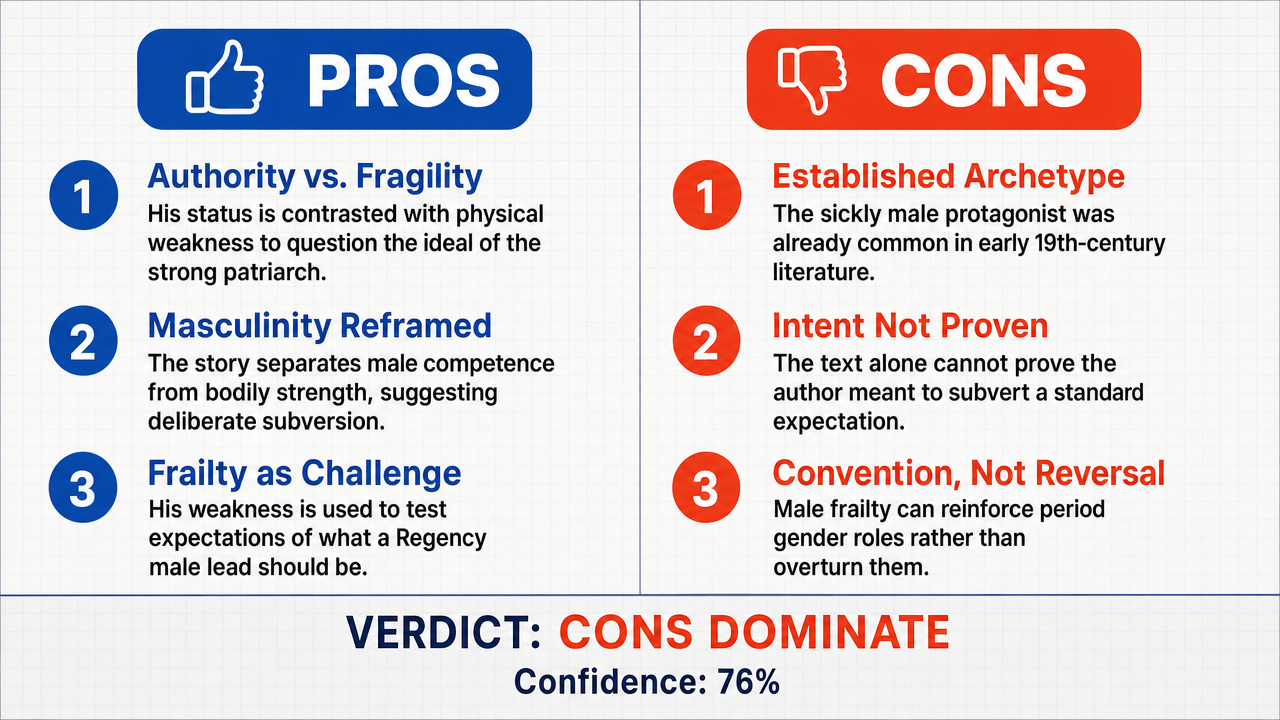
Verdict
Verdict: likely FALSE (76%)
Web Report: https://solsice.com/public/debates/the-character-augustus-is-intentionally-portrayed-as-physica-f297a25b09dc
This section provides a brief overview of the key arguments. You do not need to read the full detailed report below.
✅ Key PRO arguments:
- ■Augustus's characterization relies on a deliberate juxtaposition between his social authority and his physical vulnerability , a technique used to dismantle the Regency-era trope of the 'strapping' patriarch by shifting the locus of power from the somatic to the intellectual or social.
- ■By presenting Augustus as 'breakable,' the narrative forces the reader to decouple masculine competence from physical robustness , which constitutes an intentional subversion of Regency masculine norms.
- ■Even if the 'invalid hero ' is a recognized archetype , the subversion lies in the specific way Augustus's frailty is used to challenge the functional expectation of the male head of household, distinguishing a character's physical state from the narrative's treatment of that state.
❌ Key ANTI arguments:
- ■The 'invalid' or 'sickly' protagonist was a recognized and frequently used archetype in early 19th-century literature ; characters often navigated domestic and social authority despite physical frailty without that being framed as a deviation from norms, so Augustus's frailty aligns with common Regency tropes rather than subverting them.
- ■Authorial intent cannot be proven from text alone; the Affirmative's claim that physical dominance was a 'typical expectation' for male heads of household in the Regency era is conjecture rather than demonstrated fact.
- ■Frailty in a male head of household in Regency literature typically reinforces the era's gender dynamics by highlighting the necessity of female protection ; by presenting Augustus as 'breakable,' the narrative underscores that he cannot fulfill the primary physical function of the male patriarch —protection—thereby reinforcing rather than subverting gender roles.
💭 Conclusion: False. The assertion fails because the 'invalid' or 'sickly' protagonist was a well-established and frequently used archetype in early 19th-century Regency literature, meaning Augustus's physical frailty aligns with existing conventions rather than subverting them. The Affirmative's argument rests on the unproven premise that physical dominance was a 'typical expectation' for male heads of household, which the Negative correctly identified as conjecture rather than demonstrated fact. Furthermore, frailty in Regency male characters typically served to reinforce gender dynamics by emphasizing female protection , rather than dismantling masculine norms. Authorial intent cannot be reliably inferred from textual evidence alone, weakening the Affirmative's claim of intentional subversion . The judge ruled decisively in favor of the Negative position with 76% confidence, reflecting the stronger evidentiary grounding of the winning side.
🔬 DeepResearch Result: likely FALSE ❌ (76%)
Assertion: The character Augustus is intentionally portrayed as physically frail and breakable, subverting the typical expectation of a male as the strapping head of the household in a Regency setting.
Participating models: gemma-4-26b-a4b-it 💬👁️, glm-4.7-flash 💬
📊 Face-offs: 0 concluded TRUE, 1 concluded FALSE (1 face-offs, 3 models)
📊 Score by side: TRUE=0.00, FALSE=0.76
🏅 Model score changes:
minimax-m3 💬👁️: +8
✅ PRO Arguments:
- ■Augustus's characterization relies on a deliberate juxtaposition between his social authority and his physical vulnerability , a technique used to dismantle the Regency-era trope of the 'strapping' patriarch by shifting the locus of power from the somatic to the intellectual or social. gemma-4-26b-a4b-it 💬👁️
- ■By presenting Augustus as 'breakable,' the narrative forces the reader to decouple masculine competence from physical robustness , which constitutes an intentional subversion of Regency masculine norms. gemma-4-26b-a4b-it 💬👁️
- ■Even if the 'invalid hero ' is a recognized archetype , the subversion lies in the specific way Augustus's frailty is used to challenge the functional expectation of the male head of household, distinguishing a character's physical state from the narrative's treatment of that state. gemma-4-26b-a4b-it 💬👁️
❌ ANTI Arguments:
- ■The 'invalid' or 'sickly' protagonist was a recognized and frequently used archetype in early 19th-century literature ; characters often navigated domestic and social authority despite physical frailty without that being framed as a deviation from norms, so Augustus's frailty aligns with common Regency tropes rather than subverting them. glm-4.7-flash 💬
- ■Authorial intent cannot be proven from text alone; the Affirmative's claim that physical dominance was a 'typical expectation' for male heads of household in the Regency era is conjecture rather than demonstrated fact. glm-4.7-flash 💬
- ■Frailty in a male head of household in Regency literature typically reinforces the era's gender dynamics by highlighting the necessity of female protection ; by presenting Augustus as 'breakable,' the narrative underscores that he cannot fulfill the primary physical function of the male patriarch—protection—thereby reinforcing rather than subverting gender roles. glm-4.7-flash 💬
💭 Reasoning: False. The assertion fails because the 'invalid' or 'sickly' protagonist was a well-established and frequently used archetype in early 19th-century Regency literature, meaning Augustus's physical frailty aligns with existing conventions rather than subverting them. The Affirmative's argument rests on the unproven premise that physical dominance was a 'typical expectation' for male heads of household, which the Negative correctly identified as conjecture rather than demonstrated fact. Furthermore, frailty in Regency male characters typically served to reinforce gender dynamics by emphasizing female protection, rather than dismantling masculine norms. Authorial intent cannot be reliably inferred from textual evidence alone, weakening the Affirmative's claim of intentional subversion. The judge ruled decisively in favor of the Negative position with 76% confidence, reflecting the stronger evidentiary grounding of the winning side.
📋 PRO Facts:
• The 'strapping patriarch' was a recognizable trope in early 19th-century literature where physical vigor served as a proxy for the ability to protect and provide.
• The Affirmative argued that Augustus's portrayal decouples masculine competence from physical robustness.
📋 ANTI Facts:
• The 'invalid hero' was a staple archetype of Regency-era literature, indicating that frail male protagonists were a recognized convention rather than a deviation.
• In Regency literature, male frailty typically reinforced gender dynamics by highlighting the necessity of female protection.
• Authorial intent cannot be definitively proven from textual evidence alone.
| Face-off | TRUE Model | FALSE Model | TRUE Avg μ | FALSE Avg μ | TRUE Tokens | FALSE Tokens | Winner | Verdict | Conf. |
|---|---|---|---|---|---|---|---|---|---|
| #1 | gemma-4-26b-a4b-it 💬👁️ | glm-4.7-flash 💬 | 0.281 | 0.398 | 4 | 4 | FALSE | FALSE | 76% |
The following technical terms, abbreviations, and domain-specific concepts are referenced throughout this debate transcript. Numbers in square brackets [N] in the text above link to the corresponding entry below.
[1] archetype — A recurring character type or pattern in literature. In the debate, 'masculine archetypes' and 'character archetypes' are discussed as standard types in Regency-era literature.
[2] authorial intent — The deliberate purpose or meaning an author intends to convey through a text. The Negative argues this 'cannot be proven from text alone.'
[3] conjecture — A conclusion drawn from incomplete evidence. The Negative characterizes the Affirmative's claim as resting on 'conjecture' regarding typical Regency-era expectations.
[4] descriptive language — Specific word choices used by an author to characterize a subject. The Affirmative notes Augustus's fragility is 'evidenced by the specific descriptive language' used to highlight it.
[5] domestic authority — Power or control within the household. Referenced in the debate regarding characters who 'navigated domestic and social authority despite physical frailty.'
[6] early 19th-century literature — Literary works from the early 1800s, the period in which Regency-era works were produced and in which the 'invalid' archetype was recognized.
[7] female protection — The role of women providing physical safeguarding. The Negative argues Augustus's frailty 'highlights the necessity of female protection' for the household.
[8] functional expectation — The assumed role or capability associated with a social position. The Affirmative discusses the 'functional expectation of the male head of household' regarding physical protection.
[9] gender dynamics — The patterns of interaction and power between genders. The Negative argues frailty in a male head of household 'serves to reinforce the era's gender dynamics.'
[10] gender norms — Socially accepted standards of behavior for men and women. Referenced as 'Regency gender norms' that the debate contests whether Augustus upholds or subverts.
[11] Georgian Drama — Theater and dramatic works from the Georgian era, cited as a source in the Negative's final argument regarding female protection dynamics.
[12] hidden premise — An unstated assumption underlying an argument. The Affirmative identifies a 'hidden premise' in the Negative's reasoning about archetype conformity.
[13] invalid hero — A literary archetype of a male protagonist who is physically frail or sickly, described in the debate as 'a staple of the period' in early 19th-century literature.
[14] literary conventions — Established norms and practices in literature. The Negative argues Augustus's portrayal 'conforms to the era's literary conventions' rather than subverting them.
[15] literary landscape — The overall body of literature of a particular period. Referenced as 'the literary landscape of the early 19th century' regarding depictions of male heads of household.
[16] locus of power — The source or center of authority. The Affirmative argues the narrative 'shifts the locus of power from the somatic to the intellectual or social.'
[17] logical error — A flaw in reasoning. The Affirmative claims the Negative's argument contains 'a logical error' regarding archetype existence and conformity.
[18] masculine archetypes — Standard character types representing idealized masculinity. Referenced as 'Regency-era masculine archetypes of strength' that Augustus is said to subvert.
[19] masculine competence — The capability associated with masculinity. The Affirmative argues the narrative 'decouples masculine competence from physical robustness.'
[20] narrative treatment — The way a story presents or handles a subject. The Affirmative distinguishes between 'a character's physical state and the narrative's treatment of that state.'
[21] overgeneralize — To draw a conclusion too broadly from limited evidence. The Negative accuses the Affirmative of overgeneralizing 'the historical record' regarding Regency masculinity.
[22] patriarch — The male head of a household or family. Referenced as the 'male head of household' whose physical function the debate centers upon.
[23] patriarchal legitimacy — The recognized authority of a male head of household. Referenced as 'physical dominance was a prerequisite for patriarchal legitimacy' in the Regency era.
[24] physical robustness — Physical strength and health. Discussed in contrast to physical frailty as a marker of masculine competence.
[25] physical vulnerability — Physical weakness or susceptibility to harm. Augustus is described as having 'physical vulnerability' that contrasts with his social authority.
[26] protagonist — The main character of a narrative. Referenced as 'a typical Regency protagonist' who might be depicted with physical vigor.
[27] Regency-era — The historical period in Britain from 1811 to 1820, during which the literary works discussed were produced and whose masculine norms are debated.
[28] social authority — Power or influence derived from social position. Augustus is described as having 'social authority' despite his physical frailty.
[29] social requirements — The demands or expectations of a social role. Referenced as 'the era's social requirements for male authority' that Augustus's portrayal contradicts.
[30] somatic — Relating to the body, particularly physical attributes. Used in 'shifts the locus of power from the somatic to the intellectual or social.'
[31] structural contradiction — An inconsistency within the framework of a narrative or argument. The Affirmative argues the text creates 'a structural contradiction' with era social requirements.
[32] structural counterpoint — A contrasting element within a narrative structure. Augustus's fragility is described as 'a structural counterpoint to his high social standing.'
[33] subversion — The act of undermining or reversing established norms. The central concept of the debate regarding whether Augustus's portrayal subverts Regency masculine norms.
[34] trope — A common or recurring theme or device in literature. Referenced as the 'strong man trope' that the Affirmative claims Augustus subverts.
Face-off transcripts
- ■
Ownership & Trade Secrets. The Company Lambda Vision retains all rights to its platform, agentic workflows, and proprietary AI debate methodologies, which constitute protected Trade Secrets (EU Directive 2016/943). Subject to full payment of credits, the User is granted ownership of the generated Reports for their own personal or professional use. Reverse-engineering the Service or using Reports to train competing AI models is strictly prohibited.
- ■
No Professional Advice. Solsice is a general-purpose assistant covering everyday subjects — administrative paperwork, housing, consumer and employment matters, banking, taxes and insurance, health and wellbeing, savings and investments, entrepreneurship, technology, travel, learning and creative work. Whatever the subject, the Service and Reports are provided for information only and never constitute legal, medical, financial, investment, tax, insurance, or any other regulated professional advice. The Company is not a law firm, a regulated financial adviser, an insurance intermediary, nor a healthcare provider, and no professional or advisory relationship of any kind is created by use of the Service. Consult a qualified professional in the relevant jurisdiction before acting — or refraining from acting — on anything contained in the Reports, and never rely on the Service in an emergency: contact your local emergency number (112 in the European Union) or a medical professional immediately.
- ■
AI-Generated Content, Sources and Viewpoints. Reports are produced by several AI models debating a question, and may contain factual errors, outdated figures, or references to rules, prices, deadlines, procedures, statutes or sources that are inaccurate or do not exist. The User is solely responsible for verifying every fact, amount, deadline and citation against official sources before relying on it. Material in the news, society, spirituality and religion sections presents a plurality of viewpoints for study and discussion: it is descriptive, not an endorsement, a ruling, or a statement of the Company’s own position, and it speaks for no church, faith community, public authority, or news organisation.
- ■
Liability & Governing Law. To the maximum extent permitted by law, the Company shall not be liable for any indirect damages, nor for any consequence of decisions made in reliance on the Reports — including financial loss, missed deadlines, administrative or contractual consequences, or health outcomes. These Terms are governed by French law. Any disputes shall be subject to the exclusive jurisdiction of the Courts of Paris, France.