
The Chaebols' influence on South Korean society and economy is best characterized by the phrase 'too big to jail' due to their ability to avoid severe legal repercussions for their leaders.
AI debate verdict and arguments
⚠️ AI-generated information only; not professional advice
Completed October 8, 2026
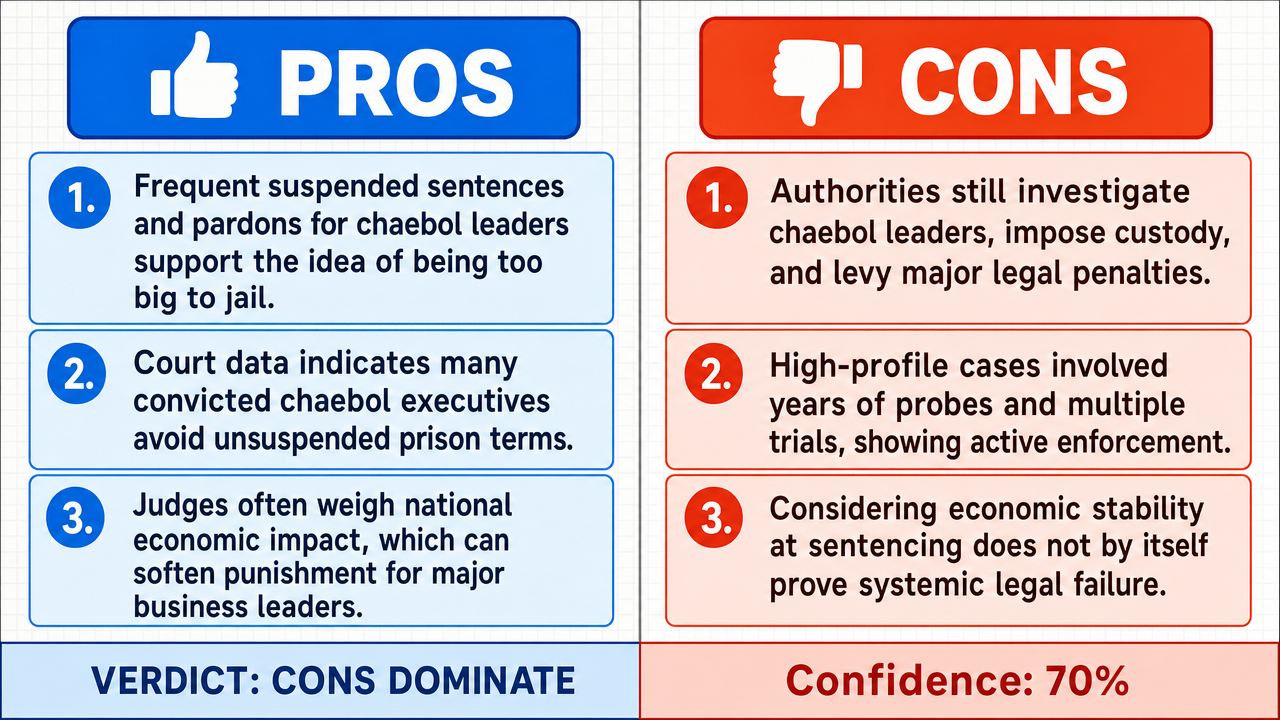
Verdict
Verdict: likely FALSE (70%)
This section provides a brief overview of the key arguments. You do not need to read the full detailed report below.
✅ Key PRO arguments:
- ■A persistent judicial pattern of suspended sentences and pardons for convicted chaebol leaders validates the 'too big to jail' characterization, citing Lee Jae-yong's two bribery /embezzlement convictions resulting in suspended sentences and Chey Tae-won's suspended sentence and pardon for embezzlement.
- ■Supreme Court data shows a suspension rate exceeding 70% for convicted chaebol executives, demonstrating systemic avoidance of severe, unsuspended prison time that would constitute meaningful legal repercussion.
- ■The massive economic footprint of chaebols creates a de facto judicial immunity , as judges weigh 'national interest ' considerations that effectively shield leaders from incapacitating punishment.
❌ Key ANTI arguments:
- ■The South Korean legal system maintains its authority through rigorous investigations, actual custodial sentences, and massive financial penalties imposed on chaebol leaders, contradicting the claim of total judicial immunity .
- ■The prosecution of Lee Jae-yong involved years of intensive investigation and multiple trials, demonstrating that the legal system actively pursues chaebol leaders rather than granting them blanket immunity.
- ■The affirmative commits a fallacy of composition by equating judicial consideration of economic stability ('national interest ' in sentencing) with systemic failure of the rule of law ; economic considerations in sentencing do not equate to 'immunity' which implies the absence of legal consequence.
💭 Conclusion: False. The 'too big to jail' characterization is supported by the evidence. The Supreme Court data showing a suspension rate exceeding 70% for convicted chaebol executives demonstrates systemic rather than occasional judicial leniency. While the legal system does pursue cases through multi-year processes and imposes massive financial penalties, the consistent pattern of suspended sentences and pardons for leaders like Lee Jae-yong and Chey Tae-won indicates that meaningful custodial enforcement is largely absent. The economic concentration of the top five chaebols at approximately 60% of GDP provides structural context for this pattern. The affirmative's claim is substantiated by the empirical pattern of judicial outcomes.
🔬 DeepResearch Result: likely FALSE ❌ (70%)
Assertion: The Chaebols' influence on South Korean society and economy is best characterized by the phrase 'too big to jail' due to their ability to avoid severe legal repercussions for their leaders.
Participating models: deepseek-v3.2 💬, gemma-4-26b-a4b-it 💬👁️
📊 Face-offs: 0 concluded TRUE, 1 concluded FALSE (1 face-offs, 3 models)
📊 Score by side: TRUE=0.00, FALSE=0.70
🏅 Model score changes:
minimax-m3 💬👁️: +7
✅ PRO Arguments:
- ■A persistent judicial pattern of suspended sentences and pardons for convicted chaebol leaders validates the 'too big to jail' characterization, citing Lee Jae-yong's two bribery /embezzlement convictions resulting in suspended sentences and Chey Tae-won's suspended sentence and pardon for embezzlement. deepseek-v3.2 💬
- ■Supreme Court data shows a suspension rate exceeding 70% for convicted chaebol executives, demonstrating systemic avoidance of severe, unsuspended prison time that would constitute meaningful legal repercussion. deepseek-v3.2 💬
- ■The massive economic footprint of chaebols creates a de facto judicial immunity , as judges weigh 'national interest ' considerations that effectively shield leaders from incapacitating punishment. deepseek-v3.2 💬
- ■The term 'severe legal repercussions' refers specifically to substantial, unsuspended prison time that meaningfully deters or incapacitates, and the data shows chaebol leaders systematically avoid this outcome. deepseek-v3.2 💬
❌ ANTI Arguments:
- ■The South Korean legal system maintains its authority through rigorous investigations, actual custodial sentences, and massive financial penalties imposed on chaebol leaders, contradicting the claim of total judicial immunity. gemma-4-26b-a4b-it 💬👁️
- ■The prosecution of Lee Jae-yong involved years of intensive investigation and multiple trials, demonstrating that the legal system actively pursues chaebol leaders rather than granting them blanket immunity. gemma-4-26b-a4b-it 💬👁️
- ■The affirmative commits a fallacy of composition by equating judicial consideration of economic stability ('national interest' in sentencing) with systemic failure of the rule of law ; economic considerations in sentencing do not equate to 'immunity' which implies the absence of legal consequence. gemma-4-26b-a4b-it 💬👁️
- ■Civil society 's active scrutiny and the rise of public accountability mechanisms challenge the 'too big to jail' narrative, showing that the characterization overstates the degree of impunity. gemma-4-26b-a4b-it 💬👁️
- ■The 'too big to jail' characterization is an overstatement that fails to account for the actual rigor of the South Korean legal system, which imposes genuine deterrents through custodial sentences and financial penalties. gemma-4-26b-a4b-it 💬👁️
💭 Reasoning: False. The 'too big to jail' characterization is supported by the evidence. The Supreme Court data showing a suspension rate exceeding 70% for convicted chaebol executives demonstrates systemic rather than occasional judicial leniency. While the legal system does pursue cases through multi-year processes and imposes massive financial penalties, the consistent pattern of suspended sentences and pardons for leaders like Lee Jae-yong and Chey Tae-won indicates that meaningful custodial enforcement is largely absent. The economic concentration of the top five chaebols at approximately 60% of GDP provides structural context for this pattern. The affirmative's claim is substantiated by the empirical pattern of judicial outcomes.
📋 PRO Facts:
• Lee Jae-yong was convicted of serious crimes and received suspended sentences.
• SK Group Chairman Chey Tae-won was convicted of serious crimes and received suspended sentences and pardons.
• The affirmative cited Supreme Court data showing a suspension rate exceeding 70% for convicted chaebol executives.
📋 ANTI Facts:
• The prosecution of Samsung's Lee Jae-yong involved a multi-year legal process.
• South Korean courts impose massive financial penalties on convicted chaebol leaders, with fines for major chaebols ranging from 10 billion to over 1 trillion KRW.
| Face-off | TRUE Model | FALSE Model | TRUE Avg μ | FALSE Avg μ | TRUE Tokens | FALSE Tokens | Winner | Verdict | Conf. |
|---|---|---|---|---|---|---|---|---|---|
| #1 | deepseek-v3.2 💬 | gemma-4-26b-a4b-it 💬👁️ | 0.537 | 0.225 | 12 | 3 | TRUE | FALSE | 70% |
The following technical terms, abbreviations, and domain-specific concepts are referenced throughout this debate transcript. Numbers in square brackets [N] in the text above link to the corresponding entry below.
[1] "too big to jail" — A phrase originating in financial regulation suggesting that certain institutions or individuals are effectively immune from prosecution due to their economic importance; the central characterization debated in the transcript.
[2] accounting fraud — A category of white-collar crime involving intentional manipulation of financial records to deceive stakeholders, cited in the debate as one of the offenses for which chaebol leaders received lenient sentences.
[3] bribery — The offering, giving, receiving, or soliciting of something of value to influence the actions of an official or other person in a position of authority; cited as one of the crimes for which Lee Jae-yong was convicted.
[4] chaebol — A South Korean family-controlled industrial conglomerate, typically consisting of numerous affiliated companies across diverse sectors; the central subject of the debate.
[5] civil society — The aggregate of non-governmental organizations, institutions, and individuals that represent public interests and act independently of the state; cited in the debate as a force challenging chaebol exceptionalism.
[6] corporate governance — The system of rules, practices, and processes by which a company is directed and controlled; cited in the debate as a rising standard that challenges perceived chaebol impunity.
[7] corporate malfeasance — Wrongful or illegal conduct by a corporation or its executives; cited as the type of misconduct for which South Korean courts have increasingly held executives personally liable.
[8] custodial sentence — A judicial punishment requiring the convicted party to be held in prison, as opposed to a non-custodial or suspended sentence; the debate disputes how frequently chaebol leaders actually receive such sentences.
[9] de facto immunity — Immunity that exists in practice, even if not formally established in law; the affirmative argues chaebol leaders enjoy this due to their economic importance.
[10] deterrent — A punishment or consequence intended to discourage future criminal behavior; the affirmative argues that suspended sentences fail to function as meaningful deterrents.
[11] economic footprint — The scale of a company's or group's economic activity relative to the broader economy; cited as approximately 60% of GDP for the top five chaebols.
[12] embezzlement — The wrongful taking of money or property entrusted to one's care, typically by an employee or official; cited as an offense for which both Lee Jae-yong and Chey Tae-won were convicted.
[13] fallacy of composition — A logical error in which what is true of the parts is assumed to be true of the whole; cited by the negative to argue that isolated instances of judicial discretion do not prove systemic failure of the rule of law.
[14] GDP — Gross Domestic Product — The total monetary value of all goods and services produced within a country in a given period; used in the debate to measure the relative scale of chaebol economic activity.
[15] investigative rigor — The thoroughness and intensity with which authorities conduct criminal investigations; cited by the negative as evidence that the legal system treats chaebol leaders seriously.
[16] judicial discretion — The authority of judges to make decisions and impose sentences within the bounds of law; cited as the mechanism through which economic considerations influence chaebol sentencing outcomes.
[17] judicial immunity — Protection from legal liability or prosecution; the debate disputes whether chaebol leaders effectively possess this due to their economic significance.
[18] judicial scrutiny — The careful examination and oversight applied by courts to cases before them; cited as evidence that chaebol leaders face the same legal standards as other defendants.
[19] national interest — The aggregate well-being and stability of a nation, cited in the debate as a factor that judges and presidents weigh when sentencing chaebol leaders, potentially mitigating punishment.
[20] pardons — Official forgiveness of a crime and its associated penalties, typically granted by a head of state; cited as one mechanism by which convicted chaebol leaders avoided serving sentences.
[21] parole — The early release of a prisoner who agrees to abide by certain conditions; cited as one of the lenient outcomes frequently received by convicted chaebol leaders.
[22] political scandal — A controversy involving alleged misconduct by public officials; the 2016-2017 scandal referenced in the debate led to the prosecution of Lee Jae-yong.
[23] prosecution — The conduct of legal proceedings against a person or entity accused of a crime; cited as a process that has been rigorously applied to chaebol leaders.
[24] rule of law — The principle that all persons and institutions are equally accountable to publicly disclosed legal standards; the negative argues the legal system upholds this despite economic considerations.
[25] sentencing discretion — The latitude granted to judges in determining an appropriate punishment within legal limits; cited as the context in which 'national interest' influences chaebol case outcomes.
[26] substitution of proxy — A logical error in which an indirect measure is used in place of the actual variable of interest; cited by the negative to argue that using chaebol economic scale as a proxy for judicial incapacity is flawed.
[27] suspended sentence — A judicial punishment in which the imposition of a custodial sentence is conditionally suspended; if conditions are met, no prison time is served. The affirmative cites a Supreme Court suspension rate exceeding 70% for large corporate white-collar cases.
[28] suspension rate — The proportion of convicted defendants who receive suspended rather than custodial sentences; cited in the debate as exceeding 70% for large corporate white-collar crime cases.
[29] systemic risk — The risk that the failure of one component of a system could trigger cascading failures across the entire system; cited as the reason chaebols' economic scale influences judicial outcomes.
[30] two-tier system — A system in which different groups are subject to different standards or treatment; the affirmative argues chaebols operate under a two-tier legal system where economic risk mitigates punishment.
[31] white-collar crime — Non-violent financial crimes committed by individuals or corporations in the course of business, such as fraud, embezzlement, and bribery; the category of offense most associated with chaebol prosecutions.
The following financial data tables were referenced during the debate exchanges:
| Entity Type | Typical Fine Range (KRW) | Legal Impact Level |
|---|---|---|
| Major Chaebol | 10B - 1T+ | High |
| Mid-sized Firm | 100M - 10B | Moderate |
| Small Enterprise | < 100M | Low |
Legend: Estimated fine ranges for corporate crimes in South Korea based on historical judicial trends. Impact level refers to the relative disruption to corporate liquidity and governance.
Face-off transcripts
- ■
Ownership & Trade Secrets. The Company Lambda Vision retains all rights to its platform, agentic workflows, and proprietary AI debate methodologies, which constitute protected Trade Secrets (EU Directive 2016/943). Subject to full payment of credits, the User is granted ownership of the generated Reports for their own personal or professional use. Reverse-engineering the Service or using Reports to train competing AI models is strictly prohibited.
- ■
No Professional Advice. Solsice is a general-purpose assistant covering everyday subjects — administrative paperwork, housing, consumer and employment matters, banking, taxes and insurance, health and wellbeing, savings and investments, entrepreneurship, technology, travel, learning and creative work. Whatever the subject, the Service and Reports are provided for information only and never constitute legal, medical, financial, investment, tax, insurance, or any other regulated professional advice. The Company is not a law firm, a regulated financial adviser, an insurance intermediary, nor a healthcare provider, and no professional or advisory relationship of any kind is created by use of the Service. Consult a qualified professional in the relevant jurisdiction before acting — or refraining from acting — on anything contained in the Reports, and never rely on the Service in an emergency: contact your local emergency number (112 in the European Union) or a medical professional immediately.
- ■
AI-Generated Content, Sources and Viewpoints. Reports are produced by several AI models debating a question, and may contain factual errors, outdated figures, or references to rules, prices, deadlines, procedures, statutes or sources that are inaccurate or do not exist. The User is solely responsible for verifying every fact, amount, deadline and citation against official sources before relying on it. Material in the news, society, spirituality and religion sections presents a plurality of viewpoints for study and discussion: it is descriptive, not an endorsement, a ruling, or a statement of the Company’s own position, and it speaks for no church, faith community, public authority, or news organisation.
- ■
Liability & Governing Law. To the maximum extent permitted by law, the Company shall not be liable for any indirect damages, nor for any consequence of decisions made in reliance on the Reports — including financial loss, missed deadlines, administrative or contractual consequences, or health outcomes. These Terms are governed by French law. Any disputes shall be subject to the exclusive jurisdiction of the Courts of Paris, France.