
The 'Cardinal Sin sundae' at Ted Drewes is the definitive dessert experience on Route 66 in Missouri.
AI debate verdict and arguments
⚠️ AI-generated information only; not professional advice
Completed October 11, 2026
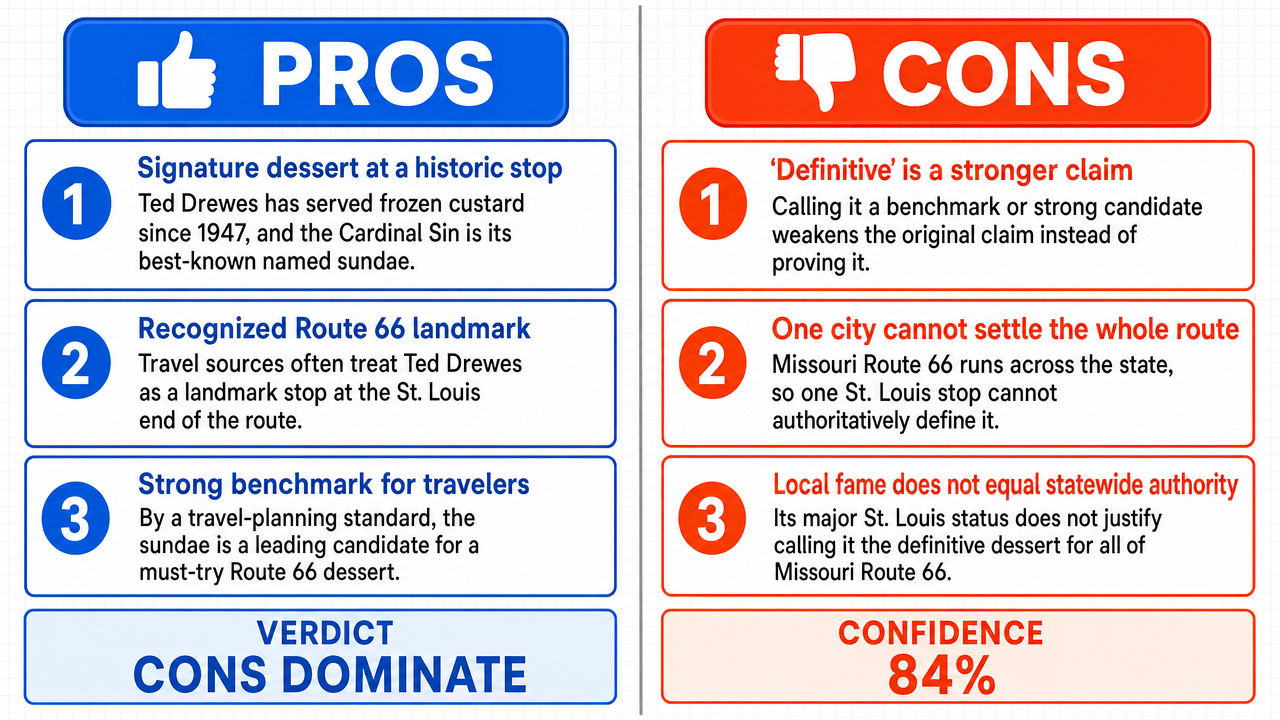
Verdict
Verdict: likely FALSE (84%)
This section provides a brief overview of the key arguments. You do not need to read the full detailed report below.
✅ Key PRO arguments:
- ■Ted Drewes has served frozen custard in St. Louis since 1947, and the Cardinal Sin is its named signature sundae (vanilla frozen custard, hot fudge, whipped cream, and nuts), giving it the continuity and specificity needed to serve as a Route 66 benchmark .
- ■The shop sits in St. Louis at the eastern Missouri end of Route 66, and route and destination sources treat it as a landmark stop rather than an ordinary menu item, lending it documented traveler authority.
- ■Under a travel-planning reading of 'definitive' as 'benchmark that best satisfies route-travel criteria,' the Cardinal Sin is the strongest candidate because it is not a generic sundae but a named signature item of a long-lived Missouri institution.
❌ Key ANTI arguments:
- ■Redefining 'definitive' as merely a 'benchmark ' or 'strong candidate' is a quantifier shift ('glissement de quantificateur ') that abandons the claim's actual meaning of authority and primacy.
- ■St. Louis is only one terminus of Route 66 in Missouri; the route spans the entire state including the Ozarks and western plains, so a single eastern-endpoint dessert cannot represent the whole corridor .
- ■Extending the Cardinal Sin's local St. Louis significance to the entirety of Route 66 in Missouri is an unjustified projection of local relevance onto a much larger and culturally diverse territory.
💭 Conclusion: False. The Cardinal Sin sundae at Ted Drewes is a well-documented St. Louis institution, but the claim that it is the 'definitive' Route 66 Missouri dessert fails because 'definitive' requires authority over the entire route, not just one terminus . The negative correctly identified that St. Louis sits at only the eastern end of a corridor that also traverses the Ozarks and western Missouri, regions with their own culinary identities that the affirmative never addressed. The affirmative's attempt to soften 'definitive' into 'benchmark ' or 'strong candidate' was treated by the judge as a quantifier shift that abandons the original claim. Because the affirmative could not demonstrate comparative exclusivity across the full Missouri stretch of Route 66, the localized landmark status of Ted Drewes does not generalize to statewide definitive authority.
🔬 DeepResearch Result: likely FALSE ❌ (84%)
Assertion: The 'Cardinal Sin sundae' at Ted Drewes is the definitive dessert experience on Route 66 in Missouri.
Participating models: deepseek-v3.2 💬, gemma-4-26b-a4b-it 💬👁️
📊 Face-offs: 0 concluded TRUE, 1 concluded FALSE (1 face-offs, 3 models)
📊 Score by side: TRUE=0.00, FALSE=0.84
🏅 Model score changes:
minimax-m3 💬👁️: +8
✅ PRO Arguments:
- ■Ted Drewes has served frozen custard in St. Louis since 1947, and the Cardinal Sin is its named signature sundae (vanilla frozen custard, hot fudge, whipped cream, and nuts), giving it the continuity and specificity needed to serve as a Route 66 benchmark . deepseek-v3.2 💬
- ■The shop sits in St. Louis at the eastern Missouri end of Route 66, and route and destination sources treat it as a landmark stop rather than an ordinary menu item, lending it documented traveler authority. deepseek-v3.2 💬
- ■Under a travel-planning reading of 'definitive' as 'benchmark that best satisfies route-travel criteria,' the Cardinal Sin is the strongest candidate because it is not a generic sundae but a named signature item of a long-lived Missouri institution. deepseek-v3.2 💬
- ■The affirmative argues that an unnamed comparator class (e.g., 'distinct culinary identities equal' in the Ozarks) cannot replace a named, documented benchmark, so the Cardinal Sin retains authority by default. deepseek-v3.2 💬
❌ ANTI Arguments:
- ■Redefining 'definitive' as merely a 'benchmark' or 'strong candidate' is a quantifier shift ('glissement de quantificateur ') that abandons the claim's actual meaning of authority and primacy. gemma-4-26b-a4b-it 💬👁️
- ■St. Louis is only one terminus of Route 66 in Missouri; the route spans the entire state including the Ozarks and western plains, so a single eastern-endpoint dessert cannot represent the whole corridor . gemma-4-26b-a4b-it 💬👁️
- ■Extending the Cardinal Sin's local St. Louis significance to the entirety of Route 66 in Missouri is an unjustified projection of local relevance onto a much larger and culturally diverse territory. gemma-4-26b-a4b-it 💬👁️
- ■The affirmative fails on scope and comparative exclusivity : it never names a competing Missouri Route 66 dessert tradition, so it cannot demonstrate that the Cardinal Sin outranks the alternatives it ignores. gemma-4-26b-a4b-it 💬👁️
💭 Reasoning: False. The Cardinal Sin sundae at Ted Drewes is a well-documented St. Louis institution, but the claim that it is the 'definitive' Route 66 Missouri dessert fails because 'definitive' requires authority over the entire route, not just one terminus. The negative correctly identified that St. Louis sits at only the eastern end of a corridor that also traverses the Ozarks and western Missouri, regions with their own culinary identities that the affirmative never addressed. The affirmative's attempt to soften 'definitive' into 'benchmark' or 'strong candidate' was treated by the judge as a quantifier shift that abandons the original claim. Because the affirmative could not demonstrate comparative exclusivity across the full Missouri stretch of Route 66, the localized landmark status of Ted Drewes does not generalize to statewide definitive authority.
📋 PRO Facts:
• Ted Drewes has served frozen custard in St. Louis since 1947.
• The Cardinal Sin is Ted Drewes' named signature sundae, made with vanilla frozen custard, hot fudge, whipped cream, and nuts.
• Ted Drewes is located in St. Louis, at the eastern Missouri end of Route 66.
• Route and destination sources treat Ted Drewes as a landmark stop rather than an ordinary menu item.
📋 ANTI Facts:
• Route 66 in Missouri spans the entire state, including the Ozarks and western plains, not just the St. Louis terminus.
• The word 'definitive' implies authority and primacy, not merely being a 'strong candidate' or 'benchmark.'
• The affirmative did not name any competing Missouri Route 66 dessert tradition to establish comparative exclusivity.
| Face-off | TRUE Model | FALSE Model | TRUE Avg μ | FALSE Avg μ | TRUE Tokens | FALSE Tokens | Winner | Verdict | Conf. |
|---|---|---|---|---|---|---|---|---|---|
| #1 | deepseek-v3.2 💬 | gemma-4-26b-a4b-it 💬👁️ | 0.618 | 0.185 | 12 | 3 | TRUE | FALSE | 84% |
The following technical terms, abbreviations, and domain-specific concepts are referenced throughout this debate transcript. Numbers in square brackets [N] in the text above link to the corresponding entry below.
[1] benchmark — A standard or reference point against which items are measured or compared; in this debate, used to mean the authoritative example that best satisfies stated criteria.
[2] comparative exclusivity — The quality of being uniquely superior when set against alternatives; in argumentation, the requirement that a claimed 'definitive' item have no serious rivals.
[3] corridor — A long, narrow strip of territory, commonly used to describe a transportation route or geographic passage such as the Missouri stretch of Route 66.
[4] fallacy of composition — A logical fallacy in which one assumes that what is true of the parts or of one location must be true of the whole, e.g., extending the authority of a St. Louis dessert to the entire state.
[5] frozen custard — A frozen dessert similar to ice cream but made with egg yolks and containing less overrun (air), giving it a denser, creamier texture.
[6] glissement de quantificateur — shift in the quantifier — A debate/logic term (borrowed from French) describing a shift in the quantifier, where the scope of a universal or existential claim is improperly narrowed or broadened to weaken the original claim.
[7] hidden premise — An unstated assumption that underlies an argument and must be accepted for the conclusion to follow; exposing hidden premises is a standard critical-thinking move.
[8] itinerary — A planned route or journey, typically listing destinations, stops, and sequencing for a traveler.
[9] place identity — The distinctive character, meanings, and cultural associations that a specific location holds for its inhabitants and visitors.
[10] quantifier — In logic, a word or phrase (such as 'all,' 'some,' 'none,' or 'the') that indicates the scope or quantity of a claim about a set of items.
[11] symbolic identity — The set of meanings, associations, and cultural significance attached to a particular entity, product, or place.
[12] symbolic specificity — The quality of having particular, identifiable symbolic meaning tied to a specific named context, as opposed to a generic category.
[13] terminus — The endpoint or final station of a transportation route; here, St. Louis is described as the eastern Missouri terminus of Route 66.
Face-off transcripts
- ■
Ownership & Trade Secrets. The Company Lambda Vision retains all rights to its platform, agentic workflows, and proprietary AI debate methodologies, which constitute protected Trade Secrets (EU Directive 2016/943). Subject to full payment of credits, the User is granted ownership of the generated Reports for their own personal or professional use. Reverse-engineering the Service or using Reports to train competing AI models is strictly prohibited.
- ■
No Professional Advice. Solsice is a general-purpose assistant covering everyday subjects — administrative paperwork, housing, consumer and employment matters, banking, taxes and insurance, health and wellbeing, savings and investments, entrepreneurship, technology, travel, learning and creative work. Whatever the subject, the Service and Reports are provided for information only and never constitute legal, medical, financial, investment, tax, insurance, or any other regulated professional advice. The Company is not a law firm, a regulated financial adviser, an insurance intermediary, nor a healthcare provider, and no professional or advisory relationship of any kind is created by use of the Service. Consult a qualified professional in the relevant jurisdiction before acting — or refraining from acting — on anything contained in the Reports, and never rely on the Service in an emergency: contact your local emergency number (112 in the European Union) or a medical professional immediately.
- ■
AI-Generated Content, Sources and Viewpoints. Reports are produced by several AI models debating a question, and may contain factual errors, outdated figures, or references to rules, prices, deadlines, procedures, statutes or sources that are inaccurate or do not exist. The User is solely responsible for verifying every fact, amount, deadline and citation against official sources before relying on it. Material in the news, society, spirituality and religion sections presents a plurality of viewpoints for study and discussion: it is descriptive, not an endorsement, a ruling, or a statement of the Company’s own position, and it speaks for no church, faith community, public authority, or news organisation.
- ■
Liability & Governing Law. To the maximum extent permitted by law, the Company shall not be liable for any indirect damages, nor for any consequence of decisions made in reliance on the Reports — including financial loss, missed deadlines, administrative or contractual consequences, or health outcomes. These Terms are governed by French law. Any disputes shall be subject to the exclusive jurisdiction of the Courts of Paris, France.