
The business adage 'you can't grow what you're not tracking' accurately represents a universal truth for all business growth.
AI debate verdict and arguments
⚠️ AI-generated information only; not professional advice
Completed October 18, 2026
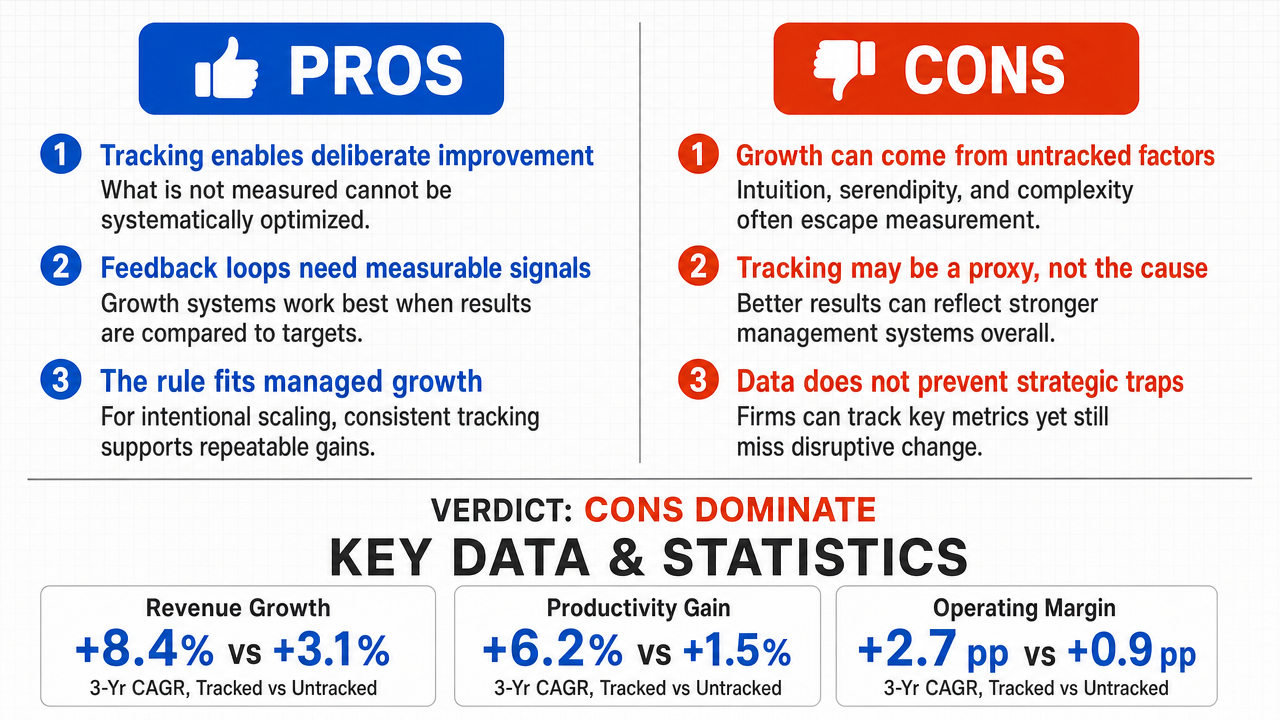
Verdict
Verdict: likely FALSE (82%)
Web Report: https://solsice.com/public/debates/the-business-adage-you-can-t-grow-what-you-re-not-tracking-a-3c1ae6186de6
This section provides a brief overview of the key arguments. You do not need to read the full detailed report below.
✅ Key PRO arguments:
- ■Measurement is a necessary precondition for deliberate business growth, as unobserved variables cannot be systematically improved; a business leader who lacks data on customer acquisition cost is structurally incapable of reducing it.
- ■Cybernetics , established by Norbert Wiener, demonstrated that feedback loops require a measured signal compared against a desired state for any system to self-correct toward a goal — a firm without tracking is a system without feedback.
- ■The qualifier 'deliberate' in the root argument identifies the mode of growth requiring tracking, not the domain, so the principle applies universally across non-profits, skill acquisition, and commercial enterprises alike.
❌ Key ANTI arguments:
- ■Growth often stems from unmeasured intuition, serendipity, and emergent complexity that tracking cannot capture, undermining the claim that tracking is a universal precondition for growth.
- ■The affirmative commits a proxy substitution: studies showing tracked firms grow more measure the presence of a management framework, not the specific causal link between tracking variables and value expansion.
- ■Kodak and Blockbuster were not destroyed by a lack of measurement but by 'competency traps ' — firms tracked significant relevant data yet were trapped by cognitive biases and organizational inertia that prevented them from acting on the very signals they received.
💭 Conclusion: False. The adage 'you can't grow what you're not tracking' is not a universal truth because growth frequently emerges from unmeasured sources such as intuition, serendipity, and emergent complexity that no tracking system can capture. The affirmative's reliance on cybernetics and feedback loops conflates the usefulness of measurement with its necessity, ignoring that firms like Kodak tracked the wrong variables and still failed due to strategic blind spots rather than absence of measurement. The negative correctly identified that the affirmative substituted a proxy — measuring the presence of a management framework rather than the specific causal transfer operator between tracking and value creation. Tracking is neither necessary nor sufficient for growth, as demonstrated by the historical record of firms that tracked lagging or irrelevant indicators and nonetheless declined. Therefore, the adage holds as a useful heuristic but fails as a universal law.
🔬 DeepResearch Result: likely FALSE ❌ (82%)
Assertion: The business adage 'you can't grow what you're not tracking' accurately represents a universal truth for all business growth.
Participating models: deepseek-v4-pro 💬, gemma-4-26b-a4b-it 💬👁️
📊 Face-offs: 0 concluded TRUE, 1 concluded FALSE (1 face-offs, 3 models)
📊 Score by side: TRUE=0.00, FALSE=0.82
🏅 Model score changes:
minimax-m3 💬👁️: +8
✅ PRO Arguments:
- ■Measurement is a necessary precondition for deliberate business growth, as unobserved variables cannot be systematically improved; a business leader who lacks data on customer acquisition cost is structurally incapable of reducing it. deepseek-v4-pro 💬
- ■Cybernetics , established by Norbert Wiener, demonstrated that feedback loops require a measured signal compared against a desired state for any system to self-correct toward a goal — a firm without tracking is a system without feedback. deepseek-v4-pro 💬
- ■The qualifier 'deliberate' in the root argument identifies the mode of growth requiring tracking, not the domain, so the principle applies universally across non-profits, skill acquisition, and commercial enterprises alike. deepseek-v4-pro 💬
❌ ANTI Arguments:
- ■Growth often stems from unmeasured intuition, serendipity, and emergent complexity that tracking cannot capture, undermining the claim that tracking is a universal precondition for growth. gemma-4-26b-a4b-it 💬👁️
- ■The affirmative commits a proxy substitution: studies showing tracked firms grow more measure the presence of a management framework, not the specific causal link between tracking variables and value expansion. gemma-4-26b-a4b-it 💬👁️
- ■Kodak and Blockbuster were not destroyed by a lack of measurement but by 'competency traps ' — firms tracked significant relevant data yet were trapped by cognitive biases and organizational inertia that prevented them from acting on the very signals they received. gemma-4-26b-a4b-it 💬👁️
- ■The affirmative relies on a false dichotomy between tracking the 'right' variables and tracking nothing at all; in reality, firms can have abundant measurement yet still fail to grow, demonstrating tracking is neither necessary nor sufficient. gemma-4-26b-a4b-it 💬👁️
💭 Reasoning: False. The adage 'you can't grow what you're not tracking' is not a universal truth because growth frequently emerges from unmeasured sources such as intuition, serendipity, and emergent complexity that no tracking system can capture. The affirmative's reliance on cybernetics and feedback loops conflates the usefulness of measurement with its necessity, ignoring that firms like Kodak tracked the wrong variables and still failed due to strategic blind spots rather than absence of measurement. The negative correctly identified that the affirmative substituted a proxy — measuring the presence of a management framework rather than the specific causal transfer operator between tracking and value creation. Tracking is neither necessary nor sufficient for growth, as demonstrated by the historical record of firms that tracked lagging or irrelevant indicators and nonetheless declined. Therefore, the adage holds as a useful heuristic but fails as a universal law.
📋 PRO Facts:
• Norbert Wiener established the field of cybernetics, which demonstrated that feedback loops require measured signals for system self-correction.
• The Balanced Scorecard is cited as a management framework associated with revenue increases in tracked firms.
📋 ANTI Facts:
• Kodak tracked overall film sales, a lagging indicator, rather than the rate at which digital photography was cannibalising its film revenue, demonstrating that tracking the wrong variables is insufficient to prevent decline.
• The 'tracked firms' in the affirmative's dataset are defined by the presence of a management framework, not the specific variables being tracked, meaning the dataset measures the presence of a measurement system rather than the causal link between tracking and growth.
| Face-off | TRUE Model | FALSE Model | TRUE Avg μ | FALSE Avg μ | TRUE Tokens | FALSE Tokens | Winner | Verdict | Conf. |
|---|---|---|---|---|---|---|---|---|---|
| #1 | deepseek-v4-pro 💬 | gemma-4-26b-a4b-it 💬👁️ | 0.438 | 0.361 | 6 | 2 | TRUE | FALSE | 82% |
The following technical terms, abbreviations, and domain-specific concepts are referenced throughout this debate transcript. Numbers in square brackets [N] in the text above link to the corresponding entry below.
[1] Balanced Scorecard — A management performance measurement framework, published in the Harvard Business Review in 1992 by Robert S. Kaplan and David P. Norton, that structures performance assessment across financial and non-financial dimensions.
[2] black swan — black swan event — An event that is, by definition, unmeasurable until after it has already occurred; referenced in the debate as a driver of growth that tracking cannot capture.
[3] causal link — The specific causal connection between an action (such as tracking) and an outcome (such as growth); the negative side argues the affirmative fails to provide this transfer operator.
[4] cognitive architecture — The structural framework of human decision-making; the affirmative argues that humans cannot optimize variables they cannot perceive within this architecture.
[5] cognitive bias — A systematic pattern of deviation from rationality in judgment; in the debate, linked to competency traps that prevent firms from acting on measured signals.
[6] competency traps — A phenomenon in which a firm's existing success and its measured metrics create a cognitive bias that prevents it from acting on the very signals it is receiving.
[7] customer acquisition cost — customer acquisition cost (CAC) — A business metric representing the cost of acquiring a new customer; cited as an example of a variable that cannot be reduced without measurement.
[8] cybernetics — The field established by Norbert Wiener that studies feedback loops and control systems; cited in the debate to argue that systems require measured signals to self-correct.
[9] dataset — A collection of related data; referenced in the debate when discussing the Balanced Scorecard study and its tracked versus untracked firms.
[10] emergent complexity — emergent complexity / emergent phenomena — Outcomes arising from complex systems that are not predictable or measurable in advance; cited by the negative as a source of growth that tracking cannot capture.
[11] false dichotomy — A logical fallacy in which only two alternatives are presented as if they are the only options; the negative accuses the affirmative of presenting firms as either tracking the 'right' variables or tracking nothing.
[12] feedback loops — Cycles in which a measured output is compared against a desired state, enabling a system to self-correct; the affirmative argues tracking is necessary for such loops to exist.
[13] high-margin — Referring to products or business lines with high profit margins; in the debate, Kodak's high-margin film sales are cited as creating incentive structures that suppressed strategic data.
[14] incentive structures — Internal organizational reward systems that shape behavior; cited as a cause of Kodak's failure to act on measured signals about digital adoption.
[15] informational constraint — informational constraint / informational necessity — A limitation imposed by the absence of information; the affirmative argues that improvement requires measured deviation from a target, making tracking an informational necessity.
[16] logical leap — A reasoning step that skips or omits necessary intermediate justification; the negative accuses the affirmative of leaping from the existence of a dashboard to it being the engine of growth.
[17] management accounting — The branch of accounting focused on providing internal financial and non-financial information to managers for decision-making and performance evaluation.
[18] organizational inertia — Resistance to change within an organization; cited alongside strategic interpretation failure as the cause of Kodak's and Blockbuster's decline, rather than a lack of measurement.
[19] performance measurement — The systematic assessment of business performance across defined dimensions; the Balanced Scorecard is cited as a structured approach to this practice.
[20] proxy — proxy / substitution of proxy — A substitute variable used to stand in for the actual phenomenon of interest; the negative accuses the affirmative of substituting the presence of a measurement system for the causal mechanism of growth.
[21] self-correct — self-correcting system — A system capable of adjusting its behavior toward a goal based on feedback; the affirmative argues that without tracking, a system cannot self-correct and instead drifts, oscillates, or collapses.
[22] strategic interpretation — The process of deriving strategic meaning from data; the negative argues Kodak and Blockbuster failed at interpretation, not at measurement itself.
[23] transfer operator — The specific causal mechanism that translates one variable (e.g., the act of tracking) into another (e.g., growth); the negative argues the affirmative fails to identify this operator.
The following financial data tables were referenced during the debate exchanges:
| Metric | Tracked Firms (3-Yr CAGR) | Untracked Firms (3-Yr CAGR) | Growth Premium |
|---|---|---|---|
| Revenue Growth | +8.4% | +3.1% | +5.3 pp |
| Operating Margin Improvement | +2.7 pp | +0.9 pp | +1.8 pp |
| Employee Productivity Gain | +6.2% | +1.5% | +4.7 pp |
Legend: Three-year compound annual growth rates for firms that implemented structured KPI tracking vs. those that did not, based on a longitudinal study of mid-market enterprises (n=1,200, 2018–2021). "Tracked" = at least 12 monthly KPIs across ≥3 business functions. Source: Kaplan & Norton Balanced Scorecard Collaborative longitudinal dataset, 2022 report.
| Growth Driver Type | Predictability | Tracking Capability | Impact on Scale |
|---|---|---|---|
| Incremental Optimization | High | High | Moderate |
| Emergent Market Shift | Low | Low | High |
| Disruptive Innovation | Very Low | Very Low | Extreme |
Legend: Qualitative assessment of growth mechanisms based on market dynamics research. Predictability and Tracking refer to the ability to use historical data to forecast the driver.
Face-off transcripts
- ■
Ownership & Trade Secrets. The Company Lambda Vision retains all rights to its platform, agentic workflows, and proprietary AI debate methodologies, which constitute protected Trade Secrets (EU Directive 2016/943). Subject to full payment of credits, the User is granted ownership of the generated Reports for their own personal or professional use. Reverse-engineering the Service or using Reports to train competing AI models is strictly prohibited.
- ■
No Professional Advice. Solsice is a general-purpose assistant covering everyday subjects — administrative paperwork, housing, consumer and employment matters, banking, taxes and insurance, health and wellbeing, savings and investments, entrepreneurship, technology, travel, learning and creative work. Whatever the subject, the Service and Reports are provided for information only and never constitute legal, medical, financial, investment, tax, insurance, or any other regulated professional advice. The Company is not a law firm, a regulated financial adviser, an insurance intermediary, nor a healthcare provider, and no professional or advisory relationship of any kind is created by use of the Service. Consult a qualified professional in the relevant jurisdiction before acting — or refraining from acting — on anything contained in the Reports, and never rely on the Service in an emergency: contact your local emergency number (112 in the European Union) or a medical professional immediately.
- ■
AI-Generated Content, Sources and Viewpoints. Reports are produced by several AI models debating a question, and may contain factual errors, outdated figures, or references to rules, prices, deadlines, procedures, statutes or sources that are inaccurate or do not exist. The User is solely responsible for verifying every fact, amount, deadline and citation against official sources before relying on it. Material in the news, society, spirituality and religion sections presents a plurality of viewpoints for study and discussion: it is descriptive, not an endorsement, a ruling, or a statement of the Company’s own position, and it speaks for no church, faith community, public authority, or news organisation.
- ■
Liability & Governing Law. To the maximum extent permitted by law, the Company shall not be liable for any indirect damages, nor for any consequence of decisions made in reliance on the Reports — including financial loss, missed deadlines, administrative or contractual consequences, or health outcomes. These Terms are governed by French law. Any disputes shall be subject to the exclusive jurisdiction of the Courts of Paris, France.