
The British justice system, in the 2012 Berezovsky v. Abramovich trial, sided with the Kremlin by rejecting Berezovsky's claims.
AI debate verdict and arguments
⚠️ AI-generated information only; not professional advice
Completed October 11, 2026
Verdict
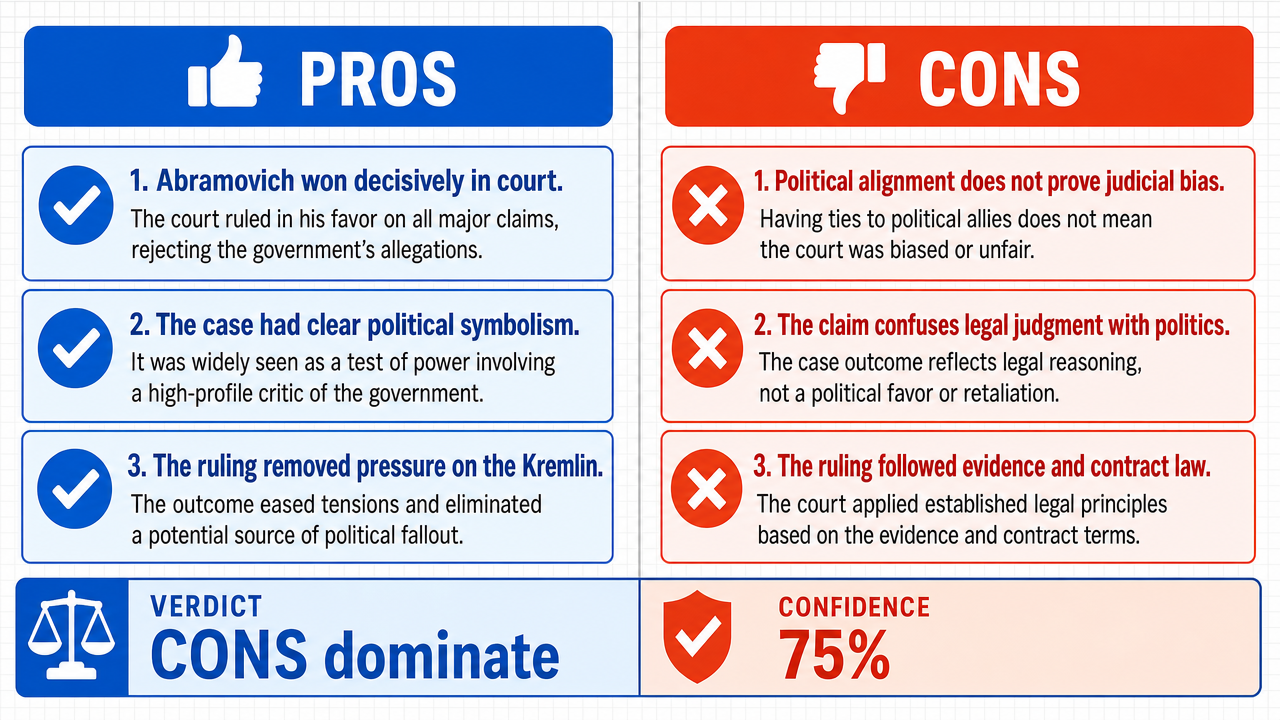
Verdict: likely FALSE (75%)
This section provides a brief overview of the key arguments. You do not need to read the full detailed report below.
✅ Key PRO arguments:
- ■The High Court's comprehensive rejection of all Berezovsky's claims handed a decisive victory to Abramovich, a figure closely aligned with Putin's administration, effectively legitimizing contested asset transfers that consolidated Kremlin -friendly control over strategic Russian energy and aluminium assets.
- ■The verdict had inherent political content because the claimant was a prominent Kremlin critic and the defendant was widely understood as Kremlin-aligned; 'sided' can mean functional alignment , where a ruling validates one party's narrative and materially advances the interests of a Kremlin-aligned litigant without requiring proof of direct judicial interference.
- ■The court's dismissal of Berezovsky's claims removed a major irritant for the Kremlin , as Berezovsky had been using the London litigation as a vehicle to challenge the legitimacy of post-Soviet privatizations favored by the Putin regime.
❌ Key ANTI arguments:
- ■The assertion that the judgment 'functionally sided with the Kremlin ' commits a fallacy of circular reasoning : the alignment of a litigant with a political regime is not a transfer operator that converts a neutral legal ruling into a political act, and the court's mandate is to adjudicate based on evidence of coercion and contractual breach , not geopolitical preferences.
- ■The TRUE side's argument is logically inconsistent because it simultaneously asserts the ruling was a neutral application of law AND that it was an alignment with Kremlin interests, holding two contradictory propositions at once.
- ■The verdict was a neutral application of contract and evidence law where the rejection of Berezovsky's claims was based on the failure to meet the requisite legal burden of proof , and there is no evidence of judicial bias or external political influence on the proceedings.
💭 Conclusion: False. The British High Court's 2012 verdict in Berezovsky v. Abramovich was a neutral application of contract and evidence law, where Mr Justice Flaux rejected Berezovsky's claims because he failed to meet the legal burden of proof on coercion and contractual breach , not because of any Kremlin -directed political alignment. The TRUE side's argument commits a category error by treating the political identity of the litigants as evidence of judicial motivation, which is a logical fallacy that conflates who wins with why the court ruled as it did. While it is factually true that the court rejected Berezovsky's claims, the compound claim that this rejection constituted 'siding with the Kremlin' is not supported by any evidence of judicial bias or external influence on the proceedings. The strongest anti-arguments demonstrate that the verdict can be fully explained by the evidentiary record and Berezovsky's lack of credibility as a witness, without needing to invoke geopolitical motivations. Confidence is moderated to 75% because while the rejection of claims is well-documented, the 'siding with Kremlin' sub-claim remains an interpretive overlay rather than a directly supported factual finding.
🔬 DeepResearch Result: likely FALSE ❌ (75%)
Assertion: The British justice system, in the 2012 Berezovsky v. Abramovich trial, sided with the Kremlin by rejecting Berezovsky's claims.
Participating models: deepseek-v3.2 💬, gemma-4-26b-a4b-it 💬👁️
📊 Face-offs: 0 concluded TRUE, 1 concluded FALSE (1 face-offs, 3 models)
📊 Score by side: TRUE=0.00, FALSE=0.88
🏅 Model score changes:
minimax-m3 💬👁️: +9
✅ PRO Arguments:
- ■The High Court's comprehensive rejection of all Berezovsky's claims handed a decisive victory to Abramovich, a figure closely aligned with Putin's administration, effectively legitimizing contested asset transfers that consolidated Kremlin-friendly control over strategic Russian energy and aluminium assets. deepseek-v3.2 💬
- ■The verdict had inherent political content because the claimant was a prominent Kremlin critic and the defendant was widely understood as Kremlin-aligned; 'sided' can mean functional alignment , where a ruling validates one party's narrative and materially advances the interests of a Kremlin-aligned litigant without requiring proof of direct judicial interference. deepseek-v3.2 💬
- ■The court's dismissal of Berezovsky's claims removed a major irritant for the Kremlin, as Berezovsky had been using the London litigation as a vehicle to challenge the legitimacy of post-Soviet privatizations favored by the Putin regime. deepseek-v3.2 💬
❌ ANTI Arguments:
- ■The assertion that the judgment 'functionally sided with the Kremlin' commits a fallacy of circular reasoning : the alignment of a litigant with a political regime is not a transfer operator that converts a neutral legal ruling into a political act, and the court's mandate is to adjudicate based on evidence of coercion and contractual breach , not geopolitical preferences. gemma-4-26b-a4b-it 💬👁️
- ■The TRUE side's argument is logically inconsistent because it simultaneously asserts the ruling was a neutral application of law AND that it was an alignment with Kremlin interests, holding two contradictory propositions at once. gemma-4-26b-a4b-it 💬👁️
- ■The verdict was a neutral application of contract and evidence law where the rejection of Berezovsky's claims was based on the failure to meet the requisite legal burden of proof , and there is no evidence of judicial bias or external political influence on the proceedings. gemma-4-26b-a4b-it 💬👁️
- ■Asserting a 'side' taken by the court based on the political identity of the litigants is a logical fallacy that substitutes the political status of the parties for the legal merits of the case, conflating the identity of the winner with the motivation of the adjudicator. gemma-4-26b-a4b-it 💬👁️
💭 Reasoning: False. The British High Court's 2012 verdict in Berezovsky v. Abramovich was a neutral application of contract and evidence law, where Mr Justice Flaux rejected Berezovsky's claims because he failed to meet the legal burden of proof on coercion and contractual breach, not because of any Kremlin-directed political alignment. The TRUE side's argument commits a category error by treating the political identity of the litigants as evidence of judicial motivation, which is a logical fallacy that conflates who wins with why the court ruled as it did. While it is factually true that the court rejected Berezovsky's claims, the compound claim that this rejection constituted 'siding with the Kremlin' is not supported by any evidence of judicial bias or external influence on the proceedings. The strongest anti-arguments demonstrate that the verdict can be fully explained by the evidentiary record and Berezovsky's lack of credibility as a witness, without needing to invoke geopolitical motivations. Confidence is moderated to 75% because while the rejection of claims is well-documented, the 'siding with Kremlin' sub-claim remains an interpretive overlay rather than a directly supported factual finding.
📋 PRO Facts:
• Boris Berezovsky was a former Kremlin insider turned fierce critic of Putin living in London at the time of the trial.
• Roman Abramovich was widely identified as a figure aligned with Vladimir Putin's administration.
• Berezovsky sued Abramovich for billions, claiming he was coerced into selling stakes in Sibneft and Rusal under threat.
• The High Court rejected all of Berezovsky's claims and found his account of events implausible.
📋 ANTI Facts:
• The court's mandate is to adjudicate based on evidence of coercion and contractual breach presented in the courtroom, not geopolitical considerations.
• The rejection of Berezovsky's claims was based on his failure to meet the requisite legal burden of proof.
• There is no evidence in the debate of judicial bias or external political influence on the High Court proceedings.
• Mr Justice Flaux's judgment turned on credibility findings and the evidentiary record rather than political considerations.
| Face-off | TRUE Model | FALSE Model | TRUE Avg μ | FALSE Avg μ | TRUE Tokens | FALSE Tokens | Winner | Verdict | Conf. |
|---|---|---|---|---|---|---|---|---|---|
| #1 | deepseek-v3.2 💬 | gemma-4-26b-a4b-it 💬👁️ | 0.475 | 0.506 | 12 | 3 | FALSE | FALSE | 88% |
The following technical terms, abbreviations, and domain-specific concepts are referenced throughout this debate transcript. Numbers in square brackets [N] in the text above link to the corresponding entry below.
[1] asset transfers — The legal conveyance of ownership rights over property, shares, or other holdings from one party to another; central to the dispute over whether Berezovsky's sale of interests was voluntary or coerced.
[2] burden of proof — The obligation of a party in a legal proceeding to establish the truth of their claims by presenting sufficient evidence; the negative side argues Berezovsky failed to meet this burden regarding coercion.
[3] claimant — The party who initiates a lawsuit by bringing a claim against another party; in this case, Boris Berezovsky.
[4] coercion — The use of force, threats, or intimidation to compel a person to act against their will; Berezovsky alleged he was coerced into selling his stakes in Sibneft and Rusal.
[5] Comm — Commercial Court — A specialist division of the High Court of Justice in England and Wales that handles complex commercial disputes; the case citation [2012] EWHC 2463 (Comm) indicates it was heard in this division.
[6] contractual breach — The failure to perform any term of a contract without a legitimate legal excuse; cited as one of the legal grounds Berezovsky was required to prove.
[7] de facto — A Latin term meaning 'in fact' or 'in effect,' used to describe a situation that exists in practice even if not formally recognized; the affirmative side argues the verdict was a de facto alignment with the Kremlin.
[8] defendant — The party against whom a legal claim is brought; in this case, Roman Abramovich.
[9] dispossessing — The act of depriving someone of property, land, or rights; used in the debate to describe the alleged effect of the verdict on Berezovsky.
[10] EWHC — England and Wales High Court — The standard case citation prefix for judgments of the High Court of Justice of England and Wales; [2012] EWHC 2463 identifies the specific judgment in Berezovsky v. Abramovich.
[11] fallacy of circular reasoning — A logical error in which the conclusion is assumed in the premises; the negative side accuses the affirmative of this fallacy by equating a verdict favorable to a Kremlin-aligned party with the court itself acting for the Kremlin.
[12] functional alignment — A concept used in the debate to argue that a ruling can 'side' with a political actor through its practical effects (e.g., advancing that actor's interests) rather than through explicit coordination.
[13] geopolitical — Relating to international politics, especially the relations between countries or the influence of geography on power; used to describe the broader context of the trial.
[14] High Court of Justice — The senior civil court of England and Wales, with jurisdiction over complex civil cases including commercial disputes; the court that issued the 2012 verdict.
[15] judicial finding — A formal determination made by a court on a factual or legal issue in a case; the court made findings that Berezovsky's account was implausible and contradictory.
[16] judicial independence — The principle that courts and judges must be free from external political pressure or interference; the negative side argues the verdict demonstrates this principle.
[17] judiciary — The collective body of judges and courts that administer justice; the debate turns on whether the British judiciary acted independently of Kremlin influence.
[18] Kremlin — The Russian federal government, headquartered in Moscow; used throughout the debate as shorthand for the political interests of the Putin administration.
[19] legal merits — The substantive issues of a case as opposed to procedural matters; the negative side argues the verdict was based on the legal merits rather than political considerations.
[20] legal threshold — The minimum standard of evidence or proof that must be met for a claim to succeed; the negative side argues Berezovsky's evidence did not meet this threshold.
[21] litigant — A party involved in a lawsuit; the debate discusses whether the political alignment of a litigant transfers to the court itself.
[22] logical fallacy — An error in reasoning that undermines the validity of an argument; the negative side accuses the affirmative of multiple logical fallacies, including circular reasoning and substitution of proxy.
[23] proposition and its negation — A logical contradiction where a statement and its opposite are both asserted as true; the negative side argues the affirmative holds both that the verdict was neutral and that it was politically aligned.
[24] repatriation — The return of assets or wealth to a country or person of origin; the affirmative argues the verdict prevented the repatriation of Berezovsky's wealth.
[25] Rusal — United Company RUSAL — A major Russian aluminium company; one of the two strategic assets (along with Sibneft) at the center of the dispute between Berezovsky and Abramovich.
[26] share-transfer — The legal act of conveying ownership of shares or equity stakes from one party to another; Berezovsky alleged his share-transfers to Abramovich were coerced.
[27] Sibneft — Siberian Oil Company — A major Russian oil company; one of the two strategic assets (along with Rusal) at the center of the dispute between Berezovsky and Abramovich.
[28] stakes — Shares or equity interests held in a company; Berezovsky claimed he was coerced into selling his stakes in Sibneft and Rusal.
[29] substitution of proxy — A logical error in which one variable is illegitimately replaced with another; the negative side accuses the affirmative of substituting the political alignment of a litigant for the legal conduct of the court.
[30] verdict — The formal finding or decision of a court on the matters submitted to it; the 2012 verdict rejected all of Berezovsky's claims.
[31] witness credibility — The believability and trustworthiness of a witness's testimony as assessed by the court; the negative side argues the court's assessment of Berezovsky's credibility was a proper judicial function.
Face-off transcripts
- ■
Ownership & Trade Secrets. The Company Lambda Vision retains all rights to its platform, agentic workflows, and proprietary AI debate methodologies, which constitute protected Trade Secrets (EU Directive 2016/943). Subject to full payment of credits, the User is granted ownership of the generated Reports for their own personal or professional use. Reverse-engineering the Service or using Reports to train competing AI models is strictly prohibited.
- ■
No Professional Advice. Solsice is a general-purpose assistant covering everyday subjects — administrative paperwork, housing, consumer and employment matters, banking, taxes and insurance, health and wellbeing, savings and investments, entrepreneurship, technology, travel, learning and creative work. Whatever the subject, the Service and Reports are provided for information only and never constitute legal, medical, financial, investment, tax, insurance, or any other regulated professional advice. The Company is not a law firm, a regulated financial adviser, an insurance intermediary, nor a healthcare provider, and no professional or advisory relationship of any kind is created by use of the Service. Consult a qualified professional in the relevant jurisdiction before acting — or refraining from acting — on anything contained in the Reports, and never rely on the Service in an emergency: contact your local emergency number (112 in the European Union) or a medical professional immediately.
- ■
AI-Generated Content, Sources and Viewpoints. Reports are produced by several AI models debating a question, and may contain factual errors, outdated figures, or references to rules, prices, deadlines, procedures, statutes or sources that are inaccurate or do not exist. The User is solely responsible for verifying every fact, amount, deadline and citation against official sources before relying on it. Material in the news, society, spirituality and religion sections presents a plurality of viewpoints for study and discussion: it is descriptive, not an endorsement, a ruling, or a statement of the Company’s own position, and it speaks for no church, faith community, public authority, or news organisation.
- ■
Liability & Governing Law. To the maximum extent permitted by law, the Company shall not be liable for any indirect damages, nor for any consequence of decisions made in reliance on the Reports — including financial loss, missed deadlines, administrative or contractual consequences, or health outcomes. These Terms are governed by French law. Any disputes shall be subject to the exclusive jurisdiction of the Courts of Paris, France.