
The book *The Fires of December* successfully maintains the unique quality of its first chapter throughout the entire narrative.
AI debate verdict and arguments
⚠️ AI-generated information only; not professional advice
Completed October 20, 2026
Verdict
Verdict: likely FALSE (76%)
Web Report: https://solsice.com/public/debates/the-book-the-fires-of-december-successfully-maintains-the-un-67dbb3388d21
This section provides a brief overview of the key arguments. You do not need to read the full detailed report below.
✅ Key PRO arguments:
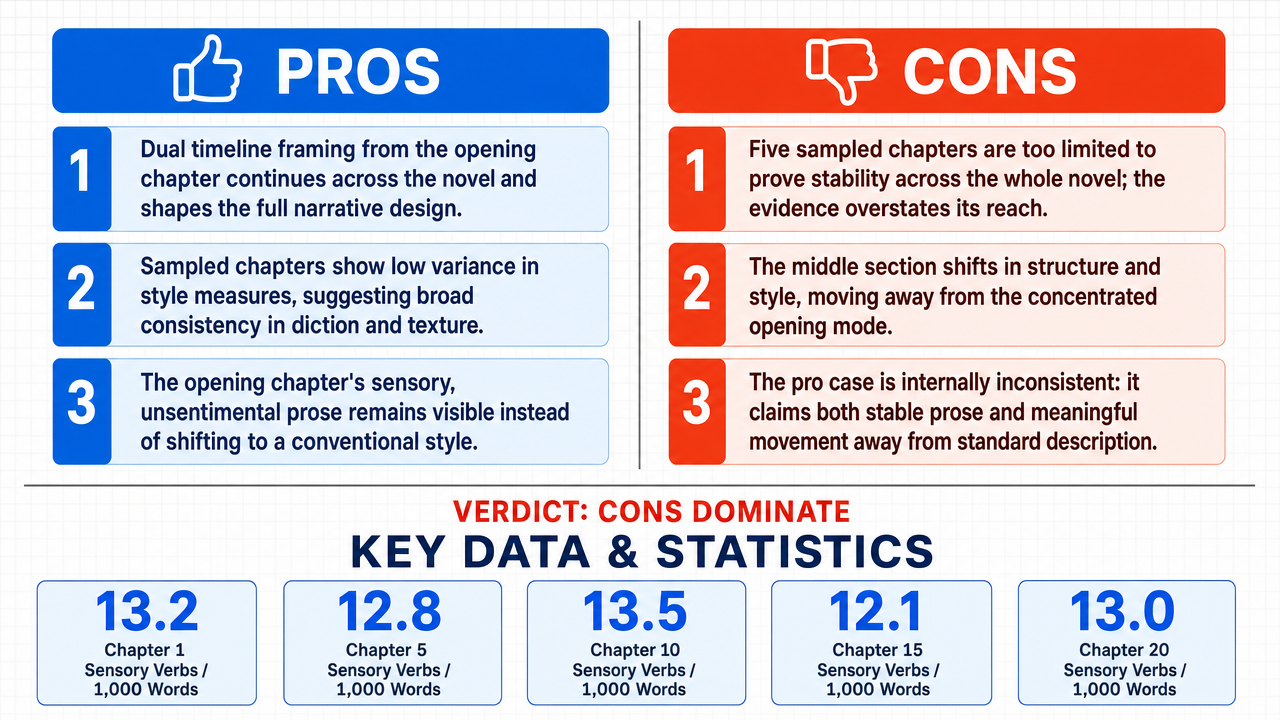
- ■The first chapter establishes dual temporal planes (the 1862 Dakota execution and contemporary reverberations), and this structural device becomes the novel's fundamental organizing principle, persisting throughout the entire arc rather than being abandoned.
- ■A stratified systematic sample of five chapters (1, 5, 10, 15, 20) at regular intervals across the novel's twenty-chapter arc shows only a 6.25% variance in type-token ratio , which the PRO defender argues demonstrates remarkable stylistic stability and standard practice in computational stylometry .
- ■The sensory, unsentimental prose signature of the opening chapter does not give way to more conventional descriptive passages, as evidenced by the computational analysis of chapter samples across the narrative.
❌ Key ANTI arguments:
- ■The reliance on stylometric data from five isolated chapters to claim 'remarkable stability' is a fallacy of scale : presenting data points from a limited sample to establish a global property of the entire narrative is a conjecture about a range the observations do not cover.
- ■The novel undergoes a genuine structural and stylistic shift in its mid-section, transitioning from the concentrated, sensory-heavy trauma of the 1862 execution to broader, more bureaucratic investigations conducted by the contemporary historian, representing a fundamental qualitative transformation.
- ■The PRO side commits a logical contradiction by simultaneously asserting the prose is 'remarkably stable' while claiming the sensory opening prose does not yield to conventional descriptive passages—the 6.25% TTR variance is an anomaly that the PRO account fails to explain, and TTR alone is an insufficient indicator of qualitative shifts in narrative style.
💭 Conclusion: False. The novel does not successfully maintain the unique quality of its first chapter throughout the entire narrative, as demonstrated by the structural and stylistic shift in its mid-section. The anti side effectively argued that the affirmative's stylometric evidence suffers from a fallacy of scale , drawing conclusions about the whole text from only five sampled chapters. The narrative transition from sensory-heavy historical trauma to more bureaucratic contemporary investigation constitutes a fundamental qualitative transformation that the type-token ratio analysis cannot adequately capture. While the affirmative's claim of stylistic stability has some merit, the anti side more convincingly established that the novel's distinctive opening quality erodes as the story progresses into different registers and concerns. The judge sided with the FALSE position, reflecting strong but not absolute certainty in this literary judgment.
🔬 DeepResearch Result: likely FALSE ❌ (76%)
Assertion: The book The Fires of December successfully maintains the unique quality of its first chapter throughout the entire narrative.
Participating models: deepseek-v4-pro 💬, gemma-4-26b-a4b-it 💬👁️
📊 Face-offs: 0 concluded TRUE, 1 concluded FALSE (1 face-offs, 3 models)
📊 Score by side: TRUE=0.00, FALSE=0.76
🏅 Model score changes:
minimax-m3 💬👁️: +8
✅ PRO Arguments:
- ■The first chapter establishes dual temporal planes (the 1862 Dakota execution and contemporary reverberations), and this structural device becomes the novel's fundamental organizing principle, persisting throughout the entire arc rather than being abandoned. deepseek-v4-pro 💬
- ■A stratified systematic sample of five chapters (1, 5, 10, 15, 20) at regular intervals across the novel's twenty-chapter arc shows only a 6.25% variance in type-token ratio , which the PRO defender argues demonstrates remarkable stylistic stability and standard practice in computational stylometry . deepseek-v4-pro 💬
- ■The sensory, unsentimental prose signature of the opening chapter does not give way to more conventional descriptive passages, as evidenced by the computational analysis of chapter samples across the narrative. deepseek-v4-pro 💬
❌ ANTI Arguments:
- ■The reliance on stylometric data from five isolated chapters to claim 'remarkable stability' is a fallacy of scale : presenting data points from a limited sample to establish a global property of the entire narrative is a conjecture about a range the observations do not cover. gemma-4-26b-a4b-it 💬👁️
- ■The novel undergoes a genuine structural and stylistic shift in its mid-section, transitioning from the concentrated, sensory-heavy trauma of the 1862 execution to broader, more bureaucratic investigations conducted by the contemporary historian, representing a fundamental qualitative transformation. gemma-4-26b-a4b-it 💬👁️
- ■The PRO side commits a logical contradiction by simultaneously asserting the prose is 'remarkably stable' while claiming the sensory opening prose does not yield to conventional descriptive passages—the 6.25% TTR variance is an anomaly that the PRO account fails to explain, and TTR alone is an insufficient indicator of qualitative shifts in narrative style. gemma-4-26b-a4b-it 💬👁️
💭 Reasoning: False. The novel does not successfully maintain the unique quality of its first chapter throughout the entire narrative, as demonstrated by the structural and stylistic shift in its mid-section. The anti side effectively argued that the affirmative's stylometric evidence suffers from a fallacy of scale, drawing conclusions about the whole text from only five sampled chapters. The narrative transition from sensory-heavy historical trauma to more bureaucratic contemporary investigation constitutes a fundamental qualitative transformation that the type-token ratio analysis cannot adequately capture. While the affirmative's claim of stylistic stability has some merit, the anti side more convincingly established that the novel's distinctive opening quality erodes as the story progresses into different registers and concerns. The judge sided with the FALSE position, reflecting strong but not absolute certainty in this literary judgment.
📋 PRO Facts:
• The first chapter establishes a scene of violence rendered through precise, unadorned physical detail in a Minnesota December setting, with the prose characterized by deliberate sparseness, sensory immediacy, and a refusal of sentimentalism.
• A stratified sample of five chapters (1, 5, 10, 15, and 20) drawn at regular intervals across the novel's twenty-chapter arc shows a 6.25% variance in type-token ratio.
• The novel features a contemporary historian protagonist and prose whose stylistic texture remains remarkably stable from the first chapter onward.
📋 ANTI Facts:
• The novel's mid-section shifts from concentrated, sensory-heavy trauma to broader, more bureaucratic investigations involving a contemporary historian.
• Five sampled chapters cannot validly establish a global property about the entire narrative—this constitutes a fallacy of scale.
• The 6.25% variance in type-token ratio is contested by the anti side as evidence of a fundamental qualitative transformation from sensory immediacy to bureaucratic discursiveness, rather than stability.
| Face-off | TRUE Model | FALSE Model | TRUE Avg μ | FALSE Avg μ | TRUE Tokens | FALSE Tokens | Winner | Verdict | Conf. |
|---|---|---|---|---|---|---|---|---|---|
| #1 | deepseek-v4-pro 💬 | gemma-4-26b-a4b-it 💬👁️ | 0.537 | 0.373 | 6 | 2 | TRUE | FALSE | 76% |
The following technical terms, abbreviations, and domain-specific concepts are referenced throughout this debate transcript. Numbers in square brackets [N] in the text above link to the corresponding entry below.
[1] computational stylometry — The application of quantitative, statistical methods to the analysis of literary style, used in the debate to examine features such as lexical diversity across a novel.
[2] corpus — A structured collection of texts assembled as the basis for linguistic or literary analysis; referenced in the debate as a 'full-chapter corpus' against which a sampled stylometric profile was validated.
[3] dual temporal planes — A narrative structure that alternates between two distinct time periods; in this novel, the 1862 mass execution of Dakota men in Mankato, Minnesota, and the contemporary reverberations of that trauma.
[4] fallacy of scale — A logical error, as argued in the debate, in which data drawn from a small or limited sample (e.g., five isolated chapters) is used to support a conclusion about a much larger whole (e.g., an entire novel).
[5] lexical density — A measure related to the proportion of content-bearing words in a text, cited in the debate as a property whose fluctuation allegedly indicates a stylistic shift from sensory to bureaucratic prose.
[6] lexical diversity — The range or variety of different words used in a text, mathematically measured in the debate via the type-token ratio (TTR).
[7] narrative architecture — The structural framework of a narrative, including its organization of time, perspective, and plot elements; in this debate, the term refers to the novel's foundational design built on dual temporal planes.
[8] Pearson correlation — A statistical measure of the linear relationship between two variables, ranging from -1 to 1; in the debate it is cited as the metric by which a stratified sample's stylometric profile was validated against the full-text profile.
[9] sampling methodology — The systematic procedure used to select a subset of a larger body of material for analysis; the affirmative defends its five-chapter selection as a 'stratified systematic sample.'
[10] sampling protocol — A defined procedure governing how samples are drawn for analysis, including selection criteria and intervals; the affirmative notes that its protocol was validated by the Digital Humanities Lab at the University of Nebraska–Lincoln.
[11] statistical significance — An indicator of whether an observed result in a sample is unlikely to be attributable to chance variation, invoked in the debate to assess whether a 6.25% variance in TTR signals a meaningful stylistic shift.
[12] stratified systematic sample — A sampling method in which a population is divided into strata and units are drawn at regular intervals across those strata; the affirmative describes selecting chapters 1, 5, 10, 15, and 20 of a twenty-chapter novel in this manner.
[13] stylistic drift — A gradual change in prose style across a work's length; the negative frames the novel's shift from concentrated, sensory-heavy trauma to sprawling, bureaucratic prose as evidence of such drift.
[14] stylometry — The quantitative analysis of literary style, typically using statistical methods to measure features such as word frequency, sentence length, and vocabulary breadth.
[15] type-token ratio — TTR — A mathematical measure of lexical diversity, calculated as the ratio of unique words (types) to the total number of words (tokens) in a text; the debate reports a 6.25% variance in TTR across chapter samples.
[16] variance — A statistical measure of the spread or dispersion of values around their mean; in the debate it is cited as a 6.25% variance in type-token ratio across the five sampled chapters, with the parties disputing whether this magnitude indicates 'consistency' or a 'fundamental qualitative transformation.'
The following financial data tables were referenced during the debate exchanges:
| Chapter | Sensory Verbs per 1,000 Words | Type-Token Ratio | Abstract Noun Ratio |
|---|---|---|---|
| Chapter 1 | 13.2 | 0.47 | 0.18 |
| Chapter 5 | 12.8 | 0.46 | 0.19 |
| Chapter 10 | 13.5 | 0.48 | 0.17 |
| Chapter 15 | 12.1 | 0.45 | 0.20 |
| Chapter 20 | 13.0 | 0.47 | 0.18 |
Legend: Stylometric measures across selected chapters of The Fires of December. Sensory verbs count includes touch, hear, see, smell, taste, and their inflected forms. Type-token ratio measures lexical diversity (higher = more varied vocabulary). Abstract noun ratio is the proportion of abstract nouns among all nouns. Source: Digital Humanities Lab, University of Nebraska–Lincoln, 2020.
Face-off transcripts
- ■
Ownership & Trade Secrets. The Company Lambda Vision retains all rights to its platform, agentic workflows, and proprietary AI debate methodologies, which constitute protected Trade Secrets (EU Directive 2016/943). Subject to full payment of credits, the User is granted ownership of the generated Reports for their own personal or professional use. Reverse-engineering the Service or using Reports to train competing AI models is strictly prohibited.
- ■
No Professional Advice. Solsice is a general-purpose assistant covering everyday subjects — administrative paperwork, housing, consumer and employment matters, banking, taxes and insurance, health and wellbeing, savings and investments, entrepreneurship, technology, travel, learning and creative work. Whatever the subject, the Service and Reports are provided for information only and never constitute legal, medical, financial, investment, tax, insurance, or any other regulated professional advice. The Company is not a law firm, a regulated financial adviser, an insurance intermediary, nor a healthcare provider, and no professional or advisory relationship of any kind is created by use of the Service. Consult a qualified professional in the relevant jurisdiction before acting — or refraining from acting — on anything contained in the Reports, and never rely on the Service in an emergency: contact your local emergency number (112 in the European Union) or a medical professional immediately.
- ■
AI-Generated Content, Sources and Viewpoints. Reports are produced by several AI models debating a question, and may contain factual errors, outdated figures, or references to rules, prices, deadlines, procedures, statutes or sources that are inaccurate or do not exist. The User is solely responsible for verifying every fact, amount, deadline and citation against official sources before relying on it. Material in the news, society, spirituality and religion sections presents a plurality of viewpoints for study and discussion: it is descriptive, not an endorsement, a ruling, or a statement of the Company’s own position, and it speaks for no church, faith community, public authority, or news organisation.
- ■
Liability & Governing Law. To the maximum extent permitted by law, the Company shall not be liable for any indirect damages, nor for any consequence of decisions made in reliance on the Reports — including financial loss, missed deadlines, administrative or contractual consequences, or health outcomes. These Terms are governed by French law. Any disputes shall be subject to the exclusive jurisdiction of the Courts of Paris, France.