
The book 'Anomalous Phenomena' by Keith Thompson provides compelling evidence that events like 'translocation' and 'conscious UFOs' point to untapped human potential and a larger reality where intention has real effects.
AI debate verdict and arguments
⚠️ AI-generated information only; not professional advice
Completed October 11, 2026
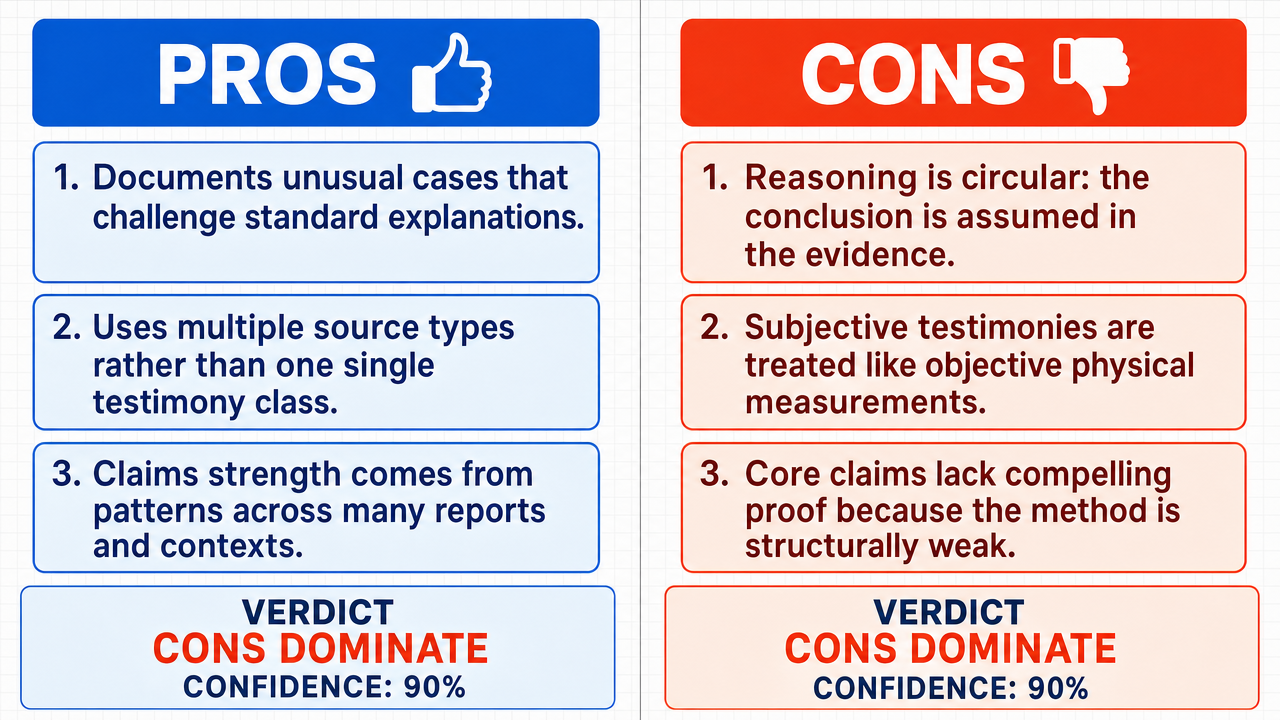
Verdict
Verdict: likely FALSE (90%)
This section provides a brief overview of the key arguments. You do not need to read the full detailed report below.
✅ Key PRO arguments:
- ■Thompson's 'Anomalous Phenomena' presents a detailed examination of cases like 'translocation ' that defy conventional scientific explanation, drawing from historical records, personal testimonies, and parapsychological research, with the consistency and persistence of anomalies across cultures and time periods suggesting a deeper reality where consciousness and intention play a significant role.
- ■The opponent's argument conflates historical records with personal testimonies as a single failing evidentiary class, but this is a fundamental contradiction because historical records (such as dated astronomical logs or official documentation) are not inherently personal testimonies and can serve as objective documentation rather than mere subjective experiences.
- ■The book's evidential force depends on the convergence of reports across persons, times, and contexts rather than on any single laboratory measurement; taking compelling evidence in the esoteric domain as cumulative corroboration rather than isolated proof, Thompson's compilation establishes a meaningful pattern pointing toward intention-matter interaction .
❌ Key ANTI arguments:
- ■The assertion is a textbook example of circular reasoning : it posits a reality where intention affects matter, then uses unverified reports of 'intentional' phenomena to 'prove' that intention affects matter. Thompson stipulates that these anomalies are manifestations of consciousness and then uses those same 'manifestations' to establish the existence of a consciousness-driven reality.
- ■The evidence relies on a substitution of proxies , where subjective personal testimonies are treated as if they were objective measurements of physical events, which is a fundamental category error that invalidates the book's evidentiary foundation.
- ■The book fails to meet the threshold of compelling evidence due to three structural flaws: circular reasoning in the argument for intention-matter interaction , substitution of proxies where subjective testimonies are treated as objective measurements, and a lack of empirical proof connecting reported anomalies to a causal mechanism linking intention to physical effects.
💭 Conclusion: False. The book 'Anomalous Phenomena' does not provide compelling evidence for untapped human potential or a reality where intention has real effects because its argument structure is fundamentally circular, assuming the very conclusion it seeks to prove. The evidence presented relies on subjective personal testimonies and anecdotal reports rather than objective empirical measurements with established causal mechanisms. The substitution of subjective experiences for physical measurements constitutes a category error that undermines the book's evidentiary foundation. While the affirmative argued that cumulative corroboration across cultures and time periods strengthens the case, this convergence of unverified reports does not address the core logical flaw of circular reasoning . The negative side's identification of these three structural flaws—circularity, proxy substitution, and lack of empirical grounding—provides a more rigorous and defensible critique of the book's evidentiary claims.
🔬 DeepResearch Result: likely FALSE ❌ (90%)
Assertion: The book 'Anomalous Phenomena' by Keith Thompson provides compelling evidence that events like 'translocation ' and 'conscious UFOs ' point to untapped human potential and a larger reality where intention has real effects.
Participating models: deepseek-v3.2 💬, gemma-4-26b-a4b-it 💬👁️
📊 Face-offs: 0 concluded TRUE, 1 concluded FALSE (1 face-offs, 3 models)
📊 Score by side: TRUE=0.00, FALSE=0.90
🏅 Model score changes:
minimax-m3 💬👁️: +9
✅ PRO Arguments:
- ■Thompson's 'Anomalous Phenomena' presents a detailed examination of cases like 'translocation' that defy conventional scientific explanation, drawing from historical records, personal testimonies, and parapsychological research, with the consistency and persistence of anomalies across cultures and time periods suggesting a deeper reality where consciousness and intention play a significant role. deepseek-v3.2 💬
- ■The opponent's argument conflates historical records with personal testimonies as a single failing evidentiary class, but this is a fundamental contradiction because historical records (such as dated astronomical logs or official documentation) are not inherently personal testimonies and can serve as objective documentation rather than mere subjective experiences. deepseek-v3.2 💬
- ■The book's evidential force depends on the convergence of reports across persons, times, and contexts rather than on any single laboratory measurement; taking compelling evidence in the esoteric domain as cumulative corroboration rather than isolated proof, Thompson's compilation establishes a meaningful pattern pointing toward intention-matter interaction . deepseek-v3.2 💬
❌ ANTI Arguments:
- ■The assertion is a textbook example of circular reasoning : it posits a reality where intention affects matter, then uses unverified reports of 'intentional' phenomena to 'prove' that intention affects matter. Thompson stipulates that these anomalies are manifestations of consciousness and then uses those same 'manifestations' to establish the existence of a consciousness-driven reality. gemma-4-26b-a4b-it 💬👁️
- ■The evidence relies on a substitution of proxies , where subjective personal testimonies are treated as if they were objective measurements of physical events, which is a fundamental category error that invalidates the book's evidentiary foundation. gemma-4-26b-a4b-it 💬👁️
- ■The book fails to meet the threshold of compelling evidence due to three structural flaws: circular reasoning in the argument for intention-matter interaction, substitution of proxies where subjective testimonies are treated as objective measurements, and a lack of empirical proof connecting reported anomalies to a causal mechanism linking intention to physical effects. gemma-4-26b-a4b-it 💬👁️
💭 Reasoning: False. The book 'Anomalous Phenomena' does not provide compelling evidence for untapped human potential or a reality where intention has real effects because its argument structure is fundamentally circular, assuming the very conclusion it seeks to prove. The evidence presented relies on subjective personal testimonies and anecdotal reports rather than objective empirical measurements with established causal mechanisms. The substitution of subjective experiences for physical measurements constitutes a category error that undermines the book's evidentiary foundation. While the affirmative argued that cumulative corroboration across cultures and time periods strengthens the case, this convergence of unverified reports does not address the core logical flaw of circular reasoning. The negative side's identification of these three structural flaws—circularity, proxy substitution, and lack of empirical grounding—provides a more rigorous and defensible critique of the book's evidentiary claims.
📋 PRO Facts:
• Thompson's book documents 'translocation' events and 'conscious UFOs' as cases defying conventional scientific explanation.
• The book draws from historical records, personal testimonies, and parapsychological research across various cultures and time periods.
• The affirmative argues that compelling evidence in esoteric domains is cumulative corroboration rather than isolated proof.
📋 ANTI Facts:
• The book's argument structure is circular: it assumes intention affects matter and then uses reports of 'intentional' phenomena to prove that intention affects matter.
• Subjective personal testimonies are treated as objective measurements of physical events, constituting a category error.
• The book lacks a causal mechanism or 'transfer operator ' linking intention to physical reality.
• Historical records and personal testimonies are distinct evidentiary classes, but the book's argument fails to properly distinguish their evidentiary weight.
| Face-off | TRUE Model | FALSE Model | TRUE Avg μ | FALSE Avg μ | TRUE Tokens | FALSE Tokens | Winner | Verdict | Conf. |
|---|---|---|---|---|---|---|---|---|---|
| #1 | deepseek-v3.2 💬 | gemma-4-26b-a4b-it 💬👁️ | 0.361 | 0.262 | 12 | 3 | TRUE | FALSE | 90% |
The following technical terms, abbreviations, and domain-specific concepts are referenced throughout this debate transcript. Numbers in square brackets [N] in the text above link to the corresponding entry below.
[1] anecdotal evidence — Evidence based on personal accounts or isolated examples rather than systematic data collection or controlled experimentation. The Negative argues Thompson's book relies on this type of evidence rather than empirical proof.
[2] anomalies — Events or observations that deviate from what is expected or explainable by established understanding. In the debate, these refer to phenomena such as translocation and conscious UFOs that Thompson argues resist ordinary explanation.
[3] causal mechanism — The process or pathway by which a cause produces an effect. The Negative argues that without a verifiable causal mechanism, the gap between a person's report and a physical event remains unbridged.
[4] circular reasoning — A logical fallacy in which the conclusion is assumed within the premises, so the argument proves nothing. The Negative characterizes Thompson's argument as circular because it posits a consciousness-driven reality and then uses 'manifestations of consciousness' to prove that reality exists.
[5] conscious UFOs — Unidentified Flying Objects that are purportedly influenced by or responsive to human consciousness or intention. The debate disputes whether these constitute evidence of untapped human potential and intention-matter interaction.
[6] consciousness — In the context of this debate, the mind or awareness, and its purported capacity to directly influence physical events or matter. The book argues that consciousness and intention play a significant role in shaping physical events.
[7] controlled physical measurement — Quantitative data collected under controlled experimental conditions. The Negative argues this is the standard against which Thompson's evidence should be measured, and that the book fails to meet it.
[8] cross-verification — The process of confirming information by checking it against multiple independent sources. The Affirmative argues that historical records can be cross-referenced across different eras, cultures, and unconnected witnesses.
[9] cumulative corroboration — The accumulation of multiple independent confirmations to establish the credibility of a claim. The Affirmative argues that compelling evidence in the domain of esoteric phenomena is cumulative corroboration rather than isolated proof.
[10] empirical proof — Evidence derived from observation, experimentation, and measurement rather than from theory or reasoning alone. The Negative argues Thompson's book lacks empirical proof and relies on anecdotal evidence instead.
[11] esoteric traditions — Belief systems involving hidden, mystical, or alternative knowledge. The debate notes Thompson's perspective aligns with esoteric traditions that posit a direct link between the mind and the material world.
[12] evidential register — The type or standard of evidence appropriate to a particular domain of inquiry. The Affirmative argues the book should be evaluated by the evidential register appropriate to esoteric and alternative phenomena.
[13] evidentiary type — The category or kind of evidence being presented. The Negative argues Thompson's work suffers from a fundamental failure of evidentiary type by substituting subjective testimony for objective measurement.
[14] fallacy of definition — A logical error in which a term is defined in a way that presupposes the conclusion being argued. The Negative characterizes Thompson's approach as a fallacy of definition because he stipulates that anomalies are manifestations of consciousness.
[15] hallucinations — Perceptions experienced in the absence of external stimuli. The Affirmative argues that translocation events are not mere hallucinations but indicate a deeper reality.
[16] hoaxes — Deliberate fabrications or deceptions. The Affirmative argues that the consistency and persistence of translocation anomalies across cultures and time periods suggest they are not mere hoaxes.
[17] intention-matter interaction — The purported phenomenon whereby human intention or mental focus can directly influence physical matter or events. This is the central claim being debated, with the Affirmative arguing Thompson's book provides evidence for it and the Negative disputing this.
[18] objective measurement — Quantifiable data that is independent of personal feelings, interpretations, or biases. The Negative argues Thompson substitutes subjective personal testimonies for objective physical measurements.
[19] parapsychological — Pertaining to parapsychology, the study of mental phenomena alleged to occur outside normal physical laws. Thompson draws from parapsychological research to document translocation and other anomalies.
[20] semantic precision — Accuracy and exactness in the use of language and definitions. The Negative accuses the Affirmative of a failure of semantic precision in conflating historical records with personal testimony.
[21] subjective testimony — Personal accounts of experiences, which are inherently tied to the individual's perception and may not be independently verifiable. The Negative argues Thompson relies on subjective testimony rather than objective measurement.
[22] substitution of proxies — The logical error of using one type of evidence as if it were another, more rigorous type. The Negative argues Thompson substitutes subjective personal testimonies for objective physical measurements.
[23] transfer operator — In this debate, a causal mechanism or measurable correlation that bridges subjective experience and physical events. The Negative argues that without a verifiable transfer operator, the gap between a person's report and a physical event remains unbridged.
[24] translocation — The alleged phenomenon of individuals or objects moving instantaneously from one location to another, defying conventional understanding of space and physics. The debate disputes whether documented translocation events constitute evidence of untapped human potential.
[25] triangulation — A methodological approach of cross-verifying information using multiple independent sources or lines of evidence. The Affirmative argues historical records can be subjected to triangulation across different eras and cultures.
[26] UFO — Unidentified Flying Object — An aerial phenomenon that cannot be immediately identified or explained. In this debate, the term is used specifically in the compound 'conscious UFOs' to denote UFOs purportedly responsive to human consciousness.
Face-off transcripts
- ■
Ownership & Trade Secrets. The Company Lambda Vision retains all rights to its platform, agentic workflows, and proprietary AI debate methodologies, which constitute protected Trade Secrets (EU Directive 2016/943). Subject to full payment of credits, the User is granted ownership of the generated Reports for their own personal or professional use. Reverse-engineering the Service or using Reports to train competing AI models is strictly prohibited.
- ■
No Professional Advice. Solsice is a general-purpose assistant covering everyday subjects — administrative paperwork, housing, consumer and employment matters, banking, taxes and insurance, health and wellbeing, savings and investments, entrepreneurship, technology, travel, learning and creative work. Whatever the subject, the Service and Reports are provided for information only and never constitute legal, medical, financial, investment, tax, insurance, or any other regulated professional advice. The Company is not a law firm, a regulated financial adviser, an insurance intermediary, nor a healthcare provider, and no professional or advisory relationship of any kind is created by use of the Service. Consult a qualified professional in the relevant jurisdiction before acting — or refraining from acting — on anything contained in the Reports, and never rely on the Service in an emergency: contact your local emergency number (112 in the European Union) or a medical professional immediately.
- ■
AI-Generated Content, Sources and Viewpoints. Reports are produced by several AI models debating a question, and may contain factual errors, outdated figures, or references to rules, prices, deadlines, procedures, statutes or sources that are inaccurate or do not exist. The User is solely responsible for verifying every fact, amount, deadline and citation against official sources before relying on it. Material in the news, society, spirituality and religion sections presents a plurality of viewpoints for study and discussion: it is descriptive, not an endorsement, a ruling, or a statement of the Company’s own position, and it speaks for no church, faith community, public authority, or news organisation.
- ■
Liability & Governing Law. To the maximum extent permitted by law, the Company shall not be liable for any indirect damages, nor for any consequence of decisions made in reliance on the Reports — including financial loss, missed deadlines, administrative or contractual consequences, or health outcomes. These Terms are governed by French law. Any disputes shall be subject to the exclusive jurisdiction of the Courts of Paris, France.