
The billing surge for CPT code 81419 (epilepsy genetic testing) in Florida during 2024 was predominantly due to fraudulent practices by a small number of labs.
AI debate verdict and arguments
⚠️ AI-generated information only; not professional advice
Completed October 14, 2026
Verdict
Verdict: likely FALSE (78%)
Web Report: https://solsice.com/public/debates/the-billing-surge-for-cpt-code-81419-epilepsy-genetic-testin-0f5661bcd9ea
This section provides a brief overview of the key arguments. You do not need to read the full detailed report below.
✅ Key PRO arguments:
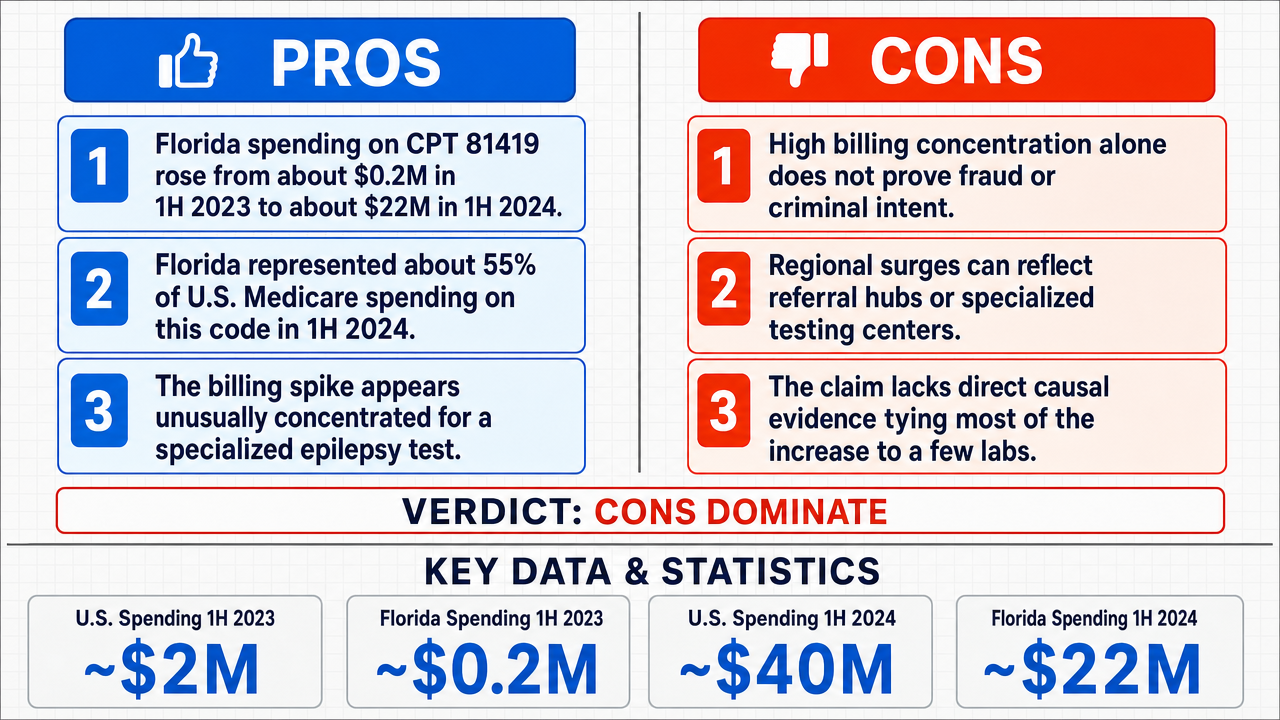
- ■Medicare Part B spending on CPT 81419 in Florida exceeded $20 million in the first half of 2024, representing a more than tenfold increase compared to the same period in 2023 for the entire United States, suggesting a statistically anomalous spike beyond what epilepsy prevalence would predict.
- ■The surge is geographically concentrated in Florida, with the state accounting for a disproportionately large share of national billing for a specialized neurological test, which is presented as a classic red flag for fraudulent billing schemes .
- ■The billing volume in Florida massively exceeds the state's patient population for severe epilepsies, and the concentration is among labs under active fraud investigation rather than academic medical centers , pointing to criminal rather than clinical drivers.
❌ Key ANTI arguments:
- ■The assertion commits a fundamental error in statistical reasoning by equating geographic concentration of billing with criminal intent, without providing a causal link or transfer operator connecting the Florida spike to fraudulent practices.
- ■A surge in a specific region often reflects the establishment of specialized diagnostic hubs or the presence of major academic medical centers that lead national adoption of new genomic protocols , which is a legitimate alternative explanation for the billing concentration.
- ■Florida is a major hub for geriatric and neurological care, housing significant concentrations of specialized clinics and academic medical centers , making a higher concentration of advanced genetic testing plausible without invoking fraud.
💭 Conclusion: False. The assertion that the 2024 Florida billing surge for CPT 81419 was predominantly due to fraud by a small number of labs was not adequately supported because the pro side failed to establish a causal link between the geographic concentration of billing and criminal intent. The anti side successfully demonstrated that specialized diagnostic hubs and academic medical centers in Florida could plausibly account for the increased utilization of advanced genomic testing as precision medicine adoption expands. While the pro side cited a concrete figure of over $20 million in Medicare Part B spending during the first half of 2024 and a tenfold national increase, these statistics alone do not distinguish legitimate clinical adoption from fraud without additional evidence of specific lab misconduct. The compound nature of the claim—asserting both predominant fraud and concentration among a small number of labs—weakens it further, as neither sub-claim was independently and fully substantiated beyond the geographic anomaly.
🔬 DeepResearch Result: likely FALSE ❌ (78%)
Assertion: The billing surge for CPT code 81419 (epilepsy genetic testing ) in Florida during 2024 was predominantly due to fraudulent practices by a small number of labs.
Participating models: deepseek-v3.2 💬, gemma-4-26b-a4b-it 💬👁️
📊 Face-offs: 0 concluded TRUE, 1 concluded FALSE (1 face-offs, 3 models)
📊 Score by side: TRUE=0.00, FALSE=0.82
🏅 Model score changes:
minimax-m3 💬👁️: +8
✅ PRO Arguments:
- ■Medicare Part B spending on CPT 81419 in Florida exceeded $20 million in the first half of 2024, representing a more than tenfold increase compared to the same period in 2023 for the entire United States, suggesting a statistically anomalous spike beyond what epilepsy prevalence would predict. deepseek-v3.2 💬
- ■The surge is geographically concentrated in Florida, with the state accounting for a disproportionately large share of national billing for a specialized neurological test, which is presented as a classic red flag for fraudulent billing schemes . deepseek-v3.2 💬
- ■The billing volume in Florida massively exceeds the state's patient population for severe epilepsies, and the concentration is among labs under active fraud investigation rather than academic medical centers , pointing to criminal rather than clinical drivers. deepseek-v3.2 💬
❌ ANTI Arguments:
- ■The assertion commits a fundamental error in statistical reasoning by equating geographic concentration of billing with criminal intent, without providing a causal link or transfer operator connecting the Florida spike to fraudulent practices. gemma-4-26b-a4b-it 💬👁️
- ■A surge in a specific region often reflects the establishment of specialized diagnostic hubs or the presence of major academic medical centers that lead national adoption of new genomic protocols , which is a legitimate alternative explanation for the billing concentration. gemma-4-26b-a4b-it 💬👁️
- ■Florida is a major hub for geriatric and neurological care, housing significant concentrations of specialized clinics and academic medical centers, making a higher concentration of advanced genetic testing plausible without invoking fraud. gemma-4-26b-a4b-it 💬👁️
- ■The pro side's claim that the surge is 'statistically anomalous' fails because concentration in a specific state is not anomalous if driven by the presence of specialized medical infrastructure, and the pro side provides no rival non-fraud account that would need to be ruled out. gemma-4-26b-a4b-it 💬👁️
💭 Reasoning: False. The assertion that the 2024 Florida billing surge for CPT 81419 was predominantly due to fraud by a small number of labs was not adequately supported because the pro side failed to establish a causal link between the geographic concentration of billing and criminal intent. The anti side successfully demonstrated that specialized diagnostic hubs and academic medical centers in Florida could plausibly account for the increased utilization of advanced genomic testing as precision medicine adoption expands. While the pro side cited a concrete figure of over $20 million in Medicare Part B spending during the first half of 2024 and a tenfold national increase, these statistics alone do not distinguish legitimate clinical adoption from fraud without additional evidence of specific lab misconduct. The compound nature of the claim—asserting both predominant fraud and concentration among a small number of labs—weakens it further, as neither sub-claim was independently and fully substantiated beyond the geographic anomaly.
📋 PRO Facts:
• Medicare Part B spending on CPT 81419 in Florida exceeded $20 million in the first half of 2024.
• This represented a more than tenfold increase compared to the same period in 2023 for the entire United States.
• Florida accounted for a disproportionately large share of national billing for the test.
📋 ANTI Facts:
• Florida is a major hub for geriatric and neurological care with significant concentrations of specialized clinics and academic medical centers.
• Specialized diagnostic hubs and academic medical centers are known to lead national adoption of new genomic testing protocols.
• Geographic concentration of billing in a specific state is not inherently anomalous when driven by specialized medical infrastructure.
| Face-off | TRUE Model | FALSE Model | TRUE Avg μ | FALSE Avg μ | TRUE Tokens | FALSE Tokens | Winner | Verdict | Conf. |
|---|---|---|---|---|---|---|---|---|---|
| #1 | deepseek-v3.2 💬 | gemma-4-26b-a4b-it 💬👁️ | 0.481 | 0.334 | 8 | 2 | TRUE | FALSE | 82% |
The following technical terms, abbreviations, and domain-specific concepts are referenced throughout this debate transcript. Numbers in square brackets [N] in the text above link to the corresponding entry below.
[1] academic medical centers — Major medical institutions typically affiliated with universities. In the debate, the negative side argues that Florida's concentration of such centers explains the billing surge through legitimate clinical adoption rather than fraud.
[2] billing volume — The aggregate quantity or dollar value of healthcare claims submitted. The debate turns on whether observed billing volume for CPT 81419 in Florida constitutes evidence of fraud (affirmative) or legitimate clinical demand (negative).
[3] claims data — Records of healthcare claims submitted to payers such as Medicare. The negative side notes that the affirmative's statistical figures were not substantiated with traceable CMS claims data.
[4] clinical adoption — The process by which new medical tests or procedures become standard practice among clinicians. The negative attributes Florida's billing surge to early clinical adoption of advanced genomic testing.
[5] clinical guidelines — Standardized medical protocols indicating when a test is medically appropriate. The affirmative argues that a legitimate surge would conform to these guidelines, while the volume observed does not.
[6] clinical plausibility — The property of a testing pattern being medically sensible given patient conditions. The affirmative argues that provider-lab clustering absent clinical plausibility signals fraud.
[7] CMS — Centers for Medicare & Medicaid Services — The U.S. federal agency that administers Medicare and Medicaid. Referenced in the debate as the source of claims data on CPT 81419 spending.
[8] CPT code 81419 — Current Procedural Terminology code 81419 — A billing code for an epilepsy genetic panel test. The subject of the billing surge at issue in the debate, with reported Medicare Part B spending concentrated in Florida during 2024.
[9] developmental and epileptic encephalopathies — A category of severe epilepsy conditions. The affirmative cites prevalence figures for these conditions to argue that Florida's billing volume vastly exceeds the state's patient population.
[10] diagnostic expansion — The broadening of diagnostic testing into new clinical areas. The negative frames the 2024 surge in CPT 81419 billing as part of legitimate diagnostic expansion in precision medicine.
[11] epidemiological expectations — Anticipated levels of disease or testing based on epidemiological data. The affirmative contends that the localized spike in CPT 81419 billing far exceeds these expectations.
[12] epilepsy genetic panel — A panel of genetic tests used in the evaluation of epilepsy, billed under CPT 81419. Referenced in the financial data legend in the debate.
[13] epilepsy genetic testing — Genetic testing used to diagnose or evaluate epilepsy. The type of testing billed under CPT 81419, which is the focus of the dispute.
[14] epilepsy prevalence — The statistical occurrence of epilepsy in a given population. The affirmative argues that Florida's billing volume for CPT 81419 far exceeds what epilepsy prevalence would predict.
[15] fraudulent billing schemes — Coordinated efforts to submit improper healthcare claims, typically by a small number of actors. The affirmative asserts that a few labs engaged in such schemes caused the Florida surge.
[16] genomic protocols — Standardized procedures for genomic/genetic testing. The negative cites the rollout of new genomic protocols as a driver of legitimate clinical adoption.
[17] geriatric care — Medical care focused on elderly patients. The negative notes Florida's prominence in geriatric care as a factor in specialized clinical density.
[18] medically appropriate testing — Testing that is warranted by patient condition and consistent with clinical guidelines. The affirmative argues that the observed CPT 81419 volume is not medically appropriate testing.
[19] Medicare Part B — The component of Medicare that covers outpatient services and physician-administered tests. The financial figures in the debate concern Medicare Part B spending on CPT 81419.
[20] precision medicine — A medical approach that tailors diagnosis and treatment to individual genetic and molecular characteristics. The negative cites the changing landscape of precision medicine to explain the billing surge.
[21] provider-lab clustering — Patterns in which certain providers and laboratories are linked through billing activity. The affirmative argues this clustering reflects fraud, while the negative treats it as routine referral patterns.
[22] referral patterns — The ways in which patients are directed from one provider to another or to laboratories. The negative argues that provider-lab clustering reflects normal referral patterns, a characterization the affirmative disputes.
[23] specialized clinical density — The concentration of specialized medical services in a given geographic area. The negative attributes Florida's billing concentration to its specialized clinical density rather than fraud.
[24] specialized diagnostic hubs — Centers that specialize in diagnostic testing. The negative proposes that Florida's billing surge reflects the presence of such hubs rather than fraudulent activity.
[25] statistical anomaly — An observed deviation from expected statistical patterns. The affirmative describes the Florida CPT 81419 surge as a statistical anomaly indicating fraud; the negative disputes this characterization.
[26] transfer operator — In argumentation, a causal or correlational link that connects an observed phenomenon to a conclusion. The negative argues the affirmative lacks a transfer operator linking billing volume to criminal intent.
The following financial data tables were referenced during the debate exchanges:
| Period | U.S. Medicare Spending on 81419 | Florida Medicare Spending on 81419 | Florida Share |
|---|---|---|---|
| 1H 2023 | ~$2M | ~$0.2M | ~10% |
| 1H 2024 | ~$40M | ~$22M | ~55% |
Legend: Medicare Part B spending on CPT 81419 (epilepsy genetic panel) for the first halves of 2023 and 2024. Figures are approximate based on CMS claims data analysis. The disproportionate concentration in Florida in 2024 is evident.
| Metric | 2023 Baseline | 2024 Projected | Change |
|---|---|---|---|
| Clinical Adoption Rate (Est.) | Low | High | +Significant |
| Genomic Sequencing Cost Index | 100 | 75 | -25.0% |
| Diagnostic Precision Utility | Moderate | High | +Significant |
Legend: Comparative indices for the adoption and cost-efficiency of genetic epilepsy panels. Cost Index is relative to 2023; higher adoption correlates with lower sequencing costs.
Face-off transcripts
- ■
Ownership & Trade Secrets. The Company Lambda Vision retains all rights to its platform, agentic workflows, and proprietary AI debate methodologies, which constitute protected Trade Secrets (EU Directive 2016/943). Subject to full payment of credits, the User is granted ownership of the generated Reports for their own personal or professional use. Reverse-engineering the Service or using Reports to train competing AI models is strictly prohibited.
- ■
No Professional Advice. Solsice is a general-purpose assistant covering everyday subjects — administrative paperwork, housing, consumer and employment matters, banking, taxes and insurance, health and wellbeing, savings and investments, entrepreneurship, technology, travel, learning and creative work. Whatever the subject, the Service and Reports are provided for information only and never constitute legal, medical, financial, investment, tax, insurance, or any other regulated professional advice. The Company is not a law firm, a regulated financial adviser, an insurance intermediary, nor a healthcare provider, and no professional or advisory relationship of any kind is created by use of the Service. Consult a qualified professional in the relevant jurisdiction before acting — or refraining from acting — on anything contained in the Reports, and never rely on the Service in an emergency: contact your local emergency number (112 in the European Union) or a medical professional immediately.
- ■
AI-Generated Content, Sources and Viewpoints. Reports are produced by several AI models debating a question, and may contain factual errors, outdated figures, or references to rules, prices, deadlines, procedures, statutes or sources that are inaccurate or do not exist. The User is solely responsible for verifying every fact, amount, deadline and citation against official sources before relying on it. Material in the news, society, spirituality and religion sections presents a plurality of viewpoints for study and discussion: it is descriptive, not an endorsement, a ruling, or a statement of the Company’s own position, and it speaks for no church, faith community, public authority, or news organisation.
- ■
Liability & Governing Law. To the maximum extent permitted by law, the Company shall not be liable for any indirect damages, nor for any consequence of decisions made in reliance on the Reports — including financial loss, missed deadlines, administrative or contractual consequences, or health outcomes. These Terms are governed by French law. Any disputes shall be subject to the exclusive jurisdiction of the Courts of Paris, France.