
The bedroom is typically the dirtiest room in a home, accumulating more hidden grime than the kitchen or bathroom.
AI debate verdict and arguments
⚠️ AI-generated information only; not professional advice
Completed October 8, 2026
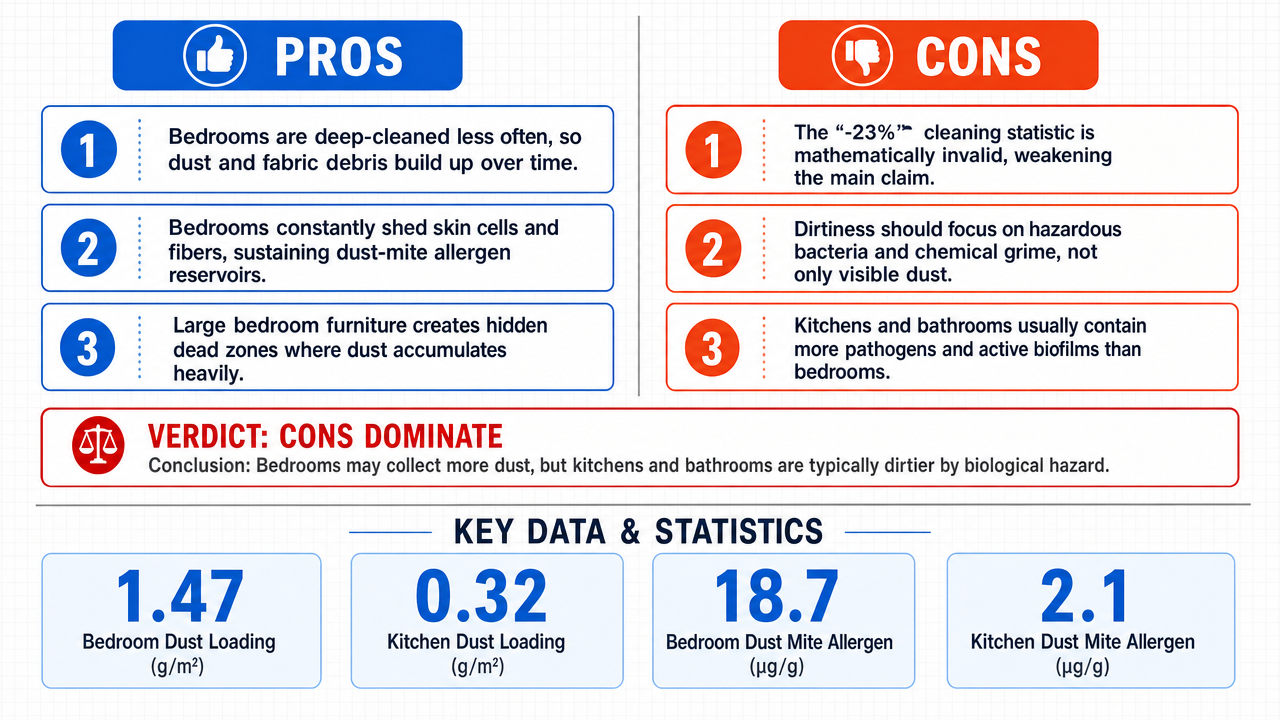
Verdict
Verdict: likely FALSE (76%)
This section provides a brief overview of the key arguments. You do not need to read the full detailed report below.
✅ Key PRO arguments:
- ■Bedrooms receive significantly less frequent and less intensive deep cleaning than kitchens or bathrooms, allowing dust, skin cells , and fabric fibers to accumulate undisturbed over time.
- ■Bedrooms are a primary continuous source of organic debris (shed skin cells , textile fibers ) that feeds persistent allergen reservoirs such as dust mites , with settled dust loading reportedly around 1.47 g/m² .
- ■Large, immovable bedroom furniture creates hidden 'dead zones ' where particulate mass accumulates to levels significantly higher than in other rooms.
❌ Key ANTI arguments:
- ■The TRUE side's cited statistic of '-23%' deep-cleaning frequency for bedrooms is arithmetically impossible as a representation of a population percentage, undermining the statistical basis of the cleaning-disparity argument.
- ■'Dirtiness' should be defined by the biological and chemical intensity of grime—pathogenic bacteria , fecal coliforms, and chemical residues —rather than by the inert mass of settled dust particles.
- ■Kitchens and bathrooms harbor significantly higher concentrations of pathogenic bacteria and active microbial biofilms than bedrooms, making them objectively dirtier by any health-relevant standard.
💭 Conclusion: False. The FALSE side prevailed because it successfully dismantled the TRUE side's core statistical evidence (the arithmetically impossible '-23%' figure) and reframed 'dirtiness' around biologically and chemically hazardous grime rather than inert particulate mass. Kitchens and bathrooms concentrate pathogenic bacteria , active microbial biofilms , and chemical residues at levels far exceeding the relatively inert organic debris (skin cells , textile fibers ) found in bedrooms. The TRUE side's reliance on settled dust mass as the defining metric was shown to be a narrow and misleading proxy for overall grime accumulation. While bedrooms do receive less frequent cleaning and accumulate notable dust, this does not translate into being the 'dirtiest' room by the most meaningful hygiene and health-relevant definitions.
🔬 DeepResearch Result: likely FALSE ❌ (76%)
Assertion: The bedroom is typically the dirtiest room in a home, accumulating more hidden grime than the kitchen or bathroom.
Participating models: deepseek-v3.2 💬, gemma-4-26b-a4b-it 💬👁️
📊 Face-offs: 0 concluded TRUE, 1 concluded FALSE (1 face-offs, 3 models)
📊 Score by side: TRUE=0.00, FALSE=0.76
🏅 Model score changes:
minimax-m3 💬👁️: +8
✅ PRO Arguments:
- ■Bedrooms receive significantly less frequent and less intensive deep cleaning than kitchens or bathrooms, allowing dust, skin cells , and fabric fibers to accumulate undisturbed over time. deepseek-v3.2 💬
- ■Bedrooms are a primary continuous source of organic debris (shed skin cells, textile fibers ) that feeds persistent allergen reservoirs such as dust mites , with settled dust loading reportedly around 1.47 g/m² . deepseek-v3.2 💬
- ■Large, immovable bedroom furniture creates hidden 'dead zones ' where particulate mass accumulates to levels significantly higher than in other rooms. deepseek-v3.2 💬
- ■Defining 'dirtiness' by total accumulated mass of particulate matter shows bedrooms as the primary reservoir of settled dust in a home. deepseek-v3.2 💬
❌ ANTI Arguments:
- ■The TRUE side's cited statistic of '-23%' deep-cleaning frequency for bedrooms is arithmetically impossible as a representation of a population percentage, undermining the statistical basis of the cleaning-disparity argument. gemma-4-26b-a4b-it 💬👁️
- ■'Dirtiness' should be defined by the biological and chemical intensity of grime—pathogenic bacteria , fecal coliforms, and chemical residues —rather than by the inert mass of settled dust particles. gemma-4-26b-a4b-it 💬👁️
- ■Kitchens and bathrooms harbor significantly higher concentrations of pathogenic bacteria and active microbial biofilms than bedrooms, making them objectively dirtier by any health-relevant standard. gemma-4-26b-a4b-it 💬👁️
- ■Using dust mite allergens as a direct proxy for 'grime' is a substitution error; allergens are a biological presence but do not equate to the total mass or hazardous quality of accumulated grime. gemma-4-26b-a4b-it 💬👁️
💭 Reasoning: False. The FALSE side prevailed because it successfully dismantled the TRUE side's core statistical evidence (the arithmetically impossible '-23%' figure) and reframed 'dirtiness' around biologically and chemically hazardous grime rather than inert particulate mass. Kitchens and bathrooms concentrate pathogenic bacteria, active microbial biofilms, and chemical residues at levels far exceeding the relatively inert organic debris (skin cells, textile fibers) found in bedrooms. The TRUE side's reliance on settled dust mass as the defining metric was shown to be a narrow and misleading proxy for overall grime accumulation. While bedrooms do receive less frequent cleaning and accumulate notable dust, this does not translate into being the 'dirtiest' room by the most meaningful hygiene and health-relevant definitions.
📋 PRO Facts:
• Bedrooms reportedly receive less frequent deep cleaning than kitchens or bathrooms.
• Settled dust loading in bedrooms has been measured at approximately 1.47 g/m².
• Skin cells and textile fibers continuously shed in bedrooms feed dust mite populations.
📋 ANTI Facts:
• The TRUE side cited a deep-cleaning frequency of '-23%' for bedrooms, which is arithmetically impossible as a population percentage.
• Kitchens and bathrooms harbor significantly higher concentrations of pathogenic bacteria than bedrooms.
• Dust mite allergens are not equivalent to total grime mass or hazardous grime quality.
• Bedroom dust consists largely of biologically stable, relatively inert organic particles, unlike the active microbial biofilms found in kitchens and bathrooms.
| Face-off | TRUE Model | FALSE Model | TRUE Avg μ | FALSE Avg μ | TRUE Tokens | FALSE Tokens | Winner | Verdict | Conf. |
|---|---|---|---|---|---|---|---|---|---|
| #1 | deepseek-v3.2 💬 | gemma-4-26b-a4b-it 💬👁️ | 0.535 | 0.240 | 12 | 3 | TRUE | FALSE | 76% |
The following technical terms, abbreviations, and domain-specific concepts are referenced throughout this debate transcript. Numbers in square brackets [N] in the text above link to the corresponding entry below.
[1] allergens — Substances, typically biological in origin (such as dust mite proteins), that trigger an immune response in sensitive individuals.
[2] bacterial colonies — Visible clusters of bacteria growing on a surface, often embedded in a protective matrix, indicating sustained microbial presence.
[3] biofilms — microbial biofilms — Structured communities of microorganisms that adhere to surfaces and are encased in a self-produced polymeric matrix, making them more resistant to cleaning.
[4] biological activity — A measure of the living processes occurring within a substance, used in the debate to contrast inert dust with active microbial grime.
[5] chemical complexity — The diversity and structural intricacy of chemical compounds present in a substance, cited as a marker of grime intensity in kitchens and bathrooms.
[6] chemical residues — Trace amounts of chemical substances (e.g., cleaning agents, grease components) that remain on surfaces after use or cleaning.
[7] cleaning frequency — The rate at which a space is cleaned, used in the debate to argue that bedrooms are cleaned less often than kitchens or bathrooms.
[8] cross-contamination — The transfer of harmful microorganisms or chemicals from one surface, food item, or area to another, commonly discussed in kitchen hygiene contexts.
[9] dead zones — dead zones (cleaning) — Areas in a room—typically behind or under large furniture—that are rarely accessed during routine cleaning, allowing grime to accumulate undisturbed.
[10] deep cleaning — An intensive, thorough cleaning process that targets hidden or hard-to-reach areas, as opposed to routine surface tidying.
[11] desiccated — Dried out; in the debate, used to describe skin cells and textile fibers that have lost moisture and are biologically stable.
[12] disinfectants — Chemical agents applied to surfaces to kill or inactivate pathogenic microorganisms, commonly used in kitchens and bathrooms.
[13] dust loading — dust loading (g/m²) — A quantitative measure of settled dust mass per unit area (grams per square meter), used in the debate as a proxy for accumulated grime.
[14] dust mite debris — Waste products and decomposed remains of dust mites, a component of bedroom dust that contributes to allergen load.
[15] dust mites — Microscopic arthropods that feed on shed skin cells and thrive in bedroom environments such as mattresses and pillows.
[16] equivocation — equivocation (logical fallacy) — A logical fallacy in which a word or term is used in multiple senses within an argument, leading to ambiguity; cited in the debate regarding the definition of 'grime.'
[17] g/m² — grams per square meter — A unit of measurement expressing mass per unit area, used in the debate to quantify dust loading across room types.
[18] grease polymers — lipid-based grease polymers — Chemically complex, polymerized fat residues that accumulate on kitchen surfaces, cited as a qualitatively intense form of grime.
[19] hidden grime — Dirt and contaminants that accumulate in unobserved or rarely cleaned areas, central to the affirmative's definition of bedroom dirtiness.
[20] hidden premise — An unstated assumption underlying an argument, identified in the debate regarding how 'grime' should be defined.
[21] high-moisture environments — Areas such as kitchens and bathrooms where elevated humidity supports greater microbial growth and chemical residue accumulation.
[22] hygiene — Practices and conditions that promote health and prevent disease, particularly relevant to food safety and sanitation standards.
[23] inert — inert (biological/chemical) — Chemically unreactive or biologically inactive; used in the debate to describe settled bedroom dust as comparatively harmless.
[24] microbial loads — The quantity or concentration of microorganisms present in a given environment, used to argue that kitchens and bathrooms are more hazardous.
[25] microbial virulence — The degree of pathogenicity or ability of a microorganism to cause disease, cited as a qualitative dimension of grime.
[26] mineral scale — Hard, crusty deposits formed by the precipitation of dissolved minerals (e.g., calcium, magnesium) from water, commonly found in bathrooms.
[27] organic debris — Biological waste material such as shed skin cells and textile fibers that accumulate in bedroom environments.
[28] particulate grime — Grime composed of small, discrete particles (e.g., dust, fibers), distinguished from sticky or biofilm-based grime in the debate.
[29] particulate matter — Microscopic solid or liquid particles suspended in air or settled on surfaces, measured by mass per unit area in dust loading studies.
[30] pathogenic bacteria — Bacteria capable of causing disease in humans, cited as evidence that kitchens and bathrooms are more hazardous than bedrooms.
[31] pathogenicity — The capacity of a microorganism to cause disease, used in the debate as a criterion for defining 'dirtiness.'
[32] pet dander — Tiny, often microscopic flakes of skin shed by animals with fur or feathers, a common component of household dust and allergens.
[33] pollen — Fine powdery grains produced by plants that can accumulate indoors and contribute to allergen and dust loads.
[34] settled dust — Dust particles that have descended from the air and accumulated on surfaces, measured in grams per square meter in the debate.
[35] skin cells — skin cells (epithelial cells) — Cells shed from the surface of human skin; humans shed approximately 1.5 grams daily, serving as a primary food source for dust mites.
[36] substitution of proxy — substitution of proxy (logical fallacy) — A logical error in which one measurable variable is used as a stand-in for another without adequate justification; cited regarding the use of allergen levels as a measure of grime.
[37] textile fibers — Small fragments of fabric shed from bedding, clothing, and upholstery that contribute to bedroom dust accumulation.
The following financial data tables were referenced during the debate exchanges:
| Room Type | Avg. Dust Mite Allergen (μg/g dust) | Primary Organic Contributor |
|---|---|---|
| Bedroom | 18.7 | Skin cells, hair, fabric fibers |
| Living Room | или | 10.2 |
| Kitchen | 2.1 | Food particles, grease |
Legend: Average concentration of Der p 1 allergen (a key dust mite protein) in settled dust by room. Data from indoor air quality studies (μg = micrograms per gram of dust). Higher bedroom levels indicate more sustained organic buildup.
| Room Type | Avg. Dust Loading (g/m²) | Key Components |
|---|---|---|
| Bedroom | 1.47 | Skin cells, textile fibers, dust mite debris |
| Living Room | 0.89 | Soil, pet dander, pollen |
| Kitchen | 0.32 | Grease aerosols, food particles |
Legend: Average mass of settled dust per unit area by room type. Dust loading is a direct measure of accumulated particulate matter. Data from residential indoor dust studies (g/m² = grams per square meter).
Face-off transcripts
- ■
Ownership & Trade Secrets. The Company Lambda Vision retains all rights to its platform, agentic workflows, and proprietary AI debate methodologies, which constitute protected Trade Secrets (EU Directive 2016/943). Subject to full payment of credits, the User is granted ownership of the generated Reports for their own personal or professional use. Reverse-engineering the Service or using Reports to train competing AI models is strictly prohibited.
- ■
No Professional Advice. Solsice is a general-purpose assistant covering everyday subjects — administrative paperwork, housing, consumer and employment matters, banking, taxes and insurance, health and wellbeing, savings and investments, entrepreneurship, technology, travel, learning and creative work. Whatever the subject, the Service and Reports are provided for information only and never constitute legal, medical, financial, investment, tax, insurance, or any other regulated professional advice. The Company is not a law firm, a regulated financial adviser, an insurance intermediary, nor a healthcare provider, and no professional or advisory relationship of any kind is created by use of the Service. Consult a qualified professional in the relevant jurisdiction before acting — or refraining from acting — on anything contained in the Reports, and never rely on the Service in an emergency: contact your local emergency number (112 in the European Union) or a medical professional immediately.
- ■
AI-Generated Content, Sources and Viewpoints. Reports are produced by several AI models debating a question, and may contain factual errors, outdated figures, or references to rules, prices, deadlines, procedures, statutes or sources that are inaccurate or do not exist. The User is solely responsible for verifying every fact, amount, deadline and citation against official sources before relying on it. Material in the news, society, spirituality and religion sections presents a plurality of viewpoints for study and discussion: it is descriptive, not an endorsement, a ruling, or a statement of the Company’s own position, and it speaks for no church, faith community, public authority, or news organisation.
- ■
Liability & Governing Law. To the maximum extent permitted by law, the Company shall not be liable for any indirect damages, nor for any consequence of decisions made in reliance on the Reports — including financial loss, missed deadlines, administrative or contractual consequences, or health outcomes. These Terms are governed by French law. Any disputes shall be subject to the exclusive jurisdiction of the Courts of Paris, France.