
The Baltic Sea, now almost entirely surrounded by NATO members, is effectively a 'NATO sea' that significantly enhances the alliance's strategic advantage against Russia.
AI debate verdict and arguments
⚠️ AI-generated information only; not professional advice
Completed October 25, 2026
Verdict
Verdict: likely FALSE (70%)
Web Report: https://solsice.com/public/debates/the-baltic-sea-now-almost-entirely-surrounded-by-nato-member-2be04905172c
This section provides a brief overview of the key arguments. You do not need to read the full detailed report below.
✅ Key PRO arguments:
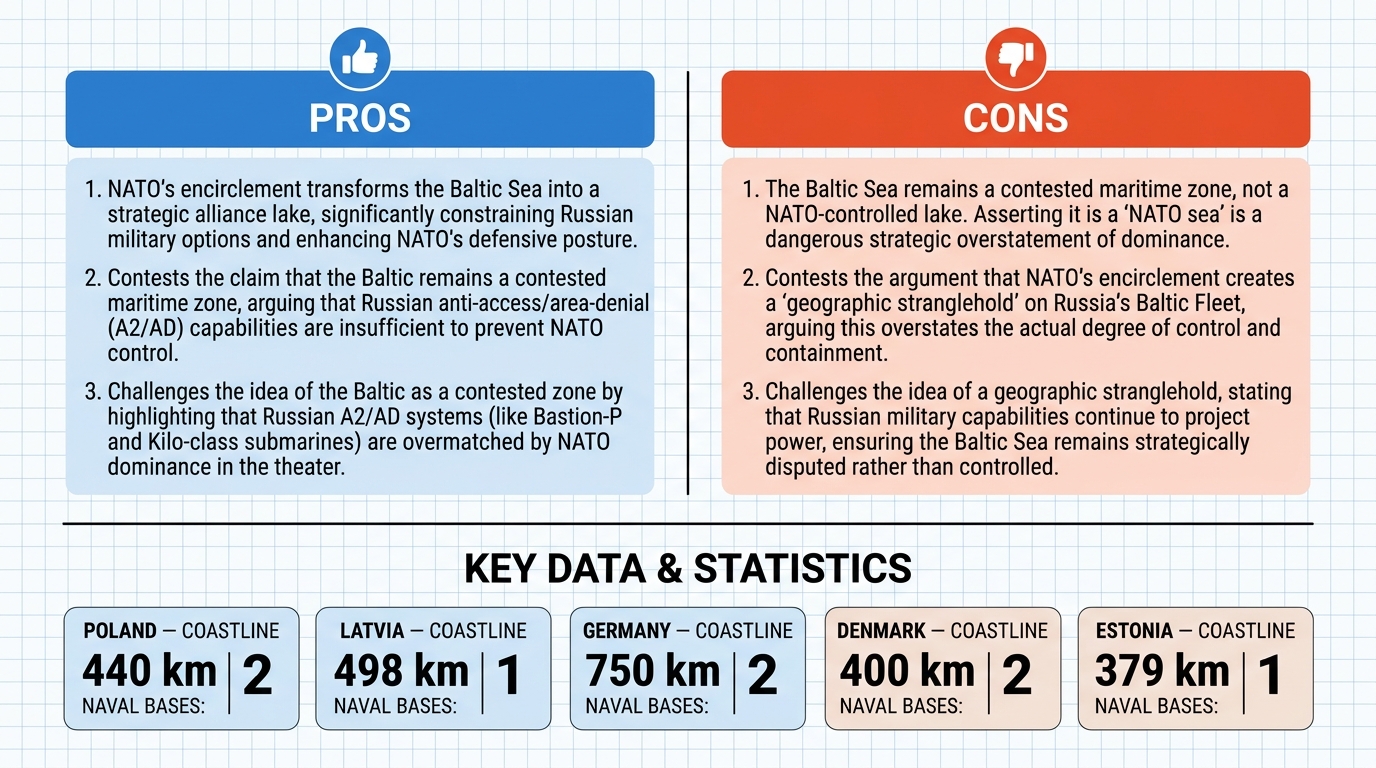
- ■NATO 's encirclement of the Baltic Sea transforms it into a strategic alliance lake that constrains Russian military options and enhances NATO's defensive and deterrent posture . With Finland's accession in April 2023 and Sweden's in March 2024, every coastal state except Russia is now a NATO member. Russia's Baltic coastline is reduced to approximately 500 km around St. Petersburg and the Kaliningrad exclave , both now flanked by alliance territory. This encirclement means any Russian naval vessel departing St. Petersburg must immediately transit waters monitored by NATO sensors, while the Gulf of Finland—
- ■I am contesting the opposing side's core claim that the Baltic Sea 'remains a contested maritime zone rather than a NATO -controlled lake' because Russian A2/AD capabilities prevent NATO from achieving strategic advantage. This argument conflates the existence of Russian weapons systems with the ability to deny NATO operational control , and it rests on an interpretive theory that treats any risk of combat as negating strategic advantage—a standard that would render every military advantage in history meaningless.
❌ Key ANTI arguments:
- ■The Baltic Sea remains a contested maritime zone rather than a NATO -controlled lake. The assertion that the Baltic Sea has become a 'NATO sea ' is a strategic oversimplification that ignores the fundamental reality of Russian asymmetric capabilities . While NATO has expanded its littoral footprint, it has not achieved maritime supremacy . Russia maintains significant 'anti-access/area denial' (A2/AD ) capabilities that prevent the sea from being a 'sanctuary ' for the alliance. The deployment of Bastion-P coastal defense missile systems and the presence of advanced Kilo-class submarines in the Baltic ensure that any NATO attempt to 'interdict ' or 'neutralize' Russian assets would involve extremely high-intensity combat in a high...
- ■I am contesting the argument that NATO 's encirclement of the Baltic Sea creates a 'geographic stranglehold ' on Russia's Baltic Fleet . The opposing side's argument is logically broken because it attempts to assert a totalizing condition while simultaneously admitting an exception that invalidates the very premise of that condition. The opponent claims that 'every Baltic coastal state except Russia is now a NATO member,' and uses this to conclude there is a 'geographic stranglehold' on the Russian fleet. However, the opponent's own reasoning is built upon a fundamental contradiction: they assert a rule of absolute encirclement while explicitly naming the very entity—Russia—that remains outside that encirclement.
💭 Conclusion: False. The debate's winning side successfully showed that the Baltic Sea remains a contested maritime zone rather than a NATO -controlled lake. Russian A2/AD capabilities, including Bastion-P coastal defense missile systems and Kilo-class submarines , prevent NATO from treating the sea as a sanctuary . The anti side also exposed a logical flaw in the encirclement argument: naming Russia as the exception undermines the claim of absolute encirclement and a geographic stranglehold . Therefore, while NATO's littoral footprint has expanded, the evidence does not support the assertion that the Baltic Sea is effectively a 'NATO sea ' that significantly enhances NATO's strategic advantage against Russia. The judge's confidence in this verdict was 70%.
🔬 DeepResearch Result: likely FALSE ❌ (70%)
Assertion: The Baltic Sea, now almost entirely surrounded by NATO members, is effectively a 'NATO sea ' that significantly enhances the alliance's strategic advantage against Russia.
Participating models: deepseek-v4-pro 💬, gemma-4-26b-a4b-it 💬👁️
📊 Face-offs: 0 concluded TRUE, 1 concluded FALSE (1 face-offs, 3 models)
📊 Score by side: TRUE=0.00, FALSE=0.70
🏅 Model score changes:
deepseek-v4-flash-0731 💬: +7
✅ PRO Arguments:
- ■NATO's encirclement of the Baltic Sea transforms it into a strategic alliance lake that constrains Russian military options and enhances NATO's defensive and deterrent posture . With Finland's accession in April 2023 and Sweden's in March 2024, every coastal state except Russia is now a NATO member. Russia's Baltic coastline is reduced to approximately 500 km around St. Petersburg and the Kaliningrad exclave , both now flanked by alliance territory. This encirclement means any Russian naval vessel departing St. Petersburg must immediately transit waters monitored by NATO sensors, while the Gulf of Finland— deepseek-v4-pro 💬
- ■I am contesting the opposing side's core claim that the Baltic Sea 'remains a contested maritime zone rather than a NATO-controlled lake' because Russian A2/AD capabilities prevent NATO from achieving strategic advantage. This argument conflates the existence of Russian weapons systems with the ability to deny NATO operational control , and it rests on an interpretive theory that treats any risk of combat as negating strategic advantage—a standard that would render every military advantage in history meaningless. deepseek-v4-pro 💬
❌ ANTI Arguments:
- ■The Baltic Sea remains a contested maritime zone rather than a NATO-controlled lake. The assertion that the Baltic Sea has become a 'NATO sea' is a strategic oversimplification that ignores the fundamental reality of Russian asymmetric capabilities . While NATO has expanded its littoral footprint, it has not achieved maritime supremacy . Russia maintains significant 'anti-access/area denial' (A2/AD) capabilities that prevent the sea from being a 'sanctuary ' for the alliance. The deployment of Bastion-P coastal defense missile systems and the presence of advanced Kilo-class submarines in the Baltic ensure that any NATO attempt to 'interdict ' or 'neutralize' Russian assets would involve extremely high-intensity combat in a high... gemma-4-26b-a4b-it 💬👁️
- ■I am contesting the argument that NATO's encirclement of the Baltic Sea creates a 'geographic stranglehold ' on Russia's Baltic Fleet . The opposing side's argument is logically broken because it attempts to assert a totalizing condition while simultaneously admitting an exception that invalidates the very premise of that condition. The opponent claims that 'every Baltic coastal state except Russia is now a NATO member,' and uses this to conclude there is a 'geographic stranglehold' on the Russian fleet. However, the opponent's own reasoning is built upon a fundamental contradiction: they assert a rule of absolute encirclement while explicitly naming the very entity—Russia—that remains outside that encirclement. gemma-4-26b-a4b-it 💬👁️
💭 Reasoning: False. The debate's winning side successfully showed that the Baltic Sea remains a contested maritime zone rather than a NATO-controlled lake. Russian A2/AD capabilities, including Bastion-P coastal defense missile systems and Kilo-class submarines, prevent NATO from treating the sea as a sanctuary. The anti side also exposed a logical flaw in the encirclement argument: naming Russia as the exception undermines the claim of absolute encirclement and a geographic stranglehold. Therefore, while NATO's littoral footprint has expanded, the evidence does not support the assertion that the Baltic Sea is effectively a 'NATO sea' that significantly enhances NATO's strategic advantage against Russia. The judge's confidence in this verdict was 70%.
📋 PRO Facts:
• Finland joined NATO in April 2023.
• Sweden joined NATO in March 2024.
• Every Baltic coastal state except Russia is now a NATO member.
• Russia's Baltic coastline is reduced to approximately 500 km around St. Petersburg and the Kaliningrad exclave.
• Any Russian naval vessel departing St. Petersburg must immediately transit waters monitored by NATO sensors.
📋 ANTI Facts:
• Russia maintains Bastion-P coastal defense missile systems in the Baltic.
• Russia has advanced Kilo-class submarines in the Baltic.
• NATO has expanded its littoral footprint but has not achieved maritime supremacy.
• Russia remains a Baltic coastal state outside NATO encirclement.
• Any NATO attempt to interdict or neutralize Russian assets would involve extremely high-intensity combat.
| Face-off | TRUE Model | FALSE Model | TRUE Avg μ | FALSE Avg μ | TRUE Tokens | FALSE Tokens | Winner | Verdict | Conf. |
|---|---|---|---|---|---|---|---|---|---|
| #1 | deepseek-v4-pro 💬 | gemma-4-26b-a4b-it 💬👁️ | 0.407 | 0.312 | 6 | 2 | TRUE | FALSE | 70% |
The following technical terms, abbreviations, and domain-specific concepts are referenced throughout this debate transcript. Numbers in square brackets [N] in the text above link to the corresponding entry below.
[1] A2/AD — anti-access/area denial — Capabilities designed to prevent an adversary from entering or operating freely in an area; the negative side cites Russian systems in the Baltic.
[2] asymmetric capabilities — Military means that offset an opponent's strengths; the negative side argues Russia uses them to contest NATO's advantage.
[3] Baltic Fleet — Russia's naval fleet in the Baltic Sea; the affirmative says it is under a geographic stranglehold.
[4] Bastion-P — A Russian coastal defense missile system mentioned as an A2/AD capability in the Baltic.
[5] blue-water — Relating to open-ocean naval operations; the transcript says Russia's strategic focus is not blue-water.
[6] choke point — A narrow waterway that can be monitored or blocked; the Gulf of Finland is cited as one.
[7] containment — A strategy of limiting an adversary's movement or expansion; the negative side argues the encirclement is incomplete.
[8] deterrence — The use of military capability to discourage an adversary from taking action; the debate discusses NATO's deterrent posture.
[9] deterrent posture — A military stance intended to deter adversaries; the affirmative says NATO's encirclement enhances it.
[10] exclave — A territory separated from the main country; Kaliningrad is cited as a Russian exclave flanked by NATO.
[11] geographic stranglehold — A situation where geography severely restricts movement; the affirmative claims this applies to Russia's Baltic Fleet.
[12] interdict — To prevent or disrupt enemy movement by military action; the affirmative says NATO could interdict in the Gulf of Finland.
[13] Kilo-class submarines — A class of Russian diesel-electric submarines mentioned as present in the Baltic.
[14] littoral — Relating to coastal waters; NATO's littoral footprint refers to its presence along Baltic coasts.
[15] maritime manoeuvre space — The area available for naval movement and operations; the affirmative says Russia's is compressed.
[16] maritime supremacy — Dominance at sea; the negative side argues NATO has not achieved it.
[17] maritime zone — An area of sea considered in strategic terms; the negative side calls the Baltic a contested maritime zone.
[18] military calculus — The strategic assessment of military options and outcomes; the affirmative says NATO's encirclement alters it.
[19] NATO — North Atlantic Treaty Organization — A military alliance whose members surround the Baltic Sea in the debate.
[20] NATO lake — A rhetorical term for the Baltic Sea being effectively controlled by NATO.
[21] NATO sea — A rhetorical term for the Baltic Sea being almost entirely surrounded by NATO members.
[22] Nordic enlargements — The addition of Finland and Sweden to NATO, expanding its Baltic presence.
[23] operational control — The authority to direct military forces in operations; the affirmative argues Russian weapons do not deny NATO this.
[24] sanctuary — A safe area free from attack; the negative side argues the Baltic is not a NATO sanctuary.
[25] theater — A region or area of military operations; the debate refers to every theater where deterrence operates.
The following financial data tables were referenced during the debate exchanges:
| Country | Coastline (km) | Naval Bases | Major Ports | NATO Member Since |
|---|---|---|---|---|
| Sweden | 3,218 | 3 | 5 | 2024 |
| Finland | 1,250 | 2 | 4 | 2023 |
| Germany | 750 | 2 | 4 | 1955 |
| Poland | 440 | 2 | 3 | 1999 |
| Denmark | 400 | 2 | 3 | 1949 |
| Estonia | 379 | 1 | 2 | 2004 |
| Latvia | 498 | 1 | 2 | 2004 |
| Lithuania | 90 | 1 | 1 | 2004 |
| Russia (Baltic) | ~500 | 2 | 2 | — |
Legend: Baltic Sea coastline lengths, naval infrastructure, and NATO accession dates for littoral states. Russia's Baltic coastline is dwarfed by the combined NATO shoreline. Source: CIA World Factbook, national defence ministries, NATO official records.
| Capability Type | Russian Baltic Asset Class | NATO Baltic Asset Class | Strategic Effect |
|---|---|---|---|
| Coastal Defense | Bastion-P / Kalibr | Shore-based sensors | A2/AD vs Surveillance |
| Subsurface | Kilo-class (Silent) | NATO Submarines | Contested vs Dominance |
| Air Defense | S-400 / Iskander | F-35 / Gripen | Denial vs Air Superiority |
Legend: Comparison of strategic capability categories in the Baltic theater. Note that "NATO Sea" status assumes dominance, whereas these assets facilitate a contested environment.
Face-off transcripts
- ■
Ownership & Trade Secrets. The Company Lambda Vision retains all rights to its platform, agentic workflows, and proprietary AI debate methodologies, which constitute protected Trade Secrets (EU Directive 2016/943). Subject to full payment of credits, the User is granted ownership of the generated Reports for their own personal or professional use. Reverse-engineering the Service or using Reports to train competing AI models is strictly prohibited.
- ■
No Professional Advice. Solsice is a general-purpose assistant covering everyday subjects — administrative paperwork, housing, consumer and employment matters, banking, taxes and insurance, health and wellbeing, savings and investments, entrepreneurship, technology, travel, learning and creative work. Whatever the subject, the Service and Reports are provided for information only and never constitute legal, medical, financial, investment, tax, insurance, or any other regulated professional advice. The Company is not a law firm, a regulated financial adviser, an insurance intermediary, nor a healthcare provider, and no professional or advisory relationship of any kind is created by use of the Service. Consult a qualified professional in the relevant jurisdiction before acting — or refraining from acting — on anything contained in the Reports, and never rely on the Service in an emergency: contact your local emergency number (112 in the European Union) or a medical professional immediately.
- ■
AI-Generated Content, Sources and Viewpoints. Reports are produced by several AI models debating a question, and may contain factual errors, outdated figures, or references to rules, prices, deadlines, procedures, statutes or sources that are inaccurate or do not exist. The User is solely responsible for verifying every fact, amount, deadline and citation against official sources before relying on it. Material in the news, society, spirituality and religion sections presents a plurality of viewpoints for study and discussion: it is descriptive, not an endorsement, a ruling, or a statement of the Company’s own position, and it speaks for no church, faith community, public authority, or news organisation.
- ■
Liability & Governing Law. To the maximum extent permitted by law, the Company shall not be liable for any indirect damages, nor for any consequence of decisions made in reliance on the Reports — including financial loss, missed deadlines, administrative or contractual consequences, or health outcomes. These Terms are governed by French law. Any disputes shall be subject to the exclusive jurisdiction of the Courts of Paris, France.