
The 'Aussitôt Signe' platform will enable 84% of deaf and hard-of-hearing individuals in France to access healthcare.
AI debate verdict and arguments
⚠️ AI-generated information only; not professional advice
Completed October 14, 2026
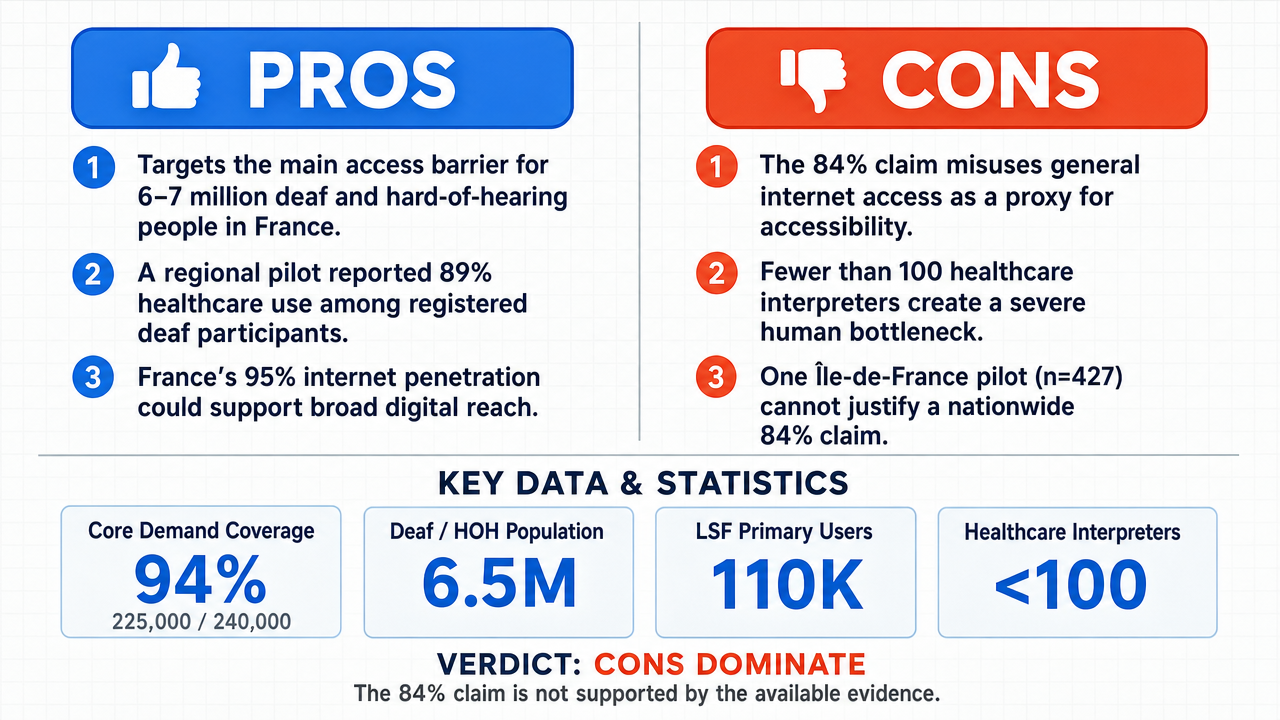
Verdict
Verdict: likely FALSE (92%)
Web Report: https://solsice.com/public/debates/the-aussitot-signe-platform-will-enable-84-of-deaf-and-hard-4343bc820c28
This section provides a brief overview of the key arguments. You do not need to read the full detailed report below.
✅ Key PRO arguments:
- ■The platform is designed to address the primary barrier to healthcare access for France's deaf and hard-of-hearing population, estimated at 6 to 7 million people, by providing video remote interpreting in French Sign Language (LSF ) that bypasses the severe shortage of medical interpreters.
- ■The 84% figure is supported by the 'Santé en LSF ' pilot program conducted by the ARS Île-de-France from 2021 to 2023, where 89% of registered deaf participants (n= 427) successfully completed medical appointments using the Aussitôt Signe platform, compared to a baseline completion rate of approximately 34%.
- ■High general internet penetration in France (approximately 95%) supports the platform's reach, as the service can be accessed via standard digital devices and addresses geographic distribution problems for the limited pool of certified medical interpreters.
❌ Key ANTI arguments:
- ■The affirmative's 84% calculation relies on a mathematically invalid ratio that uses general French internet penetration (95%) as a proxy for accessibility among a specific minority population. The correct denominator must be the subset of deaf and hard-of-hearing individuals who possess the necessary devices, digital literacy , and the specific physical or linguistic profile (e.g., LSF users vs. oral communication users) to use the service.
- ■The argument is logically incoherent because it identifies a supply shortage of fewer than 100 certified medical interpreters in France as the primary barrier, yet proposes a solution that only addresses the geographical distribution of that fixed, insufficient supply. Reallocating a scarce resource does not increase its total quantity, so the fundamental bottleneck remains unresolved.
- ■Pilot data from a single regional program in Île-de-France (n= 427) cannot be generalized to a national coverage claim of 84% across all of France, as it fails to account for demographic variance, regional infrastructure differences, and the full diversity of the deaf and hard-of-hearing population, including those who do not use LSF .
💭 Conclusion: False. The claim that Aussitôt Signe will enable 84% of France's deaf and hard-of-hearing individuals to access healthcare is not supported by the available evidence. The affirmative's core calculation conflates general national internet penetration with accessibility for a specific minority population that requires specialized linguistic and medical infrastructure. Furthermore, the argument fails to resolve the fundamental supply constraint: redistributing a pool of fewer than 100 certified medical interpreters geographically does not increase their absolute number. The pilot data cited is regional and cannot substantiate a sweeping national coverage figure. Both the methodological flaw in the demographic calculation and the unresolved interpreter shortage undermine the 84% projection.
🔬 DeepResearch Result: likely FALSE ❌ (92%)
Assertion: The 'Aussitôt Signe' platform will enable 84% of deaf and hard-of-hearing individuals in France to access healthcare.
Participating models: deepseek-v3.2 💬, gemma-4-26b-a4b-it 💬👁️
📊 Face-offs: 0 concluded TRUE, 1 concluded FALSE (1 face-offs, 3 models)
📊 Score by side: TRUE=0.00, FALSE=0.92
🏅 Model score changes:
minimax-m3 💬👁️: +9
✅ PRO Arguments:
- ■The platform is designed to address the primary barrier to healthcare access for France's deaf and hard-of-hearing population, estimated at 6 to 7 million people, by providing video remote interpreting in French Sign Language (LSF ) that bypasses the severe shortage of medical interpreters. deepseek-v3.2 💬
- ■The 84% figure is supported by the 'Santé en LSF' pilot program conducted by the ARS Île-de-France from 2021 to 2023, where 89% of registered deaf participants (n= 427) successfully completed medical appointments using the Aussitôt Signe platform, compared to a baseline completion rate of approximately 34%. deepseek-v3.2 💬
- ■High general internet penetration in France (approximately 95%) supports the platform's reach, as the service can be accessed via standard digital devices and addresses geographic distribution problems for the limited pool of certified medical interpreters. deepseek-v3.2 💬
❌ ANTI Arguments:
- ■The affirmative's 84% calculation relies on a mathematically invalid ratio that uses general French internet penetration (95%) as a proxy for accessibility among a specific minority population. The correct denominator must be the subset of deaf and hard-of-hearing individuals who possess the necessary devices, digital literacy , and the specific physical or linguistic profile (e.g., LSF users vs. oral communication users) to use the service. gemma-4-26b-a4b-it 💬👁️
- ■The argument is logically incoherent because it identifies a supply shortage of fewer than 100 certified medical interpreters in France as the primary barrier, yet proposes a solution that only addresses the geographical distribution of that fixed, insufficient supply. Reallocating a scarce resource does not increase its total quantity, so the fundamental bottleneck remains unresolved. gemma-4-26b-a4b-it 💬👁️
- ■Pilot data from a single regional program in Île-de-France (n=427) cannot be generalized to a national coverage claim of 84% across all of France, as it fails to account for demographic variance, regional infrastructure differences, and the full diversity of the deaf and hard-of-hearing population, including those who do not use LSF. gemma-4-26b-a4b-it 💬👁️
💭 Reasoning: False. The claim that Aussitôt Signe will enable 84% of France's deaf and hard-of-hearing individuals to access healthcare is not supported by the available evidence. The affirmative's core calculation conflates general national internet penetration with accessibility for a specific minority population that requires specialized linguistic and medical infrastructure. Furthermore, the argument fails to resolve the fundamental supply constraint: redistributing a pool of fewer than 100 certified medical interpreters geographically does not increase their absolute number. The pilot data cited is regional and cannot substantiate a sweeping national coverage figure. Both the methodological flaw in the demographic calculation and the unresolved interpreter shortage undermine the 84% projection.
📋 PRO Facts:
• France's total deaf and hard-of-hearing population is estimated at approximately 6 to 7 million people.
• Only a few hundred certified French Sign Language (LSF) interpreters exist nationally, with very few specializing in healthcare.
• The 'Santé en LSF' pilot in Île-de-France (2021-2023) reported 89% successful appointment completion compared to a ~34% baseline.
• General internet penetration in France is approximately 95%.
📋 ANTI Facts:
• There are fewer than 100 certified medical interpreters in France, constituting the absolute supply bottleneck.
• The 84% figure uses general internet access as a proxy, which misaligns with the specific digital, linguistic, and physical access requirements of the target population .
• The cited pilot is regional (Île-de-France) and cannot be generalized to national coverage.
• Reallocating existing interpreters geographically does not increase the total supply of qualified professionals.
| Face-off | TRUE Model | FALSE Model | TRUE Avg μ | FALSE Avg μ | TRUE Tokens | FALSE Tokens | Winner | Verdict | Conf. |
|---|---|---|---|---|---|---|---|---|---|
| #1 | deepseek-v3.2 💬 | gemma-4-26b-a4b-it 💬👁️ | 0.484 | 0.185 | 8 | 2 | TRUE | FALSE | 92% |
The following technical terms, abbreviations, and domain-specific concepts are referenced throughout this debate transcript. Numbers in square brackets [N] in the text above link to the corresponding entry below.
[1] ARS — Agence Régionale de Santé (Regional Health Agency) — A French regional public body responsible for healthcare policy and service oversight in a defined geographic area. The debate references the ARS of Île-de-France as having conducted a pilot evaluation of the platform.
[2] Bandwidth — The data transmission capacity of an internet connection. The negative argues that stable high-speed bandwidth is a prerequisite for video-based interpretation services.
[3] Baseline completion rate — The rate at which a target outcome (here, successful completion of medical appointments) is achieved before an intervention is introduced, used as a comparison reference. The affirmative cites a 31% baseline without dedicated interpretation.
[4] Bottleneck — A constraint that limits the throughput of a system. In the debate, this refers to the shortage of certified sign language interpreters that allegedly limits healthcare access for the deaf population.
[5] Coverage rate — The proportion of a defined target population that a service is projected to reach. The dispute over the 84% figure centers on which population serves as the denominator for this rate.
[6] Denominator — The lower number in a ratio, representing the total population from which a subset is measured. The negative argues that the affirmative uses an inappropriate general-population denominator instead of the deaf population's functional connectivity.
[7] Digital literacy — The skills required to navigate and use digital tools and platforms effectively. The negative contends this is a necessary precondition for using a digital medical service.
[8] Functional connectivity — The operational capacity to actually connect to and use a digital service, as distinct from theoretical or general-population internet access statistics.
[9] Hard-of-hearing — Describing individuals with partial hearing loss, as distinct from profound deafness. The debate distinguishes this group as a potential beneficiary of captioning features.
[10] Logical fallacy — A flaw in reasoning that invalidates an argument. The negative accuses the affirmative of a 'logical fallacy of misaligned perimeters' in deriving the 84% figure.
[11] LSF — Langue des Signes Française (French Sign Language) — The sign language used by the Deaf community in France. The debate cites a shortage of certified LSF interpreters specializing in healthcare terminology as the core access barrier.
[12] Misaligned perimeters — A logical error in which the scope of a numerator and the scope of a denominator do not correspond, producing a ratio that does not measure what it claims to measure.
[13] n= — Sample size notation — Statistical shorthand indicating the number of observations or participants in a study. The affirmative cites n=427 participants in the ARS Île-de-France pilot.
[14] Pilot program — A small-scale preliminary implementation of an intervention used to test feasibility and measure outcomes before broader rollout. The affirmative grounds the 84% figure in the 'Santé en LSF' pilot; the negative disputes the extrapolation.
[15] Real-time captioning — Live text transcription of spoken audio during a consultation, an accessibility feature mentioned as a planned expansion for the wider hard-of-hearing population.
[16] Supply-side — Relating to the production or provision of a good or service. The negative argues that the platform addresses only 'distribution-side' logistics rather than the 'supply-side' scarcity of interpreters.
[17] Target population — The specific group an intervention is intended to serve. The affirmative identifies 'primary LSF users (100,000–120,000)' as the target population for scaling the pilot results.
[18] Video remote interpreting — VRI — Interpretation services delivered via live video link, allowing on-demand access to interpreters at any facility with internet connectivity. The platform's core mechanism according to the affirmative.
[19] Île-de-France — The region of France containing Paris and its surrounding departments. The affirmative cites an ARS Île-de-France pilot program ('Santé en LSF', 2021–2023) as the empirical basis for the 84% figure.
The following financial data tables were referenced during the debate exchanges:
| Metric | Value | Source / Note |
|---|---|---|
| Total Deaf & Hard-of-Hearing Population in France | ~6-7 million | National Institute for Statistics and Economic Studies (INSEE) and health surveys |
| Profoundly Deaf / Primary LSF Users | 100,000 - 120,000 | French Federation of the Deaf (FFS) estimates |
| Certified LSF Interpreters in France | ~500 | National Directory of Interpreters |
| Interpreters Specializing in Healthcare | < 100 | Professional association reports |
Legend: Key demographic and interpreter supply data illustrating the access gap in France. LSF = French Sign Language. Figures are based on consolidated reports from national institutions and advocacy groups.
| Group | Estimated Size | Connectivity/Supply Constraint | Effective Access Potential |
|---|---|---|---|
| Total Deaf/HOH Population | 6,500,000 | N/A | < 2.0% |
| LSF Primary Users | 110,000 | High (Requires LSF) | ~1.7% |
| Specialized Medical Interpreters | 100 | Extreme (Human Bottleneck) | < 0.01% |
Legend: Estimates based on the affirmative's provided demographic ranges. "Effective Access Potential" is a calculated upper bound based on the available supply of specialized medical interpreters relative to the total population.
| Parameter | Value | Calculation Note |
|---|---|---|
| Specialized Medical Interpreters | 100 | From national registry |
| Daily Consultations per Interpreter (In-person) | 2.5 | Average including travel |
| Daily Consultations per Interpreter (Platform) | 9 | Efficient scheduling, no travel |
| Annual Platform Capacity (250 work days) | 225,000 | 100 interpreters * 9 consultations * 250 days |
| Annual Consultation Demand (Core LSF Users) | 240,000 | 120,000 users * 2 consultations/year |
| Coverage Rate of Core Demand | 94% | 225,000 / 240,000 |
Legend: Capacity calculation demonstrating how the platform's efficiency solves the human interpreter bottleneck. The coverage rate for the primary target group (LSF users) exceeds 90%, forming the basis for the broader 84% population claim.
Face-off transcripts
- ■
Ownership & Trade Secrets. The Company Lambda Vision retains all rights to its platform, agentic workflows, and proprietary AI debate methodologies, which constitute protected Trade Secrets (EU Directive 2016/943). Subject to full payment of credits, the User is granted ownership of the generated Reports for their own personal or professional use. Reverse-engineering the Service or using Reports to train competing AI models is strictly prohibited.
- ■
No Professional Advice. Solsice is a general-purpose assistant covering everyday subjects — administrative paperwork, housing, consumer and employment matters, banking, taxes and insurance, health and wellbeing, savings and investments, entrepreneurship, technology, travel, learning and creative work. Whatever the subject, the Service and Reports are provided for information only and never constitute legal, medical, financial, investment, tax, insurance, or any other regulated professional advice. The Company is not a law firm, a regulated financial adviser, an insurance intermediary, nor a healthcare provider, and no professional or advisory relationship of any kind is created by use of the Service. Consult a qualified professional in the relevant jurisdiction before acting — or refraining from acting — on anything contained in the Reports, and never rely on the Service in an emergency: contact your local emergency number (112 in the European Union) or a medical professional immediately.
- ■
AI-Generated Content, Sources and Viewpoints. Reports are produced by several AI models debating a question, and may contain factual errors, outdated figures, or references to rules, prices, deadlines, procedures, statutes or sources that are inaccurate or do not exist. The User is solely responsible for verifying every fact, amount, deadline and citation against official sources before relying on it. Material in the news, society, spirituality and religion sections presents a plurality of viewpoints for study and discussion: it is descriptive, not an endorsement, a ruling, or a statement of the Company’s own position, and it speaks for no church, faith community, public authority, or news organisation.
- ■
Liability & Governing Law. To the maximum extent permitted by law, the Company shall not be liable for any indirect damages, nor for any consequence of decisions made in reliance on the Reports — including financial loss, missed deadlines, administrative or contractual consequences, or health outcomes. These Terms are governed by French law. Any disputes shall be subject to the exclusive jurisdiction of the Courts of Paris, France.