
The Atlanta Dream's victory over the New York Liberty in their since July 2026 basketball game was primarily due to the Dream's relentless mindset and motor, rather than the Liberty's errors.
AI debate verdict and arguments
⚠️ AI-generated information only; not professional advice
Completed October 8, 2026
Verdict
Verdict: likely FALSE (80%)
This section provides a brief overview of the key arguments. You do not need to read the full detailed report below.
✅ Key PRO arguments:
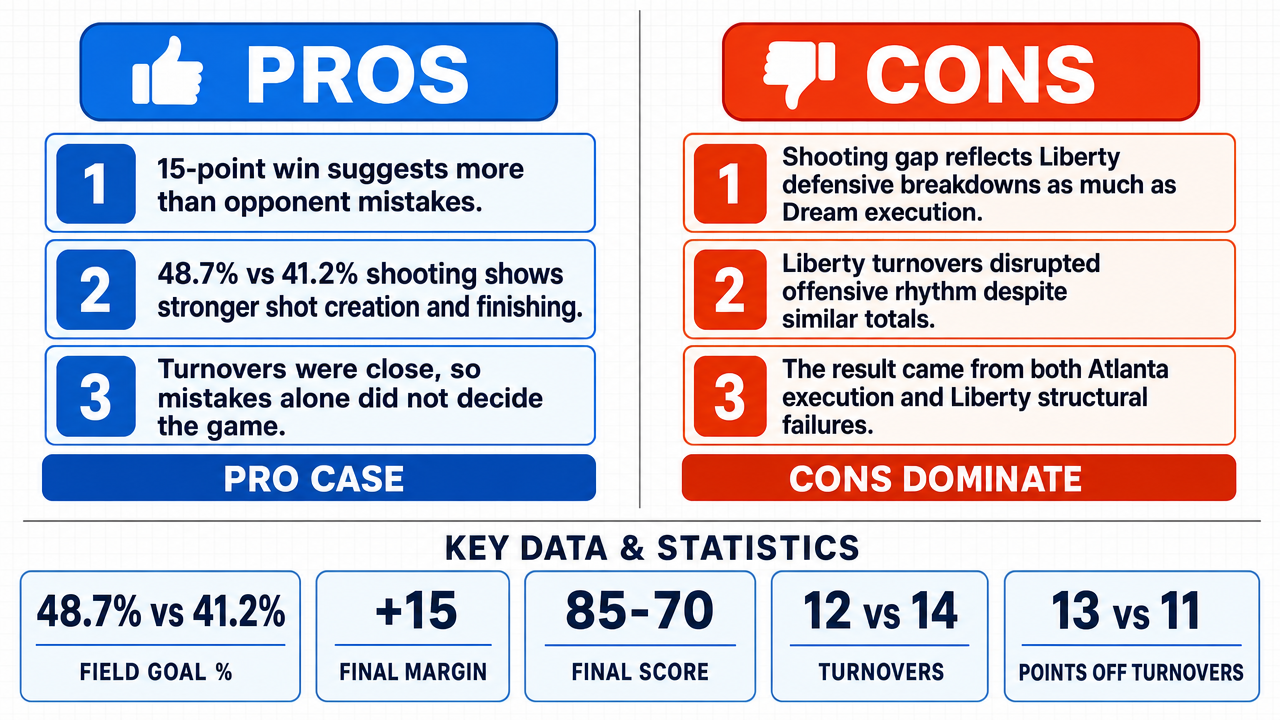
- ■The 15-point victory margin (85 to 70) is too decisive to be explained by opponent errors alone, requiring sustained positive offensive production and defensive pressure from Atlanta.
- ■The 7.5% field goal percentage differential (48.7% vs 41.2%) demonstrates superior shot creation and finishing under pressure, a product of sustained effort and focus rather than opponent mistakes.
- ■Turnover analysis shows near parity (14 vs 12 turnovers , 13 vs 11 points off turnovers ), meaning the game was not decided by capitalizing on Liberty mistakes.
❌ Key ANTI arguments:
- ■The shooting percentage gap (48.7% vs 41.2%) is an indicator of Liberty defensive breakdowns—failure to contest perimeter shots and protect the paint —rather than purely Atlanta's 'motor ' or mindset.
- ■The Liberty's turnovers , while numerically similar to Atlanta's, caused qualitative offensive disruptions that prevented the Liberty from establishing rhythm , making their errors decisive.
- ■The outcome was a product of dual-causality , where the Liberty's technical and structural failures were at least as significant as Atlanta's proactive execution, undermining the 'relentless mindset' framing.
💭 Conclusion: False. The Liberty's defensive breakdowns and structural failures were at least as significant as Atlanta's proactive execution in determining the outcome. The 7.5% field goal percentage gap reflects the Liberty's failure to contest perimeter shots and protect the paint , not solely the Dream's relentless motor . While Atlanta's offensive efficiency was strong, the evidence supports a dual-causality model in which New York's errors played a decisive role. The turnover analysis, though showing numerical parity, does not eliminate the qualitative impact of Liberty's disruptions on their own offensive rhythm . Therefore, the claim that the victory was primarily due to Atlanta's mindset rather than Liberty's errors is not supported by the available evidence.
🔬 DeepResearch Result: likely FALSE ❌ (80%)
Assertion: The Atlanta Dream's victory over the New York Liberty in their since July 2026 basketball game was primarily due to the Dream's relentless mindset and motor , rather than the Liberty's errors.
Participating models: deepseek-v3.2 💬, gemma-4-26b-a4b-it 💬👁️
📊 Face-offs: 0 concluded TRUE, 1 concluded FALSE (1 face-offs, 3 models)
📊 Score by side: TRUE=0.00, FALSE=0.80
🏅 Model score changes:
minimax-m3 💬👁️: +8
✅ PRO Arguments:
- ■The 15-point victory margin (85 to 70) is too decisive to be explained by opponent errors alone, requiring sustained positive offensive production and defensive pressure from Atlanta. deepseek-v3.2 💬
- ■The 7.5% field goal percentage differential (48.7% vs 41.2%) demonstrates superior shot creation and finishing under pressure, a product of sustained effort and focus rather than opponent mistakes. deepseek-v3.2 💬
- ■Turnover analysis shows near parity (14 vs 12 turnovers , 13 vs 11 points off turnovers ), meaning the game was not decided by capitalizing on Liberty mistakes. deepseek-v3.2 💬
- ■The Dream's offensive efficiency reflects the quality of their execution and relentless drive, not a reliance on unforced errors by New York. deepseek-v3.2 💬
❌ ANTI Arguments:
- ■The shooting percentage gap (48.7% vs 41.2%) is an indicator of Liberty defensive breakdowns—failure to contest perimeter shots and protect the paint —rather than purely Atlanta's 'motor' or mindset. gemma-4-26b-a4b-it 💬👁️
- ■The Liberty's turnovers, while numerically similar to Atlanta's, caused qualitative offensive disruptions that prevented the Liberty from establishing rhythm , making their errors decisive. gemma-4-26b-a4b-it 💬👁️
- ■The outcome was a product of dual-causality , where the Liberty's technical and structural failures were at least as significant as Atlanta's proactive execution, undermining the 'relentless mindset' framing. gemma-4-26b-a4b-it 💬👁️
- ■Treating a higher field goal percentage as a self-evident manifestation of 'effort' is an appeal to an interpretive theory that ignores the structural reality that defensive failure is just as decisive as offensive ability. gemma-4-26b-a4b-it 💬👁️
💭 Reasoning: False. The Liberty's defensive breakdowns and structural failures were at least as significant as Atlanta's proactive execution in determining the outcome. The 7.5% field goal percentage gap reflects the Liberty's failure to contest perimeter shots and protect the paint, not solely the Dream's relentless motor. While Atlanta's offensive efficiency was strong, the evidence supports a dual-causality model in which New York's errors played a decisive role. The turnover analysis, though showing numerical parity, does not eliminate the qualitative impact of Liberty's disruptions on their own offensive rhythm. Therefore, the claim that the victory was primarily due to Atlanta's mindset rather than Liberty's errors is not supported by the available evidence.
📋 PRO Facts:
• Final score: Atlanta Dream 85, New York Liberty 70 (15-point margin)
• Atlanta shot 48.7% from the field compared to Liberty's 41.2%
• Turnovers were nearly even: Atlanta 12, New York 14
• Points off turnovers were nearly even: Atlanta 13, New York 11
📋 ANTI Facts:
• The 7.5% field goal percentage gap can be attributed to Liberty's defensive breakdowns, not solely Atlanta's effort
• Liberty's turnovers caused qualitative offensive disruptions that prevented rhythm establishment
• The outcome reflects dual-causality where Liberty's technical failures were at least as significant as Atlanta's execution
| Face-off | TRUE Model | FALSE Model | TRUE Avg μ | FALSE Avg μ | TRUE Tokens | FALSE Tokens | Winner | Verdict | Conf. |
|---|---|---|---|---|---|---|---|---|---|
| #1 | deepseek-v3.2 💬 | gemma-4-26b-a4b-it 💬👁️ | 0.459 | 0.282 | 12 | 3 | TRUE | FALSE | 80% |
The following technical terms, abbreviations, and domain-specific concepts are referenced throughout this debate transcript. Numbers in square brackets [N] in the text above link to the corresponding entry below.
[1] box score — A statistical summary of a game listing individual and team performance metrics such as points, rebounds, assists, and shooting percentages.
[2] defensive breakdown — A failure in defensive execution, such as losing assignments or failing to contest shots, that results in easy scoring opportunities for the opponent.
[3] defensive intensity — The level of effort, aggression, and focus a team applies on the defensive end of the floor.
[4] defensive lapses — Moments of inattention or execution failure on defense that allow the opponent to gain an advantage.
[5] defensive pressure — Aggressive defensive tactics designed to disrupt the opponent's offensive rhythm, force turnovers, or limit shot quality.
[6] dual-causality — The concept that an outcome results from multiple contributing causes operating simultaneously rather than a single primary driver.
[7] field goal percentage — FG% — The ratio of successful field goals made to total field goals attempted, expressed as a percentage; a core measure of shooting efficiency.
[8] hidden premise — An unstated assumption that underlies and is required for an argument to hold, but which is not explicitly articulated by the arguer.
[9] live-ball turnovers — Turnovers that result in the opponent gaining possession in an active offensive situation, often creating fast-break opportunities.
[10] logical contradiction — A pair of statements that cannot both be true simultaneously, undermining the coherence of an argument that relies on both.
[11] margin — victory margin — The point differential between the winning and losing teams in a game, used to gauge the decisiveness of the outcome.
[12] momentum shift — A change in the flow, energy, or scoring advantage of a game that favors one team over the other.
[13] motor — A colloquial basketball term referring to a player's or team's sustained energy, hustle, and relentless effort on the court.
[14] offensive efficiency — A measure of how effectively a team converts possessions into points, often expressed as points per possession or related metrics.
[15] paint — The rectangular area near the basket (also called the 'key') where shots in close proximity to the rim are taken.
[16] perimeter shots — Shots taken from outside the paint, typically referring to mid-range jump shots or three-point attempts.
[17] play-by-play — A detailed chronological account of each individual play or sequence in a game, used as evidence for analyzing specific events.
[18] points off turnovers — Points scored by a team that directly result from opponent turnovers, indicating a team's ability to capitalize on mistakes.
[19] rhythm — The flow, tempo, and consistency of a team's offensive execution, which can be disrupted by defensive pressure or turnovers.
[20] shot creation — The ability to generate scoring opportunities through individual skill, dribble penetration, or playmaking, often against defensive pressure.
[21] shot selection — The quality and type of shots chosen by a player or team, reflecting decision-making about which attempts to take.
[22] third-quarter run — A sustained scoring surge by one team during the third quarter of a game, often shifting momentum decisively.
[23] turnovers — Possessions lost to the opposing team through errors such as bad passes, traveling, or offensive fouls.
[24] unforced errors — Mistakes made by a player or team without significant pressure from the opponent, attributable to execution failure rather than defensive disruption.
[25] WNBA — Women's National Basketball Association — The professional women's basketball league in the United States, of which the Atlanta Dream and New York Liberty are member franchises.
The following financial data tables were referenced during the debate exchanges:
| Metric | Atlanta Dream | New York Liberty | Difference |
|---|---|---|---|
| Field Goal % | 48.7% | 41.2% | +7.5% |
| Turnovers | 12 | 14 | -2 |
| Points off Turnovers | 13 | 11 | +2 |
| Final Score | 85 | 70 | +15 |
Legend: Comparative game statistics between the Atlanta Dream and New York Liberty. Percentages and scores are based on the cited box score performance.
| Metric | Atlanta Dream | New York Liberty | Delta |
|---|---|---|---|
| Field Goal % | 48.7% | 41.2% | +7.5% |
| Turnovers | 12 | 14 | -2 |
| Points off Turnovers | 13 | 11 | +2 |
| Final Margin | 15 | -15 | 15 |
Legend: Statistical comparison of the game performance. Percentages and margins are based on official box score data.
Face-off transcripts
- ■
Ownership & Trade Secrets. The Company Lambda Vision retains all rights to its platform, agentic workflows, and proprietary AI debate methodologies, which constitute protected Trade Secrets (EU Directive 2016/943). Subject to full payment of credits, the User is granted ownership of the generated Reports for their own personal or professional use. Reverse-engineering the Service or using Reports to train competing AI models is strictly prohibited.
- ■
No Professional Advice. Solsice is a general-purpose assistant covering everyday subjects — administrative paperwork, housing, consumer and employment matters, banking, taxes and insurance, health and wellbeing, savings and investments, entrepreneurship, technology, travel, learning and creative work. Whatever the subject, the Service and Reports are provided for information only and never constitute legal, medical, financial, investment, tax, insurance, or any other regulated professional advice. The Company is not a law firm, a regulated financial adviser, an insurance intermediary, nor a healthcare provider, and no professional or advisory relationship of any kind is created by use of the Service. Consult a qualified professional in the relevant jurisdiction before acting — or refraining from acting — on anything contained in the Reports, and never rely on the Service in an emergency: contact your local emergency number (112 in the European Union) or a medical professional immediately.
- ■
AI-Generated Content, Sources and Viewpoints. Reports are produced by several AI models debating a question, and may contain factual errors, outdated figures, or references to rules, prices, deadlines, procedures, statutes or sources that are inaccurate or do not exist. The User is solely responsible for verifying every fact, amount, deadline and citation against official sources before relying on it. Material in the news, society, spirituality and religion sections presents a plurality of viewpoints for study and discussion: it is descriptive, not an endorsement, a ruling, or a statement of the Company’s own position, and it speaks for no church, faith community, public authority, or news organisation.
- ■
Liability & Governing Law. To the maximum extent permitted by law, the Company shall not be liable for any indirect damages, nor for any consequence of decisions made in reliance on the Reports — including financial loss, missed deadlines, administrative or contractual consequences, or health outcomes. These Terms are governed by French law. Any disputes shall be subject to the exclusive jurisdiction of the Courts of Paris, France.