
The Arab world lacked a natural political center around which to organize, which was a significant impediment to achieving a unified state.
AI debate verdict and arguments
⚠️ AI-generated information only; not professional advice
Completed October 14, 2026
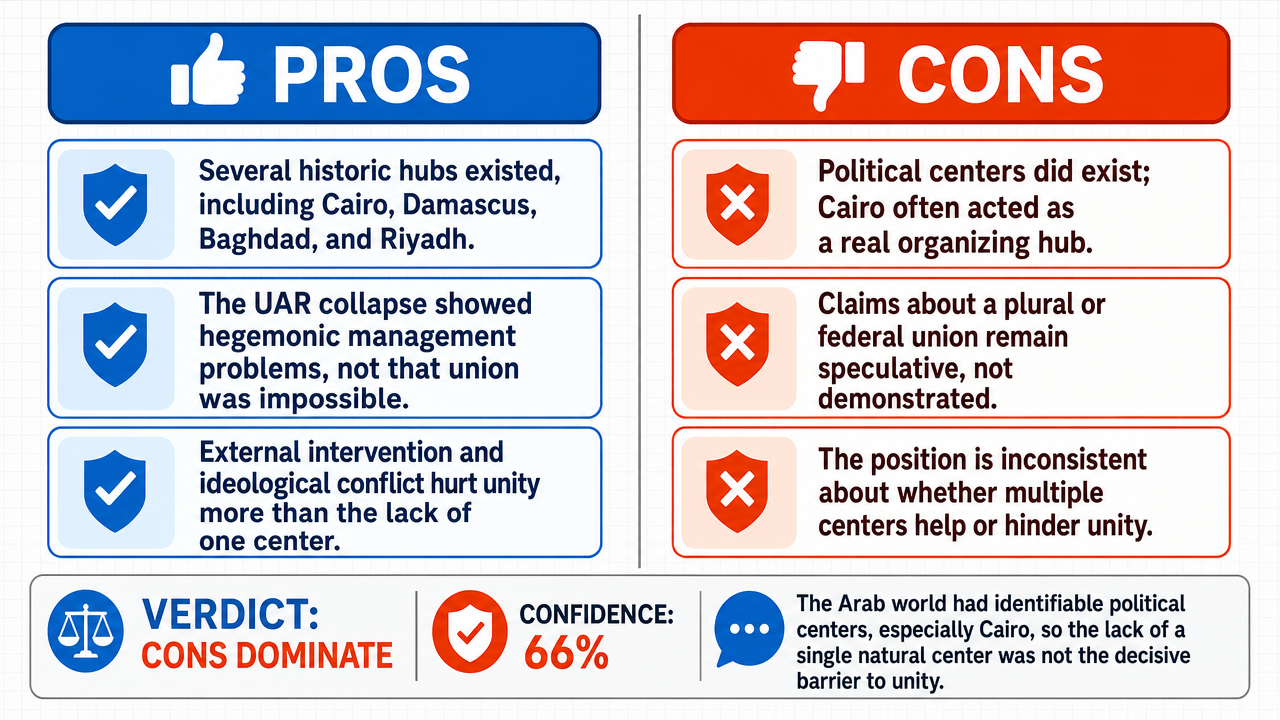
Verdict
Verdict: likely FALSE (66%)
Web Report: https://solsice.com/public/debates/the-arab-world-lacked-a-natural-political-center-around-whic-ce7e6a5c8408
This section provides a brief overview of the key arguments. You do not need to read the full detailed report below.
✅ Key PRO arguments:
- ■The absence of a dominant political center was a significant obstacle, yet the Arab world possessed multiple historic cores (Cairo, Damascus, Baghdad, Riyadh) that could have served as the foundation for a federative or pluralistic union , much like multi-centered Germany prior to 1871.
- ■The failure of the United Arab Republic (1958-1961) illustrates not the impossibility of union but the difficulty of managing hegemony; its collapse was precipitated by Cairo's overreach, not an inherent inability to organize.
- ■External intervention and ideological conflicts , rather than the absence of a natural center, were the primary factors that undermined Arab unification efforts.
❌ Key ANTI arguments:
- ■Historical political centers existed and were sufficient for organization; the affirmative's own argument concedes that Cairo functioned as a coercive political center, abandoning the original claim that no such center was available.
- ■The affirmative treats the potential for a 'federative or pluralistic union ' as an established fact rather than a conjecture, violating the requirement to demonstrate that such a multi-centered model was actually viable in the Arab context.
- ■The affirmative's position is logically incoherent: it simultaneously asserts that multiple historic centers could enable federative union while using the UAR 's failure to demonstrate that any attempted center produced 'catastrophic fragmentation '—holding a proposition and its negation at once.
💭 Conclusion: False: the Arab world did possess identifiable political centers—most notably Cairo—that historically served as gravitational hubs for political organization, and the absence of a single natural center was not the decisive impediment to unification. The affirmative's own argument concedes Cairo's role as a coercive center, which undermines the claim that no such center existed. The United Arab Republic 's failure demonstrates the difficulty of managing hegemony rather than the impossibility of organizing around a center. The affirmative's attempt to rescue the thesis by appealing to a federative multi-centered model rests on conjecture rather than demonstrated historical viability. Therefore, the lack of a natural political center was not a significant impediment to achieving a unified Arab state.
🔬 DeepResearch Result: likely FALSE ❌ (66%)
Assertion: The Arab world lacked a natural political center around which to organize, which was a significant impediment to achieving a unified state.
Participating models: deepseek-v3.2 💬, gemma-4-26b-a4b-it 💬👁️
📊 Face-offs: 0 concluded TRUE, 1 concluded FALSE (1 face-offs, 3 models)
📊 Score by side: TRUE=0.00, FALSE=0.66
🏅 Model score changes:
minimax-m3 💬👁️: +7
✅ PRO Arguments:
- ■The absence of a dominant political center was a significant obstacle, yet the Arab world possessed multiple historic cores (Cairo, Damascus, Baghdad, Riyadh) that could have served as the foundation for a federative or pluralistic union , much like multi-centered Germany prior to 1871. deepseek-v3.2 💬
- ■The failure of the United Arab Republic (1958-1961) illustrates not the impossibility of union but the difficulty of managing hegemony; its collapse was precipitated by Cairo's overreach, not an inherent inability to organize. deepseek-v3.2 💬
- ■External intervention and ideological conflicts , rather than the absence of a natural center, were the primary factors that undermined Arab unification efforts. deepseek-v3.2 💬
❌ ANTI Arguments:
- ■Historical political centers existed and were sufficient for organization; the affirmative's own argument concedes that Cairo functioned as a coercive political center, abandoning the original claim that no such center was available. gemma-4-26b-a4b-it 💬👁️
- ■The affirmative treats the potential for a 'federative or pluralistic union' as an established fact rather than a conjecture, violating the requirement to demonstrate that such a multi-centered model was actually viable in the Arab context. gemma-4-26b-a4b-it 💬👁️
- ■The affirmative's position is logically incoherent: it simultaneously asserts that multiple historic centers could enable federative union while using the UAR 's failure to demonstrate that any attempted center produced 'catastrophic fragmentation '—holding a proposition and its negation at once. gemma-4-26b-a4b-it 💬👁️
- ■The very existence of competing centers (Cairo, Hashemite , Saudi) that exercised real influence demonstrates that the Arab world did have identifiable political hubs capable of organizing political life, contradicting the assertion of absence. gemma-4-26b-a4b-it 💬👁️
💭 Reasoning: False: the Arab world did possess identifiable political centers—most notably Cairo—that historically served as gravitational hubs for political organization, and the absence of a single natural center was not the decisive impediment to unification. The affirmative's own argument concedes Cairo's role as a coercive center, which undermines the claim that no such center existed. The United Arab Republic's failure demonstrates the difficulty of managing hegemony rather than the impossibility of organizing around a center. The affirmative's attempt to rescue the thesis by appealing to a federative multi-centered model rests on conjecture rather than demonstrated historical viability. Therefore, the lack of a natural political center was not a significant impediment to achieving a unified Arab state.
📋 PRO Facts:
• The Arab world contained multiple historic political cores: Cairo, Damascus, Baghdad, and Riyadh.
• The United Arab Republic existed from 1958 to 1961 as a real unification attempt between Egypt and Syria.
• Pre-1871 Germany achieved unification despite having multiple competing centers.
📋 ANTI Facts:
• Cairo functioned as a coercive political center that imposed dominance over unification efforts.
• Competing centers such as the Hashemite monarchy and Saudi Arabia exercised real political influence in the region.
• The UAR's collapse resulted from Cairo's overreach, demonstrating that a center existed and was actively contested.
| Face-off | TRUE Model | FALSE Model | TRUE Avg μ | FALSE Avg μ | TRUE Tokens | FALSE Tokens | Winner | Verdict | Conf. |
|---|---|---|---|---|---|---|---|---|---|
| #1 | deepseek-v3.2 💬 | gemma-4-26b-a4b-it 💬👁️ | 0.336 | 0.248 | 8 | 2 | TRUE | FALSE | 66% |
The following technical terms, abbreviations, and domain-specific concepts are referenced throughout this debate transcript. Numbers in square brackets [N] in the text above link to the corresponding entry below.
[1] catastrophic fragmentation — A severe and destabilizing breakdown of political unity into separate, often hostile, entities; used in the debate to characterize the collapse of unification efforts.
[2] centrifugal fracture — Political forces or dynamics that drive a unified entity apart, causing division or disintegration among constituent parts.
[3] centrifugal pull — The tendency within a political union or state for regional or local forces to pull away from the central authority, promoting disintegration.
[4] coercive dominance — A form of political control exercised through force or the threat of force rather than through consent or legitimacy.
[5] consensual hub — A political center that attracts loyalty and coordinates action through voluntary agreement rather than coercion; contrasted in the debate with an imposed center.
[6] economic unification — The integration of separate national or regional economies into a single, coordinated economic system, often through shared markets, currencies, or trade policies.
[7] external intervention — Action by outside states or actors to influence the political affairs of another region, cited in the debate as a factor undermining Arab unification.
[8] federative union — A political arrangement in which sovereign or semi-sovereign entities join under a federal structure, sharing certain powers while retaining others.
[9] fragmented markets — Economies divided into separate, non-integrated market systems, often due to political boundaries, tariffs, or regulatory differences.
[10] glissement de quantificateur — A logical fallacy, originally from French debate tradition, in which a quantifier (such as 'all,' 'some,' or 'none') is illicitly shifted within a proposition, altering its meaning.
[11] Hashemite — A ruling Arab dynasty historically associated with the Hejaz and later with Iraq and Jordan; referenced in the debate as a competing political center.
[12] hidden premise — An unstated assumption underlying an argument that is treated as self-evident but has not been explicitly justified.
[13] ideological conflicts — Disputes between political factions rooted in fundamentally incompatible belief systems, such as competing visions of statehood or governance.
[14] inconsistent set of claims — A collection of propositions that contradict one another, such that accepting one requires rejecting another; a failure of logical coherence.
[15] logical defects — Flaws in the structure or reasoning of an argument, such as fallacies, contradictions, or unsupported premises.
[16] multi-centered organization — A political structure in which multiple cities or regions serve as co-equal hubs of authority, as opposed to a single dominant capital.
[17] mutually exclusive propositions — Statements that cannot both be true at the same time; holding both constitutes a logical contradiction.
[18] natural political center — An organic, gravitationally dominant hub around which political organization naturally coalesces, commanding consensual loyalty rather than imposed authority.
[19] pan-Arab identity — A political and cultural ideology asserting a shared identity among Arabic-speaking peoples across national borders, often serving as a basis for unification movements.
[20] pluralistic union — A political union that accommodates and preserves internal diversity—ethnic, sectarian, or regional—rather than imposing uniformity.
[21] political project — An organized, ideologically driven effort to achieve a defined political goal, such as state-building or unification.
[22] secession — The formal withdrawal of a territory or member state from a political union, as occurred when Syria left the United Arab Republic in 1961.
[23] supra-ethnic — Transcending ethnic divisions; a political identity or project that aims to unite groups across ethnic lines.
[24] tribal and sectarian diversity — The presence of multiple distinct social groupings based on kinship (tribal) or religious affiliation (sectarian), cited in the debate as a potential barrier to unification.
[25] UAR — United Arab Republic — A political union between Egypt and Syria from 1958 to 1961, formed under Nasser's leadership; its collapse is a central reference point in the debate.
[26] United Arab Republic — UAR — A short-lived political union between Egypt and Syria (1958–1961) under Egyptian President Gamal Abdel Nasser, frequently cited in debates on Arab unification.
Face-off transcripts
- ■
Ownership & Trade Secrets. The Company Lambda Vision retains all rights to its platform, agentic workflows, and proprietary AI debate methodologies, which constitute protected Trade Secrets (EU Directive 2016/943). Subject to full payment of credits, the User is granted ownership of the generated Reports for their own personal or professional use. Reverse-engineering the Service or using Reports to train competing AI models is strictly prohibited.
- ■
No Professional Advice. Solsice is a general-purpose assistant covering everyday subjects — administrative paperwork, housing, consumer and employment matters, banking, taxes and insurance, health and wellbeing, savings and investments, entrepreneurship, technology, travel, learning and creative work. Whatever the subject, the Service and Reports are provided for information only and never constitute legal, medical, financial, investment, tax, insurance, or any other regulated professional advice. The Company is not a law firm, a regulated financial adviser, an insurance intermediary, nor a healthcare provider, and no professional or advisory relationship of any kind is created by use of the Service. Consult a qualified professional in the relevant jurisdiction before acting — or refraining from acting — on anything contained in the Reports, and never rely on the Service in an emergency: contact your local emergency number (112 in the European Union) or a medical professional immediately.
- ■
AI-Generated Content, Sources and Viewpoints. Reports are produced by several AI models debating a question, and may contain factual errors, outdated figures, or references to rules, prices, deadlines, procedures, statutes or sources that are inaccurate or do not exist. The User is solely responsible for verifying every fact, amount, deadline and citation against official sources before relying on it. Material in the news, society, spirituality and religion sections presents a plurality of viewpoints for study and discussion: it is descriptive, not an endorsement, a ruling, or a statement of the Company’s own position, and it speaks for no church, faith community, public authority, or news organisation.
- ■
Liability & Governing Law. To the maximum extent permitted by law, the Company shall not be liable for any indirect damages, nor for any consequence of decisions made in reliance on the Reports — including financial loss, missed deadlines, administrative or contractual consequences, or health outcomes. These Terms are governed by French law. Any disputes shall be subject to the exclusive jurisdiction of the Courts of Paris, France.