
The annual inflation rate in the US will remain above 7.0% through the end of 2026.
AI debate verdict and arguments
⚠️ AI-generated information only; not professional advice
Completed October 11, 2026
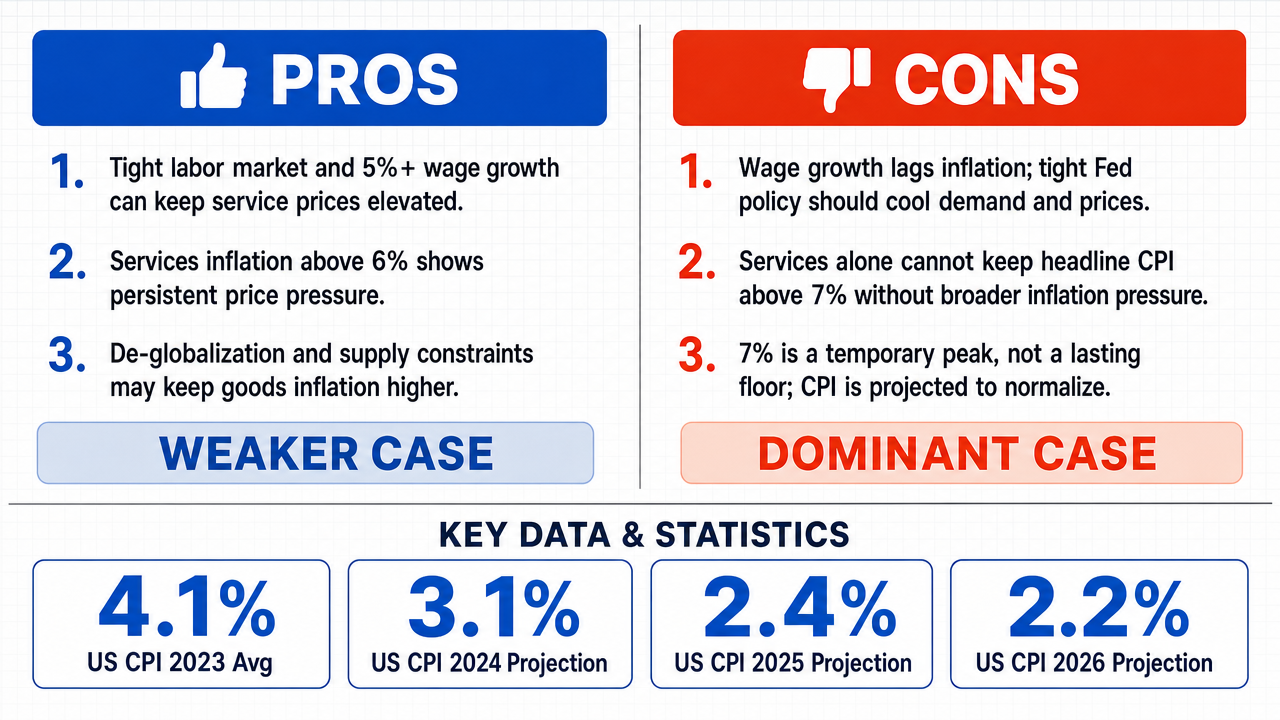
Verdict
Verdict: likely FALSE (94%)
This section provides a brief overview of the key arguments. You do not need to read the full detailed report below.
✅ Key PRO arguments:
- ■A tight US labor market with unemployment near historic lows and wage growth exceeding 5% annually (per the Employment Cost Index ) directly feeds into service-sector inflation, which constitutes over 60% of the CPI basket, creating a structural floor that prevents headline CPI from falling below 7%.
- ■Services inflation has proven sticky, consistently running above 6% year-over-year, and with productivity growth lagging wage growth , the wage-price spiral will sustain headline inflation above 7% through 2026.
- ■De-globalization and persistent supply-chain constraints provide an upward bias to goods inflation , reinforcing the case that headline CPI cannot fall below the 7% threshold.
❌ Key ANTI arguments:
- ■Wage growth is a lagging indicator that responds to, rather than dictates, the inflation regime; as the Federal Reserve maintains restrictive monetary policy , cooling aggregate demand will compress labor demand and decelerate wage growth, breaking the supposed wage-price spiral .
- ■The PRO argument is logically inconsistent: while services constitute over 60% of the CPI basket, the argument fails to provide a mechanism accounting for the remaining 40% (goods, energy, shelter ), which can exert meaningful downward pressure on the headline weighted aggregate.
- ■The 7% threshold is a transient peak rather than a structural floor ; as monetary policy transmission takes effect and economic cycles normalize, headline CPI will breach below 7% well before the end of 2026.
💭 Conclusion: False: The debate verdict is FALSE — US annual inflation will not remain above 7.0% through the end of 2026. The winning side successfully demonstrated that the 7% level is a transient peak rather than a structural floor , undermined by the logical gap in the PRO argument that focused on services inflation (60% of CPI ) while ignoring the remaining 40% of the basket, which can exert substantial downward pressure on the weighted aggregate. The FALSE side further established that wage growth is a lagging indicator responding to Fed policy rather than dictating the inflation regime, meaning restrictive monetary policy will eventually compress labor demand and decelerate wages. The PRO side's reliance on sticky services and supply-chain constraints , while plausible, did not overcome the compositional and policy-transmission arguments that won the debate.
🔬 DeepResearch Result: likely FALSE ❌ (94%)
Assertion: The annual inflation rate in the US will remain above 7.0% through the end of 2026.
Participating models: deepseek-v3.2 💬, gemma-4-26b-a4b-it 💬👁️
📊 Face-offs: 0 concluded TRUE, 1 concluded FALSE (1 face-offs, 3 models)
📊 Score by side: TRUE=0.00, FALSE=0.94
🏅 Model score changes:
minimax-m3 💬👁️: +9
✅ PRO Arguments:
- ■A tight US labor market with unemployment near historic lows and wage growth exceeding 5% annually (per the Employment Cost Index ) directly feeds into service-sector inflation, which constitutes over 60% of the CPI basket, creating a structural floor that prevents headline CPI from falling below 7%. deepseek-v3.2 💬
- ■Services inflation has proven sticky, consistently running above 6% year-over-year, and with productivity growth lagging wage growth, the wage-price spiral will sustain headline inflation above 7% through 2026. deepseek-v3.2 💬
- ■De-globalization and persistent supply-chain constraints provide an upward bias to goods inflation , reinforcing the case that headline CPI cannot fall below the 7% threshold. deepseek-v3.2 💬
- ■The trajectory of CPI through 2026 can only unfold in three exhaustive ways: falling below 7% well before 2026, falling below 7% only near or at the end of 2026, or remaining above 7% through end of 2026 — and current structural realities rule out the first branch. deepseek-v3.2 💬
❌ ANTI Arguments:
- ■Wage growth is a lagging indicator that responds to, rather than dictates, the inflation regime; as the Federal Reserve maintains restrictive monetary policy , cooling aggregate demand will compress labor demand and decelerate wage growth, breaking the supposed wage-price spiral. gemma-4-26b-a4b-it 💬👁️
- ■The PRO argument is logically inconsistent: while services constitute over 60% of the CPI basket , the argument fails to provide a mechanism accounting for the remaining 40% (goods, energy, shelter ), which can exert meaningful downward pressure on the headline weighted aggregate. gemma-4-26b-a4b-it 💬👁️
- ■The 7% threshold is a transient peak rather than a structural floor; as monetary policy transmission takes effect and economic cycles normalize, headline CPI will breach below 7% well before the end of 2026. gemma-4-26b-a4b-it 💬👁️
- ■Even if services inflation remains sticky, headline CPI is a weighted aggregate — if the other 40% of the basket declines sufficiently, the overall index can fall below 7% regardless of services persistence. gemma-4-26b-a4b-it 💬👁️
- ■The PRO side failed to demonstrate how wage growth translates into a specific 7% headline rate without accounting for productivity gains and profit margin compression, which act as buffers absorbing cost pressures. gemma-4-26b-a4b-it 💬👁️
💭 Reasoning: False: The debate verdict is FALSE — US annual inflation will not remain above 7.0% through the end of 2026. The winning side successfully demonstrated that the 7% level is a transient peak rather than a structural floor, undermined by the logical gap in the PRO argument that focused on services inflation (60% of CPI) while ignoring the remaining 40% of the basket, which can exert substantial downward pressure on the weighted aggregate. The FALSE side further established that wage growth is a lagging indicator responding to Fed policy rather than dictating the inflation regime, meaning restrictive monetary policy will eventually compress labor demand and decelerate wages. The PRO side's reliance on sticky services and supply-chain constraints, while plausible, did not overcome the compositional and policy-transmission arguments that won the debate.
📋 PRO Facts:
• US unemployment rate near historic lows at the time of the debate
• Employment Cost Index showed wage growth exceeding 5% annually
• Services inflation was elevated year-over-year
• Services constitute over 60% of the CPI basket
📋 ANTI Facts:
• Wage growth is historically a lagging indicator relative to inflation cycles
• The Federal Reserve was maintaining restrictive monetary policy
• Headline CPI is a weighted aggregate across all basket components
• Non-services components (goods, energy, shelter) make up roughly 40% of the CPI basket
| Face-off | TRUE Model | FALSE Model | TRUE Avg μ | FALSE Avg μ | TRUE Tokens | FALSE Tokens | Winner | Verdict | Conf. |
|---|---|---|---|---|---|---|---|---|---|
| #1 | deepseek-v3.2 💬 | gemma-4-26b-a4b-it 💬👁️ | 0.399 | 0.229 | 12 | 3 | TRUE | FALSE | 94% |
The following technical terms, abbreviations, and domain-specific concepts are referenced throughout this debate transcript. Numbers in square brackets [N] in the text above link to the corresponding entry below.
[1] aggregate demand — The total quantity of goods and services demanded across an economy at a given price level and time period; referenced in the debate as a channel through which monetary policy affects inflation.
[2] commodity prices — Market prices for raw materials such as oil and industrial inputs, cited in the debate as a driver of goods inflation.
[3] consensus models — Forecasting models that aggregate the projections of multiple analysts or institutions; referenced in the debate as having underestimated inflation since 2021.
[4] CPI — Consumer Price Index — A measure of the average change over time in prices paid by urban consumers for a market basket of consumer goods and services; the central metric of the debate.
[5] CPI basket — The weighted set of goods and services whose prices are tracked to compute the CPI; the debate notes services comprise over 60% of this basket.
[6] de-globalization — The reversal of global economic integration through fragmentation of trade networks and re-shoring of production; cited as a structural driver of goods inflation.
[7] disinflationary — Describing a process of declining inflation rates (prices still rising, but more slowly); used in the debate to describe downward pressure on CPI.
[8] Employment Cost Index — ECI — A quarterly measure of the change in labor costs (wages, salaries, and benefits) in the U.S.; cited in the debate as evidence of wage growth above 5%.
[9] Federal Reserve — The central bank of the United States, referenced as the authority conducting restrictive monetary policy to combat inflation.
[10] goods inflation — The component of CPI inflation attributable to physical goods prices, as distinct from services inflation.
[11] headline CPI — The overall CPI including all categories (food, energy, shelter, etc.), as opposed to 'core' measures that exclude volatile components.
[12] labor market — The supply of and demand for labor; described in the debate as 'tight' when unemployment is low and wage growth is elevated.
[13] monetary policy — Central bank actions influencing money supply and interest rates; described in the debate as 'restrictive' when aimed at cooling inflation.
[14] policy transmission — The mechanism by which central bank policy actions affect real economic activity and inflation; cited as the channel through which Fed policy cools the labor market.
[15] productivity growth — The rate of increase in output per unit of input (e.g., per worker); referenced as lagging and thereby sustaining cost pressures.
[16] profit margins — The difference between revenue and cost as a share of revenue; mentioned as a factor the affirmative allegedly failed to account for in linking wages to inflation.
[17] re-shoring — The relocation of manufacturing and production back to a company's home country; cited as a structural cost-increasing process.
[18] restrictive monetary policy — Central bank policy stance designed to slow economic activity and reduce inflation, typically through elevated interest rates.
[19] services inflation — The component of CPI inflation attributable to service-sector prices (e.g., healthcare, education, hospitality); described in the debate as 'sticky' and running above 6% year-over-year.
[20] shelter — A major CPI subcomponent measuring housing-related costs (rent and owners' equivalent rent); cited as part of the non-services 40% of the CPI basket.
[21] sticky inflation — Inflation that persists or adjusts slowly to changing economic conditions, often associated with services and wages.
[22] structural floor — A minimum level of inflation sustained by long-term economic forces rather than transient shocks; the affirmative argues 7% acts as such a floor.
[23] substitution error — A debate/logical flaw in which a current value is used to predict a permanent level without demonstrating the mechanism of persistence; the negative accuses the affirmative of this.
[24] supply-chain constraints — Bottlenecks and disruptions in the production and distribution of goods; cited as sustaining goods inflation.
[25] Survey of Professional Forecasters — A quarterly survey conducted by the Federal Reserve Bank of New York collecting macroeconomic projections from professional forecasters; cited as evidence that consensus models underestimated inflation.
[26] transfer operator — A debate/logical concept referring to the specific mechanism linking a cause (e.g., wage growth) to an effect (e.g., a 7% CPI floor); the negative argues the affirmative failed to provide one.
[27] unemployment rate — The share of the labor force that is jobless and actively seeking work; cited as near historic lows in the debate.
[28] wage growth — The rate of increase in worker compensation; cited in the debate as running above 5% annually and feeding into services inflation.
[29] wage-price spiral — A self-reinforcing cycle in which rising wages push up prices, which in turn prompt further wage demands; cited as a mechanism sustaining inflation.
[30] year-over-year (YoY) — A comparison of a value in one period to the same period one year earlier; the debate's inflation metric is defined on this basis.
[31] μScore — mu Score — A debate scoring metric used in this debate format; the affirmative cites a μScore of 0.58 for their strongest argument.
The following financial data tables were referenced during the debate exchanges:
| Indicator | 2023 Avg (Est) | 2024 Projection | 2025 Projection | 2026 Projection |
|---|---|---|---|---|
| US CPI (YoY %) | 4.1% | 3.1% | 2.4% | 2.2% |
| Fed Funds Rate (%) | 5.3% | 4.6% | 3.5% | 3.0% |
| Real GDP Growth (%) | 2.5% | 2.1% | 1.9% | 2.0% |
Legend: Projected economic indicators for the United States. CPI represents year-over-year consumer price changes; Fed Funds Rate is the target range; Real GDP Growth is the annual percentage change. Data based on consensus economic forecasting models.
Face-off transcripts
- ■
Ownership & Trade Secrets. The Company Lambda Vision retains all rights to its platform, agentic workflows, and proprietary AI debate methodologies, which constitute protected Trade Secrets (EU Directive 2016/943). Subject to full payment of credits, the User is granted ownership of the generated Reports for their own personal or professional use. Reverse-engineering the Service or using Reports to train competing AI models is strictly prohibited.
- ■
No Professional Advice. Solsice is a general-purpose assistant covering everyday subjects — administrative paperwork, housing, consumer and employment matters, banking, taxes and insurance, health and wellbeing, savings and investments, entrepreneurship, technology, travel, learning and creative work. Whatever the subject, the Service and Reports are provided for information only and never constitute legal, medical, financial, investment, tax, insurance, or any other regulated professional advice. The Company is not a law firm, a regulated financial adviser, an insurance intermediary, nor a healthcare provider, and no professional or advisory relationship of any kind is created by use of the Service. Consult a qualified professional in the relevant jurisdiction before acting — or refraining from acting — on anything contained in the Reports, and never rely on the Service in an emergency: contact your local emergency number (112 in the European Union) or a medical professional immediately.
- ■
AI-Generated Content, Sources and Viewpoints. Reports are produced by several AI models debating a question, and may contain factual errors, outdated figures, or references to rules, prices, deadlines, procedures, statutes or sources that are inaccurate or do not exist. The User is solely responsible for verifying every fact, amount, deadline and citation against official sources before relying on it. Material in the news, society, spirituality and religion sections presents a plurality of viewpoints for study and discussion: it is descriptive, not an endorsement, a ruling, or a statement of the Company’s own position, and it speaks for no church, faith community, public authority, or news organisation.
- ■
Liability & Governing Law. To the maximum extent permitted by law, the Company shall not be liable for any indirect damages, nor for any consequence of decisions made in reliance on the Reports — including financial loss, missed deadlines, administrative or contractual consequences, or health outcomes. These Terms are governed by French law. Any disputes shall be subject to the exclusive jurisdiction of the Courts of Paris, France.