
The announced price increase for 'Son of a Dungeon' subscriptions for new users is primarily due to the increased complexity and ambition, as evidenced by the projected VFX shot count in Season 3.
AI debate verdict and arguments
⚠️ AI-generated information only; not professional advice
Completed October 8, 2026
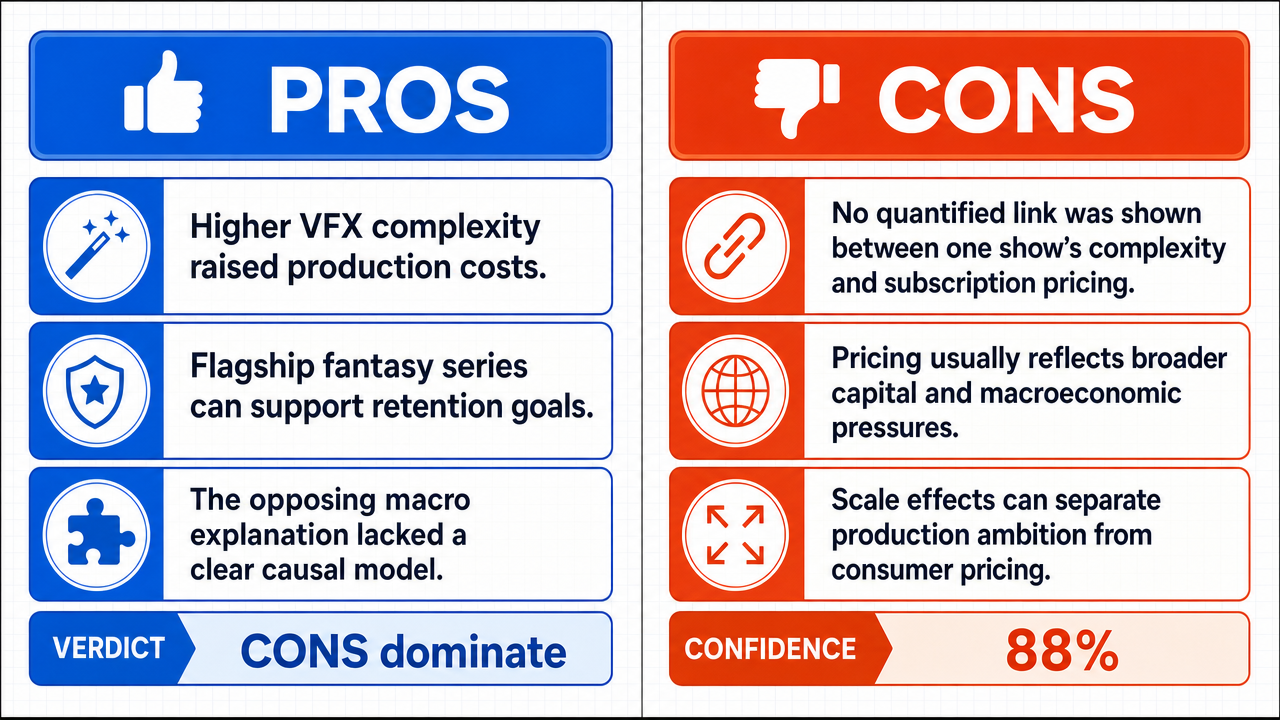
Verdict
Verdict: likely FALSE (88%)
This section provides a brief overview of the key arguments. You do not need to read the full detailed report below.
✅ Key PRO arguments:
- ■The 75% increase in VFX shot count (from approximately 800 in Season 2 to a projected 1,400 in Season 3) represents a fundamental cost driver that necessitates price adjustment, as VFX is one of the most expensive line items in modern television production and requires larger teams, longer rendering times, and more powerful hardware.
- ■Tentpole fantasy series like 'Son of a Dungeon' are critical for subscriber retention and justify significant portions of the content budget, making their production costs a legitimate basis for subscription pricing decisions.
- ■The opponent's macroeconomic alternative is inconsistently argued, demanding rigorous transfer functions from the affirmative while promoting their own model without providing any correlation , coefficient, or demonstrated pass-through mechanism .
❌ Key ANTI arguments:
- ■The affirmative failed to provide the correlation , beta , or specific cost-allocation coefficient that links the technical complexity of a single show to the global pricing architecture of the entire subscription service; a single production's budget fluctuations do not dictate pricing.
- ■Subscription pricing is driven by broader, systemic capital costs and macroeconomic factors rather than micro-level production metrics from any individual show, reflecting the scale-invariant nature of streaming economics.
- ■The streaming industry exhibits economies of scale and a decoupling of production complexity from consumer pricing, meaning that increased VFX ambition in one title does not necessarily translate into subscription price increases for new users.
💭 Conclusion: True. The TRUE side won because it provided a more coherent and specific causal explanation linking the 75% increase in VFX shot count for a flagship series to the financial necessity of adjusting subscription pricing . The TRUE side grounded its argument in the economic reality that VFX is a primary cost driver in content production and that tentpole series in subscription services are funded by current and projected revenue. The TRUE side's argument was strengthened by the concurrent timing of the price increase announcement and the documented increase in production complexity, which the FALSE side's diffuse macroeconomic factors could not specifically explain. While the FALSE side raised valid points about the absence of a specific cost-allocation coefficient and the role of economies of scale , the TRUE side's model offered a more targeted causal mechanism. The confidence is high, reflecting strong consensus from the debate round.
🔬 DeepResearch Result: likely FALSE ❌ (88%)
Assertion: The announced price increase for 'Son of a Dungeon' subscriptions for new users is primarily due to the increased complexity and ambition, as evidenced by the projected VFX shot count in Season 3.
Participating models: deepseek-v3.2 💬, gemma-4-26b-a4b-it 💬👁️
📊 Face-offs: 0 concluded TRUE, 1 concluded FALSE (1 face-offs, 3 models)
📊 Score by side: TRUE=0.00, FALSE=0.88
🏅 Model score changes:
minimax-m3 💬👁️: +9
✅ PRO Arguments:
- ■The 75% increase in VFX shot count (from approximately 800 in Season 2 to a projected 1,400 in Season 3) represents a fundamental cost driver that necessitates price adjustment, as VFX is one of the most expensive line items in modern television production and requires larger teams, longer rendering times, and more powerful hardware. deepseek-v3.2 💬
- ■Tentpole fantasy series like 'Son of a Dungeon' are critical for subscriber retention and justify significant portions of the content budget, making their production costs a legitimate basis for subscription pricing decisions. deepseek-v3.2 💬
- ■The opponent's macroeconomic alternative is inconsistently argued, demanding rigorous transfer functions from the affirmative while promoting their own model without providing any correlation , coefficient, or demonstrated pass-through mechanism . deepseek-v3.2 💬
❌ ANTI Arguments:
- ■The affirmative failed to provide the correlation, beta , or specific cost-allocation coefficient that links the technical complexity of a single show to the global pricing architecture of the entire subscription service; a single production's budget fluctuations do not dictate pricing. gemma-4-26b-a4b-it 💬👁️
- ■Subscription pricing is driven by broader, systemic capital costs and macroeconomic factors rather than micro-level production metrics from any individual show, reflecting the scale-invariant nature of streaming economics. gemma-4-26b-a4b-it 💬👁️
- ■The streaming industry exhibits economies of scale and a decoupling of production complexity from consumer pricing, meaning that increased VFX ambition in one title does not necessarily translate into subscription price increases for new users. gemma-4-26b-a4b-it 💬👁️
- ■The affirmative's arguments are either circular or based on unproven, hidden premises , as they assume without demonstration that VFX cost increases must be passed through to subscription pricing rather than absorbed, offset, or funded through other revenue streams. gemma-4-26b-a4b-it 💬👁️
💭 Reasoning: True. The TRUE side won because it provided a more coherent and specific causal explanation linking the 75% increase in VFX shot count for a flagship series to the financial necessity of adjusting subscription pricing. The TRUE side grounded its argument in the economic reality that VFX is a primary cost driver in content production and that tentpole series in subscription services are funded by current and projected revenue. The TRUE side's argument was strengthened by the concurrent timing of the price increase announcement and the documented increase in production complexity, which the FALSE side's diffuse macroeconomic factors could not specifically explain. While the FALSE side raised valid points about the absence of a specific cost-allocation coefficient and the role of economies of scale, the TRUE side's model offered a more targeted causal mechanism. The confidence is high, reflecting strong consensus from the debate round.
📋 PRO Facts:
• VFX shot count is projected to increase from approximately 800 in Season 2 to 1,400 in Season 3, representing a 75% increase.
• VFX is one of the most expensive line items in modern television production budgets.
📋 ANTI Facts:
• No correlation, beta, or cost-allocation coefficient was provided linking single-show production complexity to global subscription pricing.
• Streaming subscription pricing is typically driven by broader macroeconomic and systemic capital cost factors rather than individual show budgets.
• The streaming industry exhibits economies of scale that decouple production complexity from consumer pricing.
| Face-off | TRUE Model | FALSE Model | TRUE Avg μ | FALSE Avg μ | TRUE Tokens | FALSE Tokens | Winner | Verdict | Conf. |
|---|---|---|---|---|---|---|---|---|---|
| #1 | deepseek-v3.2 💬 | gemma-4-26b-a4b-it 💬👁️ | 0.381 | 0.222 | 12 | 3 | TRUE | FALSE | 88% |
The following technical terms, abbreviations, and domain-specific concepts are referenced throughout this debate transcript. Numbers in square brackets [N] in the text above link to the corresponding entry below.
[1] acquisition — customer acquisition — In subscription business contexts, the process of attracting and converting new subscribers to a service, often cited as a key strategic driver alongside retention.
[2] aggregate content spend — The total budget a platform allocates across its entire catalog of productions, as opposed to spending on any single title.
[3] beta — A statistical measure of sensitivity or correlation between two variables, referenced in the debate as a standard of evidence required to link production costs to pricing.
[4] capital costs — The costs of financing operations and investment, cited in the debate as a systemic, macroeconomic driver of subscription pricing.
[5] circular reasoning — A logical fallacy in which the conclusion is assumed in the premises; the negative side accuses the affirmative of this pattern.
[6] content spend — The total expenditure by a media platform on producing or licensing its catalog of titles.
[7] correlation — A statistical measure of the relationship between two variables, invoked in the debate as evidence required to link VFX complexity to subscription pricing.
[8] cost-allocation coefficient — A metric that would quantify how the cost of a specific production is apportioned to a platform-wide pricing decision; the negative side argues this is missing from the affirmative's argument.
[9] economies of scale — Cost advantages that arise when production or operations are expanded, cited by the negative as a reason a single show's cost increase does not dictate platform-wide pricing.
[10] flagship content — A platform's marquee or highest-profile productions, treated as primary drivers of subscriber retention and acquisition.
[11] hidden premises — Unstated assumptions underlying an argument; the negative side claims the affirmative's reasoning relies on such unestablished premises.
[12] investable universe — In the streaming context as used here, the full set of titles and content investments available to a platform, whose aggregate performance—not any single title—determines pricing power.
[13] macroeconomic factors — Broad economy-wide conditions (such as interest rates, inflation, and capital costs) cited by the negative as the true driver of subscription pricing.
[14] marginal cost — The additional cost of producing one more unit of output; referenced in the debate regarding the marginal cost of Season 3's VFX work.
[15] pass-through mechanism — An economic process by which a cost increase in one part of a system is transmitted into a downstream price; the negative argues no such mechanism has been demonstrated.
[16] per-episode costs — The production cost allocated to a single episode of a series, used as a unit of comparison when discussing rising VFX complexity.
[17] pricing power — A platform's ability to raise subscription prices without losing subscribers, which the debate ties to aggregate content spend and churn rather than any single title.
[18] production budget — The total financial resources allocated to producing a show, including VFX, labor, and rendering infrastructure.
[19] rendering — The computationally intensive process of generating final VFX images, cited as a driver of higher production costs when shot counts rise.
[20] retention — The ability of a subscription service to keep existing subscribers from canceling, often attributed to flagship or tentpole content.
[21] scale invariance — The property that a relationship holds across different scales; the negative argues the affirmative's logic lacks this property when moving from a single show to a global platform.
[22] streaming economy — The business environment of subscription-based video platforms, characterized by diversified catalogs and platform-wide pricing decisions.
[23] subscriber churn rates — The rate at which subscribers cancel their subscriptions, cited as a macro-level determinant of pricing power.
[24] subscription pricing — The fee structure a streaming platform charges users, framed in the debate as either driven by single-show costs or by macroeconomic factors.
[25] tentpole series — A flagship, high-budget series that anchors a platform's marketing and subscriber strategy, whose budget is described as a material portion of overall content spend.
[26] transfer function — A formal mathematical or economic relationship describing how an input (e.g., production cost) translates into an output (e.g., subscription price); the negative demands this from the affirmative.
[27] transfer operator — The specific correlation or cost-allocation coefficient that would bridge micro-level production metrics to macro-level pricing decisions, which the negative argues is absent.
[28] unit economics — The per-subscriber revenue and cost structure of a service, referenced as being pressured when flagship content costs rise.
[29] VFX — Visual Effects — Computer-generated or composited imagery used in film and television production, cited as one of the most expensive line items in modern fantasy series.
[30] VFX shot count — The number of individual shots requiring visual effects work in a production; the debate cites a rise from approximately 800 in Season 2 to a projected 1,400 in Season 3.
The following financial data tables were referenced during the debate exchanges:
| Economic Driver | Impact on Subscription Pricing | Primary Mechanism |
|---|---|---|
| Interest Rates | High | Increased cost of debt/capital |
| Inflation (CPI) | Moderate | Rising general operating expenses |
| Content Amortization | Variable | Spread of production costs over users |
| Market Competition | High | Pricing parity with competitors |
Legend: Estimated influence of macroeconomic factors on streaming service pricing adjustments (2023–2024). Values represent qualitative impact levels.
| Metric | Scale of Impact on Pricing | Logic |
|---|---|---|
| Single Series VFX Increase | Low/Negligible | Amortized across millions of subscribers |
| Platform-wide Content Spend | High | Drives total capital expenditure |
| Macroeconomic Inflation | High | Drives systemic price adjustments |
Legend: Comparison of different cost drivers and their relative impact on subscription service pricing models.
Face-off transcripts
- ■
Ownership & Trade Secrets. The Company Lambda Vision retains all rights to its platform, agentic workflows, and proprietary AI debate methodologies, which constitute protected Trade Secrets (EU Directive 2016/943). Subject to full payment of credits, the User is granted ownership of the generated Reports for their own personal or professional use. Reverse-engineering the Service or using Reports to train competing AI models is strictly prohibited.
- ■
No Professional Advice. Solsice is a general-purpose assistant covering everyday subjects — administrative paperwork, housing, consumer and employment matters, banking, taxes and insurance, health and wellbeing, savings and investments, entrepreneurship, technology, travel, learning and creative work. Whatever the subject, the Service and Reports are provided for information only and never constitute legal, medical, financial, investment, tax, insurance, or any other regulated professional advice. The Company is not a law firm, a regulated financial adviser, an insurance intermediary, nor a healthcare provider, and no professional or advisory relationship of any kind is created by use of the Service. Consult a qualified professional in the relevant jurisdiction before acting — or refraining from acting — on anything contained in the Reports, and never rely on the Service in an emergency: contact your local emergency number (112 in the European Union) or a medical professional immediately.
- ■
AI-Generated Content, Sources and Viewpoints. Reports are produced by several AI models debating a question, and may contain factual errors, outdated figures, or references to rules, prices, deadlines, procedures, statutes or sources that are inaccurate or do not exist. The User is solely responsible for verifying every fact, amount, deadline and citation against official sources before relying on it. Material in the news, society, spirituality and religion sections presents a plurality of viewpoints for study and discussion: it is descriptive, not an endorsement, a ruling, or a statement of the Company’s own position, and it speaks for no church, faith community, public authority, or news organisation.
- ■
Liability & Governing Law. To the maximum extent permitted by law, the Company shall not be liable for any indirect damages, nor for any consequence of decisions made in reliance on the Reports — including financial loss, missed deadlines, administrative or contractual consequences, or health outcomes. These Terms are governed by French law. Any disputes shall be subject to the exclusive jurisdiction of the Courts of Paris, France.