
The 'Amo Vivir Sin Miedo' campaign developed by Sagrado students significantly breaks the stigma of domestic violence in Puerto Rico.
AI debate verdict and arguments
⚠️ AI-generated information only; not professional advice
Completed October 11, 2026
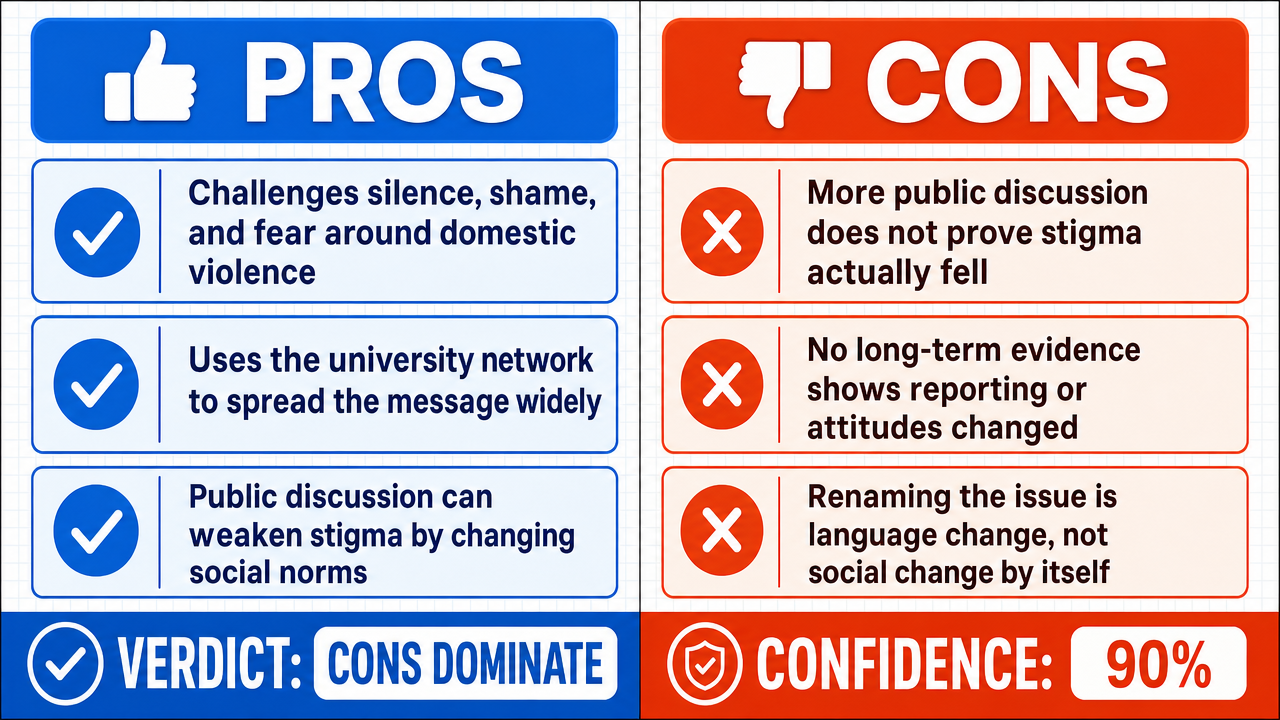
Verdict
Verdict: likely FALSE (90%)
This section provides a brief overview of the key arguments. You do not need to read the full detailed report below.
✅ Key PRO arguments:
- ■The campaign directly attacks stigma -producing norms of silence, shame, and fear of disclosure by publicly renaming domestic violence as 'living without fear,' which is a necessary first step in changing social norms per the WHO framework on violence against women.
- ■The campaign leverages institutional diffusion through Universidad del Sagrado Corazón's network, providing a ready-made channel to move from student work into community conversation.
- ■Public conversation is not merely a proxy but an observable change in the norm itself, since stigma is a social norm expressed through silence, shame, and fear of disclosure .
❌ Key ANTI arguments:
- ■The affirmative commits a substitution of proxies : measuring a shift in public conversation does not equal measuring a material shift in social stigma , since a change in volume or frequency of a topic in student-led circles is not a measurement of the social norm itself.
- ■To claim the campaign 'breaks the stigma ' requires a transfer operator —such as a longitudinal study of victim reporting rates or a verified shift in community attitudes —which has not been provided.
- ■Renaming a phenomenon is a linguistic act , not a sociological one; confusing the modality of intervention (how the message is delivered) with the substantive condition of stigma reduction mistakes the label for the mechanism.
💭 Conclusion: False. The negative side successfully demonstrated that the affirmative's claim suffers from a fundamental substitution of proxies , conflating increased public conversation about domestic violence with a measurable reduction in stigma . The affirmative failed to provide any transfer operator —such as longitudinal data on victim reporting rates , verified shifts in community attitudes , or pre/post stigma measurements—that would link the campaign's activities to actual sociological change. The negative correctly argued that renaming a problem is a linguistic act , not a sociological mechanism, and that without empirical evidence connecting the campaign to stigma reduction , the claim of 'significantly breaking' the stigma remains unsubstantiated. The judge's 90% confidence reflects the strength of this methodological critique, which the affirmative was unable to rebut with concrete evidence of impact beyond increased discourse within student and academic circles.
🔬 DeepResearch Result: likely FALSE ❌ (90%)
Assertion: The 'Amo Vivir Sin Miedo' campaign developed by Sagrado students significantly breaks the stigma of domestic violence in Puerto Rico.
Participating models: deepseek-v3.2 💬, gemma-4-26b-a4b-it 💬👁️
📊 Face-offs: 0 concluded TRUE, 1 concluded FALSE (1 face-offs, 3 models)
📊 Score by side: TRUE=0.00, FALSE=0.90
🏅 Model score changes:
minimax-m3 💬👁️: +9
✅ PRO Arguments:
- ■The campaign directly attacks stigma-producing norms of silence, shame, and fear of disclosure by publicly renaming domestic violence as 'living without fear,' which is a necessary first step in changing social norms per the WHO framework on violence against women. deepseek-v3.2 💬
- ■The campaign leverages institutional diffusion through Universidad del Sagrado Corazón's network, providing a ready-made channel to move from student work into community conversation. deepseek-v3.2 💬
- ■Public conversation is not merely a proxy but an observable change in the norm itself, since stigma is a social norm expressed through silence, shame, and fear of disclosure. deepseek-v3.2 💬
- ■The WHO describes violence against women as rooted in social norms and states that changing norms requires public communication and community engagement , which the campaign provides. deepseek-v3.2 💬
❌ ANTI Arguments:
- ■The affirmative commits a substitution of proxies : measuring a shift in public conversation does not equal measuring a material shift in social stigma, since a change in volume or frequency of a topic in student-led circles is not a measurement of the social norm itself. gemma-4-26b-a4b-it 💬👁️
- ■To claim the campaign 'breaks the stigma' requires a transfer operator —such as a longitudinal study of victim reporting rates or a verified shift in community attitudes —which has not been provided. gemma-4-26b-a4b-it 💬👁️
- ■Renaming a phenomenon is a linguistic act , not a sociological one; confusing the modality of intervention (how the message is delivered) with the substantive condition of stigma reduction mistakes the label for the mechanism. gemma-4-26b-a4b-it 💬👁️
- ■Without empirical connection between the campaign's activities and actual social change, the mere fact that students are talking about the issue does not constitute evidence that the pervasive stigma in broader Puerto Rican society has been broken. gemma-4-26b-a4b-it 💬👁️
💭 Reasoning: False. The negative side successfully demonstrated that the affirmative's claim suffers from a fundamental substitution of proxies, conflating increased public conversation about domestic violence with a measurable reduction in stigma. The affirmative failed to provide any transfer operator—such as longitudinal data on victim reporting rates, verified shifts in community attitudes, or pre/post stigma measurements—that would link the campaign's activities to actual sociological change. The negative correctly argued that renaming a problem is a linguistic act, not a sociological mechanism, and that without empirical evidence connecting the campaign to stigma reduction, the claim of 'significantly breaking' the stigma remains unsubstantiated. The judge's 90% confidence reflects the strength of this methodological critique, which the affirmative was unable to rebut with concrete evidence of impact beyond increased discourse within student and academic circles.
📋 PRO Facts:
• The WHO describes violence against women as rooted in social norms and states that changing norms requires public communication and community engagement.
• The CDC reports approximately 1 in 3 women experience domestic violence, establishing the scale of the problem.
• The campaign was developed by students at Universidad del Sagrado Corazón in Puerto Rico.
• The campaign publicly renames domestic violence as 'living without fear' (Amo Vivir Sin Miedo).
📋 ANTI Facts:
• No longitudinal study of victim reporting rates was provided to demonstrate stigma reduction.
• No verified shift in community attitudes was presented as evidence.
• No pre/post campaign measurement of stigma levels in Puerto Rico was offered.
• A change in the volume or frequency of discussion in student-led circles is not equivalent to a measurement of the underlying social norm.
| Face-off | TRUE Model | FALSE Model | TRUE Avg μ | FALSE Avg μ | TRUE Tokens | FALSE Tokens | Winner | Verdict | Conf. |
|---|---|---|---|---|---|---|---|---|---|
| #1 | deepseek-v3.2 💬 | gemma-4-26b-a4b-it 💬👁️ | 0.451 | 0.228 | 12 | 3 | TRUE | FALSE | 90% |
The following technical terms, abbreviations, and domain-specific concepts are referenced throughout this debate transcript. Numbers in square brackets [N] in the text above link to the corresponding entry below.
[1] Attitude shift — A change in the beliefs, feelings, or behavioral intentions of a group or population toward a particular issue, cited by the negative as the kind of evidence needed to demonstrate stigma reduction.
[2] CDC — U.S. Centers for Disease Control and Prevention — A U.S. federal public health agency cited in the debate for statistics on the prevalence of intimate partner violence.
[3] Community attitudes — The shared beliefs, opinions, and dispositions held by members of a local population regarding specific issues; the negative argues that verified shifts in community attitudes would be required to prove stigma reduction.
[4] Community engagement — Collaborative work with groups of people to address issues affecting their well-being; cited via the WHO as a necessary component for changing norms around violence against women.
[5] Cultural and territorial fit — The degree to which an intervention aligns with the local language, customs, and specific conditions of the target population, invoked by the affirmative to argue the campaign is well-suited to Puerto Rico.
[6] Culturally grounded community action — Public health interventions designed around the specific cultural context and led by or with the affected community, referenced by the affirmative as a WHO-endorsed principle.
[7] Demographic reach — The extent to which a campaign or intervention contacts or influences different segments of a population; the negative argues the campaign lacks sufficient demographic reach to alter national norms.
[8] Disclosure — In the context of abuse, the act of revealing or reporting experiences of violence to others; fear of disclosure is identified as a component of the stigma mechanism.
[9] Domestic violence — Physical, sexual, or emotional abuse occurring within the home or intimate relationship context; the central problem the campaign addresses.
[10] Fallacy of scale — An argumentation error in which evidence or mechanisms valid at a small or local level are assumed to produce effects at a much larger scale without justification; invoked by the negative against the campaign's claimed national impact.
[11] Institutional diffusion — The spread of ideas, practices, or norms through established organizations and their networks; the affirmative argues the campaign leverages this through the university's network.
[12] Intimate partner violence — Physical, sexual, or psychological harm by a current or former partner or spouse, as defined by public health authorities such as the CDC.
[13] Linguistic act — An action performed through speech or language, such as renaming or reframing a concept; the negative argues that renaming domestic violence is merely a linguistic act, not a sociological one.
[14] Longitudinal data — Information collected from the same subjects over an extended period of time, used to track changes; cited by the negative as the type of evidence missing from the affirmative's case.
[15] Longitudinal study — A research design that observes the same group repeatedly over time to identify trends or changes; the negative argues such a study of victim reporting rates would be needed to prove stigma reduction.
[16] Moral vocabulary — The set of language and concepts a community uses to express ethical judgments and values; the affirmative argues the campaign uses the community's moral vocabulary to resonate locally.
[17] National social shift — A change in attitudes, norms, or behaviors affecting an entire country's population; the negative argues the campaign cannot produce such a shift.
[18] Public communication — The dissemination of messages to a broad audience through media or organized campaigns; cited via the WHO as a means of changing social norms around violence.
[19] Public discourse — The exchange of ideas and information about issues in the public sphere. The parties dispute whether a shift in public discourse constitutes direct evidence of stigma reduction (affirmative) or merely a proxy for underlying norm change (negative).
[20] Public-health norms — Shared expectations about behavior related to health that are promoted through public health initiatives; the affirmative argues the campaign socializes such norms.
[21] Reporting rates — The frequency with which incidents, such as crimes or abuse, are officially documented or brought to authorities; the affirmative argues these are not a clean measure of stigma.
[22] Social fabric — The network of relationships, institutions, and shared norms that hold a society together; the negative argues the campaign cannot alter the social fabric of Puerto Rico.
[23] Social norm — An unwritten rule or expectation of behavior shared by members of a group or society; both sides agree violence against women is rooted in social norms.
[24] Socializing public-health norms — The process through which health-related expectations and behaviors become embedded in a community's shared practices; cited by the affirmative as a mechanism the campaign employs.
[25] Stigma — A mark of disgrace or disapproval that sets certain individuals or conditions apart, often producing silence, shame, and fear of disclosure; the central concept the campaign aims to reduce.
[26] Stigma mechanism — The process by which social disapproval operates to suppress discussion, reporting, or help-seeking related to a condition; the affirmative argues public conversation is part of this mechanism.
[27] Stigma reduction — Interventions aimed at decreasing the social disapproval and silence surrounding a condition such as domestic violence; framed by the affirmative as a public-health need.
[28] Structural stigma — Pervasive, society-wide patterns of discrimination and devaluation embedded in institutions and norms; the negative argues the campaign does not address this pervasive stigma.
[29] Substitution of proxies — An argumentation error in which a measurable but indirect indicator is treated as equivalent to the underlying concept it only approximates; the negative accuses the affirmative of this error.
[30] Survivors — Individuals who have experienced and lived through domestic violence; the affirmative notes that many survivors do not seek help because of stigma, shame, or fear of not being believed.
[31] Transfer operator — A demonstrated causal link or mechanism showing how an intervention produces a claimed outcome; the negative argues the affirmative has not provided one linking the campaign to stigma reduction.
[32] Victim reporting rates — The frequency with which individuals who have experienced abuse formally report these incidents; cited by the negative as a potential measure of stigma change.
[33] WHO — World Health Organization — An international public health agency cited in the debate for its framework describing violence against women as rooted in social norms and requiring public communication and community engagement to address.
Face-off transcripts
- ■
Ownership & Trade Secrets. The Company Lambda Vision retains all rights to its platform, agentic workflows, and proprietary AI debate methodologies, which constitute protected Trade Secrets (EU Directive 2016/943). Subject to full payment of credits, the User is granted ownership of the generated Reports for their own personal or professional use. Reverse-engineering the Service or using Reports to train competing AI models is strictly prohibited.
- ■
No Professional Advice. Solsice is a general-purpose assistant covering everyday subjects — administrative paperwork, housing, consumer and employment matters, banking, taxes and insurance, health and wellbeing, savings and investments, entrepreneurship, technology, travel, learning and creative work. Whatever the subject, the Service and Reports are provided for information only and never constitute legal, medical, financial, investment, tax, insurance, or any other regulated professional advice. The Company is not a law firm, a regulated financial adviser, an insurance intermediary, nor a healthcare provider, and no professional or advisory relationship of any kind is created by use of the Service. Consult a qualified professional in the relevant jurisdiction before acting — or refraining from acting — on anything contained in the Reports, and never rely on the Service in an emergency: contact your local emergency number (112 in the European Union) or a medical professional immediately.
- ■
AI-Generated Content, Sources and Viewpoints. Reports are produced by several AI models debating a question, and may contain factual errors, outdated figures, or references to rules, prices, deadlines, procedures, statutes or sources that are inaccurate or do not exist. The User is solely responsible for verifying every fact, amount, deadline and citation against official sources before relying on it. Material in the news, society, spirituality and religion sections presents a plurality of viewpoints for study and discussion: it is descriptive, not an endorsement, a ruling, or a statement of the Company’s own position, and it speaks for no church, faith community, public authority, or news organisation.
- ■
Liability & Governing Law. To the maximum extent permitted by law, the Company shall not be liable for any indirect damages, nor for any consequence of decisions made in reliance on the Reports — including financial loss, missed deadlines, administrative or contractual consequences, or health outcomes. These Terms are governed by French law. Any disputes shall be subject to the exclusive jurisdiction of the Courts of Paris, France.