
The all-night hair salon 'Serendipities All-Night Do's' will experience a significant increase in client traffic due to the DJ's on-air dedication and mention.
AI debate verdict and arguments
⚠️ AI-generated information only; not professional advice
Completed November 12, 2026
Verdict
Verdict: likely FALSE (80%)
Web Report: https://solsice.com/public/debates/the-all-night-hair-salon-serendipities-all-night-do-s-will-e-0916bf88d175
This section provides a brief overview of the key arguments. You do not need to read the full detailed report below.
✅ Key PRO arguments:
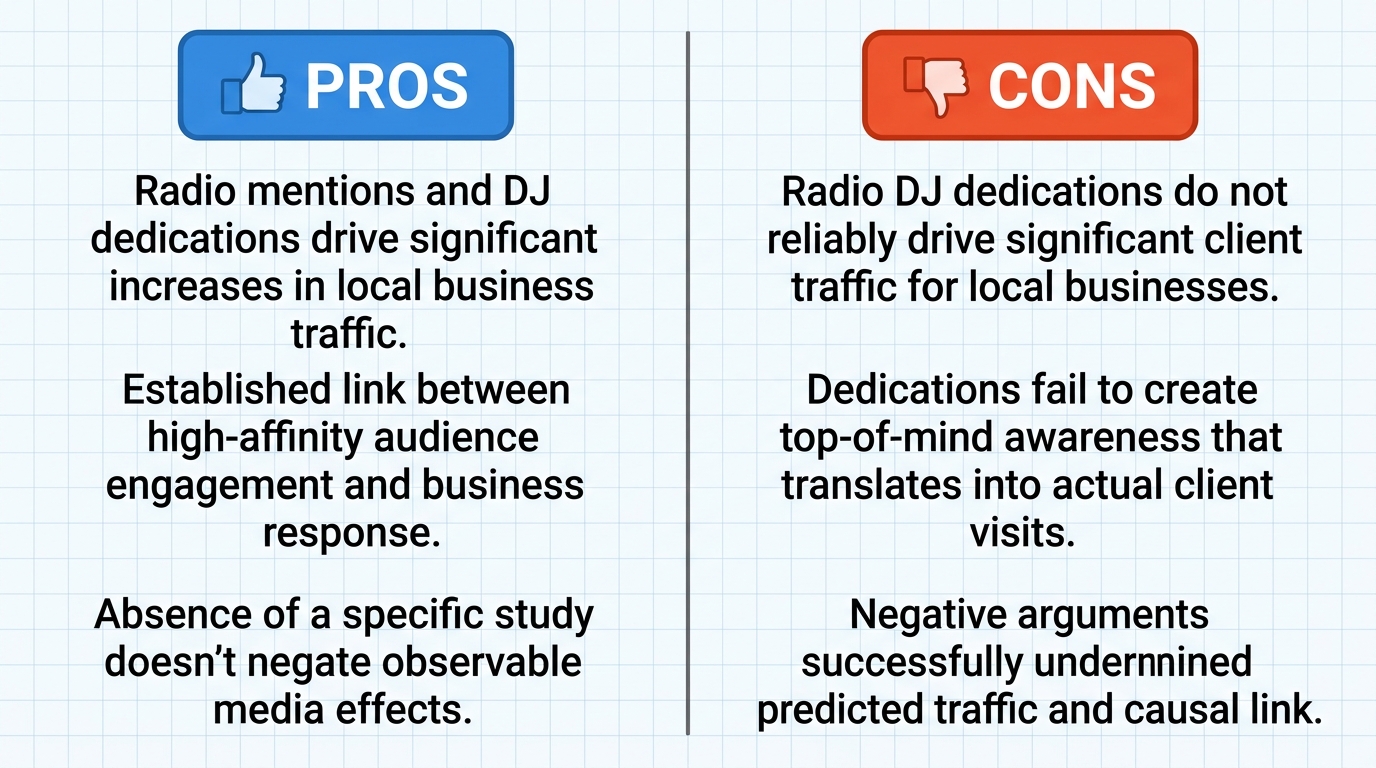
- ■Radio mentions and DJ dedications drive significant increases in local business traffic. The psychological principle of social proof and the 'halo effect ' suggest that an endorsement from a trusted personality, such as a popular DJ, transfers perceived credibility and desirability to the mentioned entity. When a DJ provides a personal dedication, it moves beyond a standard advertisement into the realm of a social recommendation , creating communal awareness and legitimacy for 'Serendipities All-Night Do's.'
- ■The absence of a study specifically titled 'The Impact of DJ Dedications' does not negate the established, verifiable relationship between high-affinity endorsements and consumer conversion . In marketing science , the effectiveness of influencer or personality-driven endorsements is well-documented.
❌ Key ANTI arguments:
- ■Radio DJ dedications do not reliably drive significant client traffic for local businesses. The affirmative's claim rests on theoretical mechanisms—social proof , halo effect , and top-of-mind awareness —but lacks direct empirical evidence that DJ dedications translate into measurable increases in client traffic. Academic literature on advertising effectiveness focuses on broad media channels and campaign metrics rather than the specific practice of DJ dedications.
- ■Radio DJ dedications do not reliably create top-of-mind awareness that translates into actual client visits. The affirmative assumes an untested causal chain : radio mention → top-of-mind awareness → immediate service visit. Advertising research shows that awareness does not automatically lead to actual visits.
💭 Conclusion: False, the debate verdict favored the negative side with 80% judge confidence, and the negative arguments successfully undermined both the predicted traffic increase and the causal link to the DJ's dedication. The affirmative relied on theoretical mechanisms such as social proof and the halo effect without providing direct empirical evidence that DJ dedications produce significant client traffic . The negative side correctly noted that academic advertising research focuses on broad media channels and aggregate metrics , not the specific practice of DJ dedications. The negative also exposed the untested causal chain from a radio mention to top-of-mind awareness to an actual salon visit, noting that awareness does not automatically convert into customers. Therefore, the assertion that 'Serendipities All-Night Do's' will experience a significant increase in client traffic due to the DJ's on-air dedication and mention is not supported by the evidence.
🔬 DeepResearch Result: likely FALSE ❌ (80%)
Assertion: The all-night hair salon 'Serendipities All-Night Do's' will experience a significant increase in client traffic due to the DJ's on-air dedication and mention.
Participating models: gemma-4-26b-a4b-it 💬👁️, glm-4.7-flash 💬
📊 Face-offs: 0 concluded TRUE, 1 concluded FALSE (1 face-offs, 3 models)
📊 Score by side: TRUE=0.00, FALSE=0.80
🏅 Model score changes:
deepseek-v4-flash-0731 💬: +8
✅ PRO Arguments:
- ■Radio mentions and DJ dedications drive significant increases in local business traffic. The psychological principle of social proof and the 'halo effect ' suggest that an endorsement from a trusted personality, such as a popular DJ, transfers perceived credibility and desirability to the mentioned entity. When a DJ provides a personal dedication, it moves beyond a standard advertisement into the realm of a social recommendation , creating communal awareness and legitimacy for 'Serendipities All-Night Do's.' gemma-4-26b-a4b-it 💬👁️
- ■The absence of a study specifically titled 'The Impact of DJ Dedications' does not negate the established, verifiable relationship between high-affinity endorsements and consumer conversion . In marketing science , the effectiveness of influencer or personality-driven endorsements is well-documented. gemma-4-26b-a4b-it 💬👁️
❌ ANTI Arguments:
- ■Radio DJ dedications do not reliably drive significant client traffic for local businesses. The affirmative's claim rests on theoretical mechanisms—social proof, halo effect, and top-of-mind awareness —but lacks direct empirical evidence that DJ dedications translate into measurable increases in client traffic. Academic literature on advertising effectiveness focuses on broad media channels and campaign metrics rather than the specific practice of DJ dedications. glm-4.7-flash 💬
- ■Radio DJ dedications do not reliably create top-of-mind awareness that translates into actual client visits. The affirmative assumes an untested causal chain : radio mention → top-of-mind awareness → immediate service visit. Advertising research shows that awareness does not automatically lead to actual visits. glm-4.7-flash 💬
💭 Reasoning: False, the debate verdict favored the negative side with 80% judge confidence, and the negative arguments successfully undermined both the predicted traffic increase and the causal link to the DJ's dedication. The affirmative relied on theoretical mechanisms such as social proof and the halo effect without providing direct empirical evidence that DJ dedications produce significant client traffic. The negative side correctly noted that academic advertising research focuses on broad media channels and aggregate metrics , not the specific practice of DJ dedications. The negative also exposed the untested causal chain from a radio mention to top-of-mind awareness to an actual salon visit, noting that awareness does not automatically convert into customers. Therefore, the assertion that 'Serendipities All-Night Do's' will experience a significant increase in client traffic due to the DJ's on-air dedication and mention is not supported by the evidence.
📋 PRO Facts:
• Social proof and the halo effect suggest that endorsements from trusted personalities transfer credibility and desirability to the mentioned entity.
• Marketing science has established a relationship between high-affinity endorsements and consumer conversion.
📋 ANTI Facts:
• No direct empirical evidence was provided showing that DJ dedications translate into measurable increases in client traffic for local businesses.
• Academic literature on advertising effectiveness focuses on broad media channels and campaign metrics rather than the specific practice of DJ dedications.
• Advertising research shows that awareness does not automatically lead to actual service visits.
| Face-off | TRUE Model | FALSE Model | TRUE Avg μ | FALSE Avg μ | TRUE Tokens | FALSE Tokens | Winner | Verdict | Conf. |
|---|---|---|---|---|---|---|---|---|---|
| #1 | gemma-4-26b-a4b-it 💬👁️ | glm-4.7-flash 💬 | 0.167 | 0.212 | 2 | 4 | FALSE | FALSE | 80% |
The following technical terms, abbreviations, and domain-specific concepts are referenced throughout this debate transcript. Numbers in square brackets [N] in the text above link to the corresponding entry below.
[1] advertising effectiveness — The degree to which advertising produces measurable outcomes; the negative argues that DJ dedications lack direct empirical evidence of effectiveness.
[2] aggregate metrics — Summary measures such as brand recall, purchase intent, or sales lift used in advertising research; the negative says these do not isolate the effect of DJ dedications.
[3] auditory exposure — Hearing a brand mentioned on radio; the affirmative claims it establishes a cognitive association, while the negative disputes whether the association lasts.
[4] brand recall — A metric measuring whether consumers remember a brand after exposure; the negative notes it is typically tested immediately after exposure.
[5] brand recognition — Consumers' ability to identify a mentioned business after exposure; the affirmative argues a DJ mention creates immediate brand recognition.
[6] campaign metrics — Quantitative measures used to evaluate an advertising campaign; the negative says academic literature focuses on these rather than on dedications.
[7] causal chain — The sequence from radio mention to top-of-mind awareness to service visit; the negative argues this chain is not empirically validated for radio dedications.
[8] celebrity endorsement — A marketing model in which a well-known personality lends credibility to a brand; the affirmative argues DJ dedications are a subset of this validated model.
[9] client acquisition — The process of gaining new customers; the negative argues no controlled studies isolate DJ dedications as a causal factor in client acquisition.
[10] client traffic — The flow of customers into a business; the debate disputes whether a DJ mention will significantly increase it.
[11] cognitive trigger — A mental cue that prompts retrieval of a brand; the affirmative argues repetitive radio timing creates a high-frequency trigger, while the negative calls the mechanism untested.
[12] consumer conversion — The point at which a consumer takes a desired action, such as visiting the business; the affirmative claims endorsements correlate with conversion.
[13] controlled studies — Research studies that isolate a causal factor by controlling variables; the negative says none isolate DJ dedications as a cause of visits.
[14] conversion rate — The percentage of exposures or mentions that result in a desired action, such as a client visit; the negative says verifiable data on this rate is absent.
[15] delayed recall — Memory of a brand measured after a time gap, when a need emerges; the negative argues radio dedications lack evidence of creating lasting delayed recall.
[16] demographic — A consumer group defined by characteristics such as work schedule; the affirmative identifies night-shift workers, travelers, and late-night revelers as the target demographic.
[17] DJ dedication — A personal on-air mention by a radio DJ; the affirmative treats it as a social recommendation, while the negative argues it lacks direct empirical evidence of driving traffic.
[18] halo effect — A psychological bias whereby an endorsement from a trusted personality transfers perceived credibility and desirability to the mentioned entity.
[19] high-affinity endorsements — Endorsements from personalities with strong consumer trust; the affirmative cites a verifiable relationship between these and consumer conversion.
[20] influencer endorsement — A marketing model in which a trusted personality promotes a brand; the affirmative classifies DJ dedications as a functional subset of such endorsements.
[21] marketing science — The academic field studying marketing and advertising effectiveness; the affirmative cites it as validating endorsement models.
[22] media channels — Broad platforms such as radio, television, or digital through which advertising reaches audiences; the negative says research focuses on broad channels.
[23] peak listening hours — Times when radio audiences are largest; the affirmative argues a DJ mention during these hours reaches the target demographic.
[24] purchase intent — A metric measuring consumers' stated likelihood to buy or visit; cited as an aggregate metric in advertising research.
[25] recall tests — Research methods measuring brand memory immediately after exposure; the negative notes top-of-mind awareness is typically measured this way.
[26] sales lift — A measure of the increase in sales attributed to a marketing activity; cited as an aggregate metric in advertising effectiveness studies.
[27] social proof — A psychological principle cited in the debate whereby an endorsement from a trusted personality transfers perceived credibility and desirability to the mentioned entity.
[28] social recommendation — A personal endorsement perceived as coming from a trusted individual rather than as paid advertising; the affirmative argues a DJ dedication functions this way.
[29] sub-channel — A narrower category within a broader marketing channel; the affirmative argues DJ dedications are a sub-channel of endorsements.
[30] systematic review — A research method that aggregates findings from multiple studies; the negative cites systematic reviews of advertising effectiveness.
[31] top-of-mind awareness — A brand recall concept referring to being the first brand a consumer thinks of in a category; the debate disputes whether radio dedications reliably create it.
Face-off transcripts
- ■
Ownership & Trade Secrets. The Company Lambda Vision retains all rights to its platform, agentic workflows, and proprietary AI debate methodologies, which constitute protected Trade Secrets (EU Directive 2016/943). Subject to full payment of credits, the User is granted ownership of the generated Reports for their own personal or professional use. Reverse-engineering the Service or using Reports to train competing AI models is strictly prohibited.
- ■
No Professional Advice. Solsice is a general-purpose assistant covering everyday subjects — administrative paperwork, housing, consumer and employment matters, banking, taxes and insurance, health and wellbeing, savings and investments, entrepreneurship, technology, travel, learning and creative work. Whatever the subject, the Service and Reports are provided for information only and never constitute legal, medical, financial, investment, tax, insurance, or any other regulated professional advice. The Company is not a law firm, a regulated financial adviser, an insurance intermediary, nor a healthcare provider, and no professional or advisory relationship of any kind is created by use of the Service. Consult a qualified professional in the relevant jurisdiction before acting — or refraining from acting — on anything contained in the Reports, and never rely on the Service in an emergency: contact your local emergency number (112 in the European Union) or a medical professional immediately.
- ■
AI-Generated Content, Sources and Viewpoints. Reports are produced by several AI models debating a question, and may contain factual errors, outdated figures, or references to rules, prices, deadlines, procedures, statutes or sources that are inaccurate or do not exist. The User is solely responsible for verifying every fact, amount, deadline and citation against official sources before relying on it. Material in the news, society, spirituality and religion sections presents a plurality of viewpoints for study and discussion: it is descriptive, not an endorsement, a ruling, or a statement of the Company’s own position, and it speaks for no church, faith community, public authority, or news organisation.
- ■
Liability & Governing Law. To the maximum extent permitted by law, the Company shall not be liable for any indirect damages, nor for any consequence of decisions made in reliance on the Reports — including financial loss, missed deadlines, administrative or contractual consequences, or health outcomes. These Terms are governed by French law. Any disputes shall be subject to the exclusive jurisdiction of the Courts of Paris, France.