
The 7th of Marcheshvan signifies a spiritual ascent superior to the Tishrei holidays, as it represents the true work of building a dwelling place for God in the lowest world through mundane life.
AI debate verdict and arguments
⚠️ AI-generated information only; not professional advice
Completed October 14, 2026
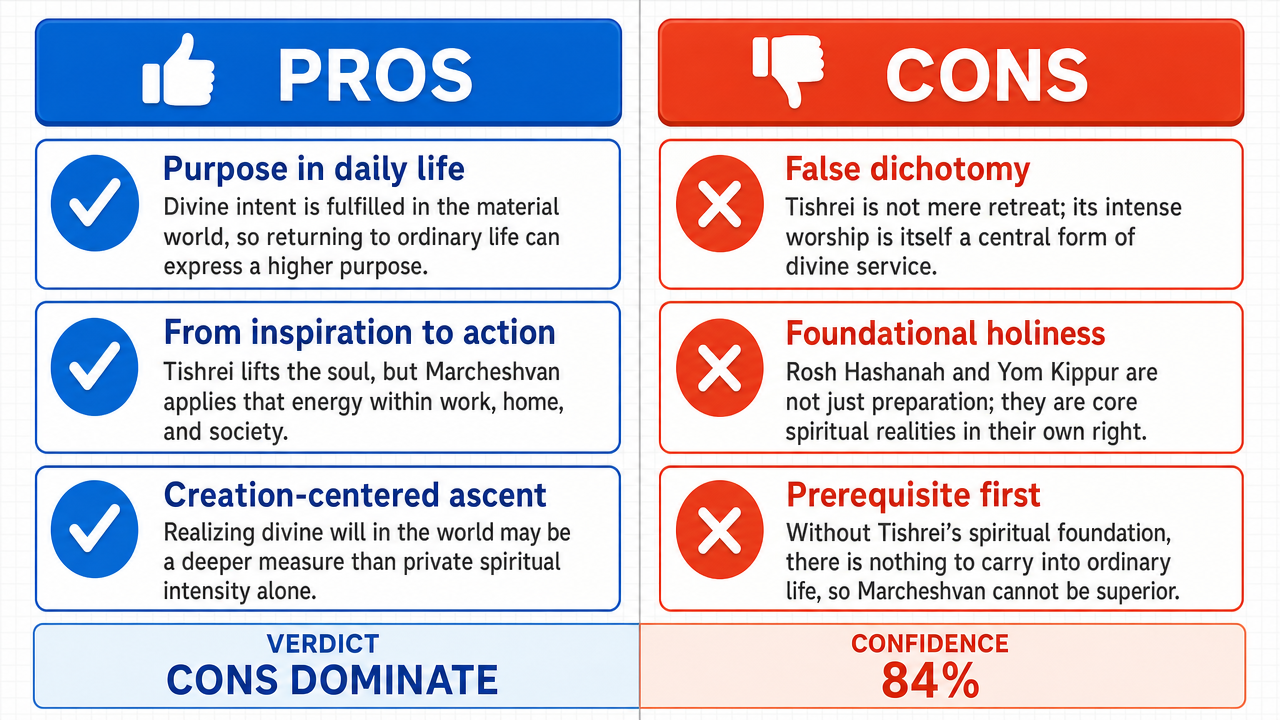
Verdict
Verdict: likely FALSE (84%)
Web Report: https://solsice.com/public/debates/the-7th-of-marcheshvan-signifies-a-spiritual-ascent-superior-509f2afee71e
This section provides a brief overview of the key arguments. You do not need to read the full detailed report below.
✅ Key PRO arguments:
- ■The ultimate divine intent is realized specifically within the material world, not through withdrawal from it, so a date marking the return to mundane life (7th of Marcheshvan ) embodies the deeper purpose of creation.
- ■Tishrei holidays represent a retreat from ordinary life where the soul is elevated but the world remains untouched, whereas Marcheshvan transitions Jews into the routine of the year, enabling permeation of the mundane with received holiness.
- ■Ascent measured by how completely divine will is realized in creation is superior to ascent measured by subjective spiritual intensity, so Marcheshvan 's integrative work surpasses Tishrei in purpose and final cause .
❌ Key ANTI arguments:
- ■The assertion commits a false dichotomy by framing Tishrei 's intense spiritual states as mere 'retreat' or 'isolation' rather than as the primary mechanism by which the 'dwelling place' is defined and built.
- ■The Tishrei holidays are not merely sources of 'powers' (kochos ) to be spent later; Yom Kippur 's Teshuva and Rosh Hashanah 's Yirah are themselves the ontological realignments that constitute the 'true work' the proposition misattributes to Marcheshvan .
- ■Without the spiritual foundation of Tishrei , there would be no resources to actualize in mundane life, so Marcheshvan cannot be superior to its own prerequisite.
💭 Conclusion: False. The assertion is rejected because it rests on a false dichotomy that mischaracterizes the Tishrei holidays as merely preparatory states of retreat, whereas in Jewish liturgy and law they constitute the foundational ontological realignments—Teshuva , Yirah , and Sukkot rejoicing—that themselves define and produce the 'dwelling place' the proposition attributes to mundane work in Marcheshvan . The negative side demonstrated that Marcheshvan presupposes rather than surpasses Tishrei, since without the spiritual resources conferred in Tishrei there is nothing to permeate the material world. Furthermore, the symbolic-to-practical transition of the Geshem prayer does not establish a hierarchy of spiritual significance, as the temporal relationship covers a range of liturgical and physical states that invalidates the asserted superiority. The compound claim's weakest sub-claim—that Marcheshvan surpasses rather than depends on Tishrei—is decisively undermined, and confidence is set at the 84% level the judge awarded rather than overstated.
🔬 DeepResearch Result: likely FALSE ❌ (84%)
Assertion: The 7th of Marcheshvan signifies a spiritual ascent superior to the Tishrei holidays, as it represents the true work of building a dwelling place for God in the lowest world through mundane life.
Participating models: deepseek-v3.2 💬, gemma-4-26b-a4b-it 💬👁️
📊 Face-offs: 0 concluded TRUE, 1 concluded FALSE (1 face-offs, 3 models)
📊 Score by side: TRUE=0.00, FALSE=0.84
🏅 Model score changes:
minimax-m3 💬👁️: +8
✅ PRO Arguments:
- ■The ultimate divine intent is realized specifically within the material world, not through withdrawal from it, so a date marking the return to mundane life (7th of Marcheshvan) embodies the deeper purpose of creation. deepseek-v3.2 💬
- ■Tishrei holidays represent a retreat from ordinary life where the soul is elevated but the world remains untouched, whereas Marcheshvan transitions Jews into the routine of the year, enabling permeation of the mundane with received holiness. deepseek-v3.2 💬
- ■Ascent measured by how completely divine will is realized in creation is superior to ascent measured by subjective spiritual intensity, so Marcheshvan's integrative work surpasses Tishrei in purpose and final cause . deepseek-v3.2 💬
- ■Citing Midrash Tanchuma 's principle of a 'dwelling place in the lower world,' Marcheshvan's task of building sanctity within materiality fulfills the final cause that Tishrei only initiates. deepseek-v3.2 💬
❌ ANTI Arguments:
- ■The assertion commits a false dichotomy by framing Tishrei's intense spiritual states as mere 'retreat' or 'isolation' rather than as the primary mechanism by which the 'dwelling place' is defined and built. gemma-4-26b-a4b-it 💬👁️
- ■The Tishrei holidays are not merely sources of 'powers' (kochos ) to be spent later; Yom Kippur 's Teshuva and Rosh Hashanah 's Yirah are themselves the ontological realignments that constitute the 'true work' the proposition misattributes to Marcheshvan. gemma-4-26b-a4b-it 💬👁️
- ■Without the spiritual foundation of Tishrei, there would be no resources to actualize in mundane life, so Marcheshvan cannot be superior to its own prerequisite. gemma-4-26b-a4b-it 💬👁️
- ■The liturgical timing of Geshem (prayer for rain) does not establish a hierarchy: the transition from recitation on Shemini Atzeret to practical application after the 7th of Marcheshvan spans a range of states that invalidates any claim of Marcheshvan's superior spiritual significance. gemma-4-26b-a4b-it 💬👁️
💭 Reasoning: False. The assertion is rejected because it rests on a false dichotomy that mischaracterizes the Tishrei holidays as merely preparatory states of retreat, whereas in Jewish liturgy and law they constitute the foundational ontological realignments—Teshuva, Yirah, and Sukkot rejoicing—that themselves define and produce the 'dwelling place' the proposition attributes to mundane work in Marcheshvan. The negative side demonstrated that Marcheshvan presupposes rather than surpasses Tishrei, since without the spiritual resources conferred in Tishrei there is nothing to permeate the material world. Furthermore, the symbolic-to-practical transition of the Geshem prayer does not establish a hierarchy of spiritual significance, as the temporal relationship covers a range of liturgical and physical states that invalidates the asserted superiority. The compound claim's weakest sub-claim—that Marcheshvan surpasses rather than depends on Tishrei—is decisively undermined, and confidence is set at the 84% level the judge awarded rather than overstated.
📋 PRO Facts:
• The Midrash Tanchuma principle of building a 'dwelling place in the lower world' is invoked as the ultimate divine intent.
• The 7th of Marcheshvan is identified as the date when the last holiday pilgrim returned home and the rainy season in Israel traditionally begins.
📋 ANTI Facts:
• Tishrei holidays function in Jewish liturgy and law as primary moments of ontological realignment , not merely preparatory retreats.
• The recitation of Geshem on Shemini Atzeret precedes its practical application after the 7th of Marcheshvan, spanning multiple liturgical states without establishing hierarchy.
| Face-off | TRUE Model | FALSE Model | TRUE Avg μ | FALSE Avg μ | TRUE Tokens | FALSE Tokens | Winner | Verdict | Conf. |
|---|---|---|---|---|---|---|---|---|---|
| #1 | deepseek-v3.2 💬 | gemma-4-26b-a4b-it 💬👁️ | 0.526 | 0.343 | 8 | 2 | TRUE | FALSE | 84% |
The following technical terms, abbreviations, and domain-specific concepts are referenced throughout this debate transcript. Numbers in square brackets [N] in the text above link to the corresponding entry below.
[1] Chassidic — Relating to Chassidism, a mystical movement within Orthodox Judaism referenced in this debate as the source of a core principle that the ultimate divine intent is realized within the material world rather than through withdrawal from it.
[2] conjecture à contenu excédentaire — A logical fallacy identified in this debate as the basis for asserting an unobserved hierarchy of spiritual value; in English, a 'conjecture with surplus content'—a hypothesis whose conclusion asserts more than its premises support.
[3] dwelling place for God — A theological concept cited in this debate as the ultimate purpose of integrating holiness into the mundane world, framed as the work that the 7th of Marcheshvan begins.
[4] final cause — An Aristotelian philosophical concept denoting the purpose or end (telos) for which something is done, invoked in this debate to argue that the work of Marcheshvan fulfills the ultimate purpose of divine creation.
[5] Geshem — The Jewish liturgical prayer for rain, recited beginning on Shemini Atzeret; distinguished in this debate between symbolic recitation (in the liturgical calendar) and practical agricultural reliance (after the 7th of Marcheshvan).
[6] Hebrew civil calendar — The Jewish calendrical system in which the civil new year begins with the month of Tishrei, with Marcheshvan as its second month.
[7] kochos — Hebrew term for 'powers' or 'capacities,' used in this debate (in transliteration) to denote the spiritual resources generated during the Tishrei holidays.
[8] lowest world — A Kabbalistic cosmological concept referring to the realm of mundane, material life, described in this debate as the intended site for a dwelling place for God.
[9] Marcheshvan — The second month of the Hebrew civil calendar, immediately following Tishrei; its 7th day is the focal date of this debate, said to mark the transition into the year's routine of mundane divine service.
[10] Midrash Tanchuma — A classical Midrashic (rabbinic homiletic) work cited in this debate as the source of the teaching that the ultimate divine desire is for a dwelling in the lower world.
[11] ontological realignment — A philosophical/theological phrase used in this debate to describe the soul-level transformation effected by the Tishrei holidays, framed by the Negative as the foundational rectification enabling later mundane service.
[12] Rosh Hashanah — The Jewish New Year, a Tishrei holiday characterized in this debate by Yirah (awe) and treated as the opening of the High Holiday season.
[13] Shemini Atzeret — The 'eighth day of assembly,' the Jewish holiday immediately concluding the Sukkot festival; in this debate it marks the point at which the Geshem (rain) prayer is first recited in the liturgy.
[14] Sukkot — The Jewish Feast of Tabernacles, a Tishrei holiday described in this debate as a period of joyous transcendence in which pilgrims would later return home.
[15] Talmud — The central rabbinic text of Jewish law and commentary; cited in this debate specifically via the tractate Yoma 86a for a teaching on the effect of Yom Kippur repentance.
[16] Teshuva — Hebrew term for repentance or return (to God), used in this debate as the defining spiritual activity of Yom Kippur and the mechanism of ontological realignment.
[17] Tishrei — The first month of the Hebrew civil calendar, containing the High Holidays Rosh Hashanah, Yom Kippur, and Sukkot; treated in this debate as a season of extraordinary spiritual retreat preceding Marcheshvan.
[18] Yirah — Hebrew term for awe (often rendered 'fear of God'), used in this debate as the defining spiritual quality of Rosh Hashanah.
[19] Yom Kippur — The Jewish Day of Atonement, the central Tishrei holiday associated in this debate with Teshuva (repentance) and the ontological transformation of the individual.
[20] Yoma 86a — A specific folio (page 86, side a) of the Talmudic tractate Yoma, cited in this debate for the teaching that the repentance of Yom Kippur renders a person 'like a new creation.'
Face-off transcripts
- ■
Ownership & Trade Secrets. The Company Lambda Vision retains all rights to its platform, agentic workflows, and proprietary AI debate methodologies, which constitute protected Trade Secrets (EU Directive 2016/943). Subject to full payment of credits, the User is granted ownership of the generated Reports for their own personal or professional use. Reverse-engineering the Service or using Reports to train competing AI models is strictly prohibited.
- ■
No Professional Advice. Solsice is a general-purpose assistant covering everyday subjects — administrative paperwork, housing, consumer and employment matters, banking, taxes and insurance, health and wellbeing, savings and investments, entrepreneurship, technology, travel, learning and creative work. Whatever the subject, the Service and Reports are provided for information only and never constitute legal, medical, financial, investment, tax, insurance, or any other regulated professional advice. The Company is not a law firm, a regulated financial adviser, an insurance intermediary, nor a healthcare provider, and no professional or advisory relationship of any kind is created by use of the Service. Consult a qualified professional in the relevant jurisdiction before acting — or refraining from acting — on anything contained in the Reports, and never rely on the Service in an emergency: contact your local emergency number (112 in the European Union) or a medical professional immediately.
- ■
AI-Generated Content, Sources and Viewpoints. Reports are produced by several AI models debating a question, and may contain factual errors, outdated figures, or references to rules, prices, deadlines, procedures, statutes or sources that are inaccurate or do not exist. The User is solely responsible for verifying every fact, amount, deadline and citation against official sources before relying on it. Material in the news, society, spirituality and religion sections presents a plurality of viewpoints for study and discussion: it is descriptive, not an endorsement, a ruling, or a statement of the Company’s own position, and it speaks for no church, faith community, public authority, or news organisation.
- ■
Liability & Governing Law. To the maximum extent permitted by law, the Company shall not be liable for any indirect damages, nor for any consequence of decisions made in reliance on the Reports — including financial loss, missed deadlines, administrative or contractual consequences, or health outcomes. These Terms are governed by French law. Any disputes shall be subject to the exclusive jurisdiction of the Courts of Paris, France.