
The 2026 student challenge organized by the French insurance federation will implement the winning student projects.
AI debate verdict and arguments
⚠️ AI-generated information only; not professional advice
Completed October 11, 2026
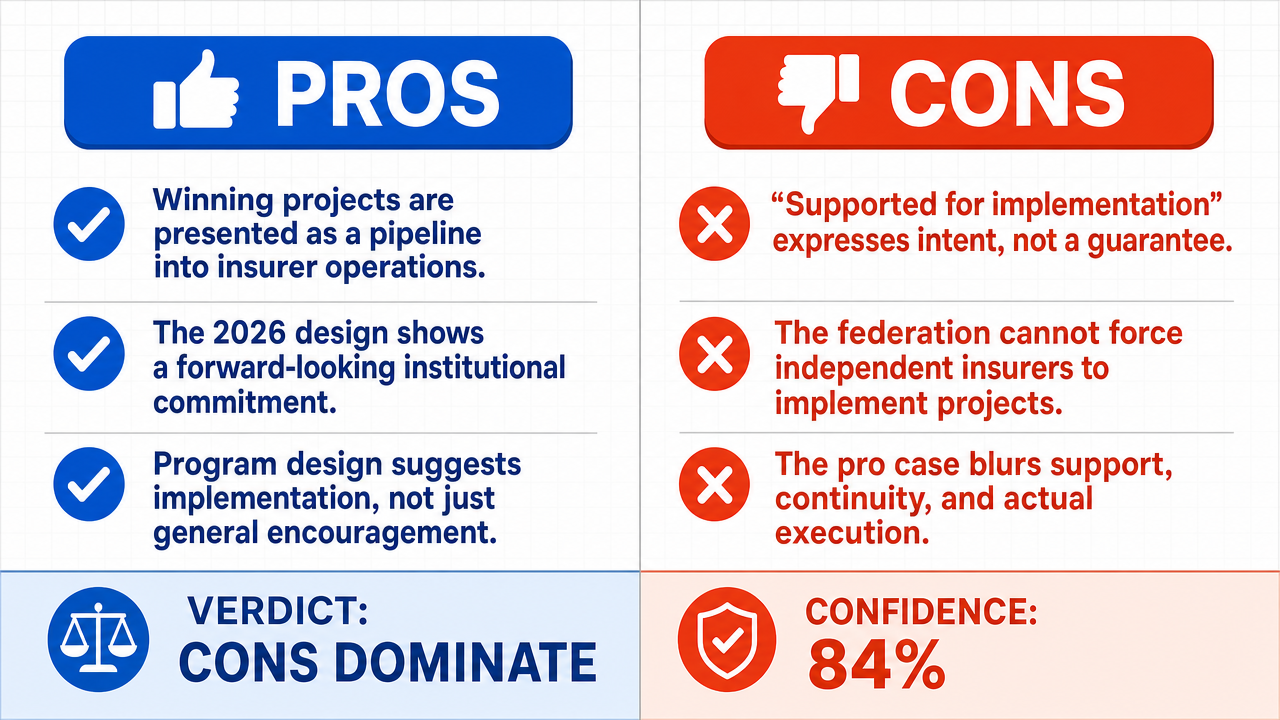
Verdict
Verdict: likely FALSE (84%)
This section provides a brief overview of the key arguments. You do not need to read the full detailed report below.
✅ Key PRO arguments:
- ■The FFA presents the 2026 student challenge as an industry innovation pipeline in which winning student projects are routed to insurance companies for operational rollout , not merely awarded, with the federation 's own announcement framing the prize as support for implementing winning projects.
- ■The 2026 rollout is a forward-looking institutional commitment recorded in the challenge's public design, and the federation 's announcement frames the challenge as a mechanism for turning student proposals into concrete prevention and inclusion actions through member companies .
- ■The affirmative contests that 'support' and 'implement' are mutually exclusive, arguing that the program's stated design is implementation and that the absence of a contractual guarantee does not falsify the claim that the challenge 'will implement' winning projects.
❌ Key ANTI arguments:
- ■The FFA 's announcement states that winning projects will be 'supported' for implementation, but this is a statement of institutional aim, not a contractual guarantee of execution; the decision to move a project from concept to operational reality rests with individual member companies ' risk management , budgetary constraints , and strategic priorities .
- ■The FFA is a federation , not a centralized insurer , and lacks the agency and authority to mandate the implementation of specific student projects within its independent member companies ; its role is that of a facilitator, not an implementer.
- ■The affirmative's reasoning is internally inconsistent: it simultaneously claims the 2026 edition maintains continuity of the 'implementation support ' model while defining that continuity solely through a selection criterion of projects that 'can be carried out,' which describes a post-selection facilitation role rather than an implementation guarantee.
💭 Conclusion: False. The claim that the FFA 's 2026 student challenge 'will implement' winning student projects is not supported because the federation 's role is one of coordination and support, not operational execution. The FFA is a federation of independent member insurers, and it lacks the authority to mandate that any specific winning project be put into production by those companies. While the challenge is designed to facilitate and support the implementation of winning ideas through partnerships, this constitutes an institutional aim rather than a guarantee of execution. The affirmative's argument conflates the stated intent to support implementation with a commitment that implementation will occur, which the negative correctly identified as a logical fallacy . The decision to operationalize any project ultimately rests with individual member companies ' risk, budget, and strategic considerations.
🔬 DeepResearch Result: likely FALSE ❌ (84%)
Assertion: The 2026 student challenge organized by the French insurance federation will implement the winning student projects.
Participating models: deepseek-v3.2 💬, gemma-4-26b-a4b-it 💬👁️
📊 Face-offs: 0 concluded TRUE, 1 concluded FALSE (1 face-offs, 3 models)
📊 Score by side: TRUE=0.00, FALSE=0.84
🏅 Model score changes:
minimax-m3 💬👁️: +8
✅ PRO Arguments:
- ■The FFA presents the 2026 student challenge as an industry innovation pipeline in which winning student projects are routed to insurance companies for operational rollout , not merely awarded, with the federation's own announcement framing the prize as support for implementing winning projects. deepseek-v3.2 💬
- ■The 2026 rollout is a forward-looking institutional commitment recorded in the challenge's public design, and the federation's announcement frames the challenge as a mechanism for turning student proposals into concrete prevention and inclusion actions through member companies . deepseek-v3.2 💬
- ■The affirmative contests that 'support' and 'implement' are mutually exclusive, arguing that the program's stated design is implementation and that the absence of a contractual guarantee does not falsify the claim that the challenge 'will implement' winning projects. deepseek-v3.2 💬
❌ ANTI Arguments:
- ■The FFA's announcement states that winning projects will be 'supported' for implementation, but this is a statement of institutional aim, not a contractual guarantee of execution; the decision to move a project from concept to operational reality rests with individual member companies' risk management , budgetary constraints , and strategic priorities . gemma-4-26b-a4b-it 💬👁️
- ■The FFA is a federation, not a centralized insurer , and lacks the agency and authority to mandate the implementation of specific student projects within its independent member companies; its role is that of a facilitator, not an implementer. gemma-4-26b-a4b-it 💬👁️
- ■The affirmative's reasoning is internally inconsistent: it simultaneously claims the 2026 edition maintains continuity of the 'implementation support ' model while defining that continuity solely through a selection criterion of projects that 'can be carried out,' which describes a post-selection facilitation role rather than an implementation guarantee. gemma-4-26b-a4b-it 💬👁️
- ■The claim that the challenge 'will implement' winning projects conflates institutional intent with operational certainty , and the structural and legal reality of the insurance industry means that moving a project from a mentored concept to an active insurance product remains subject to independent corporate decisions. gemma-4-26b-a4b-it 💬👁️
💭 Reasoning: False. The claim that the FFA's 2026 student challenge 'will implement' winning student projects is not supported because the federation's role is one of coordination and support, not operational execution. The FFA is a federation of independent member insurers, and it lacks the authority to mandate that any specific winning project be put into production by those companies. While the challenge is designed to facilitate and support the implementation of winning ideas through partnerships, this constitutes an institutional aim rather than a guarantee of execution. The affirmative's argument conflates the stated intent to support implementation with a commitment that implementation will occur, which the negative correctly identified as a logical fallacy . The decision to operationalize any project ultimately rests with individual member companies' risk, budget, and strategic considerations.
📋 PRO Facts:
• The FFA presents the 2026 student challenge as an industry innovation pipeline where winning projects are routed to member insurers for operational rollout.
• The federation's announcement frames the prize as support for implementing winning projects rather than merely awarding them.
• The challenge is described as a mechanism for turning student proposals into concrete prevention and inclusion actions through member companies.
📋 ANTI Facts:
• The FFA is a federation, not a centralized insurer, and cannot mandate implementation by its independent member companies.
• The decision to operationalize a project rests with individual member companies' risk management, budgetary constraints, and strategic priorities.
• The FFA's stated aim to 'support' implementation is a facilitator's role, not an implementer's role.
• No contractual guarantee of execution is attached to the winning projects under the 2026 challenge.
| Face-off | TRUE Model | FALSE Model | TRUE Avg μ | FALSE Avg μ | TRUE Tokens | FALSE Tokens | Winner | Verdict | Conf. |
|---|---|---|---|---|---|---|---|---|---|
| #1 | deepseek-v3.2 💬 | gemma-4-26b-a4b-it 💬👁️ | 0.583 | 0.588 | 12 | 3 | FALSE | FALSE | 84% |
The following technical terms, abbreviations, and domain-specific concepts are referenced throughout this debate transcript. Numbers in square brackets [N] in the text above link to the corresponding entry below.
[1] budgetary constraints — Financial limitations on spending that affect an organization's ability to fund projects or operations, cited in the debate as a factor in insurers' implementation decisions.
[2] centralized insurer — An insurance entity operating under unified control from a single headquarters, contrasted in the debate with a federation of independent member companies.
[3] Challenge Étudiants — A student challenge program organized by the FFA, described in the debate as an industry innovation pipeline in which winning projects are supported for implementation by member insurers.
[4] contractual guarantee — A binding assurance within a formal agreement that obligates a party to fulfill specific terms, distinguished in the debate from a statement of institutional aim.
[5] feasibility — The practicality or viability of a project being carried out successfully given available resources and constraints; referenced in the debate as a pre-selection criterion.
[6] federation — An organizational structure in which independent member entities coordinate under a common body while retaining their own decision-making authority.
[7] FFA — Fédération Française de l'Assurance — The French insurance federation, an industry body that coordinates among insurance companies in France and organizes the Challenge Étudiants.
[8] implementation support — Assistance provided to help turn a concept or winning proposal into an operational reality, described in the debate as the stated aim of the FFA challenge.
[9] innovation pipeline — A structured process through which new ideas are sourced, developed, and moved toward operational deployment, used in the debate to describe the FFA challenge's design.
[10] institutional commitment — A formal pledge or stated purpose by an organization to pursue a particular course of action, invoked in the debate as the basis for the affirmative's claim.
[11] institutional intent — The stated aim or purpose of an organization, distinguished in the debate from a binding operational obligation.
[12] insurance product — A financial offering provided by an insurance company, such as a policy or coverage plan, cited as the type of output that implementation would produce.
[13] logical conflation — The error of treating two distinct concepts as if they were equivalent or interchangeable, identified in the debate as the affirmative's alleged error in equating feasibility with implementation.
[14] logical fallacy — An error in reasoning that undermines the validity of an argument, cited in the debate regarding the affirmative's framing of the challenge.
[15] member companies — Independent firms that belong to a federation or industry association while retaining their own corporate autonomy and decision-making authority.
[16] necessary condition — A requirement that must be met for a given outcome to occur, though meeting it alone does not guarantee the outcome; referenced in the debate regarding feasibility versus implementation.
[17] operational certainty — Assured execution of a plan or project in practice, as opposed to a stated intention or aim.
[18] operational rollout — The process of deploying a project or initiative into active use within an organization, described in the debate as the endpoint of the FFA challenge's pipeline.
[19] prevention and inclusion actions — Initiatives aimed at reducing risk and promoting broader participation, referenced in the debate as the intended real-world outputs of winning student projects.
[20] regulatory discretion — The latitude granted to regulated entities to make independent decisions within the bounds of applicable rules, cited as a factor in insurers' implementation choices.
[21] risk management — The identification, assessment, and mitigation of potential losses or uncertainties faced by an organization, cited as a factor in member insurers' implementation decisions.
[22] selection criteria — The standards used to evaluate and choose among competing proposals or candidates, referenced in the debate as including feasibility checks.
[23] strategic priorities — The key objectives that guide an organization's long-term planning and resource allocation, cited as a factor in insurers' implementation decisions.
[24] youth-participation — The involvement of young people in activities or decision-making processes, referenced in the debate as a social function of the FFA challenge.
Face-off transcripts
- ■
Ownership & Trade Secrets. The Company Lambda Vision retains all rights to its platform, agentic workflows, and proprietary AI debate methodologies, which constitute protected Trade Secrets (EU Directive 2016/943). Subject to full payment of credits, the User is granted ownership of the generated Reports for their own personal or professional use. Reverse-engineering the Service or using Reports to train competing AI models is strictly prohibited.
- ■
No Professional Advice. Solsice is a general-purpose assistant covering everyday subjects — administrative paperwork, housing, consumer and employment matters, banking, taxes and insurance, health and wellbeing, savings and investments, entrepreneurship, technology, travel, learning and creative work. Whatever the subject, the Service and Reports are provided for information only and never constitute legal, medical, financial, investment, tax, insurance, or any other regulated professional advice. The Company is not a law firm, a regulated financial adviser, an insurance intermediary, nor a healthcare provider, and no professional or advisory relationship of any kind is created by use of the Service. Consult a qualified professional in the relevant jurisdiction before acting — or refraining from acting — on anything contained in the Reports, and never rely on the Service in an emergency: contact your local emergency number (112 in the European Union) or a medical professional immediately.
- ■
AI-Generated Content, Sources and Viewpoints. Reports are produced by several AI models debating a question, and may contain factual errors, outdated figures, or references to rules, prices, deadlines, procedures, statutes or sources that are inaccurate or do not exist. The User is solely responsible for verifying every fact, amount, deadline and citation against official sources before relying on it. Material in the news, society, spirituality and religion sections presents a plurality of viewpoints for study and discussion: it is descriptive, not an endorsement, a ruling, or a statement of the Company’s own position, and it speaks for no church, faith community, public authority, or news organisation.
- ■
Liability & Governing Law. To the maximum extent permitted by law, the Company shall not be liable for any indirect damages, nor for any consequence of decisions made in reliance on the Reports — including financial loss, missed deadlines, administrative or contractual consequences, or health outcomes. These Terms are governed by French law. Any disputes shall be subject to the exclusive jurisdiction of the Courts of Paris, France.