
The 2023 construction of only 55 miles of high-voltage transmission lines in the US indicates a critical failure of utility companies to invest in essential grid infrastructure.
AI debate verdict and arguments
⚠️ AI-generated information only; not professional advice
Completed October 8, 2026
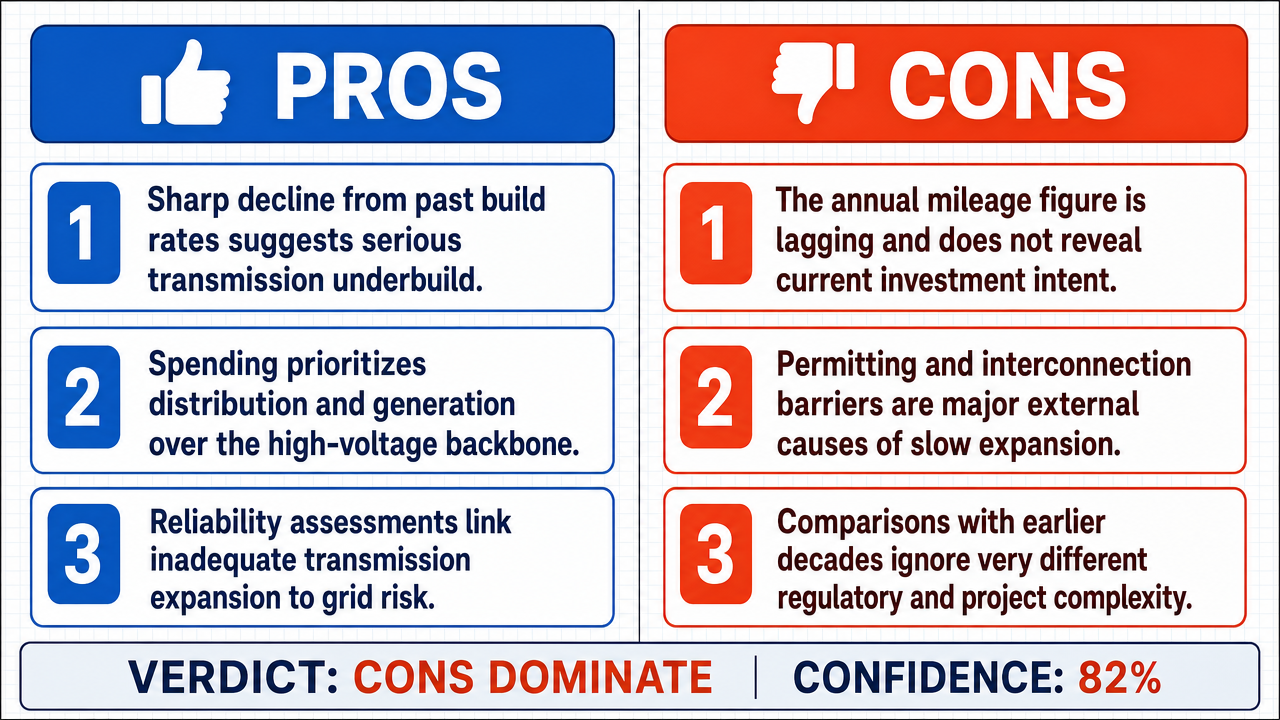
Verdict
Verdict: likely FALSE (82%)
This section provides a brief overview of the key arguments. You do not need to read the full detailed report below.
✅ Key PRO arguments:
- ■The 55-mile figure represents a collapse from over 1,000 miles of high-voltage transmission built annually in the 1990s and early 2000s, placing the U.S. on track to achieve less than 10% of the 60% transmission expansion the Department of Energy states is needed by 2030.
- ■Utility capital expenditure is disproportionately directed toward distribution and generation rather than the high-voltage backbone , indicating a misallocation of investment away from the core bottleneck.
- ■The NERC 2023 Long-Term Reliability Assessment identifies insufficient transmission build as a driver of grid reliability risk , demonstrating documented consequences of underinvestment .
❌ Key ANTI arguments:
- ■The 55-mile figure is a lagging indicator that cannot diagnose investment intent because high-voltage transmission projects have multi-decade lifecycles and extreme regulatory lead times of 5–10 years, meaning 2023 completions reflect decisions made years earlier.
- ■The primary barriers to grid expansion are external structural constraints—specifically complex multi-jurisdictional permitting processes and the massive interconnection queue backlog—rather than a lack of utility capital.
- ■Historical comparisons to the 1990s fail due to a lack of scale invariance; the regulatory environment, project complexity, and stakeholder requirements are fundamentally different today, making direct mileage comparisons misleading.
💭 Conclusion: False. The 55-mile figure for 2023 high-voltage transmission construction is best understood as a lagging indicator shaped by multi-decade project lifecycles and 5–10 year permitting lead times , rather than as direct evidence of a critical utility investment failure. The primary barriers to grid expansion are external structural constraints—multi-jurisdictional permitting processes and an interconnection queue backlog exceeding 2,000 GW —rather than a lack of utility capital deployment. Historical comparisons to the 1990s, when over 1,000 miles were built annually, fail because the regulatory environment and project complexity have fundamentally changed, undermining the scale-invariance of the affirmative's argument. The NERC 2023 LTRA identifies reliability risk as multifaceted, involving fuel supply volatility and extreme weather alongside transmission, so it cannot be read as a standalone indictment of utility investment. While the affirmative correctly notes that the U.S. is far short of the DOE 's 60% expansion target by 2030, the gap reflects systemic permitting and planning bottlenecks more than a deliberate failure by utilities to invest.
🔬 DeepResearch Result: likely FALSE ❌ (82%)
Assertion: The 2023 construction of only 55 miles of high-voltage transmission lines in the US indicates a critical failure of utility companies to invest in essential grid infrastructure .
Participating models: deepseek-v3.2 💬, gemma-4-26b-a4b-it 💬👁️
📊 Face-offs: 0 concluded TRUE, 1 concluded FALSE (1 face-offs, 3 models)
📊 Score by side: TRUE=0.00, FALSE=0.82
🏅 Model score changes:
minimax-m3 💬👁️: +8
✅ PRO Arguments:
- ■The 55-mile figure represents a collapse from over 1,000 miles of high-voltage transmission built annually in the 1990s and early 2000s, placing the U.S. on track to achieve less than 10% of the 60% transmission expansion the Department of Energy states is needed by 2030. deepseek-v3.2 💬
- ■Utility capital expenditure is disproportionately directed toward distribution and generation rather than the high-voltage backbone , indicating a misallocation of investment away from the core bottleneck. deepseek-v3.2 💬
- ■The NERC 2023 Long-Term Reliability Assessment identifies insufficient transmission build as a driver of grid reliability risk , demonstrating documented consequences of underinvestment . deepseek-v3.2 💬
- ■The interconnection queue backlog exceeding 2,000 GW is itself a direct consequence of utility companies failing to invest in the transmission capacity needed to study and connect new projects, so regulatory bottlenecks cannot be blamed solely on administrative friction. deepseek-v3.2 💬
❌ ANTI Arguments:
- ■The 55-mile figure is a lagging indicator that cannot diagnose investment intent because high-voltage transmission projects have multi-decade lifecycles and extreme regulatory lead times of 5–10 years, meaning 2023 completions reflect decisions made years earlier. gemma-4-26b-a4b-it 💬👁️
- ■The primary barriers to grid expansion are external structural constraints—specifically complex multi-jurisdictional permitting processes and the massive interconnection queue backlog —rather than a lack of utility capital. gemma-4-26b-a4b-it 💬👁️
- ■Historical comparisons to the 1990s fail due to a lack of scale invariance; the regulatory environment, project complexity, and stakeholder requirements are fundamentally different today, making direct mileage comparisons misleading. gemma-4-26b-a4b-it 💬👁️
- ■The NERC 2023 LTRA characterizes reliability risk as a multifaceted phenomenon involving fuel supply volatility , extreme weather events, and other factors—not solely transmission build—so it cannot be read as a direct indictment of utility investment. gemma-4-26b-a4b-it 💬👁️
- ■Utilities are deploying capital into transmission but face structural constraints beyond their control, meaning low annual mileage reflects systemic permitting and planning bottlenecks rather than a failure of investment intent. gemma-4-26b-a4b-it 💬👁️
💭 Reasoning: False. The 55-mile figure for 2023 high-voltage transmission construction is best understood as a lagging indicator shaped by multi-decade project lifecycles and 5–10 year permitting lead times , rather than as direct evidence of a critical utility investment failure. The primary barriers to grid expansion are external structural constraints—multi-jurisdictional permitting processes and an interconnection queue backlog exceeding 2,000 GW—rather than a lack of utility capital deployment. Historical comparisons to the 1990s, when over 1,000 miles were built annually, fail because the regulatory environment and project complexity have fundamentally changed, undermining the scale-invariance of the affirmative's argument. The NERC 2023 LTRA identifies reliability risk as multifaceted, involving fuel supply volatility and extreme weather alongside transmission, so it cannot be read as a standalone indictment of utility investment. While the affirmative correctly notes that the U.S. is far short of the DOE 's 60% expansion target by 2030, the gap reflects systemic permitting and planning bottlenecks more than a deliberate failure by utilities to invest.
📋 PRO Facts:
• The U.S. added over 1,000 miles of high-voltage transmission annually in the 1990s and early 2000s.
• The Department of Energy states the nation needs to expand transmission systems by 60% by 2030.
• The interconnection queue backlog exceeds 2,000 GW.
• The NERC 2023 Long-Term Reliability Assessment identifies insufficient transmission build as a reliability concern.
📋 ANTI Facts:
• High-voltage transmission projects face 5–10 year permitting lead times.
• The NERC 2023 LTRA characterizes reliability risk as multifaceted, including fuel supply volatility and extreme weather events.
• Multi-jurisdictional permitting processes are a primary external barrier to grid expansion.
• The 55-mile figure is a lagging indicator reflecting decisions made years earlier due to multi-decade project lifecycles.
| Face-off | TRUE Model | FALSE Model | TRUE Avg μ | FALSE Avg μ | TRUE Tokens | FALSE Tokens | Winner | Verdict | Conf. |
|---|---|---|---|---|---|---|---|---|---|
| #1 | deepseek-v3.2 💬 | gemma-4-26b-a4b-it 💬👁️ | 0.518 | 0.387 | 12 | 3 | TRUE | FALSE | 82% |
The following technical terms, abbreviations, and domain-specific concepts are referenced throughout this debate transcript. Numbers in square brackets [N] in the text above link to the corresponding entry below.
[1] congestion costs — Costs incurred on the electrical grid when transmission capacity is insufficient to deliver the lowest-cost electricity to demand centers. The debate cites over $20 billion annually in such costs borne by consumers.
[2] construction velocity — The rate at which new infrastructure, such as transmission lines, is built and brought online over a given period.
[3] de facto bottleneck — A constraint that functions as a bottleneck in practice, even if not formally designated as one; used in the debate to characterize the interconnection queue.
[4] decentralized grid — An electrical grid characterized by distributed energy resources and generation sources located closer to end users, rather than centralized large-scale power plants.
[5] deregulated — Referring to electricity markets where generation and transmission services are separated and subject to competitive market forces rather than monopoly utility control.
[6] distribution networks — The lower-voltage portion of the electrical grid that delivers electricity from substations to end-use customers.
[7] Docket No. RM22-14-000 — The Federal Energy Regulatory Commission docket number for its proceeding on interconnection queue reform, cited in the debate in connection with FERC Order No. 2023.
[8] DOE — Department of Energy — The U.S. federal department responsible for energy policy and energy research, cited in the debate for transmission expansion targets.
[9] DOE National Transmission Needs Study — A Department of Energy analysis cited in the debate as stating the U.S. needs to expand transmission systems by 60% by 2030 to integrate renewables and ensure reliability.
[10] fallacy of composition — A logical error in which what is true of individual parts is assumed to be true of the whole system; used in the debate to critique isolating transmission as the primary driver of grid reliability risk.
[11] FERC — Federal Energy Regulatory Commission — The U.S. federal agency that regulates the interstate transmission of electricity, natural gas, and oil, cited in the debate regarding interconnection procedures.
[12] FERC Order No. 2023 — A Federal Energy Regulatory Commission order issued July 28, 2023, addressing reforms to the interconnection queue process, cited in the debate.
[13] firm generation — Electricity generation from sources that can be dispatched on demand and are not dependent on weather or time of day, such as fossil fuel or nuclear plants.
[14] fuel supply volatility — Variability and unpredictability in the availability and pricing of fuels used for electricity generation, cited in the debate as a contributor to grid reliability risk.
[15] generation — The production of electricity from various energy sources, including fossil fuels, nuclear, and renewables.
[16] grid infrastructure — The physical network of power plants, transmission lines, substations, and distribution systems that deliver electricity from producers to consumers.
[17] grid reliability risk — The risk that the electrical grid will fail to deliver electricity consistently and adequately to meet demand.
[18] grid-edge technologies — Technologies deployed at the distribution level of the electrical grid, such as smart meters, distributed energy resources, and demand response systems.
[19] GW — gigawatts — A unit of electrical power equal to one billion watts, used in the debate to measure interconnection queue backlogs (cited as exceeding 2,000 GW).
[20] high-voltage backbone — The core long-distance high-voltage transmission network that moves large quantities of electricity across regions.
[21] high-voltage transmission lines — Electrical transmission lines operating at high voltages (typically 230 kV and above) used to move bulk electricity over long distances.
[22] interconnection queue — A list of proposed generation and storage projects awaiting study and connection to the electrical grid by the transmission owner.
[23] interconnection queue backlog — The accumulation of proposed energy projects awaiting processing and approval to connect to the electrical grid. The debate cites this backlog as exceeding 2,000 GW.
[24] interconnection requests — Formal applications submitted by project developers to connect new generation or storage facilities to the electrical grid.
[25] intermittency of renewable resources — The variable and non-dispatchable nature of renewable energy sources like solar and wind, which depend on weather and time of day.
[26] lagging indicator — A metric that reflects past activity or outcomes rather than current conditions; used in the debate to argue that annual construction figures cannot diagnose current investment intent.
[27] lead time — The time required to plan, permit, and construct a project before it becomes operational. The debate cites lead times often exceeding a decade for high-voltage transmission projects.
[28] Long-Term Reliability Assessment (LTRA) — An annual report published by NERC evaluating the future reliability of the North American bulk power system over a 10-year horizon.
[29] misallocation — The deployment of capital or resources toward uses that do not address the most critical needs; used in the debate to characterize utility spending patterns.
[30] multi-decade lifecycles — The extended planning, permitting, construction, and operational periods characteristic of large-scale transmission infrastructure projects.
[31] multi-jurisdictional permitting processes — Regulatory approval processes that require coordination across multiple federal, state, and local authorities, cited as a barrier to transmission construction.
[32] NERC — North American Electric Reliability Corporation — The nonprofit organization responsible for developing and enforcing reliability standards for the North American bulk power system.
[33] NERC 2023 LTRA — The 2023 Long-Term Reliability Assessment published by NERC, cited in the debate as identifying insufficient transmission build as a contributor to elevated reliability risk.
[34] permitting lead times — The duration required to obtain regulatory approvals for infrastructure projects. The debate cites 5–10 year permitting lead times for transmission projects.
[35] permitting processes — The regulatory procedures required to obtain approval for infrastructure projects, involving federal, state, and local review.
[36] regulatory bottlenecks — Constraints in the approval and authorization processes that slow or prevent infrastructure development, cited in the debate as an alternative explanation for low transmission construction.
[37] transmission owners — Utilities or other entities that own and operate high-voltage transmission facilities and are responsible for processing interconnection requests.
[38] transmission shortfall — A deficit in the amount of new transmission infrastructure built relative to identified needs or targets.
[39] underinvestment — Investment spending that falls below the level required to maintain, expand, or modernize infrastructure adequately.
[40] utility capital expenditure — Spending by utility companies on physical assets and infrastructure, including generation, transmission, and distribution facilities.
The following financial data tables were referenced during the debate exchanges:
| Metric | Estimated Value | Context |
|---|---|---|
| Interconnection Queue Backlog | >2,000 GW | Capacity waiting for grid access |
| Average Permitting Lead Time | 5–10 Years | For multi-state transmission |
| Utility Capital Expenditure Trend | Increasing | Consistent YoY growth in grid hardening |
Legend: Estimates regarding the US power grid interconnection and regulatory environment. Values are approximate based on industry reporting.
Face-off transcripts
- ■
Ownership & Trade Secrets. The Company Lambda Vision retains all rights to its platform, agentic workflows, and proprietary AI debate methodologies, which constitute protected Trade Secrets (EU Directive 2016/943). Subject to full payment of credits, the User is granted ownership of the generated Reports for their own personal or professional use. Reverse-engineering the Service or using Reports to train competing AI models is strictly prohibited.
- ■
No Professional Advice. Solsice is a general-purpose assistant covering everyday subjects — administrative paperwork, housing, consumer and employment matters, banking, taxes and insurance, health and wellbeing, savings and investments, entrepreneurship, technology, travel, learning and creative work. Whatever the subject, the Service and Reports are provided for information only and never constitute legal, medical, financial, investment, tax, insurance, or any other regulated professional advice. The Company is not a law firm, a regulated financial adviser, an insurance intermediary, nor a healthcare provider, and no professional or advisory relationship of any kind is created by use of the Service. Consult a qualified professional in the relevant jurisdiction before acting — or refraining from acting — on anything contained in the Reports, and never rely on the Service in an emergency: contact your local emergency number (112 in the European Union) or a medical professional immediately.
- ■
AI-Generated Content, Sources and Viewpoints. Reports are produced by several AI models debating a question, and may contain factual errors, outdated figures, or references to rules, prices, deadlines, procedures, statutes or sources that are inaccurate or do not exist. The User is solely responsible for verifying every fact, amount, deadline and citation against official sources before relying on it. Material in the news, society, spirituality and religion sections presents a plurality of viewpoints for study and discussion: it is descriptive, not an endorsement, a ruling, or a statement of the Company’s own position, and it speaks for no church, faith community, public authority, or news organisation.
- ■
Liability & Governing Law. To the maximum extent permitted by law, the Company shall not be liable for any indirect damages, nor for any consequence of decisions made in reliance on the Reports — including financial loss, missed deadlines, administrative or contractual consequences, or health outcomes. These Terms are governed by French law. Any disputes shall be subject to the exclusive jurisdiction of the Courts of Paris, France.