
The 1988 Seoul Olympics significantly contributed to the systematic rounding up and confinement of homeless people, disabled individuals, and 'lost children' in centers like the Brothers Home in Busan.
AI debate verdict and arguments
⚠️ AI-generated information only; not professional advice
Completed October 8, 2026
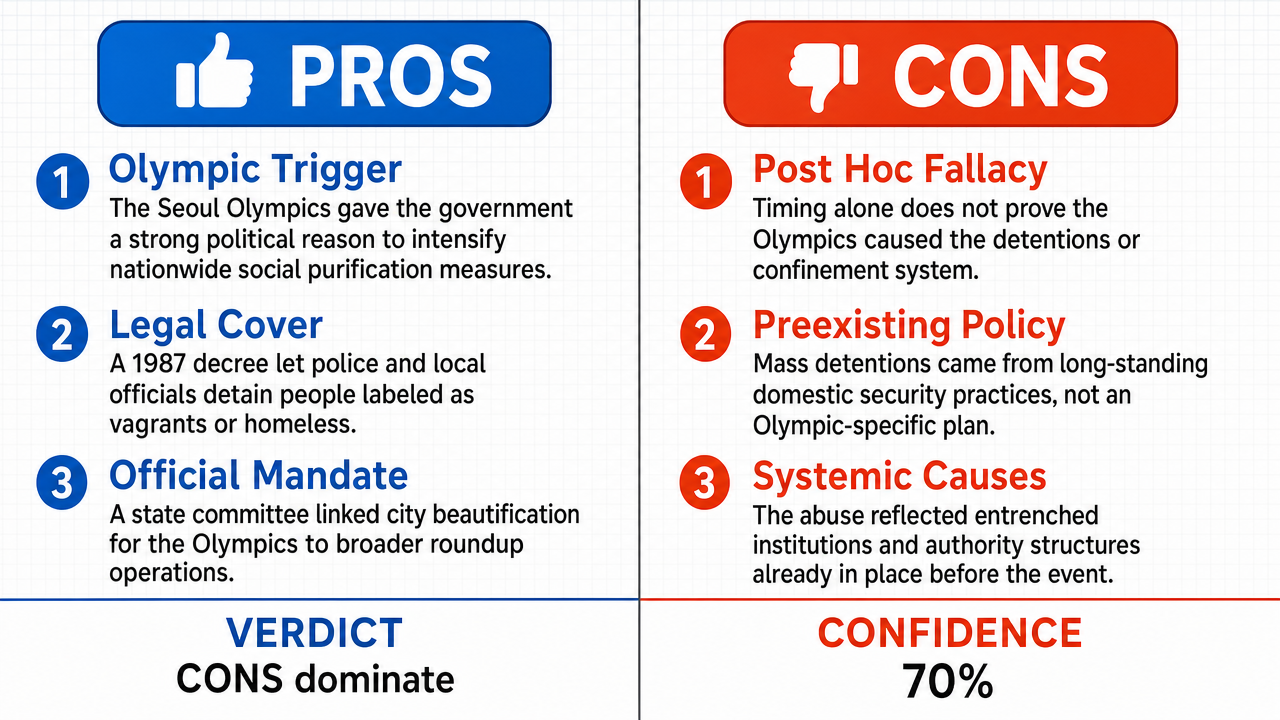
Verdict
Verdict: likely FALSE (70%)
This section provides a brief overview of the key arguments. You do not need to read the full detailed report below.
✅ Key PRO arguments:
- ■The Seoul Olympics provided the political impetus and legal cover for a nationwide 'purification' campaign, with President Chun Doo-hwan's government issuing directives to local authorities to 'beautify' cities and clear streets to present a modern image to the world.
- ■A 1987 presidential decree , 'Measures for the Protection of Social Order ,' empowered police and local officials to detain vagrants and homeless individuals, providing legal authority for the crackdown.
- ■The government's Social Purification Committee , established in 1986, was explicitly tasked with 'beautifying the city environment for the Olympics,' with operational guidelines ordering removal of vagrants to improve Seoul's 'international image.'
❌ Key ANTI arguments:
- ■The affirmative's argument commits a post hoc ergo propter hoc fallacy, mistaking temporal correlation for causation; the institutional structures and 'purification' directives were products of the authoritarian administration's long-standing domestic security and urban management doctrines that predated the Olympic bid.
- ■Mass detentions were not motivated by Olympic-related 'beautification' but were the result of long-standing, systemic domestic security policies; by contraposition , because the institutional frameworks , legal decrees, and administrative capacity for mass detention were already established and functional, the motive cannot be attributed to the Olympics.
- ■The confinement of homeless and disabled individuals was not an event-driven phenomenon caused by the Olympics but rather the result of pre-existing, systemic state policies designed to maintain social order and domestic security under the authoritarian regime .
💭 Conclusion: False. The winning FALSE side successfully argued that the affirmative's case rests on a post hoc ergo propter hoc fallacy, mistaking temporal correlation for causation. The institutional frameworks , legal decrees, and administrative capacity for mass detention of vulnerable populations were products of South Korea's long-standing authoritarian domestic security and urban management doctrines, predating the Olympic bid. While the affirmative cited the 1987 'Measures for the Protection of Social Order ' decree and the Social Purification Committee , the negative side effectively demonstrated that these were continuations of pre-existing policies rather than Olympic-driven innovations. The temporal overlap between intensified enforcement and Olympic preparations does not establish that the Olympics were the 'significant' contributing factor claimed in the assertion, as the underlying systems of confinement were already operational. The compound nature of the claim—linking the Olympics specifically to systematic confinement of multiple vulnerable groups in facilities like Brothers Home—remains insufficiently supported given that the causal chain runs through broader authoritarian social control policies rather than Olympic-specific motivations.
🔬 DeepResearch Result: likely FALSE ❌ (70%)
Assertion: The 1988 Seoul Olympics significantly contributed to the systematic rounding up and confinement of homeless people, disabled individuals, and 'lost children' in centers like the Brothers Home in Busan.
Participating models: deepseek-v3.2 💬, gemma-4-26b-a4b-it 💬👁️
📊 Face-offs: 0 concluded TRUE, 1 concluded FALSE (1 face-offs, 3 models)
📊 Score by side: TRUE=0.00, FALSE=0.70
🏅 Model score changes:
minimax-m3 💬👁️: +7
✅ PRO Arguments:
- ■The Seoul Olympics provided the political impetus and legal cover for a nationwide 'purification' campaign, with President Chun Doo-hwan's government issuing directives to local authorities to 'beautify' cities and clear streets to present a modern image to the world. deepseek-v3.2 💬
- ■A 1987 presidential decree , 'Measures for the Protection of Social Order ,' empowered police and local officials to detain vagrants and homeless individuals, providing legal authority for the crackdown. deepseek-v3.2 💬
- ■The government's Social Purification Committee , established in 1986, was explicitly tasked with 'beautifying the city environment for the Olympics,' with operational guidelines ordering removal of vagrants to improve Seoul's 'international image.' deepseek-v3.2 💬
- ■The scale of the crackdown peaked in 1987-1988 and sharply declined post-Games, demonstrating an event-driven campaign rather than a continuous policy, and state-sanctioned funding of facilities like Brothers Home with per-diem payments created a detention infrastructure tied to Olympic preparations. deepseek-v3.2 💬
❌ ANTI Arguments:
- ■The affirmative's argument commits a post hoc ergo propter hoc fallacy, mistaking temporal correlation for causation; the institutional structures and 'purification' directives were products of the authoritarian administration's long-standing domestic security and urban management doctrines that predated the Olympic bid. gemma-4-26b-a4b-it 💬👁️
- ■Mass detentions were not motivated by Olympic-related 'beautification' but were the result of long-standing, systemic domestic security policies; by contraposition , because the institutional frameworks , legal decrees, and administrative capacity for mass detention were already established and functional, the motive cannot be attributed to the Olympics. gemma-4-26b-a4b-it 💬👁️
- ■The confinement of homeless and disabled individuals was not an event-driven phenomenon caused by the Olympics but rather the result of pre-existing, systemic state policies designed to maintain social order and domestic security under the authoritarian regime . gemma-4-26b-a4b-it 💬👁️
- ■The legal and administrative infrastructure for mass detention existed independently of Olympic planning, meaning the Olympics at most coincided with intensified enforcement of pre-existing policies rather than driving the policy itself. gemma-4-26b-a4b-it 💬👁️
💭 Reasoning: False. The winning FALSE side successfully argued that the affirmative's case rests on a post hoc ergo propter hoc fallacy, mistaking temporal correlation for causation. The institutional frameworks, legal decrees, and administrative capacity for mass detention of vulnerable populations were products of South Korea's long-standing authoritarian domestic security and urban management doctrines, predating the Olympic bid. While the affirmative cited the 1987 'Measures for the Protection of Social Order' decree and the Social Purification Committee, the negative side effectively demonstrated that these were continuations of pre-existing policies rather than Olympic-driven innovations. The temporal overlap between intensified enforcement and Olympic preparations does not establish that the Olympics were the 'significant' contributing factor claimed in the assertion, as the underlying systems of confinement were already operational. The compound nature of the claim—linking the Olympics specifically to systematic confinement of multiple vulnerable groups in facilities like Brothers Home—remains insufficiently supported given that the causal chain runs through broader authoritarian social control policies rather than Olympic-specific motivations.
📋 PRO Facts:
• A 1987 presidential decree 'Measures for the Protection of Social Order' empowered police to detain vagrants and homeless individuals.
• The Social Purification Committee was established in 1986 with a stated mandate related to 'beautifying the city environment for the Olympics.'
• The scale of detentions reportedly peaked in 1987-1988 and declined after the Games concluded.
• Facilities like Brothers Home received state funding through per-diem payments for detained individuals.
📋 ANTI Facts:
• South Korea's authoritarian domestic security and urban management doctrines predated the Olympic bid and the 1986 establishment of the Social Purification Committee.
• The institutional and legal infrastructure for mass detention of vagrants was already established and functional before Olympic preparations intensified.
• The confinement of vulnerable populations was consistent with broader authoritarian social control policies unrelated to international sporting events.
• Temporal correlation between the Olympics and intensified enforcement does not establish the Olympics as the primary causal driver.
| Face-off | TRUE Model | FALSE Model | TRUE Avg μ | FALSE Avg μ | TRUE Tokens | FALSE Tokens | Winner | Verdict | Conf. |
|---|---|---|---|---|---|---|---|---|---|
| #1 | deepseek-v3.2 💬 | gemma-4-26b-a4b-it 💬👁️ | 0.440 | 0.342 | 12 | 3 | TRUE | FALSE | 70% |
The following technical terms, abbreviations, and domain-specific concepts are referenced throughout this debate transcript. Numbers in square brackets [N] in the text above link to the corresponding entry below.
[1] administrative capacity — The ability of governmental institutions and bureaucracies to implement policies, enforce laws, and manage public operations at scale.
[2] anomaly — In argumentation, an observation or data point that does not fit an expected pattern and must be accounted for or explained by a theory.
[3] authoritarian regime — A system of government characterized by strong centralized power, limited political pluralism, and suppression of dissent, often exercised through coercive state apparatus.
[4] contraposition — A logical inference in which one derives the contrapositive of a conditional statement; used in debate to argue that negating the consequent negates the antecedent.
[5] democratic transition — The process by which a country moves from an authoritarian or non-democratic political system toward a democratic one, often involving political volatility and institutional reform.
[6] domestic security — State policies and operations aimed at maintaining internal order, controlling dissent, and managing perceived threats within a nation's borders.
[7] event-driven — Describing a phenomenon, policy, or campaign that is triggered or significantly intensified by a specific, identifiable event rather than by continuous structural factors.
[8] evidentiary validity — The quality of evidence being reliable, verifiable, and properly traceable to its source, such that it can support the claims made about it.
[9] hidden premise — An unstated assumption underlying an argument that must be accepted for the conclusion to follow; exposing it is a common debate technique.
[10] institutional frameworks — The established structures, laws, norms, and administrative bodies through which a state or organization operates and exercises authority.
[11] intensification of enforcement — A marked increase in the application or strictness of laws, regulations, or administrative measures over a given period.
[12] legal instrument — A formal legal document such as a decree, statute, or regulation that establishes or confers legal authority.
[13] Measures for the Protection of Social Order — A 1987 presidential decree referenced in the debate that empowered police and local officials to detain vagrants and homeless individuals; the affirmative argues it was activated for Olympic-related purposes, while the negative argues it predated the Games as part of broader authoritarian policy.
[14] per-diem payments — A fixed daily allowance or stipend paid to an organization or individual; in this debate context, referenced as per-head payments to facilities housing detainees.
[15] political volatility — A state of instability or rapid change in political conditions, institutions, or public order, often associated with periods of regime transition.
[16] post hoc ergo propter hoc — A logical fallacy in which one infers causation merely because one event preceded another; cited by the negative to challenge the affirmative's causal claim.
[17] presidential decree — An order or regulation issued directly by a head of state, often carrying the force of law without requiring legislative approval.
[18] round-up quotas — Numerical targets set for the apprehension or detention of specified categories of people, referenced in the debate as a driver of mass detentions.
[19] Social Purification Committee — A governmental body established in 1986, referenced in the debate as having been tasked with beautifying urban environments in connection with the Olympics.
[20] state-sanctioned funding — Financial resources authorized or provided by the state, often through official channels, to support designated institutions or activities.
[21] temporal correlation — A relationship in which two events or trends occur at the same time or in close sequence; distinguished from causation in logical analysis.
[22] traceability — The ability to follow evidence, data, or claims back to their original source for verification; cited as a standard for evaluating cited statistics.
[23] vagrancy — The legal status or offense associated with homelessness, begging, or wandering without visible means of support; historically criminalized in many jurisdictions.
Face-off transcripts
- ■
Ownership & Trade Secrets. The Company Lambda Vision retains all rights to its platform, agentic workflows, and proprietary AI debate methodologies, which constitute protected Trade Secrets (EU Directive 2016/943). Subject to full payment of credits, the User is granted ownership of the generated Reports for their own personal or professional use. Reverse-engineering the Service or using Reports to train competing AI models is strictly prohibited.
- ■
No Professional Advice. Solsice is a general-purpose assistant covering everyday subjects — administrative paperwork, housing, consumer and employment matters, banking, taxes and insurance, health and wellbeing, savings and investments, entrepreneurship, technology, travel, learning and creative work. Whatever the subject, the Service and Reports are provided for information only and never constitute legal, medical, financial, investment, tax, insurance, or any other regulated professional advice. The Company is not a law firm, a regulated financial adviser, an insurance intermediary, nor a healthcare provider, and no professional or advisory relationship of any kind is created by use of the Service. Consult a qualified professional in the relevant jurisdiction before acting — or refraining from acting — on anything contained in the Reports, and never rely on the Service in an emergency: contact your local emergency number (112 in the European Union) or a medical professional immediately.
- ■
AI-Generated Content, Sources and Viewpoints. Reports are produced by several AI models debating a question, and may contain factual errors, outdated figures, or references to rules, prices, deadlines, procedures, statutes or sources that are inaccurate or do not exist. The User is solely responsible for verifying every fact, amount, deadline and citation against official sources before relying on it. Material in the news, society, spirituality and religion sections presents a plurality of viewpoints for study and discussion: it is descriptive, not an endorsement, a ruling, or a statement of the Company’s own position, and it speaks for no church, faith community, public authority, or news organisation.
- ■
Liability & Governing Law. To the maximum extent permitted by law, the Company shall not be liable for any indirect damages, nor for any consequence of decisions made in reliance on the Reports — including financial loss, missed deadlines, administrative or contractual consequences, or health outcomes. These Terms are governed by French law. Any disputes shall be subject to the exclusive jurisdiction of the Courts of Paris, France.