
Temporarily relinquishing personal control and 'going with the flow' is a beneficial strategy that will lead to blockages clearing and a return of agency, according to tarot interpretation.
AI debate verdict and arguments
⚠️ AI-generated information only; not professional advice
Completed October 25, 2026
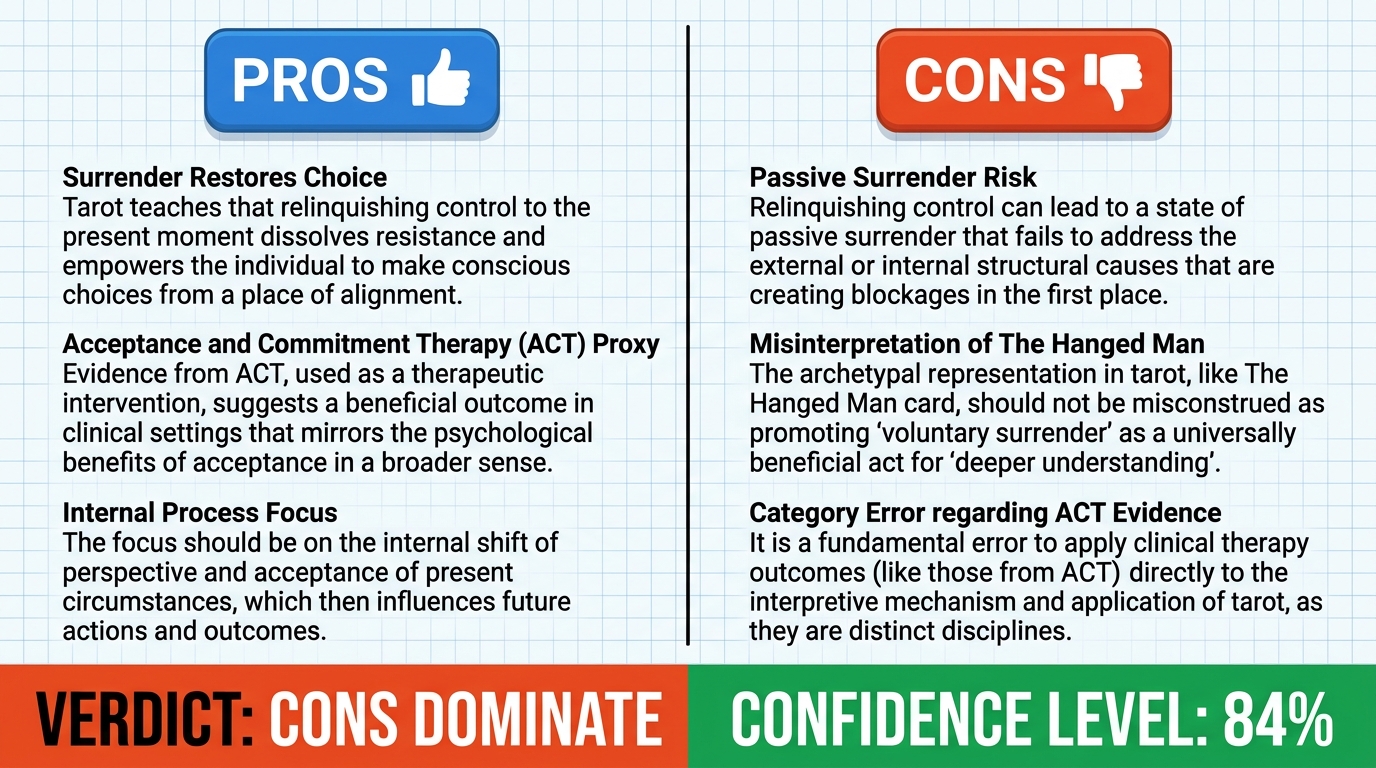
Verdict
Verdict: likely FALSE (84%)
Web Report: https://solsice.com/public/debates/temporarily-relinquishing-personal-control-and-going-with-th-bc0219b20ed0
This section provides a brief overview of the key arguments. You do not need to read the full detailed report below.
✅ Key PRO arguments:
- ■Core claim: Tarot teaches that surrender to the present moment dissolves resistance and restores empowered choice. The archetypal foundation of this claim rests on the Major Arcana card The Hanged Man (Key XII ), which is widely interpreted across authoritative tarot traditions as the embodiment of voluntary suspension, surrender, and the shift in perspective that emerges when one ceases to force outcomes. In the Rider-Waite-Smith system , the figure hangs upside-down by one foot, his expression serene rather than anguished, indicating that the suspension is self-imposed and generative rather than punitive. Rachel Pollack, a preeminent tarot scholar, writes that The Hanged Man “represents a voluntary sacrifice, a giving up of control i...
- ■The opposing side contends that ACT evidence is a clinical proxy with no legitimate bearing on tarot interpretation, because ACT measures a therapeutic intervention on human distress rather than the tarot's interpretive mechanism , and no "transfer operator " links the two domains. This objection misidentifies what the ACT evidence was introduced to establish. The ACT data was never offered as a direct measurement of tarot's metaphysical mechanism. It was introduced to support a specific, falsifiable psychological claim embedded within the tarot principle: that temporarily suspending efforts to control internal experience leads to a measurable increase in goal-directed , agentic behavior . This is a claim about human psychology, not about ar...
❌ Key ANTI arguments:
- ■Core claim: Relinquishing control is a passive surrender that fails to address the structural causes of blockages. The affirmative's argument suffers from a fundamental substitution of entities. They attempt to validate a metaphysical tarot principle—that relinquishing control clears blockages—by citing empirical data from Acceptance and Commitment Therapy (ACT ). However, the psychological efficacy of ACT is a measurement of a clinical intervention on human distress, not a measurement of the tarot's interpretive mechanism . The affirmative provides no transfer operator —no correlation or causal link—to bridge the gap between a clinical reduction in "experiential avoidance " and the tarot's claim that "blockages clear" through "natural flo...
- ■I am contesting the affirmative's interpretation of The Hanged Man as a symbol of "voluntary surrender " that facilitates a "deeper understanding." This interpretation relies on a circularity that fails to address the core claim: that such a strategy is actually beneficial for restoring agency. The affirmative argues that the figure's serene expression indicates the suspension is self-imposed and generative, and then uses this "generative" quality to conclude that the surrender is a beneficial strategy. This is a textbook case of a circular demonstration : the conclusion (that the surrender is a beneficial, generative act ) is essentially the same as the premise (that the figure's expression indicates the surrender is generative). The affirma...
💭 Conclusion: False. The winning side successfully showed that the affirmative's reliance on Acceptance and Commitment Therapy (ACT ) evidence is a category error, because clinical therapy outcomes do not transfer to tarot 's interpretive mechanism . The anti side also exposed the circularity in the Hanged Man interpretation, where the conclusion that surrender is beneficial is assumed in the premise. The affirmative failed to provide a transfer operator linking psychological findings to tarot claims about blockages clearing and agency return. Therefore the compound assertion is not supported, and the verdict is FALSE with moderate confidence.
🔬 DeepResearch Result: likely FALSE ❌ (84%)
Assertion: Temporarily relinquishing personal control and 'going with the flow' is a beneficial strategy that will lead to blockages clearing and a return of agency, according to tarot interpretation.
Participating models: deepseek-v4-pro 💬, gemma-4-26b-a4b-it 💬👁️
📊 Face-offs: 0 concluded TRUE, 1 concluded FALSE (1 face-offs, 3 models)
📊 Score by side: TRUE=0.00, FALSE=0.84
🏅 Model score changes:
deepseek-v4-flash-0731 💬: +8
✅ PRO Arguments:
- ■Core claim: Tarot teaches that surrender to the present moment dissolves resistance and restores empowered choice. The archetypal foundation of this claim rests on the Major Arcana card The Hanged Man (Key XII ), which is widely interpreted across authoritative tarot traditions as the embodiment of voluntary suspension, surrender, and the shift in perspective that emerges when one ceases to force outcomes. In the Rider-Waite-Smith system , the figure hangs upside-down by one foot, his expression serene rather than anguished, indicating that the suspension is self-imposed and generative rather than punitive. Rachel Pollack, a preeminent tarot scholar, writes that The Hanged Man “represents a voluntary sacrifice, a giving up of control i... deepseek-v4-pro 💬
- ■The opposing side contends that ACT evidence is a clinical proxy with no legitimate bearing on tarot interpretation, because ACT measures a therapeutic intervention on human distress rather than the tarot's interpretive mechanism , and no "transfer operator " links the two domains. This objection misidentifies what the ACT evidence was introduced to establish. The ACT data was never offered as a direct measurement of tarot's metaphysical mechanism. It was introduced to support a specific, falsifiable psychological claim embedded within the tarot principle: that temporarily suspending efforts to control internal experience leads to a measurable increase in goal-directed , agentic behavior . This is a claim about human psychology, not about ar... deepseek-v4-pro 💬
❌ ANTI Arguments:
- ■Core claim: Relinquishing control is a passive surrender that fails to address the structural causes of blockages. The affirmative's argument suffers from a fundamental substitution of entities. They attempt to validate a metaphysical tarot principle—that relinquishing control clears blockages—by citing empirical data from Acceptance and Commitment Therapy (ACT). However, the psychological efficacy of ACT is a measurement of a clinical intervention on human distress, not a measurement of the tarot's interpretive mechanism. The affirmative provides no transfer operator—no correlation or causal link—to bridge the gap between a clinical reduction in "experiential avoidance " and the tarot's claim that "blockages clear" through "natural flo... gemma-4-26b-a4b-it 💬👁️
- ■I am contesting the affirmative's interpretation of The Hanged Man as a symbol of "voluntary surrender " that facilitates a "deeper understanding." This interpretation relies on a circularity that fails to address the core claim: that such a strategy is actually beneficial for restoring agency. The affirmative argues that the figure's serene expression indicates the suspension is self-imposed and generative, and then uses this "generative" quality to conclude that the surrender is a beneficial strategy. This is a textbook case of a circular demonstration : the conclusion (that the surrender is a beneficial, generative act) is essentially the same as the premise (that the figure's expression indicates the surrender is generative). The affirma... gemma-4-26b-a4b-it 💬👁️
💭 Reasoning: False. The winning side successfully showed that the affirmative's reliance on Acceptance and Commitment Therapy (ACT) evidence is a category error, because clinical therapy outcomes do not transfer to tarot's interpretive mechanism. The anti side also exposed the circularity in the Hanged Man interpretation, where the conclusion that surrender is beneficial is assumed in the premise. The affirmative failed to provide a transfer operator linking psychological findings to tarot claims about blockages clearing and agency return. Therefore the compound assertion is not supported, and the verdict is FALSE with moderate confidence.
📋 PRO Facts:
• The Hanged Man is Major Arcana Key XII and is interpreted as voluntary suspension and surrender.
• In the Rider-Waite-Smith system, the Hanged Man's serene expression indicates the suspension is self-imposed and generative.
• Rachel Pollack describes The Hanged Man as representing a voluntary sacrifice and giving up of control.
• ACT evidence was introduced to support the psychological claim that suspending control over internal experience increases goal-directed, agentic behavior.
📋 ANTI Facts:
• ACT is a clinical intervention measuring human distress, not a measurement of tarot's interpretive mechanism.
• The affirmative provided no transfer operator linking clinical reductions in experiential avoidance to tarot's claim that blockages clear.
• The Hanged Man interpretation is circular because the conclusion of benefit is the same as the premise of generativity.
• Relinquishing control is characterized as passive surrender that fails to address structural causes of blockages.
| Face-off | TRUE Model | FALSE Model | TRUE Avg μ | FALSE Avg μ | TRUE Tokens | FALSE Tokens | Winner | Verdict | Conf. |
|---|---|---|---|---|---|---|---|---|---|
| #1 | deepseek-v4-pro 💬 | gemma-4-26b-a4b-it 💬👁️ | 0.604 | 0.332 | 6 | 2 | TRUE | FALSE | 84% |
The following technical terms, abbreviations, and domain-specific concepts are referenced throughout this debate transcript. Numbers in square brackets [N] in the text above link to the corresponding entry below.
[1] ACT — Acceptance and Commitment Therapy — A psychological intervention that focuses on accepting present-moment experience and reducing experiential avoidance; cited by the affirmative as empirical support for the claim that relinquishing control increases agentic behavior.
[2] agentic behavior — Goal-directed behavior reflecting personal agency; the affirmative claims it measurably increases when efforts to control internal experience are suspended.
[3] archetypal system — A symbolic framework based on recurring universal patterns, such as tarot; the negative contrasts it with clinical psychology.
[4] circular demonstration — A logical fallacy in which the conclusion is assumed in the premise; the negative accuses the affirmative of using this in interpreting The Hanged Man.
[5] clinical proxy — A clinical measure used as a stand-in for a different phenomenon; the negative calls ACT evidence a clinical proxy for tarot's interpretive mechanism.
[6] Cups sequence — The tarot suit of Cups, referenced by the affirmative as part of the tradition describing acceptance of present-moment experience.
[7] experiential avoidance — In ACT, the tendency to avoid or control unwanted internal experiences; the affirmative claims ACT reduces this.
[8] falsifiable — Capable of being tested and potentially disproven by evidence; used to describe the psychological claim embedded in the tarot principle.
[9] goal-directed — Aimed at achieving a specific objective; used to describe the agentic behavior that the affirmative says increases after suspending control.
[10] interpretive imposition — Reading a meaning into a symbol that is not supported by its structure; the negative accuses the affirmative of this.
[11] interpretive mechanism — The process by which a symbolic system produces meaning; the negative says ACT measures a clinical intervention, not tarot's interpretive mechanism.
[12] Key XII — The Roman numeral designation of The Hanged Man in the Major Arcana.
[13] Major Arcana — The set of major trump cards in a tarot deck, including The Hanged Man and The Hermit, representing major archetypal themes.
[14] metaphysical — Relating to abstract, non-empirical principles; used to describe tarot's claims about blockages and flow.
[15] present-moment experience — Immediate conscious awareness of current sensations and thoughts; central to both ACT and the tarot tradition's 'going with the flow'.
[16] purgatory — A state of waiting or suffering; used by the negative to describe traditional interpretations of The Hanged Man.
[17] querent — The person asking a question in a tarot reading.
[18] Rider-Waite-Smith system — A widely used tarot deck and symbolic system; in it, The Hanged Man is depicted hanging upside-down by one foot with a serene expression.
[19] stagnation — A state of being stuck or inactive; the negative says some traditional systems associate The Hanged Man with this.
[20] tarot — A system of symbolic cards used for divination and self-reflection; the debate concerns whether its interpretive guidance to relinquish control is beneficial.
[21] The Hanged Man — A Major Arcana tarot card (Key XII) depicting a figure suspended upside-down; the affirmative interprets it as voluntary surrender and a shift in perspective, while the negative argues some traditions see it as stagnation or purgatory.
[22] The Hermit — A Major Arcana tarot card mentioned by the negative as, in certain contexts, representing suspension or stagnation.
[23] therapeutic modality — A form or method of therapy; ACT is described as one.
[24] transfer operator — In the debate, a hypothetical correlation or causal link that would connect clinical findings to tarot's interpretive claims; the negative argues none is provided.
[25] voluntary surrender — The deliberate giving up of control; the affirmative's interpretation of The Hanged Man.
Face-off transcripts
- ■
Ownership & Trade Secrets. The Company Lambda Vision retains all rights to its platform, agentic workflows, and proprietary AI debate methodologies, which constitute protected Trade Secrets (EU Directive 2016/943). Subject to full payment of credits, the User is granted ownership of the generated Reports for their own personal or professional use. Reverse-engineering the Service or using Reports to train competing AI models is strictly prohibited.
- ■
No Professional Advice. Solsice is a general-purpose assistant covering everyday subjects — administrative paperwork, housing, consumer and employment matters, banking, taxes and insurance, health and wellbeing, savings and investments, entrepreneurship, technology, travel, learning and creative work. Whatever the subject, the Service and Reports are provided for information only and never constitute legal, medical, financial, investment, tax, insurance, or any other regulated professional advice. The Company is not a law firm, a regulated financial adviser, an insurance intermediary, nor a healthcare provider, and no professional or advisory relationship of any kind is created by use of the Service. Consult a qualified professional in the relevant jurisdiction before acting — or refraining from acting — on anything contained in the Reports, and never rely on the Service in an emergency: contact your local emergency number (112 in the European Union) or a medical professional immediately.
- ■
AI-Generated Content, Sources and Viewpoints. Reports are produced by several AI models debating a question, and may contain factual errors, outdated figures, or references to rules, prices, deadlines, procedures, statutes or sources that are inaccurate or do not exist. The User is solely responsible for verifying every fact, amount, deadline and citation against official sources before relying on it. Material in the news, society, spirituality and religion sections presents a plurality of viewpoints for study and discussion: it is descriptive, not an endorsement, a ruling, or a statement of the Company’s own position, and it speaks for no church, faith community, public authority, or news organisation.
- ■
Liability & Governing Law. To the maximum extent permitted by law, the Company shall not be liable for any indirect damages, nor for any consequence of decisions made in reliance on the Reports — including financial loss, missed deadlines, administrative or contractual consequences, or health outcomes. These Terms are governed by French law. Any disputes shall be subject to the exclusive jurisdiction of the Courts of Paris, France.