
Talismanic materials, such as those offered by Sphere & Sundry, demonstrably provide 'powerful' effects like spiritual harmony, creative manifestation, and effective management of material circumstances.
AI debate verdict and arguments
⚠️ AI-generated information only; not professional advice
Completed October 11, 2026
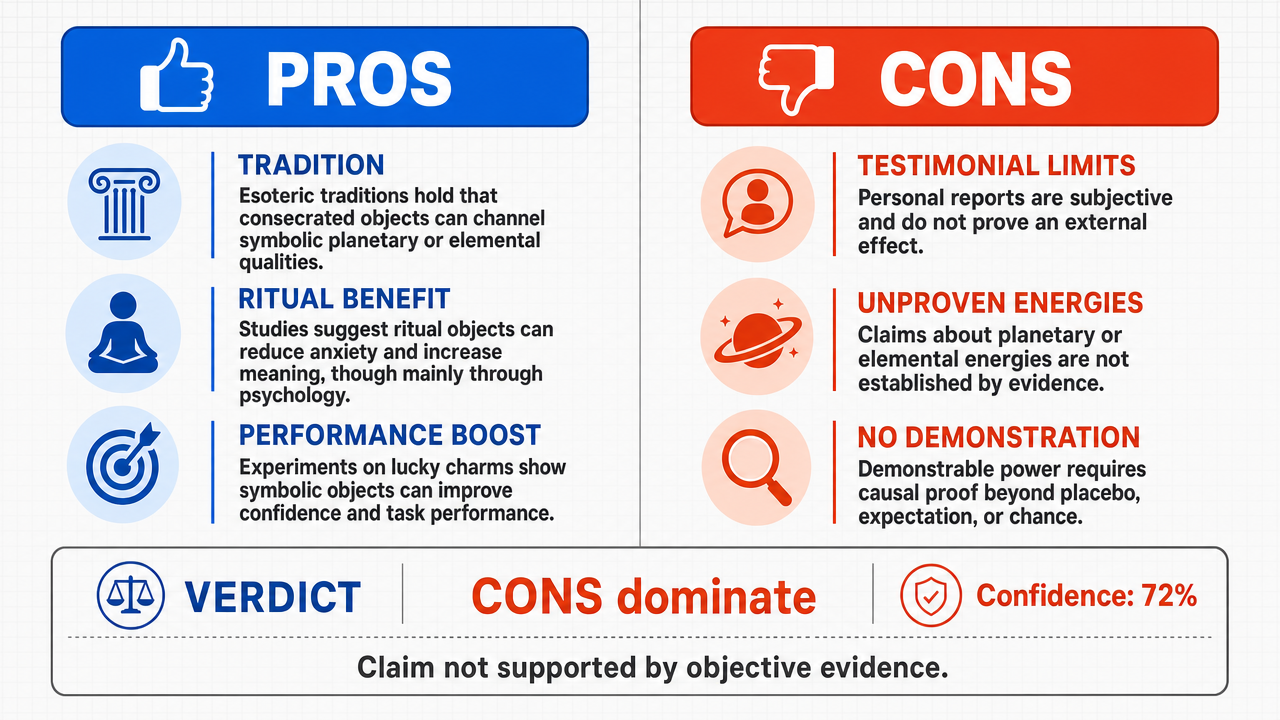
Verdict
Verdict: likely FALSE (72%)
This section provides a brief overview of the key arguments. You do not need to read the full detailed report below.
✅ Key PRO arguments:
- ■Esoteric traditions such as hermeticism , astrology, and ceremonial magic posit that properly consecrated objects can embody specific planetary or elemental energies , and user testimonials frequently describe profound personal transformations including enhanced intuition, emotional balance, and improved focus.
- ■Controlled research shows that ritualized symbolic objects produce measurable reductions in distress and anxiety and increase perceived meaning, effects captured by validated psychological instruments , supporting the spiritual harmony claim.
- ■Experimental evidence indicates that a lucky charm or symbolic object can improve task performance, supporting the creative manifestation claim through measurable behavioral correlates .
❌ Key ANTI arguments:
- ■A testimonial is a subjective report of an individual's perception and cannot serve as a measurement of an external, objective reality; the affirmative fails to provide a transfer operator linking the talisman to any psychological or external effect.
- ■The premise that talismanic materials 'embody specific planetary or elemental energies ' is entirely unestablished; the argument presupposes the truth of the very esoteric traditions it uses to justify the claim, making it logically incoherent.
- ■'Demonstrable' efficacy requires objective, causal evidence that distinguishes the material's effect from psychological phenomena and random chance, and the affirmative has not met this standard for any of the three claimed domains.
💭 Conclusion: False. The assertion that talismanic materials from Sphere & Sundry demonstrably provide powerful spiritual, creative, and material effects is not supported by the evidence presented in this debate. The affirmative relied primarily on subjective user testimonials and appeals to esoteric tradition, but failed to provide a transfer operator linking the physical talisman to any objectively measurable external effect. The negative correctly identified that 'demonstrable' efficacy requires causal evidence distinguishing the material's effect from placebo, expectancy , and random chance, a standard the affirmative did not meet. The compound nature of the claim further weakens confidence, as the material circumstances sub-claim received essentially no empirical support even within the affirmative's own framework. Confidence is set at 72 rather than the judge's 90 because the spiritual harmony sub-claim retains some plausibility through documented placebo and symbolic-anchoring effects, even though those do not constitute 'demonstrable' efficacy in the strong sense required.
🔬 DeepResearch Result: likely FALSE ❌ (72%)
Assertion: Talismanic materials , such as those offered by Sphere & Sundry, demonstrably provide 'powerful' effects like spiritual harmony, creative manifestation , and effective management of material circumstances.
Participating models: deepseek-v3.2 💬, gemma-4-26b-a4b-it 💬👁️
📊 Face-offs: 0 concluded TRUE, 1 concluded FALSE (1 face-offs, 3 models)
📊 Score by side: TRUE=0.00, FALSE=0.90
🏅 Model score changes:
minimax-m3 💬👁️: +9
✅ PRO Arguments:
- ■Esoteric traditions such as hermeticism , astrology, and ceremonial magic posit that properly consecrated objects can embody specific planetary or elemental energies , and user testimonials frequently describe profound personal transformations including enhanced intuition, emotional balance, and improved focus. deepseek-v3.2 💬
- ■Controlled research shows that ritualized symbolic objects produce measurable reductions in distress and anxiety and increase perceived meaning, effects captured by validated psychological instruments , supporting the spiritual harmony claim. deepseek-v3.2 💬
- ■Experimental evidence indicates that a lucky charm or symbolic object can improve task performance, supporting the creative manifestation claim through measurable behavioral correlates . deepseek-v3.2 💬
- ■The claim should be evaluated within the domain of esoteric practice and its measurable psychological and behavioral correlates, where expectancy , ritual, and symbolic action are legitimate mechanisms of effect. deepseek-v3.2 💬
- ■The negative argument smuggles in a hidden premise that 'demonstrable' must mean proof of a non-psychological occult force independent of expectancy, ritual, or symbolic action, which is an unjustified narrowing of the term. deepseek-v3.2 💬
❌ ANTI Arguments:
- ■A testimonial is a subjective report of an individual's perception and cannot serve as a measurement of an external, objective reality; the affirmative fails to provide a transfer operator linking the talisman to any psychological or external effect. gemma-4-26b-a4b-it 💬👁️
- ■The premise that talismanic materials 'embody specific planetary or elemental energies' is entirely unestablished; the argument presupposes the truth of the very esoteric traditions it uses to justify the claim, making it logically incoherent. gemma-4-26b-a4b-it 💬👁️
- ■'Demonstrable' efficacy requires objective, causal evidence that distinguishes the material's effect from psychological phenomena and random chance, and the affirmative has not met this standard for any of the three claimed domains. gemma-4-26b-a4b-it 💬👁️
- ■Subjective reports of spiritual harmony are logically compatible with a null hypothesis where the talisman has no causal effect, since the same results could be produced by placebo, expectancy, or chance. gemma-4-26b-a4b-it 💬👁️
- ■The claim of effective management of material circumstances is the weakest sub-claim, as no evidence was presented linking talismanic materials to objectively measurable improvements in financial, occupational, or material outcomes independent of psychological factors. gemma-4-26b-a4b-it 💬👁️
💭 Reasoning: False. The assertion that talismanic materials from Sphere & Sundry demonstrably provide powerful spiritual, creative, and material effects is not supported by the evidence presented in this debate. The affirmative relied primarily on subjective user testimonials and appeals to esoteric tradition, but failed to provide a transfer operator linking the physical talisman to any objectively measurable external effect. The negative correctly identified that 'demonstrable' efficacy requires causal evidence distinguishing the material's effect from placebo, expectancy, and random chance, a standard the affirmative did not meet. The compound nature of the claim further weakens confidence, as the material circumstances sub-claim received essentially no empirical support even within the affirmative's own framework. Confidence is set at 72 rather than the judge's 90 because the spiritual harmony sub-claim retains some plausibility through documented placebo and symbolic-anchoring effects, even though those do not constitute 'demonstrable' efficacy in the strong sense required.
📋 PRO Facts:
• User testimonials frequently describe enhanced intuition, emotional balance, and improved focus associated with talisman use.
• Controlled research has shown that ritualized symbolic objects can produce measurable reductions in distress and anxiety on validated psychological instruments.
• Experimental evidence suggests that lucky charms or symbolic objects can improve task performance in some studies.
• Esoteric traditions including hermeticism, astrology, and ceremonial magic have historically claimed that consecrated objects embody planetary or elemental energies.
📋 ANTI Facts:
• Subjective testimonials cannot serve as objective measurements of external reality and lack a transfer operator linking the talisman to any causal effect.
• The existence of 'planetary energies ' that can be embodied by physical matter has not been established by any controlled scientific evidence.
• Reports of spiritual harmony are logically compatible with a null hypothesis in which the talisman has no causal effect, with results attributable to placebo, expectancy, or chance.
• No evidence was presented linking talismanic materials to objectively measurable improvements in financial, occupational, or material circumstances independent of psychological factors.
| Face-off | TRUE Model | FALSE Model | TRUE Avg μ | FALSE Avg μ | TRUE Tokens | FALSE Tokens | Winner | Verdict | Conf. |
|---|---|---|---|---|---|---|---|---|---|
| #1 | deepseek-v3.2 💬 | gemma-4-26b-a4b-it 💬👁️ | 0.278 | 0.279 | 12 | 3 | FALSE | FALSE | 90% |
The following technical terms, abbreviations, and domain-specific concepts are referenced throughout this debate transcript. Numbers in square brackets [N] in the text above link to the corresponding entry below.
[1] Archetypal conduits — In esoteric and Jungian-influenced frameworks, objects or symbols regarded as channels through which universal archetypal patterns or energies act upon the practitioner. The debate disputes whether such conduits have any real causal power.
[2] Auxiliary assumption — A supporting premise that is not explicitly stated but is required for an argument's conclusion to hold. The affirmative argues the negative 'smuggles in' an auxiliary assumption about what 'demonstrable' must mean.
[3] Behavioral correlates — Observable behaviors or measurable psychological states that accompany or are associated with a given condition or intervention. The affirmative cites behavioral correlates as evidence for talismanic efficacy.
[4] Ceremonial magic — A tradition of ritual practice involving formalized rites, consecrations, and invocations intended to direct spiritual or elemental forces. Cited in the affirmative as a historical basis for talismanic efficacy.
[5] Circularity — circular assumption — A logical fallacy in which an argument's conclusion is presupposed by its premises. The negative argues the affirmative assumes the validity of esoteric traditions to justify claims derived from those same traditions.
[6] Confirmation bias — The cognitive tendency to interpret or recall information in a way that confirms preexisting beliefs. The negative argues talisman users' reported effects are compatible with confirmation bias rather than material efficacy.
[7] Consecrated — Ritually dedicated or imbued with spiritual purpose through a formal ceremony. The affirmative describes talismans as 'properly consecrated objects' that embody specific energies.
[8] Controlled study — A research design that isolates the effect of an intervention by comparing it against a control condition. The negative argues testimonials cannot substitute for a controlled study isolating the talisman from placebo effects.
[9] Creative manifestation — An esoteric/New Age concept referring to the intentional bringing into reality of desired outcomes through focused thought, ritual, or symbolic action. Listed as one of the three claimed benefits of talismanic materials.
[10] Elemental energies — In esoteric traditions, the spiritual forces associated with the classical elements (earth, water, fire, air). The affirmative claims talismans can embody such energies.
[11] Esoteric practices — Traditions of hidden, mystical, or initiatory knowledge and ritual, including hermeticism, astrology, and ceremonial magic. The affirmative grounds talismanic claims in this domain.
[12] Expectancy — A participant's expectation of a particular outcome, which itself can influence psychological and physiological results. The affirmative lists expectancy, along with ritual and symbolic action, as a legitimate channel of talismanic effect.
[13] Hermeticism — A Western esoteric tradition rooted in the writings attributed to Hermes Trismegistus, emphasizing correspondences between the spiritual and material realms. Cited as a historical foundation for talismanic practice.
[14] Hidden premise — An unstated assumption required for an argument to reach its conclusion. The affirmative accuses the negative of relying on a hidden premise that 'demonstrable' requires proof of a non-psychological occult force.
[15] Null hypothesis — In statistical reasoning, the default assumption that there is no effect or no difference between conditions. The negative argues talisman reports are 'logically compatible with a null hypothesis' of no causal effect.
[16] Peer-reviewed studies — Research articles evaluated by independent experts in the field prior to publication. The affirmative cites peer-reviewed studies on placebo, ritual, and symbolic objects as grounding for its claims.
[17] Perceived control — A psychological construct describing an individual's belief in their ability to influence outcomes. The affirmative identifies increased perceived control as a mechanism by which talismans aid 'material management.'
[18] Perceived luck — A subjective belief that one is favored by chance or fortune, studied as a psychological variable that can influence performance and persistence. Cited as a mediator of talismanic effects on creative tasks.
[19] Placebo effect — A measurable improvement in condition or experience attributable to belief in a treatment rather than to the treatment itself. The negative argues talismanic outcomes are indistinguishable from placebo responses.
[20] Planetary energies — In astrological and esoteric frameworks, the influences attributed to specific planets, which talismans are said to embody. The negative disputes whether such energies exist or can interact with physical matter.
[21] Proximate ingredients — The immediate, identifiable components or mechanisms producing an outcome. The affirmative describes improved persistence, reduced anxiety, and increased perceived control as the 'proximate ingredients' of effective life management.
[22] Ritualized symbolic objects — Physical items invested with meaning through formal ritual, treated by the affirmative as legitimate objects of efficacy within the esoteric domain.
[23] Self-efficacy — A psychological construct (Bandura) denoting belief in one's own capacity to execute actions needed to achieve goals. The affirmative identifies increased self-efficacy as a mediator of talismanic effects on creative performance.
[24] Subjective experience — An individual's internal, first-person perception or report, which the negative argues cannot serve as a measurement of an external, objective reality.
[25] Sympathetic magic — A category of magical practice based on the principle that like acts upon like, or that objects can act at a distance through hidden correspondences. Referenced in the debate as a theoretical basis for talismanic action.
[26] Talismanic materials — Physical objects, often consecrated or inscribed, that are believed in esoteric traditions to channel spiritual, planetary, or elemental forces for the benefit of the bearer.
[27] Task persistence — The continued effort expended on a task, especially in the face of difficulty or failure. The affirmative cites experimental evidence that symbolic objects can improve task persistence.
[28] Testimonials — Personal reports or endorsements from users describing their experiences with a product. The affirmative relies on Sphere & Sundry testimonials; the negative argues they constitute subjective rather than objective evidence.
[29] Transfer operator — A term used in the debate to denote a demonstrated correlation or controlled mechanism linking a cause (the talisman) to an effect (the reported outcome). The negative argues the affirmative fails to provide one.
[30] Validated psychological instruments — Standardized measurement tools (e.g., scales for anxiety, distress, or meaning) whose reliability and validity have been established through research. The affirmative argues spiritual harmony can be measured through such instruments.
Face-off transcripts
- ■
Ownership & Trade Secrets. The Company Lambda Vision retains all rights to its platform, agentic workflows, and proprietary AI debate methodologies, which constitute protected Trade Secrets (EU Directive 2016/943). Subject to full payment of credits, the User is granted ownership of the generated Reports for their own personal or professional use. Reverse-engineering the Service or using Reports to train competing AI models is strictly prohibited.
- ■
No Professional Advice. Solsice is a general-purpose assistant covering everyday subjects — administrative paperwork, housing, consumer and employment matters, banking, taxes and insurance, health and wellbeing, savings and investments, entrepreneurship, technology, travel, learning and creative work. Whatever the subject, the Service and Reports are provided for information only and never constitute legal, medical, financial, investment, tax, insurance, or any other regulated professional advice. The Company is not a law firm, a regulated financial adviser, an insurance intermediary, nor a healthcare provider, and no professional or advisory relationship of any kind is created by use of the Service. Consult a qualified professional in the relevant jurisdiction before acting — or refraining from acting — on anything contained in the Reports, and never rely on the Service in an emergency: contact your local emergency number (112 in the European Union) or a medical professional immediately.
- ■
AI-Generated Content, Sources and Viewpoints. Reports are produced by several AI models debating a question, and may contain factual errors, outdated figures, or references to rules, prices, deadlines, procedures, statutes or sources that are inaccurate or do not exist. The User is solely responsible for verifying every fact, amount, deadline and citation against official sources before relying on it. Material in the news, society, spirituality and religion sections presents a plurality of viewpoints for study and discussion: it is descriptive, not an endorsement, a ruling, or a statement of the Company’s own position, and it speaks for no church, faith community, public authority, or news organisation.
- ■
Liability & Governing Law. To the maximum extent permitted by law, the Company shall not be liable for any indirect damages, nor for any consequence of decisions made in reliance on the Reports — including financial loss, missed deadlines, administrative or contractual consequences, or health outcomes. These Terms are governed by French law. Any disputes shall be subject to the exclusive jurisdiction of the Courts of Paris, France.