
Taking out a $500 payday loan with a 900% interest rate is a financially sound decision for an individual facing immediate cash flow problems.
AI debate verdict and arguments
⚠️ AI-generated information only; not professional advice
Completed October 8, 2026
Verdict
Verdict: likely FALSE (90%)
This section provides a brief overview of the key arguments. You do not need to read the full detailed report below.
✅ Key PRO arguments:
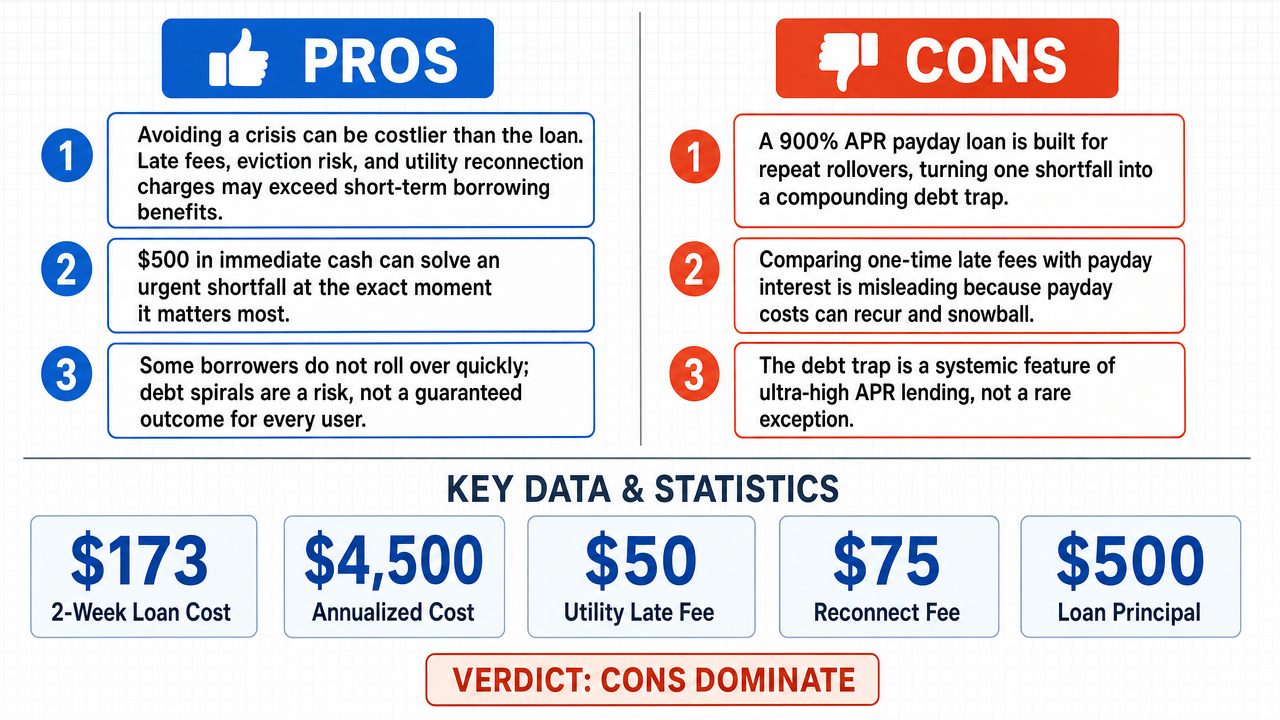
- ■The cost of an immediate cash shortfall (late fees of 5-10% of payment, eviction /foreclosure costs in thousands, utility reconnection fees , and a 60-110 point FICO drop from a single 30-day delinquency ) often vastly exceeds the cost of a $500 payday loan , making the loan a rational expenditure to avoid greater financial harm.
- ■A $500 payday loan provides immediate liquidity that directly resolves the cash shortage at the point of crisis, and the decision's soundness should be judged at that moment rather than by hypothetical future outcomes.
- ■Approximately 45% of borrowers in certain studies do not re-borrow within 30 days, suggesting the 'debt trap ' is not an inevitable outcome and therefore does not universally make the loan financially unsound.
❌ Key ANTI arguments:
- ■A 900% APR payday loan is structurally designed to create a 'debt trap ': when borrowers cannot repay principal plus massive interest in the initial two-week window, they are forced to roll over the loan, incurring compounding fees and interest that drive total costs far beyond the original shortfall .
- ■The affirmative's comparison between a ~$173 interest charge and a $50 late fee is a false equivalence that ignores the recurring, compounding nature of payday loan debt versus one-time late fees.
- ■The debt trap is a systemic feature of 900% APR products, not an anomaly affecting only a subset of borrowers; the 45% non-rollover statistic reflects individual variance while the structural risk applies to the product as a whole.
💭 Conclusion: False. The winning FALSE side demonstrated that a 900% APR payday loan is not financially sound because its structural design creates a compounding debt trap through rollovers, transforming a single cash flow problem into a recurring cycle of escalating obligations. The anti side effectively argued that the pro position's comparison between a ~$173 interest charge and one-time late fees is a false equivalence that ignores the systemic, recurring nature of payday loan costs. The pro side's reliance on the 45% non-rollover statistic was rebutted by the observation that structural risk applies to the product as a whole, not merely to individual outcomes. The anti side's argument that the debt trap is a systemic feature rather than an anomaly was decisive in establishing that the loan's design inherently worsens the financial instability it purports to solve.
🔬 DeepResearch Result: likely FALSE ❌ (90%)
Assertion: Taking out a $500 payday loan with a 900% interest rate is a financially sound decision for an individual facing immediate cash flow problems.
Participating models: deepseek-v3.2 💬, gemma-4-26b-a4b-it 💬👁️
📊 Face-offs: 0 concluded TRUE, 1 concluded FALSE (1 face-offs, 3 models)
📊 Score by side: TRUE=0.00, FALSE=0.90
🏅 Model score changes:
minimax-m3 💬👁️: +9
✅ PRO Arguments:
- ■The cost of an immediate cash shortfall (late fees of 5-10% of payment, eviction /foreclosure costs in thousands, utility reconnection fees , and a 60-110 point FICO drop from a single 30-day delinquency ) often vastly exceeds the cost of a $500 payday loan, making the loan a rational expenditure to avoid greater financial harm. deepseek-v3.2 💬
- ■A $500 payday loan provides immediate liquidity that directly resolves the cash shortage at the point of crisis, and the decision's soundness should be judged at that moment rather than by hypothetical future outcomes. deepseek-v3.2 💬
- ■Approximately 45% of borrowers in certain studies do not re-borrow within 30 days, suggesting the 'debt trap ' is not an inevitable outcome and therefore does not universally make the loan financially unsound. deepseek-v3.2 💬
❌ ANTI Arguments:
- ■A 900% APR payday loan is structurally designed to create a 'debt trap': when borrowers cannot repay principal plus massive interest in the initial two-week window, they are forced to roll over the loan, incurring compounding fees and interest that drive total costs far beyond the original shortfall. gemma-4-26b-a4b-it 💬👁️
- ■The affirmative's comparison between a ~$173 interest charge and a $50 late fee is a false equivalence that ignores the recurring, compounding nature of payday loan debt versus one-time late fees. gemma-4-26b-a4b-it 💬👁️
- ■The debt trap is a systemic feature of 900% APR products, not an anomaly affecting only a subset of borrowers; the 45% non-rollover statistic reflects individual variance while the structural risk applies to the product as a whole. gemma-4-26b-a4b-it 💬👁️
- ■While the loan may solve a single immediate crisis, the extreme interest rate facilitates a cycle of compounding debt through rollovers that can drive total repayment costs far beyond the original cash shortfall the borrower sought to avoid, ultimately worsening financial instability . gemma-4-26b-a4b-it 💬👁️
💭 Reasoning: False. The winning FALSE side demonstrated that a 900% APR payday loan is not financially sound because its structural design creates a compounding debt trap through rollovers, transforming a single cash flow problem into a recurring cycle of escalating obligations. The anti side effectively argued that the pro position's comparison between a ~$173 interest charge and one-time late fees is a false equivalence that ignores the systemic, recurring nature of payday loan costs. The pro side's reliance on the 45% non-rollover statistic was rebutted by the observation that structural risk applies to the product as a whole, not merely to individual outcomes. The anti side's argument that the debt trap is a systemic feature rather than an anomaly was decisive in establishing that the loan's design inherently worsens the financial instability it purports to solve.
📋 PRO Facts:
• Missing a rent or mortgage payment can trigger a late fee of 5-10% of the payment amount plus potential eviction or foreclosure costs in the thousands of dollars.
• A single delinquency can drop a credit score by 100+ points, increasing future borrowing costs .
• Approximately 45% of payday loan borrowers in certain studies do not re-borrow within 30 days.
📋 ANTI Facts:
• A $500 payday loan at 900% APR carries approximately $173 in interest charges.
• Payday loans typically have a two-week repayment window, after which borrowers who cannot repay are forced to roll over the loan.
• The debt trap mechanism through rollovers creates compounding fees and interest that drive total costs far beyond the original cash shortfall.
| Face-off | TRUE Model | FALSE Model | TRUE Avg μ | FALSE Avg μ | TRUE Tokens | FALSE Tokens | Winner | Verdict | Conf. |
|---|---|---|---|---|---|---|---|---|---|
| #1 | deepseek-v3.2 💬 | gemma-4-26b-a4b-it 💬👁️ | 0.401 | 0.287 | 12 | 3 | TRUE | FALSE | 90% |
The following technical terms, abbreviations, and domain-specific concepts are referenced throughout this debate transcript. Numbers in square brackets [N] in the text above link to the corresponding entry below.
[1] 30-day delinquency — A missed debt payment that is at least 30 days past due, which typically results in reporting to credit bureaus and a drop in the borrower's credit score.
[2] APR — Annual Percentage Rate — The yearly cost of a loan expressed as a percentage, including interest and certain fees, allowing borrowers to compare the true cost of different loan products.
[3] borrowing costs — The total expense incurred to obtain funds through a loan, including interest, fees, and other charges over the life of the loan.
[4] bridge loan — A short-term loan used to cover immediate expenses until a more permanent source of funding or income is obtained; in the debate, a payday loan is described as a 'single bridge' when used once.
[5] cash flow — The movement of money into and out of an individual's or business's accounts, used here to describe a situation where available funds are insufficient to cover immediate obligations.
[6] catastrophic failure — In financial risk assessment, an extreme negative outcome (such as eviction or severe debt spiral) that a financial product may cause for a portion of its users.
[7] CFPB — Consumer Financial Protection Bureau — A U.S. federal agency that regulates consumer financial products and conducts research on lending practices; cited in the debate for data on borrower rollover rates.
[8] compounding debt — A cycle in which unpaid interest and fees are added to the principal of a loan, causing the total amount owed to grow rapidly over successive rollover periods.
[9] credit score — A numerical measure of a borrower's creditworthiness used by lenders to assess the risk of lending; damage to it can increase future borrowing costs.
[10] debt trap — A situation in which a borrower is unable to repay a loan and is forced to repeatedly roll it over or take new loans, incurring escalating fees and interest.
[11] delinquency — The state of failing to make a required payment on time, which can trigger penalties and negative credit reporting.
[12] disbursed — Funds that have been paid out from a lender to a borrower; in the debate, payday loan funds are described as being disbursed within hours.
[13] eviction — The legal process of removing a tenant from a rental property, often initiated after missed rent payments, with potential costs in the thousands of dollars.
[14] FICO score — Fair Isaac Corporation score — A specific type of credit score widely used by U.S. lenders; a single 30-day delinquency can drop it by 60-110 points according to the affirmative's argument.
[15] financial instability — A condition in which an individual or household is unable to reliably meet financial obligations, often worsened by high-cost debt cycles.
[16] financial risk assessment — The process of evaluating the likelihood and severity of negative outcomes associated with a financial product, focusing on structural risk across the user population.
[17] financial soundness — A judgment that a financial decision or product is rational, sustainable, and does not create greater long-term harm than it resolves.
[18] foreclosure — A legal process by which a lender seizes a property after the borrower fails to make mortgage payments, with substantial associated costs.
[19] interest — The cost charged by a lender for the use of borrowed funds, typically expressed as a percentage of the principal.
[20] late fee — A penalty charged when a payment is not made by its due date, often 5-10% of the payment amount as cited in the affirmative's argument.
[21] liquidity — The availability of cash or easily convertible assets to meet immediate financial needs; a payday loan is described as providing immediate liquidity.
[22] non-rollover rate — The percentage of borrowers who repay their payday loan in full by the due date without extending or renewing it; cited as approximately 45% in the debate.
[23] payday loan — A short-term, high-interest loan typically due on the borrower's next payday, often carrying extremely high APRs such as the 900% cited in the debate.
[24] principal — The original sum of money borrowed, excluding interest and fees; the $500 figure in the debate refers to the principal of the loan.
[25] reconnection fees — Charges imposed by a utility company to restore service after it has been shut off due to non-payment.
[26] rollover — loan rollover — The extension of a short-term loan by paying only the fees or interest when due, with the principal carried forward, often triggering new interest charges.
[27] shortfall — cash shortfall — A gap between available funds and required payments, which a payday loan is taken to cover.
[28] solvency — The ability of an individual or entity to meet long-term financial obligations and avoid catastrophic debt.
[29] systemic risk — Risk inherent in the structure of a financial product or system that affects a broad population of users rather than isolated individuals.
[30] two-week term — The standard repayment period for a payday loan, aligning with the borrower's pay cycle; the $173 interest figure in the debate is calculated over this period.
[31] utility shut-off — The disconnection of essential services such as electricity, water, or gas due to non-payment, often accompanied by reconnection fees and deposits.
The following financial data tables were referenced during the debate exchanges:
| Scenario | Immediate Cost of $500 Shortfall | Payday Loan Cost (2 weeks) | Net Financial Position |
|---|---|---|---|
| Miss Rent Payment | $50 late fee + risk of eviction | ~$173 interest | -$123 and housing security |
| Utility Disconnection | $75 reconnect fee + deposit | ~$173 interest | -$98 and service continuity |
| Credit Card Default | ~$35 late fee + 100+ pt credit score drop | ~$173 interest | -$138 and credit preservation |
Legend: Comparative cost analysis of a $500 shortfall versus taking a two-week payday loan at a 900% APR (~$173 finance charge). Costs are estimated based on typical late fees and reconnection charges. The payday loan results in a negative net financial outcome in each emergency scenario when considering only the immediate monetary cost, though it may preserve essential services or credit standing.
| Loan Characteristic | s Payday Loan (900% APR) | Utility Late Fee | Credit Card Late Fee |
|---|---|---|---|
| Principal/Base | $500.00 | $500.00 | $500.00 |
| Immediate Cost | $173.00 | $50.00 | $35.00 |
| Annualized Cost | $4,500.00 | $50.00 | $35.00 |
| Risk of Recurrence | Very High (Rollovers) | Low (One-time) | Moderate |
Legend: Comparison of the immediate and annualized costs of a $500 shortfall. The payday loan carries an annualized cost of $4,500 due to the 900% old APR, whereas late fees are typically one-time or significantly lower in scale.
| Borrower Segment | Estimated Repayment Pattern | Financial Impact |
|---|---|---|
| Single-Use Borrowers | One-time transaction | Limited interest expense |
| Cycle Borrowers | Multiple rollovers | Exponentially increasing debt |
| Defaulting Borrowers | Failure to repay principal | Severe credit/legal damage |
Legend: Categorization of borrower behaviors based on repayment patterns. "Cycle Borrowers" represent the segment where the 900% APR leads to compounding debt instability.
Face-off transcripts
- ■
Ownership & Trade Secrets. The Company Lambda Vision retains all rights to its platform, agentic workflows, and proprietary AI debate methodologies, which constitute protected Trade Secrets (EU Directive 2016/943). Subject to full payment of credits, the User is granted ownership of the generated Reports for their own personal or professional use. Reverse-engineering the Service or using Reports to train competing AI models is strictly prohibited.
- ■
No Professional Advice. Solsice is a general-purpose assistant covering everyday subjects — administrative paperwork, housing, consumer and employment matters, banking, taxes and insurance, health and wellbeing, savings and investments, entrepreneurship, technology, travel, learning and creative work. Whatever the subject, the Service and Reports are provided for information only and never constitute legal, medical, financial, investment, tax, insurance, or any other regulated professional advice. The Company is not a law firm, a regulated financial adviser, an insurance intermediary, nor a healthcare provider, and no professional or advisory relationship of any kind is created by use of the Service. Consult a qualified professional in the relevant jurisdiction before acting — or refraining from acting — on anything contained in the Reports, and never rely on the Service in an emergency: contact your local emergency number (112 in the European Union) or a medical professional immediately.
- ■
AI-Generated Content, Sources and Viewpoints. Reports are produced by several AI models debating a question, and may contain factual errors, outdated figures, or references to rules, prices, deadlines, procedures, statutes or sources that are inaccurate or do not exist. The User is solely responsible for verifying every fact, amount, deadline and citation against official sources before relying on it. Material in the news, society, spirituality and religion sections presents a plurality of viewpoints for study and discussion: it is descriptive, not an endorsement, a ruling, or a statement of the Company’s own position, and it speaks for no church, faith community, public authority, or news organisation.
- ■
Liability & Governing Law. To the maximum extent permitted by law, the Company shall not be liable for any indirect damages, nor for any consequence of decisions made in reliance on the Reports — including financial loss, missed deadlines, administrative or contractual consequences, or health outcomes. These Terms are governed by French law. Any disputes shall be subject to the exclusive jurisdiction of the Courts of Paris, France.