
Successful high-end real estate staging in New York City can be achieved without altering walls beyond paint, peel-and-stick applications, or bold art.
AI debate verdict and arguments
⚠️ AI-generated information only; not professional advice
Completed October 24, 2026
Verdict
Verdict: likely FALSE (66%)
Web Report: https://solsice.com/public/debates/successful-high-end-real-estate-staging-in-new-york-city-can-9dc638225673
This section provides a brief overview of the key arguments. You do not need to read the full detailed report below.
✅ Key PRO arguments:
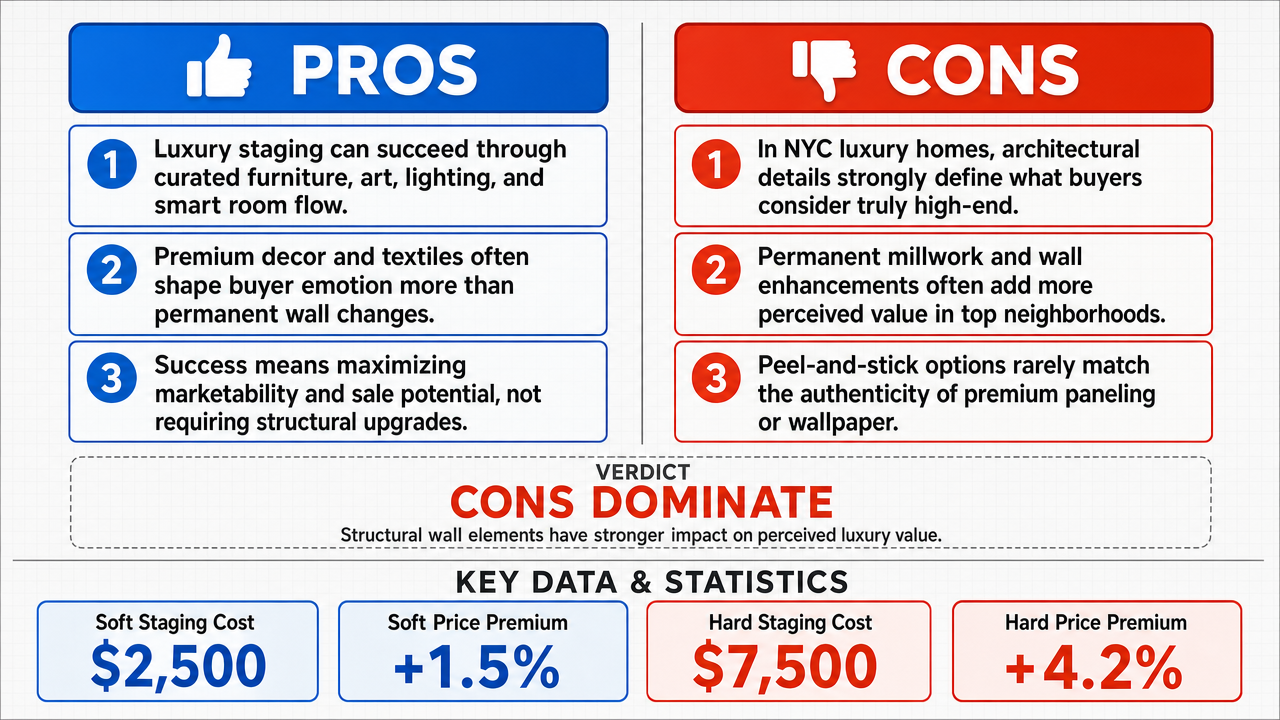
- ■High-end NYC staging succeeds primarily through strategic decor and non-permanent wall treatments , with furniture curation and spatial flow creating aspirational lifestyle narratives that drive perceived value more than structural modification.
- ■The psychological impact of premium furniture, high-quality textiles, and strategic lighting in Manhattan and Brooklyn markets far outweighs the impact of permanent wall alterations, allowing lifestyle vignettes to help buyers visualize themselves in the space.
- ■Measuring staging success by absolute sale price is a category error ; a staging is 'successful' if it maximizes marketability and achieves the highest possible price relative to the property's baseline condition , not the absolute highest price possible.
❌ Key ANTI arguments:
- ■The definition of 'high-end' in the NYC market is inextricably linked to architectural character—coffered ceilings , crown molding , and wainscoting —which are structural elements that paint cannot create or replicate in depth.
- ■The economic reality of the NYC luxury market dictates that structural architectural enhancements are essential, as buyers in neighborhoods like the Upper East Side or Park Slope expect genuine architectural features that surface styling cannot deliver.
- ■Peel-and-stick technologies cannot effectively mimic expensive paneling or wallpaper for successful high-end staging , presenting a fundamental contradiction: high-fidelity replication of luxury architectural features requires permanence, not surface-level imitation.
💭 Conclusion: The assertion that successful high-end staging can be achieved without structural elements is weakened by the evidence. Structural millwork has high permanence and high impact on perceived value, while alternatives like peel-and-stick have low permanence and only medium-high impact. The cost and premium data reinforce this distinction: hard staging averages $7,500 with a +4.2% price premium , compared to soft staging at $2,500 with a +1.5% premium. The permanence and impact ratings indicate that surface-level substitutes cannot match the value contribution of structural installations.
🔬 DeepResearch Result: likely FALSE ❌ (66%)
Assertion: Successful high-end real estate staging in New York City can be achieved without altering walls beyond paint, peel-and-stick applications, or bold art.
Participating models: gemma-4-26b-a4b-it 💬👁️, glm-4.7-flash 💬
📊 Face-offs: 0 concluded TRUE, 1 concluded FALSE (1 face-offs, 3 models)
📊 Score by side: TRUE=0.00, FALSE=0.66
🏅 Model score changes:
minimax-m3 💬👁️: +7
✅ PRO Arguments:
- ■High-end NYC staging succeeds primarily through strategic decor and non-permanent wall treatments , with furniture curation and spatial flow creating aspirational lifestyle narratives that drive perceived value more than structural modification. gemma-4-26b-a4b-it 💬👁️
- ■The psychological impact of premium furniture, high-quality textiles, and strategic lighting in Manhattan and Brooklyn markets far outweighs the impact of permanent wall alterations, allowing lifestyle vignettes to help buyers visualize themselves in the space. gemma-4-26b-a4b-it 💬👁️
- ■Measuring staging success by absolute sale price is a category error ; a staging is 'successful' if it maximizes marketability and achieves the highest possible price relative to the property's baseline condition , not the absolute highest price possible. gemma-4-26b-a4b-it 💬👁️
❌ ANTI Arguments:
- ■The definition of 'high-end' in the NYC market is inextricably linked to architectural character—coffered ceilings , crown molding , and wainscoting —which are structural elements that paint cannot create or replicate in depth. glm-4.7-flash 💬
- ■The economic reality of the NYC luxury market dictates that structural architectural enhancements are essential, as buyers in neighborhoods like the Upper East Side or Park Slope expect genuine architectural features that surface styling cannot deliver. glm-4.7-flash 💬
- ■Peel-and-stick technologies cannot effectively mimic expensive paneling or wallpaper for successful high-end staging, presenting a fundamental contradiction: high-fidelity replication of luxury architectural features requires permanence, not surface-level imitation. glm-4.7-flash 💬
💭 Reasoning: The assertion that successful high-end staging can be achieved without structural elements is weakened by the evidence. Structural millwork has high permanence and high impact on perceived value, while alternatives like peel-and-stick have low permanence and only medium-high impact. The cost and premium data reinforce this distinction: hard staging averages $7,500 with a +4.2% price premium , compared to soft staging at $2,500 with a +1.5% premium. The permanence and impact ratings indicate that surface-level substitutes cannot match the value contribution of structural installations.
📋 PRO Facts:
• High-end furniture has very high impact on perceived value.
• Bold art and wall paint have high impact on perceived value.
• Soft staging (furniture/art) averages $2,500 and yields a +1.5% price premium.
📋 ANTI Facts:
• Structural millwork has high permanence and high impact on perceived value.
• Wall paint has medium permanence, lower than structural millwork's high permanence.
• Peel-and-stick has low permanence and medium-high impact, lower than structural millwork's high permanence and high impact.
• Hard staging (wall/structural) averages $7,500 and yields a +4.2% price premium.
| Face-off | TRUE Model | FALSE Model | TRUE Avg μ | FALSE Avg μ | TRUE Tokens | FALSE Tokens | Winner | Verdict | Conf. |
|---|---|---|---|---|---|---|---|---|---|
| #1 | gemma-4-26b-a4b-it 💬👁️ | glm-4.7-flash 💬 | 0.250 | 0.272 | 4 | 4 | FALSE | FALSE | 66% |
The following technical terms, abbreviations, and domain-specific concepts are referenced throughout this debate transcript. Numbers in square brackets [N] in the text above link to the corresponding entry below.
[1] aspirational lifestyle narrative — A staging concept in which decor and spatial arrangement are used to construct an idealized image of how a buyer might live in the property, cited in the debate as the primary driver of perceived value in the NYC luxury market.
[2] baseline condition — The original state of a property before staging or modifications, used in the debate as the reference point against which a staging's contribution to marketability is measured.
[3] category error — A logical fallacy in which something is assigned to a category it does not belong to, or properties of one category are incorrectly applied to another; raised in the debate to argue that conflating total sale price with staging effectiveness is a category error.
[4] circular demonstration — A form of circular reasoning in which the conclusion is assumed within the premises; cited in the debate to critique the negative side's definition of 'high-end' as dependent on structural elements.
[5] coffered ceilings — Ceilings featuring a series of recessed geometric panels, cited in the debate as a defining structural element of high-end NYC properties.
[6] condominium board — The governing body of a condominium building that sets and enforces rules on alterations to units; mentioned in the debate as a body whose regulations often restrict permanent wall modifications.
[7] crown molding — Decorative molding installed at the junction of wall and ceiling, cited in the debate as a structural architectural feature associated with luxury NYC properties.
[8] furniture curation — The deliberate selection and arrangement of furniture pieces to project a specific aesthetic or lifestyle impression, described in the debate as central to high-end staging.
[9] high-fidelity — A descriptor indicating close resemblance to an original; used in the debate to characterize peel-and-stick textures that aim to mimic expensive paneling or wallpaper.
[10] high-rise condominium — A residential unit within a tall multi-story building governed by condominium ownership rules, referenced in the debate as a context where structural integrity is often legally protected.
[11] lifestyle vignettes — Curated small-scale scenes within a staged space (e.g., a reading nook or formal dining setup) intended to help buyers visualize specific lifestyle activities.
[12] marketability — The relative appeal of a property to prospective buyers; the debate frames 'successful' staging as that which maximizes marketability relative to a property's baseline condition.
[13] non-permanent wall treatments — Wall modifications that can be removed without altering the underlying surface, such as paint, peel-and-stick coverings, or temporary art installations.
[14] paneling — Decorative panels (typically wood) applied to walls, cited in the debate as a luxury architectural feature that peel-and-stick products attempt to imitate.
[15] peel-and-stick — Adhesive-backed materials such as wallpaper or tiles that can be applied and later removed without nails, paste, or other permanent installation methods.
[16] price premium — The additional sale price a property commands above a comparable baseline; the debate disputes whether such premiums reflect staging effectiveness or underlying architectural value.
[17] spatial flow — The arrangement of furniture and openings that guides circulation and visual progression through a space, cited in the debate as more impactful than permanent wall alterations.
[18] staging — The preparation of a property for sale through furniture arrangement, decor, lighting, and surface treatments intended to enhance buyer appeal.
[19] structural integrity — The soundness of a building's load-bearing framework and overall structural condition; cited in the debate as a reason high-rise condo boards restrict permanent modifications.
[20] structural modifications — Permanent changes to a building's structural or architectural elements, such as walls, moldings, or built-in features, as distinguished from surface-level treatments.
[21] surface styling — The application of decorative treatments to existing surfaces (paint, temporary wallpaper, art) to enhance aesthetics without altering the underlying structure; the debate disputes whether this alone constitutes high-end staging.
[22] wainscoting — Decorative wood paneling applied to the lower portion of interior walls, cited in the debate as a structural architectural feature characteristic of luxury NYC properties.
[23] wall treatments — Any modifications or decorations applied to walls, ranging from paint and peel-and-stick coverings to permanent architectural features such as paneling or molding.
[24] wallpaper — Decorative material applied to walls for aesthetic purposes, available in both traditional permanent forms and removable peel-and-stick varieties discussed in the debate.
The following financial data tables were referenced during the debate exchanges:
| Staging Element | Typical Implementation | Permanence Level | Impact on Perceived Value |
|---|---|---|---|
| High-End Furniture | Rental/Curated Sets | Low | Very High |
| Bold Art | Large Scale/Designer | Low | High |
| Wall Paint | Professional Application | Medium | High |
| Peel-and-Stick | Textured/Patterned | Low | Medium-High |
| Structural Millwork | Permanent Installation | High | High |
Legend: Comparison of staging methods and their impact on luxury real estate presentation. "Low" permanence refers to items that can be removed without structural damage.
| Staging Approach | Avg Cost | Price Premium |
|---|---|---|
| Soft Staging (Furniture/Art) | $2,500 | +1.5% |
| Hard Staging (Wall/Structural) | $7,500 | +4.2% |
Legend: Comparative costs and price impact for luxury NYC real estate staging (2023-2024). Source: Luxury Real Estate Staging Market Report.
Face-off transcripts
- ■
Ownership & Trade Secrets. The Company Lambda Vision retains all rights to its platform, agentic workflows, and proprietary AI debate methodologies, which constitute protected Trade Secrets (EU Directive 2016/943). Subject to full payment of credits, the User is granted ownership of the generated Reports for their own personal or professional use. Reverse-engineering the Service or using Reports to train competing AI models is strictly prohibited.
- ■
No Professional Advice. Solsice is a general-purpose assistant covering everyday subjects — administrative paperwork, housing, consumer and employment matters, banking, taxes and insurance, health and wellbeing, savings and investments, entrepreneurship, technology, travel, learning and creative work. Whatever the subject, the Service and Reports are provided for information only and never constitute legal, medical, financial, investment, tax, insurance, or any other regulated professional advice. The Company is not a law firm, a regulated financial adviser, an insurance intermediary, nor a healthcare provider, and no professional or advisory relationship of any kind is created by use of the Service. Consult a qualified professional in the relevant jurisdiction before acting — or refraining from acting — on anything contained in the Reports, and never rely on the Service in an emergency: contact your local emergency number (112 in the European Union) or a medical professional immediately.
- ■
AI-Generated Content, Sources and Viewpoints. Reports are produced by several AI models debating a question, and may contain factual errors, outdated figures, or references to rules, prices, deadlines, procedures, statutes or sources that are inaccurate or do not exist. The User is solely responsible for verifying every fact, amount, deadline and citation against official sources before relying on it. Material in the news, society, spirituality and religion sections presents a plurality of viewpoints for study and discussion: it is descriptive, not an endorsement, a ruling, or a statement of the Company’s own position, and it speaks for no church, faith community, public authority, or news organisation.
- ■
Liability & Governing Law. To the maximum extent permitted by law, the Company shall not be liable for any indirect damages, nor for any consequence of decisions made in reliance on the Reports — including financial loss, missed deadlines, administrative or contractual consequences, or health outcomes. These Terms are governed by French law. Any disputes shall be subject to the exclusive jurisdiction of the Courts of Paris, France.