
State-funded family caregivers should be paid at least $21.50 per hour, the same wage as a full-time milk delivery driver.
AI debate verdict and arguments
⚠️ AI-generated information only; not professional advice
Completed October 28, 2026
Verdict
Verdict: likely FALSE (76%)
Web Report: https://solsice.com/public/debates/state-funded-family-caregivers-should-be-paid-at-least-21-50-fffc14a7b52d
This section provides a brief overview of the key arguments. You do not need to read the full detailed report below.
✅ Key PRO arguments:
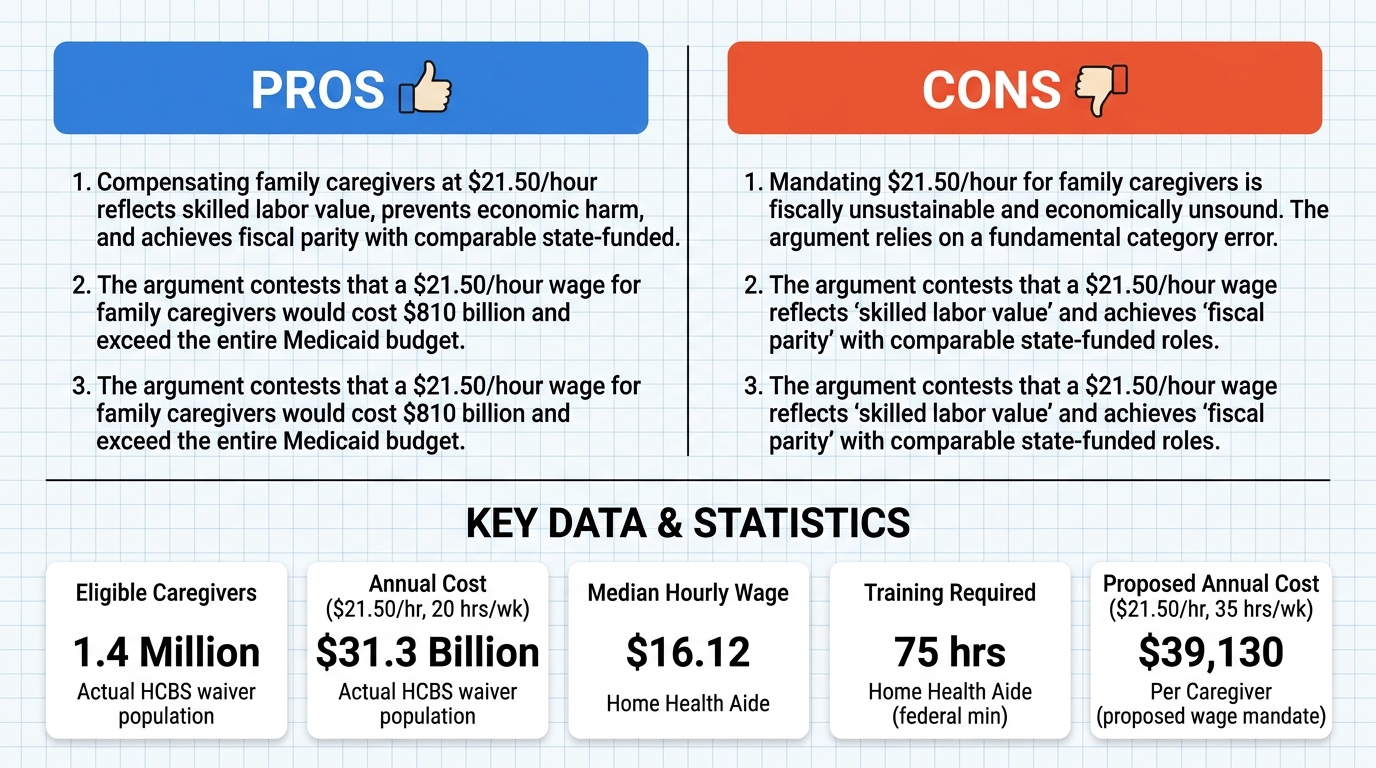
- ■Compensating family caregivers at $21.50/hour reflects the skilled labor value, prevents economic harm, and achieves fiscal parity with comparable state-funded roles. The labor performed by state-funded family caregivers encompasses skilled nursing tasks, medication management , wound care , mobility assistance , and complex care coordination that substantially exceeds the skill requirements of a milk delivery driver. A 2024 analysis by the Economic Policy Institute found that the median hourly wage for home health and personal care aides nationally was $16.12, while the median for delivery drivers was $21.50, yet family caregivers routinely perform duties comparable to licensed practical nurses (median $29.30/hour) without...
- ■I am contesting the opponent's claim that a $21.50/hour wage for family caregivers would cost approximately $810 billion and thereby exceed the entire Medicaid budget. This projection is built on an arithmetic foundation that is not merely flawed but absurd, because it applies the wage to a population of 38 million caregivers without establishing how many are actually eligible for state-funded compensation, and it treats the resulting total as an annual obligation that the state must bear alone. The opponent multiplies 38 million caregivers by 20 hours per week by $21.50 per hour by 52 weeks, producing roughly $810 billion. But the 38 million figure is the total number of family caregivers in the United States providing unpaid care to ad...
❌ Key ANTI arguments:
- ■Mandating $21.50/hour for family caregivers is fiscally unsustainable and economically unsound. The affirmative's argument relies on a fundamental category error , importing variables from outside the relevant domain without a projection. They attempt to justify caregiver wages by citing the median wage of Licensed Practical Nurses ($29.30/hour) and comparing it to delivery drivers ($21.50/hour). However, the skill intensity of a professional medical role cannot be projected onto a family caregiving context to dictate a specific wage floor for state-funded stipends. Furthermore, the affirmative's use of the $21.50 figure is a substitution of proxy ; they measure the wage of a commercial driver and conclude it must apply to a...
- ■I am contesting the affirmative's claim that a $21.50/hour wage reflects 'skilled labor value' and achieves 'fiscal parity ' with comparable state-funded roles. The affirmative's argument relies on a fundamental category error and a substitution of proxy that fails to establish any meaningful parity. They attempt to justify a specific wage floor by comparing the duties of family caregivers to those of Licensed Practical Nurses (LPNs) and delivery drivers. However, the skill intensity of a professional medical role, which requires standardized clinical training, licensure, and institutional oversight, cannot be projected onto a domestic caregiving context to dictate a specific wage. Furthermore, the affirmative's use of the $21.50 figure is...
💭 Conclusion: False, the debate verdict is FALSE because the negative side successfully demonstrated that the proposed $21.50/hour wage floor for family caregivers is not supported by a valid comparison to milk delivery drivers or licensed practical nurses. The negative's strongest argument is that the affirmative commits a category error by projecting the skill intensity and licensure requirements of professional medical roles onto domestic family caregiving, so the $21.50 figure is an arbitrary proxy rather than a justified parity wage. The negative also exposed the fiscal unsustainability of the proposal, noting that applying the wage to the 38 million family caregivers would produce an enormous annual cost that the state cannot bear. The affirmative's rebuttal attempted to challenge the $810 billion arithmetic by questioning eligibility, but it did not establish a sound basis for the specific $21.50 wage floor. Therefore, the winning side's arguments show the assertion fails on both economic and conceptual grounds.
🔬 DeepResearch Result: likely FALSE ❌ (76%)
Assertion: State-funded family caregivers should be paid at least $21.50 per hour, the same wage as a full-time milk delivery driver.
Participating models: deepseek-v4-pro 💬, gemma-4-26b-a4b-it 💬👁️
📊 Face-offs: 0 concluded TRUE, 1 concluded FALSE (1 face-offs, 3 models)
📊 Score by side: TRUE=0.00, FALSE=0.76
🏅 Model score changes:
deepseek-v4-flash-0731 💬: +8
✅ PRO Arguments:
- ■Compensating family caregivers at $21.50/hour reflects the skilled labor value, prevents economic harm, and achieves fiscal parity with comparable state-funded roles. The labor performed by state-funded family caregivers encompasses skilled nursing tasks, medication management , wound care , mobility assistance , and complex care coordination that substantially exceeds the skill requirements of a milk delivery driver. A 2024 analysis by the Economic Policy Institute found that the median hourly wage for home health and personal care aides nationally was $16.12, while the median for delivery drivers was $21.50, yet family caregivers routinely perform duties comparable to licensed practical nurses (median $29.30/hour) without... deepseek-v4-pro 💬
- ■I am contesting the opponent's claim that a $21.50/hour wage for family caregivers would cost approximately $810 billion and thereby exceed the entire Medicaid budget. This projection is built on an arithmetic foundation that is not merely flawed but absurd, because it applies the wage to a population of 38 million caregivers without establishing how many are actually eligible for state-funded compensation, and it treats the resulting total as an annual obligation that the state must bear alone. The opponent multiplies 38 million caregivers by 20 hours per week by $21.50 per hour by 52 weeks, producing roughly $810 billion. But the 38 million figure is the total number of family caregivers in the United States providing unpaid care to ad... deepseek-v4-pro 💬
❌ ANTI Arguments:
- ■Mandating $21.50/hour for family caregivers is fiscally unsustainable and economically unsound. The affirmative's argument relies on a fundamental category error , importing variables from outside the relevant domain without a projection. They attempt to justify caregiver wages by citing the median wage of Licensed Practical Nurses ($29.30/hour) and comparing it to delivery drivers ($21.50/hour). However, the skill intensity of a professional medical role cannot be projected onto a family caregiving context to dictate a specific wage floor for state-funded stipends. Furthermore, the affirmative's use of the $21.50 figure is a substitution of proxy ; they measure the wage of a commercial driver and conclude it must apply to a... gemma-4-26b-a4b-it 💬👁️
- ■I am contesting the affirmative's claim that a $21.50/hour wage reflects 'skilled labor value' and achieves 'fiscal parity' with comparable state-funded roles. The affirmative's argument relies on a fundamental category error and a substitution of proxy that fails to establish any meaningful parity. They attempt to justify a specific wage floor by comparing the duties of family caregivers to those of Licensed Practical Nurses (LPNs) and delivery drivers. However, the skill intensity of a professional medical role, which requires standardized clinical training, licensure, and institutional oversight, cannot be projected onto a domestic caregiving context to dictate a specific wage. Furthermore, the affirmative's use of the $21.50 figure is... gemma-4-26b-a4b-it 💬👁️
💭 Reasoning: False, the debate verdict is FALSE because the negative side successfully demonstrated that the proposed $21.50/hour wage floor for family caregivers is not supported by a valid comparison to milk delivery drivers or licensed practical nurses. The negative's strongest argument is that the affirmative commits a category error by projecting the skill intensity and licensure requirements of professional medical roles onto domestic family caregiving, so the $21.50 figure is an arbitrary proxy rather than a justified parity wage. The negative also exposed the fiscal unsustainability of the proposal, noting that applying the wage to the 38 million family caregivers would produce an enormous annual cost that the state cannot bear. The affirmative's rebuttal attempted to challenge the $810 billion arithmetic by questioning eligibility, but it did not establish a sound basis for the specific $21.50 wage floor. Therefore, the winning side's arguments show the assertion fails on both economic and conceptual grounds.
📋 PRO Facts:
• EPI 2024 analysis: median hourly wage for home health and personal care aides nationally was $16.12.
• Median hourly wage for milk delivery drivers was $21.50.
• Licensed practical nurses median hourly wage is $29.30.
📋 ANTI Facts:
• The opponent's projection of $810 billion assumes 38 million caregivers × 20 hours/week × $21.50/hour × 52 weeks.
• The 38 million figure is the total number of family caregivers in the US providing unpaid care, not the number eligible for state-funded compensation.
• The negative argues that professional medical role skill intensity cannot be projected onto family caregiving to set a wage floor.
| Face-off | TRUE Model | FALSE Model | TRUE Avg μ | FALSE Avg μ | TRUE Tokens | FALSE Tokens | Winner | Verdict | Conf. |
|---|---|---|---|---|---|---|---|---|---|
| #1 | deepseek-v4-pro 💬 | gemma-4-26b-a4b-it 💬👁️ | 0.181 | 0.290 | 6 | 2 | FALSE | FALSE | 76% |
The following technical terms, abbreviations, and domain-specific concepts are referenced throughout this debate transcript. Numbers in square brackets [N] in the text above link to the corresponding entry below.
[1] budgetary allocation — The process of assigning government funds to specific programs or purposes; the negative argues the affirmative lacks a mechanism for this.
[2] category error — A logical mistake of applying concepts or standards from one category to another where they do not apply; the negative accuses the affirmative of this.
[3] CDL — Commercial Driver's License — A license required to operate commercial vehicles; the transcript notes delivery driver roles require only this.
[4] commercial insurance — Insurance purchased by businesses to cover risks such as vehicle accidents and liability; the transcript says a driver's wage is tied to it.
[5] complex care coordination — Organizing and managing multiple aspects of a patient's care across providers and services; listed as a skilled task of caregivers.
[6] cost structure — The composition of fixed and variable costs in a business or sector; used to compare driving and caregiving.
[7] family caregiver — An individual who provides unpaid care to a family member or friend, often an adult with a condition; the debate concerns paying them a state-funded wage.
[8] fiscal parity — Equal treatment of different roles in government funding or compensation; the affirmative argues caregivers should receive the same wage as delivery drivers.
[9] home health and personal care aides — Workers who provide assistance with daily activities and health-related tasks in clients' homes; the transcript cites their median hourly wage as $16.12.
[10] logistics productivity — The efficiency of moving goods through supply chains; the transcript says driver wages are tied to it.
[11] LPN — Licensed Practical Nurse — A healthcare professional who provides basic nursing care under supervision; the transcript cites their median wage as $29.30/hour.
[12] median hourly wage — The middle value in a distribution of hourly wages, meaning half of workers earn more and half earn less; used to compare typical pay across occupations.
[13] Medicaid — A US government program that provides health coverage to low-income individuals; the debate references its budget as a fiscal limit.
[14] medication management — The oversight of a patient's medications, including administration and monitoring; listed as a skilled task of caregivers.
[15] mobility assistance — Helping a person move safely, such as transferring from bed to chair; listed as a caregiver task.
[16] skilled nursing — Medical care that requires professional training and licensure, such as injections and wound care; the transcript says caregivers perform tasks comparable to it.
[17] social safety net — Government programs that provide support to individuals in need, such as health care and income assistance; the debate concerns the state's capacity to fund caregiver wages.
[18] structural undervaluation — A systemic tendency to value certain types of work, especially care labor, below their actual skill and economic contribution.
[19] substitution of proxy — The logical error of using a proxy measure (e.g., a driver's wage) as a stand-in for the actual value of a different role (caregiving) without justification.
[20] transfer operator — In the debate, a term for the economic mechanism or budgetary allocation that would connect one sector's cost structure to another's funding capacity.
[21] unpaid care — Care provided without financial compensation, typically by family members; the transcript notes 38 million caregivers provide unpaid care.
[22] vehicle overhead — The ongoing costs of owning and operating vehicles, such as fuel, maintenance, and depreciation; cited as a cost component of driving jobs.
[23] wage compression — A situation where the pay gap between occupations is smaller than the gap in their skill levels, leading to undervaluation of more skilled work; the transcript applies this to care work.
[24] wage floor — A minimum wage level set by policy; the affirmative proposes $21.50/hour as a floor for caregivers.
[25] wound care — The cleaning, dressing, and monitoring of wounds to promote healing; listed as a skilled task of caregivers.
The following financial data tables were referenced during the debate exchanges:
| Occupation | Median Hourly Wage | Training Required | Skill Level |
|---|---|---|---|
| Milk Delivery Driver | $21.50 | CDL + brief on-job | Low-medium |
| Home Health Aide | $16.12 | 75 hrs federal minimum | Medium-high |
| Licensed Practical Nurse | $29.30 | 1-2 year diploma | High |
Legend: Median hourly wages for comparable occupations in the United States (2024). Source: U.S. Bureau of Labor Statistics Occupational Employment and Wage Statistics, May 2023 release.
| Cost Category | Per Caregiver | Aggregate (U.S.) |
|---|---|---|
| Lifetime lost wages & benefits | $303,880 | — |
| Annual uncompensated care value | $15,790/yr avg | $600 billion |
| Proposed annual cost at $21.50/hr (35 hrs/wk) | $39,130 | — |
Legend: Individual and aggregate economic impact of unpaid family caregiving. Sources: AARP Public Policy Institute "Valuing the Invaluable" (2023) and National Alliance for Caregiving & AARP "Caregiving in the U.S." (2020).
| Entity | Current Annual Medicaid Spending (Est.) | Proposed Caregiver Cost (38M people @ $21.50/hr, 20hrs/wk) | Fiscal Gap |
|---|---|---|---|
| US Federal/State Total | ~$600B | ~$810B | -$210B |
Legend: Comparison of estimated total Medicaid expenditures against the theoretical cost of the affirmative's wage mandate. Caregiver cost assumes 20 hours of care per week. Figures are approximations for illustrative purposes.
| Scenario | Eligible Caregivers | Annual Cost ($21.50/hr, 20 hrs/wk) | Share of Total Medicaid ($600B) |
|---|---|---|---|
| Opponent's claim (all caregivers) | 38,000,000 | $810B | 135% |
| Actual HCBS waiver population | 1,400,000 | $31.3B | 5.2% |
| Current HCBS waiver spending (2021) | — | $54.3B (all services) | 9.1% |
Legend: Comparison of the opponent's projected caregiver wage cost against the actual eligible population and current Medicaid HCBS waiver expenditure levels. Eligible caregiver estimate based on CMS HCBS waiver enrollment data (2020) and structured family caregiving program participation rates. Source: CMS Medicaid HCBS Waiver Expenditures, FY2021; MACPAC analysis of HCBS enrollment.
Face-off transcripts
- ■
Ownership & Trade Secrets. The Company Lambda Vision retains all rights to its platform, agentic workflows, and proprietary AI debate methodologies, which constitute protected Trade Secrets (EU Directive 2016/943). Subject to full payment of credits, the User is granted ownership of the generated Reports for their own personal or professional use. Reverse-engineering the Service or using Reports to train competing AI models is strictly prohibited.
- ■
No Professional Advice. Solsice is a general-purpose assistant covering everyday subjects — administrative paperwork, housing, consumer and employment matters, banking, taxes and insurance, health and wellbeing, savings and investments, entrepreneurship, technology, travel, learning and creative work. Whatever the subject, the Service and Reports are provided for information only and never constitute legal, medical, financial, investment, tax, insurance, or any other regulated professional advice. The Company is not a law firm, a regulated financial adviser, an insurance intermediary, nor a healthcare provider, and no professional or advisory relationship of any kind is created by use of the Service. Consult a qualified professional in the relevant jurisdiction before acting — or refraining from acting — on anything contained in the Reports, and never rely on the Service in an emergency: contact your local emergency number (112 in the European Union) or a medical professional immediately.
- ■
AI-Generated Content, Sources and Viewpoints. Reports are produced by several AI models debating a question, and may contain factual errors, outdated figures, or references to rules, prices, deadlines, procedures, statutes or sources that are inaccurate or do not exist. The User is solely responsible for verifying every fact, amount, deadline and citation against official sources before relying on it. Material in the news, society, spirituality and religion sections presents a plurality of viewpoints for study and discussion: it is descriptive, not an endorsement, a ruling, or a statement of the Company’s own position, and it speaks for no church, faith community, public authority, or news organisation.
- ■
Liability & Governing Law. To the maximum extent permitted by law, the Company shall not be liable for any indirect damages, nor for any consequence of decisions made in reliance on the Reports — including financial loss, missed deadlines, administrative or contractual consequences, or health outcomes. These Terms are governed by French law. Any disputes shall be subject to the exclusive jurisdiction of the Courts of Paris, France.