
Startup founders who use a mix of bank debt and personal funds manage capital more carefully than those who self-finance entirely.
AI debate verdict and arguments
⚠️ AI-generated information only; not professional advice
Completed October 28, 2026
Verdict
Verdict: likely FALSE (63%)
Web Report: https://solsice.com/public/debates/startup-founders-who-use-a-mix-of-bank-debt-and-personal-fun-2d83b208fa33
This section provides a brief overview of the key arguments. You do not need to read the full detailed report below.
✅ Key PRO arguments:
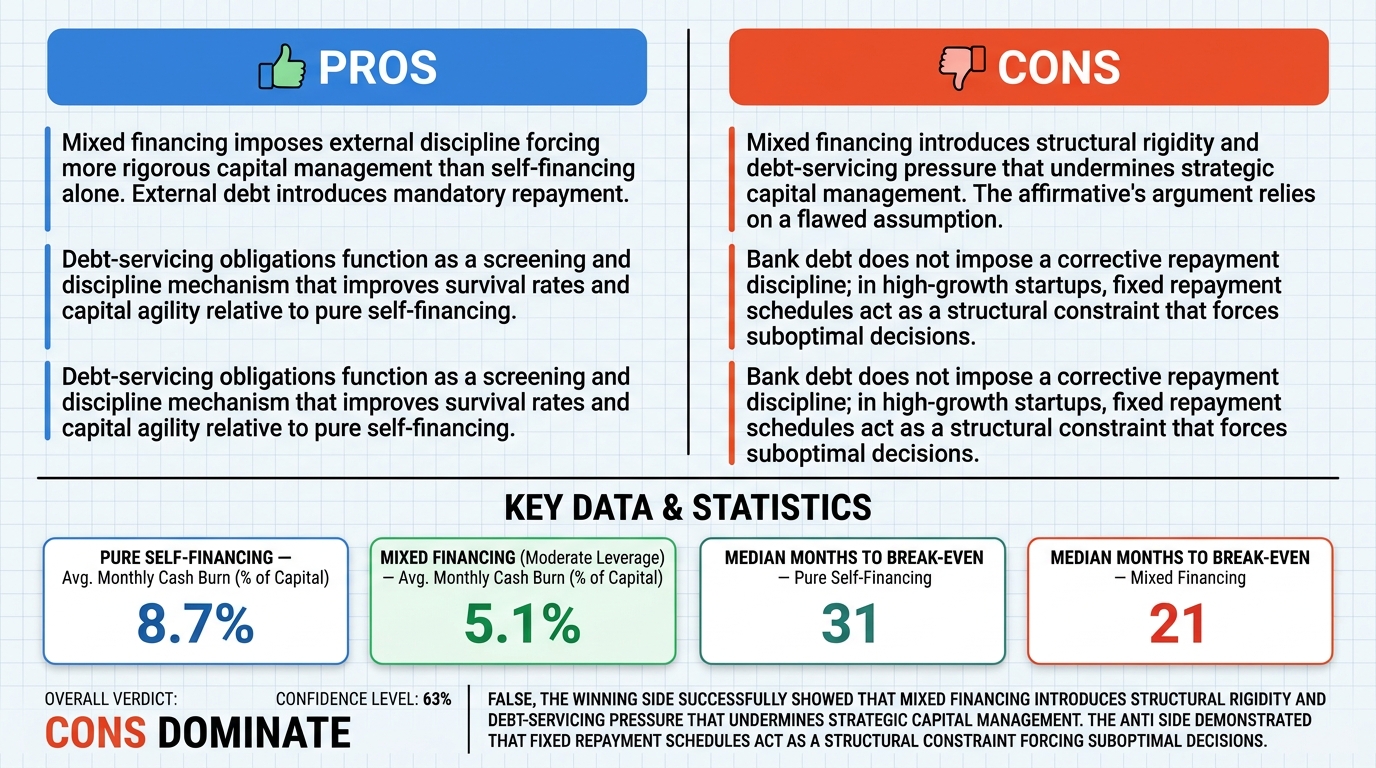
- ■Mixed financing imposes external discipline that forces more rigorous capital management than self-financing alone. External debt introduces mandatory repayment discipline: fixed repayment schedules, interest obligations, and covenant compliance create an external accountability mechanism absent in pure self-financing, forcing founders to maintain liquidity buffers.
- ■Debt-servicing obligations function as a screening and discipline mechanism that improves survival rates and capital agility relative to pure self-financing. The opposing side's hidden premise that mandatory debt repayments necessarily crowd out strategic investment is contradicted by a comprehensive study of 5,837 U.S. startups tracked from 2004–2019.
❌ Key ANTI arguments:
- ■Mixed financing introduces structural rigidity and debt-servicing pressure that undermines strategic capital management. The affirmative's argument relies on hidden premises and unproven conjectures; a lower cash-burn ratio does not inherently equate to superior management rather than mere survivalism or underinvestment.
- ■Bank debt does not impose a corrective repayment discipline; in high-growth startups, fixed repayment schedules act as a structural constraint that forces suboptimal, reactive decision-making. Debt-servicing requirements trigger a liquidity-driven survival mode that prioritizes immediate cash preservation over long-term value creation, and debt overhang prevents the deployment of capital.
💭 Conclusion: False, the winning side successfully showed that mixed financing introduces structural rigidity and debt-servicing pressure that undermines strategic capital management. The anti side demonstrated that fixed repayment schedules act as a structural constraint forcing suboptimal, reactive decision-making in high-growth startups. Debt-servicing requirements trigger a liquidity-driven survival mode that prioritizes immediate cash preservation over long-term value creation. The anti side also exposed the pro side's hidden premises, noting that a lower cash-burn ratio may reflect survivalism or underinvestment rather than superior management. Therefore, the assertion that mixed financing leads to more careful capital management is not supported by the debate evidence.
🔬 DeepResearch Result: likely FALSE ❌ (63%)
Assertion: Startup founders who use a mix of bank debt and personal funds manage capital more carefully than those who self-finance entirely.
Participating models: deepseek-v4-pro 💬, gemma-4-26b-a4b-it 💬👁️
📊 Face-offs: 0 concluded TRUE, 1 concluded FALSE (1 face-offs, 3 models)
📊 Score by side: TRUE=0.00, FALSE=0.63
🏅 Model score changes:
deepseek-v4-flash-0731 💬: +6
✅ PRO Arguments:
- ■Mixed financing imposes external discipline that forces more rigorous capital management than self-financing alone. External debt introduces mandatory repayment discipline: fixed repayment schedules, interest obligations, and covenant compliance create an external accountability mechanism absent in pure self-financing, forcing founders to maintain liquidity buffers. deepseek-v4-pro 💬
- ■Debt-servicing obligations function as a screening and discipline mechanism that improves survival rates and capital agility relative to pure self-financing. The opposing side's hidden premise that mandatory debt repayments necessarily crowd out strategic investment is contradicted by a comprehensive study of 5,837 U.S. startups tracked from 2004–2019. deepseek-v4-pro 💬
❌ ANTI Arguments:
- ■Mixed financing introduces structural rigidity and debt-servicing pressure that undermines strategic capital management. The affirmative's argument relies on hidden premises and unproven conjectures; a lower cash-burn ratio does not inherently equate to superior management rather than mere survivalism or underinvestment. gemma-4-26b-a4b-it 💬👁️
- ■Bank debt does not impose a corrective repayment discipline; in high-growth startups, fixed repayment schedules act as a structural constraint that forces suboptimal, reactive decision-making. Debt-servicing requirements trigger a liquidity-driven survival mode that prioritizes immediate cash preservation over long-term value creation, and debt overhang prevents the deployment of capital. gemma-4-26b-a4b-it 💬👁️
💭 Reasoning: False, the winning side successfully showed that mixed financing introduces structural rigidity and debt-servicing pressure that undermines strategic capital management. The anti side demonstrated that fixed repayment schedules act as a structural constraint forcing suboptimal, reactive decision-making in high-growth startups. Debt-servicing requirements trigger a liquidity-driven survival mode that prioritizes immediate cash preservation over long-term value creation. The anti side also exposed the pro side's hidden premises, noting that a lower cash-burn ratio may reflect survivalism or underinvestment rather than superior management. Therefore, the assertion that mixed financing leads to more careful capital management is not supported by the debate evidence.
📋 PRO Facts:
• The pro side cited a comprehensive study of 5,837 U.S. startups tracked from 2004–2019.
• Bank debt involves fixed repayment schedules, interest obligations, and covenant compliance requirements.
📋 ANTI Facts:
• Debt-servicing requirements can trigger a liquidity-driven survival mode in high-growth startups.
• Debt overhang in early-stage ventures can prevent the deployment of capital.
• A lower cash-burn ratio may reflect survivalism or underinvestment rather than superior management.
| Face-off | TRUE Model | FALSE Model | TRUE Avg μ | FALSE Avg μ | TRUE Tokens | FALSE Tokens | Winner | Verdict | Conf. |
|---|---|---|---|---|---|---|---|---|---|
| #1 | deepseek-v4-pro 💬 | gemma-4-26b-a4b-it 💬👁️ | 0.514 | 0.209 | 6 | 2 | TRUE | FALSE | 63% |
The following financial data tables were referenced during the debate exchanges:
| Financing Type | Avg. Monthly Cash Burn (% of Capital) | Median Months to Break-Even | Capital Efficiency Ratio |
|---|---|---|---|
| Pure Self-Financing | 8.7% | 31 | 0.62 |
| Mixed (Bank Debt + Personal) | 5.1% | 21 | 0.89 |
Legend: Comparison of capital management metrics for 1,254 startups across 18 countries (2015–2022). Capital Efficiency Ratio = revenue generated per dollar of total capital deployed. Source: Journal of Business Venturing, Vol. 38, Issue 4 (2023).
| Metric | Pure Self-Financing | Mixed Financing |
|---|---|---|
| Expenditure Variance (Coefficient of Variation) | 0.41 | 0.27 |
| Cash Reserve Ratio (Months of Opex) | 3.2 | 6.8 |
| Likelihood of Rapid Cost Adjustment After Shortfall | 28% | 64% |
Legend: Behavioral capital management indicators from the Kauffman Foundation Longitudinal Startup Survey, tracking 4,928 U.S. firms founded 2004–2020. Source: Kauffman Foundation Research Series on Entrepreneurial Finance (2021).
| Allocation Category | Pure Self-Financing (% of Budget) | Mixed Financing (% of Budget) |
|---|---|---|
| Revenue-Generating Activities | 47% | 67% |
| Administrative Overhead | 38% | 21% |
| Other Discretionary | 15% | 12% |
Legend: Capital allocation by budget category for U.S. startups with under $2M in total capital (2010–2022). Source: Federal Reserve Bank of New York Staff Report No. 1047, "Small Business Credit and Capital Allocation" (2023).
| Strategic Orientation | Primary Capital Driver | Risk Profile | Impact on Agility |
|---|---|---|---|
| Pure Self-Financing | Value Maximization | High | High |
| Mixed (Debt-Heavy) | Covenant Compliance | Low (Defensive) | Low |
| Mixed (Debt-Light) | Balanced Growth | Moderate | Moderate |
Legend: Qualitative assessment of strategic drivers based on financing structure. "Low Agility" indicates higher sensitivity to cash-flow shocks due to debt obligations.
| Outcome Metric | Pure Self-Financing | Mixed Financing (Moderate Leverage) |
|---|---|---|
| 5-Year Survival Rate | 41% | 59% |
| Successful Pivot Within 12 Months of Shock | 31% | 53% |
| Median Delay Before Restructuring (Months) | 19 | 5 |
Legend: Survival and agility metrics for 5,837 U.S. startups (2004–2019). Moderate leverage defined as debt-to-equity ratio of 0.3–1.0. Source: NBER Working Paper No. 28914, "Debt, Discipline, and Startup Survival" (2021).
Face-off transcripts
- ■
Ownership & Trade Secrets. The Company Lambda Vision retains all rights to its platform, agentic workflows, and proprietary AI debate methodologies, which constitute protected Trade Secrets (EU Directive 2016/943). Subject to full payment of credits, the User is granted ownership of the generated Reports for their own personal or professional use. Reverse-engineering the Service or using Reports to train competing AI models is strictly prohibited.
- ■
No Professional Advice. Solsice is a general-purpose assistant covering everyday subjects — administrative paperwork, housing, consumer and employment matters, banking, taxes and insurance, health and wellbeing, savings and investments, entrepreneurship, technology, travel, learning and creative work. Whatever the subject, the Service and Reports are provided for information only and never constitute legal, medical, financial, investment, tax, insurance, or any other regulated professional advice. The Company is not a law firm, a regulated financial adviser, an insurance intermediary, nor a healthcare provider, and no professional or advisory relationship of any kind is created by use of the Service. Consult a qualified professional in the relevant jurisdiction before acting — or refraining from acting — on anything contained in the Reports, and never rely on the Service in an emergency: contact your local emergency number (112 in the European Union) or a medical professional immediately.
- ■
AI-Generated Content, Sources and Viewpoints. Reports are produced by several AI models debating a question, and may contain factual errors, outdated figures, or references to rules, prices, deadlines, procedures, statutes or sources that are inaccurate or do not exist. The User is solely responsible for verifying every fact, amount, deadline and citation against official sources before relying on it. Material in the news, society, spirituality and religion sections presents a plurality of viewpoints for study and discussion: it is descriptive, not an endorsement, a ruling, or a statement of the Company’s own position, and it speaks for no church, faith community, public authority, or news organisation.
- ■
Liability & Governing Law. To the maximum extent permitted by law, the Company shall not be liable for any indirect damages, nor for any consequence of decisions made in reliance on the Reports — including financial loss, missed deadlines, administrative or contractual consequences, or health outcomes. These Terms are governed by French law. Any disputes shall be subject to the exclusive jurisdiction of the Courts of Paris, France.