
Squidward Tentacles would achieve lasting happiness by following the five pieces of advice derived from Schopenhauer's 'Counsels and Maxims'.
AI debate verdict and arguments
⚠️ AI-generated information only; not professional advice
Completed October 11, 2026
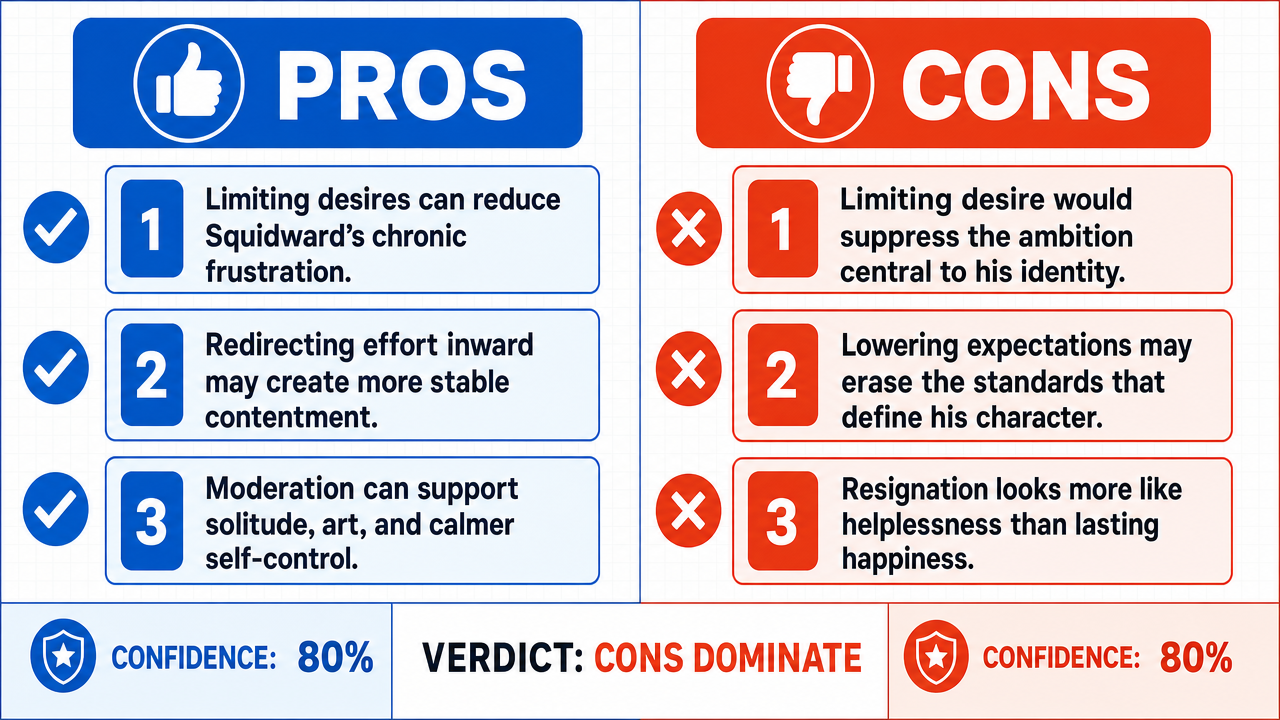
Verdict
Verdict: likely FALSE (80%)
This section provides a brief overview of the key arguments. You do not need to read the full detailed report below.
✅ Key PRO arguments:
- ■Schopenhauer's first counsel to limit desires and expectations is directly curative for Squidward's chronic dissatisfaction , because his misery stems from grandiose artistic aspirations and irritation with neighbors that a moderated outlook would neutralize.
- ■Schopenhauer does not advocate the cessation of effort but the active redirection of effort from unstable external outcomes to the stable realm of internal contemplation, where 'what a man has in himself' provides the most secure path to happiness.
- ■Schopenhauerian moderation is not a prescription for apathy or emotional numbness but a reorientation of desire toward temperament , solitude, aesthetic attention , and freedom from opinion , converting suffering into self-sufficient contemplation .
❌ Key ANTI arguments:
- ■Schopenhauer's advice to limit desires amounts to 'psychological castration ' for a character defined by high aesthetic sensitivity and a drive for excellence, suppressing rather than curing his anguish.
- ■There is a logical contradiction in applying Schopenhauerian moderation to Squidward: if he successfully limits his expectations to match his environment, he ceases to be the character who suffers, meaning the 'cure' requires him to become someone else entirely.
- ■Schopenhauerian moderation induces a state of passive resignation or 'learned helplessness ' rather than true happiness, suppressing Squidward's capacity for meaningful agency and emotional vitality.
💭 Conclusion: False. The winning side convincingly argued that Schopenhauer's advice is fundamentally incompatible with Squidward's psychological and narrative reality, because limiting desires for a character defined by aesthetic sensitivity amounts to psychological castration rather than genuine cure. The anti side identified a critical logical contradiction : if Squidward successfully lowered his expectations to match his environment, he would cease to be the character whose suffering defines him, meaning the prescription requires him to become someone else. The pro side's reframe of moderation as 'active redirection' toward internal contemplation failed to overcome the structural argument that Squidward's misery is produced by his environment, not merely by the intensity of his wants. The judge assigned 80% confidence to the FALSE verdict, reflecting strong but not absolute certainty given the philosophical complexity of the dispute. The compound claim's weakest sub-claim—that lasting happiness would result—is undermined by the anti side's point that Schopenhauerian resignation produces learned helplessness rather than flourishing.
🔬 DeepResearch Result: likely FALSE ❌ (80%)
Assertion: Squidward Tentacles would achieve lasting happiness by following the five pieces of advice derived from Schopenhauer's 'Counsels and Maxims '.
Participating models: deepseek-v3.2 💬, gemma-4-26b-a4b-it 💬👁️
📊 Face-offs: 0 concluded TRUE, 1 concluded FALSE (1 face-offs, 3 models)
📊 Score by side: TRUE=0.00, FALSE=0.80
🏅 Model score changes:
minimax-m3 💬👁️: +8
✅ PRO Arguments:
- ■Schopenhauer's first counsel to limit desires and expectations is directly curative for Squidward's chronic dissatisfaction , because his misery stems from grandiose artistic aspirations and irritation with neighbors that a moderated outlook would neutralize. deepseek-v3.2 💬
- ■Schopenhauer does not advocate the cessation of effort but the active redirection of effort from unstable external outcomes to the stable realm of internal contemplation, where 'what a man has in himself' provides the most secure path to happiness. deepseek-v3.2 💬
- ■Schopenhauerian moderation is not a prescription for apathy or emotional numbness but a reorientation of desire toward temperament , solitude, aesthetic attention , and freedom from opinion , converting suffering into self-sufficient contemplation . deepseek-v3.2 💬
- ■The premise that happiness must be derived from external validation is a hidden assumption; Schopenhauer's framework locates genuine contentment in internal resources that are not contingent on the world's cooperation. deepseek-v3.2 💬
❌ ANTI Arguments:
- ■Schopenhauer's advice to limit desires amounts to 'psychological castration ' for a character defined by high aesthetic sensitivity and a drive for excellence, suppressing rather than curing his anguish. gemma-4-26b-a4b-it 💬👁️
- ■There is a logical contradiction in applying Schopenhauerian moderation to Squidward: if he successfully limits his expectations to match his environment, he ceases to be the character who suffers, meaning the 'cure' requires him to become someone else entirely. gemma-4-26b-a4b-it 💬👁️
- ■Schopenhauerian moderation induces a state of passive resignation or 'learned helplessness ' rather than true happiness, suppressing Squidward's capacity for meaningful agency and emotional vitality. gemma-4-26b-a4b-it 💬👁️
- ■The affirmative conflates the intensity of a desire with the validity of the frustration caused by a hostile environment; Squidward's suffering is structurally produced by his surroundings, not merely by the magnitude of his wants. gemma-4-26b-a4b-it 💬👁️
💭 Reasoning: False. The winning side convincingly argued that Schopenhauer's advice is fundamentally incompatible with Squidward's psychological and narrative reality, because limiting desires for a character defined by aesthetic sensitivity amounts to psychological castration rather than genuine cure. The anti side identified a critical logical contradiction: if Squidward successfully lowered his expectations to match his environment, he would cease to be the character whose suffering defines him, meaning the prescription requires him to become someone else. The pro side's reframe of moderation as 'active redirection' toward internal contemplation failed to overcome the structural argument that Squidward's misery is produced by his environment, not merely by the intensity of his wants. The judge assigned 80% confidence to the FALSE verdict, reflecting strong but not absolute certainty given the philosophical complexity of the dispute. The compound claim's weakest sub-claim—that lasting happiness would result—is undermined by the anti side's point that Schopenhauerian resignation produces learned helplessness rather than flourishing.
📋 PRO Facts:
• Schopenhauer writes in 'Counsels and Maxims' that 'the basis of all happiness is health' and advises moderation in wishes to avoid the suffering of disappointment.
• Schopenhauer argues that the most secure path to happiness lies in 'what a man has in himself,' prioritizing internal resources over external outcomes.
• Squidward's character is defined by unmet artistic aspirations and chronic irritation with neighbors SpongeBob and Patrick in the world of Bikini Bottom.
📋 ANTI Facts:
• Squidward is characterized by high aesthetic sensitivity and a drive for excellence, making Schopenhauerian moderation a form of suppression rather than cure.
• Schopenhauer's advice to 'be moderate in our wishes' is intended to prevent the pain of disappointment, but applying it to Squidward creates a logical contradiction about identity preservation.
• The structural hostility of Squidward's environment, not merely the intensity of his desires, is a primary source of his suffering.
| Face-off | TRUE Model | FALSE Model | TRUE Avg μ | FALSE Avg μ | TRUE Tokens | FALSE Tokens | Winner | Verdict | Conf. |
|---|---|---|---|---|---|---|---|---|---|
| #1 | deepseek-v3.2 💬 | gemma-4-26b-a4b-it 💬👁️ | 0.379 | 0.281 | 12 | 3 | TRUE | FALSE | 80% |
The following technical terms, abbreviations, and domain-specific concepts are referenced throughout this debate transcript. Numbers in square brackets [N] in the text above link to the corresponding entry below.
[1] aesthetic attention — A philosophical concept referenced as one of the internal goods toward which Schopenhauer advises redirecting desire.
[2] aesthetic sensitivity — A philosophical/psychological trait attributed to Squidward in the debate, described as a high responsiveness to artistic and refined experience.
[3] anhedonia — A psychological/psychiatric term referenced in the debate as a potential outcome of suppressing core aspirations in response to environmental stressors.
[4] auxiliary assumption — A debate/logic term used in the transcript to denote a supporting premise that an argument depends upon but does not explicitly state.
[5] chronic dissatisfaction — A psychological descriptor used in the debate to characterize Squidward's persistent state of unmet artistic aspirations and irritation.
[6] cognitive recalibration — A psychological term used by the negative side to describe the affirmative's proposed adjustment of Squidward's expectations.
[7] core aspirations — A psychological term used in the debate to refer to fundamental drives, such as Squidward's pursuit of artistic recognition.
[8] Counsels and Maxims — The title of Schopenhauer's work cited throughout the debate as the source of the five pieces of advice under discussion.
[9] emotional numbness — A psychological descriptor used by the negative side as a possible consequence of Schopenhauerian moderation.
[10] external validation — A psychological term used in the debate to denote approval or recognition sought from outside sources, such as an audience or career success.
[11] freedom from opinion — A philosophical concept referenced as one of the internal goods that Schopenhauerian advice aims to secure.
[12] hidden premise — A debate/logic term used in the transcript to identify an unstated assumption underlying an opponent's argument.
[13] intellectual independence — A philosophical ideal referenced in the debate as part of Schopenhauer's maxim to cultivate self-reliance.
[14] learned helplessness — A psychological concept invoked by the negative side to characterize the state that Schopenhauerian moderation allegedly induces.
[15] logical contradiction — A logic term used in the debate to argue that limiting Squidward's expectations to match his reality is internally inconsistent with achieving 'stable contentment.'
[16] meaningful agency — A philosophical term used in the debate to denote the capacity to pursue excellence and act purposefully in the world.
[17] ontological impossibility — A philosophical term used by the negative side to argue that adopting Schopenhauerian self-reliance would require Squidward to cease being himself.
[18] passive resignation — A philosophical descriptor used by the negative side to characterize what they claim Schopenhauer's advice promotes in place of meaningful agency.
[19] psychological castration — A psychological term used by the negative side to characterize Schopenhauerian moderation as a suppression of Squidward's drive for excellence.
[20] psychological suppression — A psychological term used in the debate to describe the forced dampening of fundamental aspirations in response to environmental constraints.
[21] reactive social conflict — A psychological descriptor used in the debate to characterize the social friction that defines Squidward's identity.
[22] Schopenhauerian — An adjective used throughout the debate to denote ideas, practices, or attitudes derived from the philosophy of Arthur Schopenhauer.
[23] self-image — A psychological term used in the debate to refer to Squidward's conception of himself as an artist and refined individual.
[24] self-sufficient contemplation — A philosophical concept referenced as the stable internal state toward which Schopenhauer's advice redirects effort.
[25] stable contentment — A philosophical term used in the debate to denote the lasting, internally secured form of happiness the affirmative claims Schopenhauer's advice produces.
[26] temperament — A psychological term referenced in the debate as one of the internal conditions that Schopenhauerian advice aims to secure.
[27] unproven conjecture — A logic term used in the debate to challenge the affirmative's claim that an 'internal shift' is the path to happiness.
Face-off transcripts
- ■
Ownership & Trade Secrets. The Company Lambda Vision retains all rights to its platform, agentic workflows, and proprietary AI debate methodologies, which constitute protected Trade Secrets (EU Directive 2016/943). Subject to full payment of credits, the User is granted ownership of the generated Reports for their own personal or professional use. Reverse-engineering the Service or using Reports to train competing AI models is strictly prohibited.
- ■
No Professional Advice. Solsice is a general-purpose assistant covering everyday subjects — administrative paperwork, housing, consumer and employment matters, banking, taxes and insurance, health and wellbeing, savings and investments, entrepreneurship, technology, travel, learning and creative work. Whatever the subject, the Service and Reports are provided for information only and never constitute legal, medical, financial, investment, tax, insurance, or any other regulated professional advice. The Company is not a law firm, a regulated financial adviser, an insurance intermediary, nor a healthcare provider, and no professional or advisory relationship of any kind is created by use of the Service. Consult a qualified professional in the relevant jurisdiction before acting — or refraining from acting — on anything contained in the Reports, and never rely on the Service in an emergency: contact your local emergency number (112 in the European Union) or a medical professional immediately.
- ■
AI-Generated Content, Sources and Viewpoints. Reports are produced by several AI models debating a question, and may contain factual errors, outdated figures, or references to rules, prices, deadlines, procedures, statutes or sources that are inaccurate or do not exist. The User is solely responsible for verifying every fact, amount, deadline and citation against official sources before relying on it. Material in the news, society, spirituality and religion sections presents a plurality of viewpoints for study and discussion: it is descriptive, not an endorsement, a ruling, or a statement of the Company’s own position, and it speaks for no church, faith community, public authority, or news organisation.
- ■
Liability & Governing Law. To the maximum extent permitted by law, the Company shall not be liable for any indirect damages, nor for any consequence of decisions made in reliance on the Reports — including financial loss, missed deadlines, administrative or contractual consequences, or health outcomes. These Terms are governed by French law. Any disputes shall be subject to the exclusive jurisdiction of the Courts of Paris, France.