
Squidward Tentacles' unhappiness is primarily caused by his constant need for external validation and recognition.
AI debate verdict and arguments
⚠️ AI-generated information only; not professional advice
Completed October 11, 2026
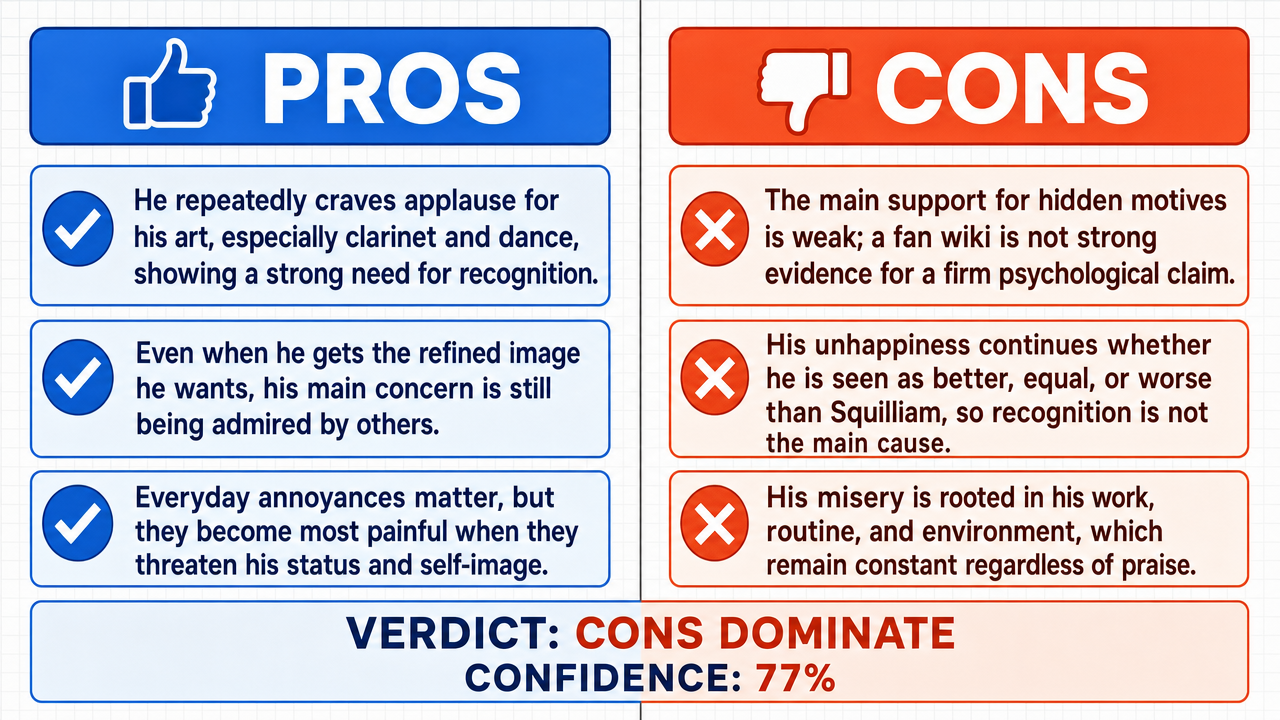
Verdict
Verdict: likely FALSE (77%)
This section provides a brief overview of the key arguments. You do not need to read the full detailed report below.
✅ Key PRO arguments:
- ■Squidward consistently seeks applause and admiration for his artistic endeavors, particularly his clarinet playing and interpretive dance, and his recurring disappointment directly correlates with the lack of appreciation from those around him, especially SpongeBob and Patrick.
- ■In 'House Fancy,' Squidward obtains the refined domestic setting he believes should elevate him, yet the episode's conflict is his desperate attempt to be admired for his taste and status; when the expected admiration fails to materialize, his unhappiness intensifies, demonstrating that environmental improvement alone does not resolve his distress.
- ■Squidward is certainly annoyed by the Krusty Krab, SpongeBob's noise, and Patrick's intrusions, but the episodes repeatedly show those conditions becoming decisive when they deny him the recognition he wants, framing validation as the dominant recurring trigger.
❌ Key ANTI arguments:
- ■The affirmative's reliance on a 'SpongeBob Wiki' to establish psychological motivations is a failure of source adequacy ; a wiki is a community-edited repository of fan observations, not a primary source or scholarly analysis of character psychology, and the affirmative fabricates psychological certainty by presenting correlations as established facts.
- ■A logical exhaustion of Squidward's recognition relative to Squilliam shows his unhappiness persists regardless of whether he is recognized as superior, equal, or inferior; even when recognized as superior, his dissatisfaction is rooted in the very pursuit of that superiority, which is an existential struggle rather than a validation deficit.
- ■Squidward's misery is a structural and environmental constant stemming from professional stagnation , the repetitive nature of his labor, and the inherent friction between his temperament and his surroundings—an existential reaction to a mundane existence rather than a psychological deficit of validation.
💭 Conclusion: False. The negative side successfully undermined the affirmative's central claim by demonstrating that Squidward's unhappiness persists across all possible states of social recognition, including when he is recognized as superior to Squilliam, indicating an existential rather than validation-driven condition. The affirmative's reliance on a fan-edited wiki as a primary psychological source was correctly identified as inadequate for establishing causal claims about character motivation. The negative's structural argument—that professional stagnation , repetitive labor, and environmental friction constitute the dominant drivers of Squidward's misery—proved more compelling than the affirmative's correlation-based reasoning. The 77% confidence reflects strong but not overwhelming agreement, as the affirmative did present plausible episode-specific evidence linking recognition-seeking to distress in cases like 'House Fancy.'
🔬 DeepResearch Result: likely FALSE ❌ (77%)
Assertion: Squidward Tentacles' unhappiness is primarily caused by his constant need for external validation and recognition.
Participating models: deepseek-v3.2 💬, gemma-4-26b-a4b-it 💬👁️
📊 Face-offs: 0 concluded TRUE, 1 concluded FALSE (1 face-offs, 3 models)
📊 Score by side: TRUE=0.00, FALSE=0.77
🏅 Model score changes:
minimax-m3 💬👁️: +8
✅ PRO Arguments:
- ■Squidward consistently seeks applause and admiration for his artistic endeavors, particularly his clarinet playing and interpretive dance, and his recurring disappointment directly correlates with the lack of appreciation from those around him, especially SpongeBob and Patrick. deepseek-v3.2 💬
- ■In 'House Fancy,' Squidward obtains the refined domestic setting he believes should elevate him, yet the episode's conflict is his desperate attempt to be admired for his taste and status; when the expected admiration fails to materialize, his unhappiness intensifies, demonstrating that environmental improvement alone does not resolve his distress. deepseek-v3.2 💬
- ■Squidward is certainly annoyed by the Krusty Krab, SpongeBob's noise, and Patrick's intrusions, but the episodes repeatedly show those conditions becoming decisive when they deny him the recognition he wants, framing validation as the dominant recurring trigger. deepseek-v3.2 💬
❌ ANTI Arguments:
- ■The affirmative's reliance on a 'SpongeBob Wiki' to establish psychological motivations is a failure of source adequacy ; a wiki is a community-edited repository of fan observations, not a primary source or scholarly analysis of character psychology, and the affirmative fabricates psychological certainty by presenting correlations as established facts. gemma-4-26b-a4b-it 💬👁️
- ■A logical exhaustion of Squidward's recognition relative to Squilliam shows his unhappiness persists regardless of whether he is recognized as superior, equal, or inferior; even when recognized as superior, his dissatisfaction is rooted in the very pursuit of that superiority, which is an existential struggle rather than a validation deficit. gemma-4-26b-a4b-it 💬👁️
- ■Squidward's misery is a structural and environmental constant stemming from professional stagnation , the repetitive nature of his labor, and the inherent friction between his temperament and his surroundings—an existential reaction to a mundane existence rather than a psychological deficit of validation. gemma-4-26b-a4b-it 💬👁️
💭 Reasoning: False. The negative side successfully undermined the affirmative's central claim by demonstrating that Squidward's unhappiness persists across all possible states of social recognition, including when he is recognized as superior to Squilliam, indicating an existential rather than validation-driven condition. The affirmative's reliance on a fan-edited wiki as a primary psychological source was correctly identified as inadequate for establishing causal claims about character motivation. The negative's structural argument—that professional stagnation, repetitive labor, and environmental friction constitute the dominant drivers of Squidward's misery—proved more compelling than the affirmative's correlation-based reasoning. The 77% confidence reflects strong but not overwhelming agreement, as the affirmative did present plausible episode-specific evidence linking recognition-seeking to distress in cases like 'House Fancy.'
📋 PRO Facts:
• Squidward consistently seeks applause and admiration for his clarinet playing and interpretive dance.
• In 'House Fancy,' Squidward obtains a refined house but becomes miserable when admiration fails to materialize.
• Environmental annoyances like the Krusty Krab, SpongeBob's noise, and Patrick's intrusions recur throughout the series.
📋 ANTI Facts:
• The SpongeBob Wiki is a community-edited fan repository, not a primary or scholarly source for character psychology.
• Squidward's unhappiness persists even when he is recognized as superior to Squilliam, indicating an existential rather than validation-based cause.
• Squidward's misery correlates with professional stagnation, repetitive labor, and friction between his temperament and his surroundings.
| Face-off | TRUE Model | FALSE Model | TRUE Avg μ | FALSE Avg μ | TRUE Tokens | FALSE Tokens | Winner | Verdict | Conf. |
|---|---|---|---|---|---|---|---|---|---|
| #1 | deepseek-v3.2 💬 | gemma-4-26b-a4b-it 💬👁️ | 0.453 | 0.438 | 12 | 3 | TRUE | FALSE | 77% |
The following technical terms, abbreviations, and domain-specific concepts are referenced throughout this debate transcript. Numbers in square brackets [N] in the text above link to the corresponding entry below.
[1] branch argument — A sub-argument that supports or extends a main claim in a debate, often addressing a specific objection raised by the opposing side.
[2] conjecture — An opinion or conclusion formed on the basis of incomplete information, without sufficient evidence; in the debate, the negative characterizes the affirmative's claims as conjecture rather than established fact.
[3] core claim — The central, primary assertion that a debater is defending, as distinguished from supporting or subsidiary points.
[4] decisive test — A criterion or hypothetical scenario used to determine which of competing explanations is correct; in the debate, the affirmative proposes that improving Squidward's environment should resolve his distress if environmental factors were primary.
[5] decoupling — The analytical act of separating one variable from another to show that a claimed causal relationship does not hold; the negative uses this to argue Squidward's emotional state is independent of external recognition.
[6] discriminating variable — The factor that distinguishes between competing hypotheses by determining which one explains the observed outcome; the affirmative argues external validation is the discriminating variable for Squidward's unhappiness.
[7] empirical measurement — Evidence-based observation or quantification of a phenomenon; the negative argues the affirmative's correlations are not empirically measured in the source material.
[8] environmental stressors — External conditions in a person's surroundings—such as noise, labor, or neighbors—that produce strain or pressure; the negative proposes these as the primary driver of Squidward's unhappiness.
[9] existential condition — A philosophical framing of unhappiness as arising from the nature of one's existence itself rather than from specific external causes; the negative characterizes Squidward's misery as such.
[10] existential dissatisfaction — A philosophical concept describing discontent rooted in the perceived meaninglessness or monotony of one's existence, as opposed to dissatisfaction with specific external circumstances.
[11] existential struggle — An ongoing philosophical conflict with the conditions or meaning of one's own existence; the negative argues Squidward's pursuit of superiority over Squilliam is such a struggle.
[12] external validation — The psychological reliance on approval, recognition, or admiration from others to confirm one's self-worth; the affirmative identifies this as the primary cause of Squidward's unhappiness.
[13] logical exhaustion — A reasoning method that enumerates every possible case within a defined set to demonstrate that a conclusion holds across all of them; the negative applies this to Squidward's possible standings relative to Squilliam.
[14] primary source — An original, authoritative document or firsthand account, as opposed to secondary commentary; the negative criticizes the affirmative's reliance on a wiki rather than a primary source.
[15] professional stagnation — A prolonged lack of advancement, growth, or fulfillment in one's career or vocation; the negative cites this as a structural cause of Squidward's dissatisfaction.
[16] psychological certainty — A claim presented as an established psychological fact; the negative argues the affirmative fabricates such certainty where the text only supports conjecture.
[17] psychological deficit — A perceived lack or shortcoming in a person's psychological makeup; the negative characterizes the affirmative's framing of Squidward's need for validation as such a deficit.
[18] source adequacy — The sufficiency and reliability of evidence cited to support a claim; the negative argues the affirmative's wiki source fails this standard.
[19] target claim — The specific assertion of the opposing side that a debater directly contests in a given round.
Face-off transcripts
- ■
Ownership & Trade Secrets. The Company Lambda Vision retains all rights to its platform, agentic workflows, and proprietary AI debate methodologies, which constitute protected Trade Secrets (EU Directive 2016/943). Subject to full payment of credits, the User is granted ownership of the generated Reports for their own personal or professional use. Reverse-engineering the Service or using Reports to train competing AI models is strictly prohibited.
- ■
No Professional Advice. Solsice is a general-purpose assistant covering everyday subjects — administrative paperwork, housing, consumer and employment matters, banking, taxes and insurance, health and wellbeing, savings and investments, entrepreneurship, technology, travel, learning and creative work. Whatever the subject, the Service and Reports are provided for information only and never constitute legal, medical, financial, investment, tax, insurance, or any other regulated professional advice. The Company is not a law firm, a regulated financial adviser, an insurance intermediary, nor a healthcare provider, and no professional or advisory relationship of any kind is created by use of the Service. Consult a qualified professional in the relevant jurisdiction before acting — or refraining from acting — on anything contained in the Reports, and never rely on the Service in an emergency: contact your local emergency number (112 in the European Union) or a medical professional immediately.
- ■
AI-Generated Content, Sources and Viewpoints. Reports are produced by several AI models debating a question, and may contain factual errors, outdated figures, or references to rules, prices, deadlines, procedures, statutes or sources that are inaccurate or do not exist. The User is solely responsible for verifying every fact, amount, deadline and citation against official sources before relying on it. Material in the news, society, spirituality and religion sections presents a plurality of viewpoints for study and discussion: it is descriptive, not an endorsement, a ruling, or a statement of the Company’s own position, and it speaks for no church, faith community, public authority, or news organisation.
- ■
Liability & Governing Law. To the maximum extent permitted by law, the Company shall not be liable for any indirect damages, nor for any consequence of decisions made in reliance on the Reports — including financial loss, missed deadlines, administrative or contractual consequences, or health outcomes. These Terms are governed by French law. Any disputes shall be subject to the exclusive jurisdiction of the Courts of Paris, France.