
Squidward Tentacles' inability to find solace in his art is because he uses it as a means to an end rather than enjoying it for its own sake.
AI debate verdict and arguments
⚠️ AI-generated information only; not professional advice
Completed October 11, 2026
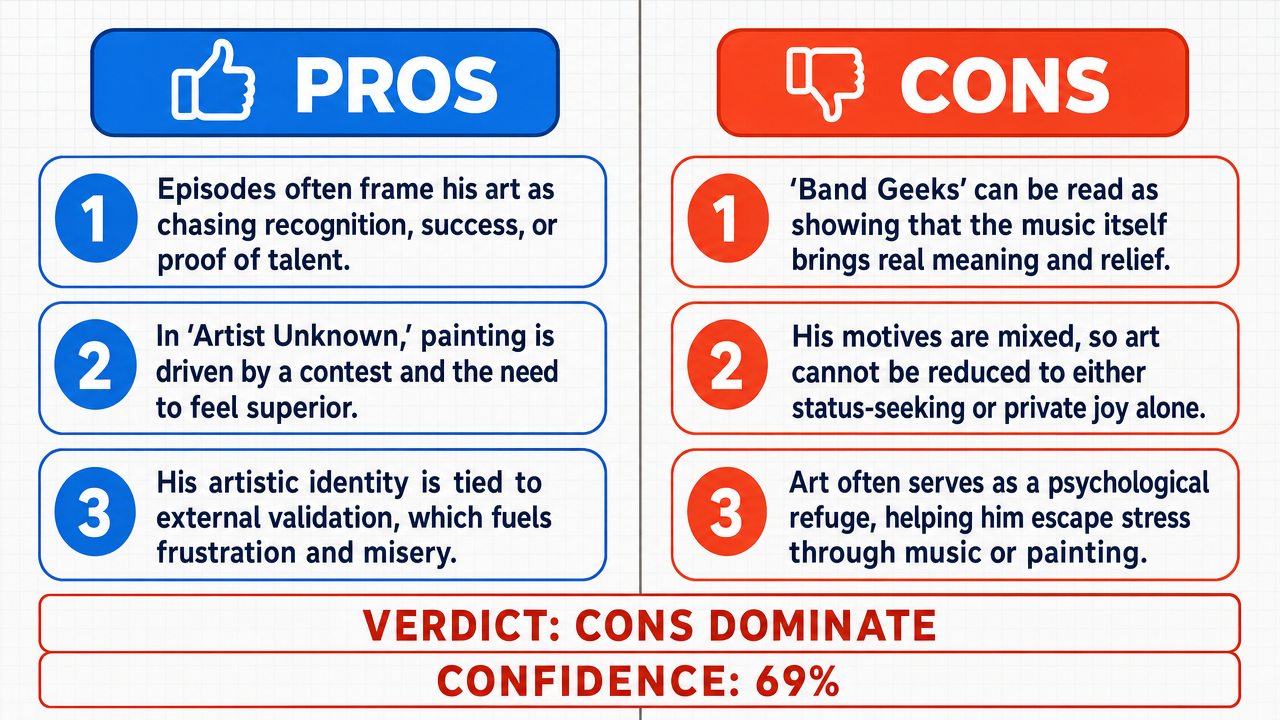
Verdict
Verdict: likely FALSE (69%)
This section provides a brief overview of the key arguments. You do not need to read the full detailed report below.
✅ Key PRO arguments:
- ■Canonical episodes like 'Band Geeks,' 'Squidward's Big Break,' and 'Squidward in Clarinetland' frame Squidward's artistic projects as bids for external payoff (public performance, career-making break, imagined adoring audience) rather than private enjoyment, treating his clarinet work as a vehicle for vindication rather than a refuge.
- ■In 'Artist Unknown,' Squidward's entire motivation for painting is to win a contest and prove his superiority, demonstrating that his artistic identity is defined by a craving for external validation rather than intrinsic appreciation.
- ■Squidward's temperament and his instrumentalism are the same thing: his artistic identity is defined by a craving for external validation , so his misery stems directly from treating art as a means to an end .
❌ Key ANTI arguments:
- ■The affirmative 's reliance on 'Band Geeks' as evidence of instrumentalism is a flawed reading; the episode's resolution shows that the music itself provides a moment of genuine, unadulterated communal harmony that transcends the initial goal of humiliation.
- ■The categorization of Squidward's motivations into two mutually exclusive branches ('bid for external payoff' vs. 'private enjoyment') is insufficient to capture the character's complexity, as the canonical record demonstrates motivations that fall into several distinct branches.
- ■Squidward's art frequently functions as a non-instrumental, psychological sanctuary: by retreating into music or painting to escape environmental stressors, he demonstrates that his art is a functional necessity for emotional regulation rather than a mere tool for external status.
💭 Conclusion: False. The debate verdict favors the Negative position that Squidward's art functions as an intrinsic psychological refuge rather than purely as a means to an end . The Negative successfully argued that the affirmative 's binary categorization of motivations (external payoff vs. private enjoyment) is reductive and fails to capture the complexity of Squidward's character. The strongest anti-argument established that Squidward's art serves as a functional necessity for emotional regulation , with episodes like 'Band Geeks' actually resolving in genuine communal harmony rather than mere vindication. The affirmative's case, while presenting valid examples of validation-seeking behavior, could not establish that this pattern universally defines Squidward's relationship with art. The 69% judge confidence reflects a clear but not overwhelming consensus, as some episodes do support the instrumental reading.
🔬 DeepResearch Result: likely FALSE ❌ (69%)
Assertion: Squidward Tentacles' inability to find solace in his art is because he uses it as a means to an end rather than enjoying it for its own sake.
Participating models: deepseek-v3.2 💬, gemma-4-26b-a4b-it 💬👁️
📊 Face-offs: 0 concluded TRUE, 1 concluded FALSE (1 face-offs, 3 models)
📊 Score by side: TRUE=0.00, FALSE=0.69
🏅 Model score changes:
minimax-m3 💬👁️: +7
✅ PRO Arguments:
- ■Canonical episodes like 'Band Geeks,' 'Squidward's Big Break,' and 'Squidward in Clarinetland' frame Squidward's artistic projects as bids for external payoff (public performance, career-making break, imagined adoring audience) rather than private enjoyment, treating his clarinet work as a vehicle for vindication rather than a refuge. deepseek-v3.2 💬
- ■In 'Artist Unknown,' Squidward's entire motivation for painting is to win a contest and prove his superiority, demonstrating that his artistic identity is defined by a craving for external validation rather than intrinsic appreciation. deepseek-v3.2 💬
- ■Squidward's temperament and his instrumentalism are the same thing: his artistic identity is defined by a craving for external validation, so his misery stems directly from treating art as a means to an end. deepseek-v3.2 💬
- ■The dominant emotional pattern of the series shows Squidward as an artistic octopus who considers himself unrecognized and is frustrated by the lack of recognition, supporting the claim that his art is organized around payoff rather than pure enjoyment. deepseek-v3.2 💬
❌ ANTI Arguments:
- ■The affirmative 's reliance on 'Band Geeks' as evidence of instrumentalism is a flawed reading; the episode's resolution shows that the music itself provides a moment of genuine, unadulterated communal harmony that transcends the initial goal of humiliation. gemma-4-26b-a4b-it 💬👁️
- ■The categorization of Squidward's motivations into two mutually exclusive branches ('bid for external payoff' vs. 'private enjoyment') is insufficient to capture the character's complexity, as the canonical record demonstrates motivations that fall into several distinct branches. gemma-4-26b-a4b-it 💬👁️
- ■Squidward's art frequently functions as a non-instrumental, psychological sanctuary: by retreating into music or painting to escape environmental stressors, he demonstrates that his art is a functional necessity for emotional regulation rather than a mere tool for external status. gemma-4-26b-a4b-it 💬👁️
- ■The behavior of using art as a refuge is not an 'anomaly ' to be explained away but a core component of Squidward's character, indicating that his art serves intrinsic psychological purposes beyond seeking applause. gemma-4-26b-a4b-it 💬👁️
💭 Reasoning: False. The debate verdict favors the Negative position that Squidward's art functions as an intrinsic psychological refuge rather than purely as a means to an end. The Negative successfully argued that the affirmative's binary categorization of motivations (external payoff vs. private enjoyment) is reductive and fails to capture the complexity of Squidward's character. The strongest anti-argument established that Squidward's art serves as a functional necessity for emotional regulation, with episodes like 'Band Geeks' actually resolving in genuine communal harmony rather than mere vindication. The affirmative's case, while presenting valid examples of validation-seeking behavior, could not establish that this pattern universally defines Squidward's relationship with art. The 69% judge confidence reflects a clear but not overwhelming consensus, as some episodes do support the instrumental reading.
📋 PRO Facts:
• In 'Band Geeks,' Squidward forms a band because Mr. Krabs promises a public performance to humiliate a rival and win applause.
• In 'Artist Unknown,' Squidward's motivation for painting is to win a contest and prove his superiority.
• Squidward is described as an artistic octopus who considers himself unrecognized and is frustrated by the lack of recognition.
📋 ANTI Facts:
• The resolution of 'Band Geeks' shows the music itself providing a moment of genuine, unadulterated communal harmony that transcends the initial goal of humiliation.
• Squidward's motivations for art fall into several distinct branches, not just two mutually exclusive categories.
• Squidward's art functions as a psychological sanctuary for emotional regulation, not merely as a tool for external status.
| Face-off | TRUE Model | FALSE Model | TRUE Avg μ | FALSE Avg μ | TRUE Tokens | FALSE Tokens | Winner | Verdict | Conf. |
|---|---|---|---|---|---|---|---|---|---|
| #1 | deepseek-v3.2 💬 | gemma-4-26b-a4b-it 💬👁️ | 0.528 | 0.320 | 12 | 3 | TRUE | FALSE | 69% |
The following technical terms, abbreviations, and domain-specific concepts are referenced throughout this debate transcript. Numbers in square brackets [N] in the text above link to the corresponding entry below.
[1] affirmative — In formal debate, the side that argues in favor of the resolution or proposition being debated.
[2] anomaly — An observation or case that deviates from an expected pattern or general rule, often treated as an exception to be explained.
[3] canonical — Referring to the officially recognized or authoritative body of works within a series or body of literature; in this debate, the canonical record refers to the established episodes of the show.
[4] core claim — The central thesis or main assertion that a debater is defending throughout a round.
[5] emotional regulation — The psychological process by which individuals monitor, manage, and respond to their emotional states, often through coping behaviors.
[6] external validation — Seeking approval, recognition, or affirmation from others as the motivating purpose behind an action or creative work.
[7] Facet — A labeled category or dimension used in structured debate analysis to organize arguments by topic area (e.g., 'Culture & Leisure').
[8] false dichotomy — A logical fallacy in which an argument presents only two options as if they are the only possibilities, when in fact additional alternatives exist.
[9] hidden premise — An unstated assumption that must be accepted for an argument's conclusion to follow from its stated premises.
[10] instrumentalism — The philosophical view that an activity or object is valued primarily as a means to achieve some further end, rather than for its own sake.
[11] intrinsic — Having value or worth in itself, independent of any external purpose or consequence; the opposite of instrumental.
[12] means to an end — A philosophical concept describing something pursued not for its own sake but for the sake of what it can deliver, such as recognition or success.
[13] mutually exclusive — Describing categories or options that cannot overlap or coexist; if one is true, the other cannot be.
[14] negative — In formal debate, the side that argues against the resolution or proposition being debated.
[15] pillar — A foundational supporting argument within a debater's case, typically one of the main reasons the side advances its position.
[16] reductive — Describing an analysis that oversimplifies a complex phenomenon by explaining it in terms of fewer components or a single cause.
[17] sampling error — A statistical or logical error in which conclusions are drawn from a non-representative subset of cases; in this debate, it refers to generalizing from a few selected episodes.
[18] self-validation — Seeking affirmation of one's worth or abilities from oneself, often through external markers of success or recognition.
[19] status claim — A behavior or display aimed at establishing or asserting one's social rank, prestige, or recognition relative to others.
Face-off transcripts
- ■
Ownership & Trade Secrets. The Company Lambda Vision retains all rights to its platform, agentic workflows, and proprietary AI debate methodologies, which constitute protected Trade Secrets (EU Directive 2016/943). Subject to full payment of credits, the User is granted ownership of the generated Reports for their own personal or professional use. Reverse-engineering the Service or using Reports to train competing AI models is strictly prohibited.
- ■
No Professional Advice. Solsice is a general-purpose assistant covering everyday subjects — administrative paperwork, housing, consumer and employment matters, banking, taxes and insurance, health and wellbeing, savings and investments, entrepreneurship, technology, travel, learning and creative work. Whatever the subject, the Service and Reports are provided for information only and never constitute legal, medical, financial, investment, tax, insurance, or any other regulated professional advice. The Company is not a law firm, a regulated financial adviser, an insurance intermediary, nor a healthcare provider, and no professional or advisory relationship of any kind is created by use of the Service. Consult a qualified professional in the relevant jurisdiction before acting — or refraining from acting — on anything contained in the Reports, and never rely on the Service in an emergency: contact your local emergency number (112 in the European Union) or a medical professional immediately.
- ■
AI-Generated Content, Sources and Viewpoints. Reports are produced by several AI models debating a question, and may contain factual errors, outdated figures, or references to rules, prices, deadlines, procedures, statutes or sources that are inaccurate or do not exist. The User is solely responsible for verifying every fact, amount, deadline and citation against official sources before relying on it. Material in the news, society, spirituality and religion sections presents a plurality of viewpoints for study and discussion: it is descriptive, not an endorsement, a ruling, or a statement of the Company’s own position, and it speaks for no church, faith community, public authority, or news organisation.
- ■
Liability & Governing Law. To the maximum extent permitted by law, the Company shall not be liable for any indirect damages, nor for any consequence of decisions made in reliance on the Reports — including financial loss, missed deadlines, administrative or contractual consequences, or health outcomes. These Terms are governed by French law. Any disputes shall be subject to the exclusive jurisdiction of the Courts of Paris, France.