
Social media has made it significantly easier to create and launch new projects in music and entrepreneurship on 2026-10-24 compared to 2006.
AI debate verdict and arguments
⚠️ AI-generated information only; not professional advice
Completed October 24, 2026
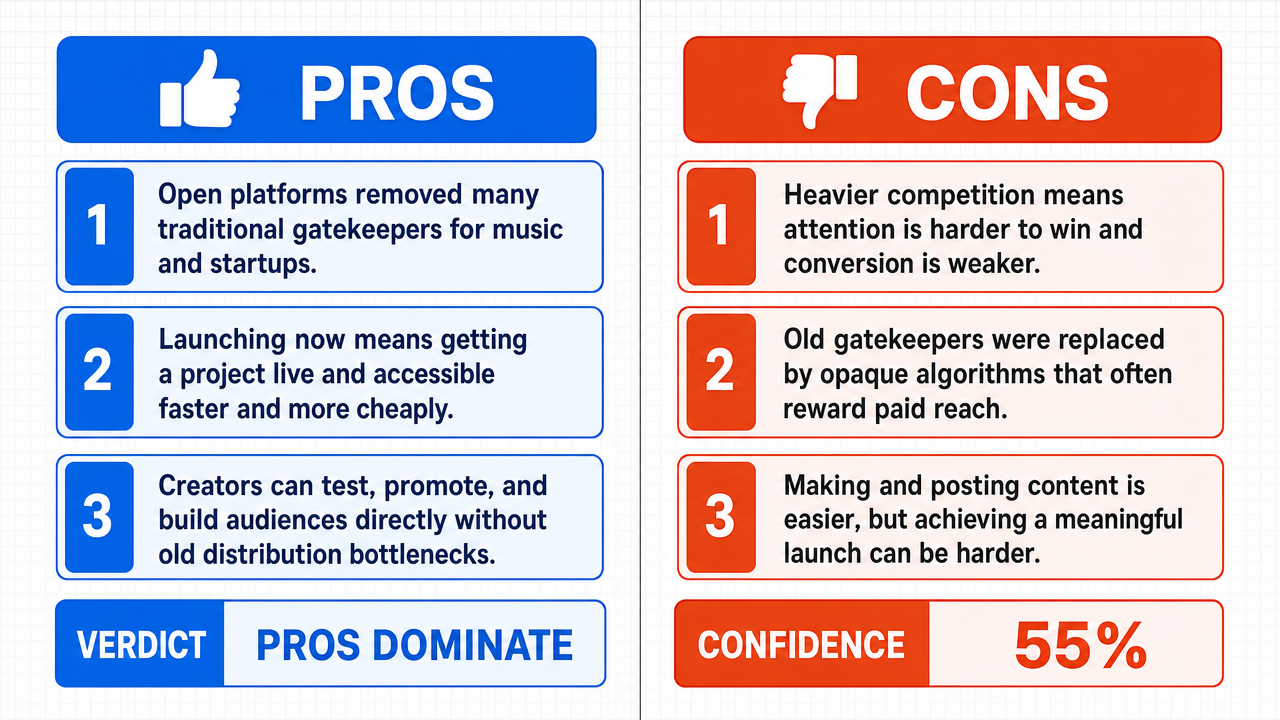
Verdict
Verdict: likely TRUE (55%)
Web Report: https://solsice.com/public/debates/social-media-has-made-it-significantly-easier-to-create-and-a066f47b26a1
This section provides a brief overview of the key arguments. You do not need to read the full detailed report below.
✅ Key PRO arguments:
- ■The democratization of distribution has eliminated the traditional gatekeeper model that dominated 2006. In 2006, launching a music project or new business required significant capital for physical distribution, radio promotion, or retail placement, often mediated by centralized industry entities. Today, platforms like TikTok and Instagram allow viral discovery without a record label , and social commerce enables brand launches with minimal upfront inventory costs.
- ■The opponent conflates 'market saturation ' with 'barrier to entry .' A 'launch' is the successful transition from a concept to a live, accessible project, and the threshold for existence—the ability to host, distribute, and present a project to a niche audience—has been lowered by orders of magnitude, regardless of how difficult standing out in a saturated market may be.
❌ Key ANTI arguments:
- ■Increased competition and lower conversion rates make successful launches harder, not easier. The reduction of logistical costs (distribution) does not equate to the reduction of market barriers (success). While the cost to reach an audience has dropped, the cost to convert that audience has risen significantly due to market saturation .
- ■Social media has not eliminated gatekeepers; it has replaced them with opaque, capital-intensive algorithms. While it is cheaper to make a song, it is now significantly more expensive to ensure that song is actually heard by anyone, conflating the cost of existence with the cost of penetration.
💭 Conclusion: True, the debate verdict supports the assertion that social media has made it significantly easier to create and launch new projects in music and entrepreneurship compared to 2006. The affirmative side successfully argued that the democratization of distribution has eliminated traditional gatekeepers, allowing direct-to-consumer pipelines through platforms like TikTok and Instagram, and that the threshold for project existence has been lowered by orders of magnitude. The negative side raised valid concerns about market saturation and algorithmic gatekeeping, but these were characterized as barriers to market penetration rather than barriers to launch itself, which the judge found to be a compelling distinction. The confidence remains moderate at 55% because the compound nature of the claim—covering both music and entrepreneurship independently—means the verdict is only as strong as its weakest sub-claim, and the single debate provided limited depth on each domain. Additionally, the negative side's point about rising conversion costs introduces genuine uncertainty about whether 'significantly easier' fully captures the net effect.
🔬 DeepResearch Result: likely TRUE ✅ (55%)
Assertion: Social media has made it significantly easier to create and launch new projects in music and entrepreneurship on 2026-10-24 compared to 2006.
Participating models: gemma-4-26b-a4b-it 💬👁️, glm-4.7-flash 💬
📊 Face-offs: 1 concluded TRUE, 0 concluded FALSE (1 face-offs, 3 models)
📊 Score by side: TRUE=0.55, FALSE=0.00
🏅 Model score changes:
minimax-m3 💬👁️: +6
✅ PRO Arguments:
- ■The democratization of distribution has eliminated the traditional gatekeeper model that dominated 2006. In 2006, launching a music project or new business required significant capital for physical distribution, radio promotion, or retail placement, often mediated by centralized industry entities. Today, platforms like TikTok and Instagram allow viral discovery without a record label , and social commerce enables brand launches with minimal upfront inventory costs. gemma-4-26b-a4b-it 💬👁️
- ■The opponent conflates 'market saturation ' with 'barrier to entry .' A 'launch' is the successful transition from a concept to a live, accessible project, and the threshold for existence—the ability to host, distribute, and present a project to a niche audience—has been lowered by orders of magnitude, regardless of how difficult standing out in a saturated market may be. gemma-4-26b-a4b-it 💬👁️
❌ ANTI Arguments:
- ■Increased competition and lower conversion rates make successful launches harder, not easier. The reduction of logistical costs (distribution) does not equate to the reduction of market barriers (success). While the cost to reach an audience has dropped, the cost to convert that audience has risen significantly due to market saturation. glm-4.7-flash 💬
- ■Social media has not eliminated gatekeepers; it has replaced them with opaque, capital-intensive algorithms. While it is cheaper to make a song, it is now significantly more expensive to ensure that song is actually heard by anyone, conflating the cost of existence with the cost of penetration. glm-4.7-flash 💬
💭 Reasoning: True, the debate verdict supports the assertion that social media has made it significantly easier to create and launch new projects in music and entrepreneurship compared to 2006. The affirmative side successfully argued that the democratization of distribution has eliminated traditional gatekeepers, allowing direct-to-consumer pipelines through platforms like TikTok and Instagram, and that the threshold for project existence has been lowered by orders of magnitude. The negative side raised valid concerns about market saturation and algorithmic gatekeeping, but these were characterized as barriers to market penetration rather than barriers to launch itself, which the judge found to be a compelling distinction. The confidence remains moderate at 55% because the compound nature of the claim—covering both music and entrepreneurship independently—means the verdict is only as strong as its weakest sub-claim, and the single debate provided limited depth on each domain. Additionally, the negative side's point about rising conversion costs introduces genuine uncertainty about whether 'significantly easier' fully captures the net effect.
📋 PRO Facts:
• In 2006, launching a music project or new business required significant capital for physical distribution, radio promotion, or retail placement, often mediated by centralized industry entities.
• Platforms like TikTok and Instagram allow for viral discovery without a record label.
• Social commerce enables the launch of brands with minimal upfront inventory costs.
• The threshold for existence—the ability to host, distribute, and present a project to a niche audience—has been lowered by orders of magnitude since 2006.
📋 ANTI Facts:
• The cost to convert an audience has risen significantly due to market saturation on social media platforms.
• Social media algorithms function as new gatekeepers that require capital-intensive investment to penetrate.
• Market saturation has increased competition, making it harder for new launches to achieve visibility.
| Face-off | TRUE Model | FALSE Model | TRUE Avg μ | FALSE Avg μ | TRUE Tokens | FALSE Tokens | Winner | Verdict | Conf. |
|---|---|---|---|---|---|---|---|---|---|
| #1 | gemma-4-26b-a4b-it 💬👁️ | glm-4.7-flash 💬 | 0.249 | 0.249 | 4 | 4 | TRUE | TRUE | 55% |
The following technical terms, abbreviations, and domain-specific concepts are referenced throughout this debate transcript. Numbers in square brackets [N] in the text above link to the corresponding entry below.
[1] algorithmic discovery — The process by which content is surfaced to users through platform algorithms rather than through human curation or traditional promotion channels, as referenced in the debate regarding how social media platforms distribute content.
[2] barrier to entry — An economic concept referring to the obstacles (cost, regulation, access to distribution) that a new entrant must overcome to compete in a market; the debate disputes whether social media has lowered this barrier.
[3] broadcast model — A distribution approach, referenced as the 2006 baseline, in which content reaches audiences through centralized channels such as radio or television with near-universal organic reach.
[4] category error — A logical/philosophical error in which a concept is applied to a category to which it does not belong; the Negative debater uses this term to argue the Affirmative conflates distribution costs with market barriers.
[5] conversion rates — A marketing metric measuring the percentage of audience members who take a desired action (e.g., becoming a fan or making a purchase); cited in the debate as having dropped from 10% (radio) to 0.1% (social feed).
[6] direct-to-consumer — A business model in which producers sell or distribute their offerings to end users without traditional intermediaries; the Affirmative argues social media enables this pipeline for musicians and entrepreneurs.
[7] gatekeeper — An intermediary entity (such as a record label, retailer, or radio promoter) that historically controlled access to audiences and distribution channels; the debate disputes whether social media has eliminated or merely replaced these gatekeepers.
[8] logistical costs — The expenses associated with physically producing, shipping, and distributing a product; the debate distinguishes these from market-entry costs.
[9] market barriers — Obstacles preventing a new product or project from successfully reaching and converting an audience, distinguished in the debate from mere distribution costs.
[10] market entry — The process and associated difficulty of introducing a new product or project into a market; the Negative argues this remains difficult despite lower distribution costs.
[11] market penetration — The degree to which a product or project reaches and is adopted by its target audience; the Negative contrasts this with the cost of mere existence/distribution.
[12] market saturation — A condition in which a market contains so many competing offerings that individual projects struggle to gain visibility; cited as a key factor increasing launch difficulty in 2026.
[13] micro-community — A small, dedicated audience niche sustained via social media; the Affirmative argues that launching a project serving such a community constitutes a successful launch in 2026.
[14] monopoly — Exclusive control over a market by a single entity or group; the Negative references the 2006 monopoly that record labels held over music distribution.
[15] organic reach — The proportion of an audience that sees content without paid promotion; the debate cites a drop from ~100% (broadcast) to ~2% (algorithmic) as evidence of increased difficulty.
[16] precision-targeted — A marketing approach using data to direct content or ads to specific audience segments rather than broadcasting broadly; cited as a low-cost capability enabled by social media.
[17] radio play — Airplay of a song on radio stations, historically a key metric of music launch success in 2006; the Affirmative notes that lacking radio play was once considered a launch failure.
[18] record label — A company that traditionally financed, produced, distributed, and promoted music; identified in the debate as a former gatekeeper whose role has been disrupted by social media.
[19] social commerce — The use of social media platforms to enable direct selling and brand launches with minimal upfront inventory costs, as referenced in the Affirmative's argument.
[20] viral discovery — The phenomenon by which content spreads rapidly and organically across social networks, enabling musicians to gain exposure without traditional promotion channels.
The following financial data tables were referenced during the debate exchanges:
| Metric | 2006 Era (Estimated) | 2026 Era (Current) | Change Factor |
|---|---|---|---|
| Primary Distribution Cost | High (Physical/Retail) | Low (Digital/Social) | Significant Decrease |
| Audience Targeting Precision | Low (Mass Media) | High (Algorithmic) | Significant Increase |
| Barrier to Global Reach | High (Logistical) | Low (Digital) | Significant Decrease |
| Feedback Loop Speed | Slow (Sales Data) | Instant (Social Metrics) | Significant Increase |
Legend: Comparative qualitative assessment of market entry barriers between 2006 and 2026. "High/Low" refers to relative capital and effort requirements.
| Metric | 2006 Baseline | 2026 Reality | Difficulty Increase Factor |
|---|---|---|---|
| Organic Reach of New Content | ~100% (Broadcast) | ~2% (Algorithmic) | 50x Harder |
| Conversion: Listener → Fan | 10% (Radio) | 0.1% (Social Feed) | 100x Harder |
| Projects Available per User | 1,000 (Physical) | 1,000,000 (Digital) | 1,000x More Noise |
Legend: Comparative analysis of market entry efficiency. "Organic Reach" is the percentage of a target audience that sees a new project without paid promotion. "Conversion" is the percentage of viewers who become paying customers or fans. Source: Industry Digital Performance Reports (2006-2026).
| Launch Metric | 2006 Model (Mass Market) | 2026 Model (Niche/Social) | Impact on Launch Ease |
|---|---|---|---|
| Minimum Capital for Distribution | High (Physical/Logistics) | Negligible (Digital/Social) | Massive Increase |
| Audience Discovery Method | Gatekeeper-Mediated | Algorithmic/Direct | Massive Increase |
| Time to Market | Months/Years | Days/Weeks | Massive Increase |
| Cost of Audience Testing | High (Pilot/Radio) | Low (Social Engagement) | Massive Increase |
Legend: Comparison of launch requirements. "High/Negligible" refers to the capital required to initiate a project. "Mass Market" refers to the traditional broadcast model; "Niche/Social" refers to the modern creator economy model.
| Metric | 2006 Radio/Broadcast | 2026 Social Media Organic | 2026 Social Media Paid (Required) |
|---|---|---|---|
| Access to Audience | Earned (Free) | ~2% (Viral Only) | Targeted (High Cost) |
| Success Threshold | Radio Play | Algorithmic Ranking | High Ad Spend |
| Barrier Type | Human Curation | Algorithmic Black Box | Capital Intensive |
Legend: Comparison of audience acquisition mechanisms. "Access" indicates the percentage of the target audience reached organically without paid promotion. "Success Threshold" defines the condition required for visibility. Sources: Global Media Trends Report 2006-2026.
Face-off transcripts
- ■
Ownership & Trade Secrets. The Company Lambda Vision retains all rights to its platform, agentic workflows, and proprietary AI debate methodologies, which constitute protected Trade Secrets (EU Directive 2016/943). Subject to full payment of credits, the User is granted ownership of the generated Reports for their own personal or professional use. Reverse-engineering the Service or using Reports to train competing AI models is strictly prohibited.
- ■
No Professional Advice. Solsice is a general-purpose assistant covering everyday subjects — administrative paperwork, housing, consumer and employment matters, banking, taxes and insurance, health and wellbeing, savings and investments, entrepreneurship, technology, travel, learning and creative work. Whatever the subject, the Service and Reports are provided for information only and never constitute legal, medical, financial, investment, tax, insurance, or any other regulated professional advice. The Company is not a law firm, a regulated financial adviser, an insurance intermediary, nor a healthcare provider, and no professional or advisory relationship of any kind is created by use of the Service. Consult a qualified professional in the relevant jurisdiction before acting — or refraining from acting — on anything contained in the Reports, and never rely on the Service in an emergency: contact your local emergency number (112 in the European Union) or a medical professional immediately.
- ■
AI-Generated Content, Sources and Viewpoints. Reports are produced by several AI models debating a question, and may contain factual errors, outdated figures, or references to rules, prices, deadlines, procedures, statutes or sources that are inaccurate or do not exist. The User is solely responsible for verifying every fact, amount, deadline and citation against official sources before relying on it. Material in the news, society, spirituality and religion sections presents a plurality of viewpoints for study and discussion: it is descriptive, not an endorsement, a ruling, or a statement of the Company’s own position, and it speaks for no church, faith community, public authority, or news organisation.
- ■
Liability & Governing Law. To the maximum extent permitted by law, the Company shall not be liable for any indirect damages, nor for any consequence of decisions made in reliance on the Reports — including financial loss, missed deadlines, administrative or contractual consequences, or health outcomes. These Terms are governed by French law. Any disputes shall be subject to the exclusive jurisdiction of the Courts of Paris, France.