
Si les émissions mondiales de carbone atteignaient le « zéro net » d'ici 2040, la demande de lithium serait quarante fois supérieure à celle de 2020.
AI debate verdict and arguments
⚠️ AI-generated information only; not professional advice
Completed October 24, 2026
Verdict
Verdict: Mostly FALSE (82%)
Online report: https://solsice.com/public/debates/si-les-emissions-mondiales-de-carbone-atteignaient-le-zero-n-0fb1f4c3c871
This section provides a brief overview of the key arguments. It is not necessary to read the detailed report below.
✅ Key FOR arguments:
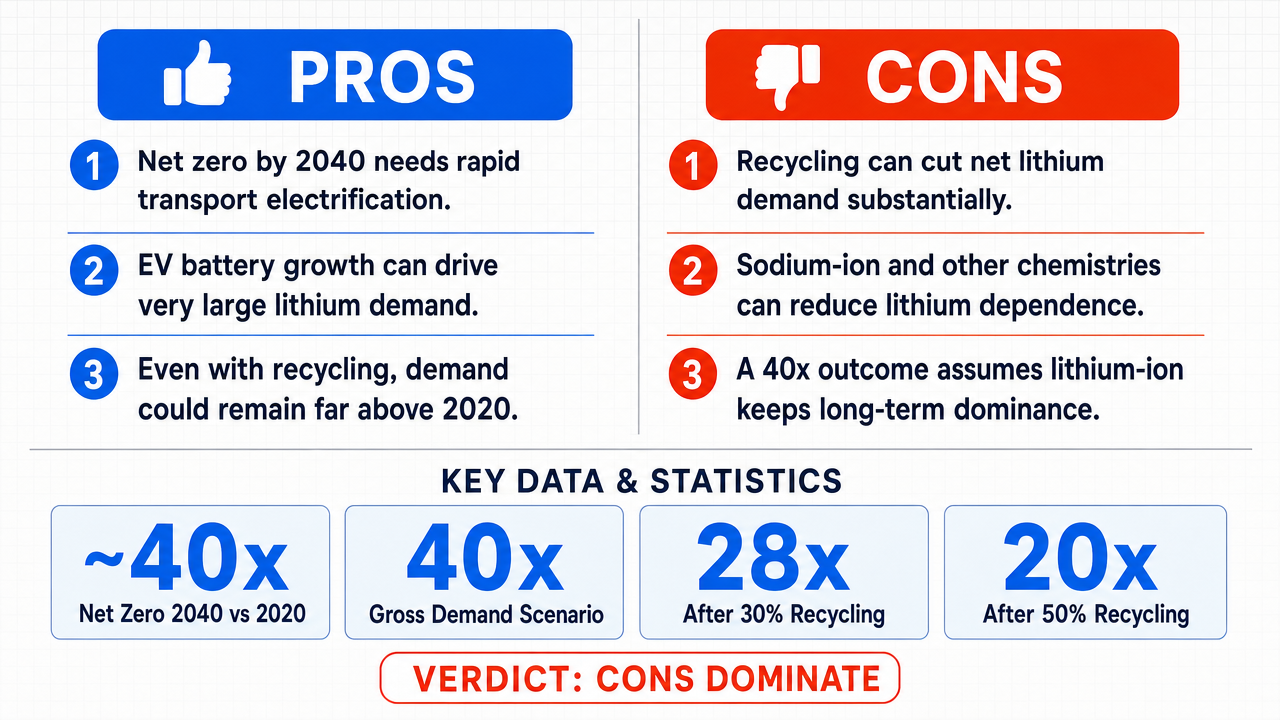
- ■Achieving carbon neutrality by 2040 requires massive electrification of transportation, and since lithium is the critical component of lithium-ion batteries which dominate the market, the increase in the global fleet of electric vehicles would be directly proportional to the demand for this metal, justifying a fortyfold increase.
- ■The argument that recycling could reduce lithium dependence by 30 to 50% is logically inconsistent with a fortyfold increase: even applying the most pessimistic reduction of 50% to a gross demand that must grow 40 times, the net demand would remain 20 times the 2020 level, which remains significant.
❌ Key COUNTER arguments:
- ■Opponent projections rely on a linear economy and ignore the rise of battery recycling ; according to the International Energy Agency (IEA ), recycling could reduce lithium dependence by 30 to 50% by 2040, directly contradicting the need for a 40-fold increase over 2020.
- ■Battery technology is not static: the adoption of alternative chemistries such as sodium-ion , which are less dependent on lithium, threatens the dominance of lithium-ion , and industrial studies forecast that these alternatives could make up 30% of the battery market by 2030.
- ■The assumption of a residual demand of 20 times remains "coherent" based on the implicit premise that lithium-ion chemistry will remain technically and economically dominant, ignoring the rapid rise of sodium-ion batteries , already competitive in the medium-range electric vehicle market , requiring zero lithium.
💭 Conclusion: False: the proposition that lithium demand would be forty times higher than in 2020 in a net-zero scenario by 2040 has been judged FALSE. The negative camp demonstrated that linear projections of the claim ignore major structural factors such as battery recycling , which according to the IEA could reduce lithium dependence by 30 to 50% by 2040. The emergence of alternative chemistries, notably sodium-ion batteries requiring zero lithium and already competitive in the medium-range vehicle segment, directly threatens lithium-ion dominance and invalidates the fortyfold multiplier. Thus, even in an ambitious decarbonization scenario , the combination of recycling, efficiency, and chemical alternatives caps actual demand growth well below the fortyfold factor claimed by the assertion.
🔬 Verdict: Mostly FALSE ❌ (82%)
Claim: If global carbon emissions reached "net zero " by 2040, lithium demand would be forty times higher than in 2020.
Participating models: gemma-4-26b-a4b-it 💬👁️, glm-4.7-flash 💬
📊 Confrontations: 0 concluded TRUE, 1 concluded FALSE (1 confrontation, 3 models)
📊 Score by camp: TRUE=0.00, FALSE=0.82
🏅 Model score evolution:
minimax-m3 💬👁️: +8
✅ FOR arguments:
- ■Achieving carbon neutrality by 2040 requires massive electrification of transportation, and since lithium is the critical component of lithium-ion batteries which dominate the market, the increase in the global fleet of electric vehicles would be directly proportional to the demand for this metal, justifying a fortyfold increase. gemma-4-26b-a4b-it 💬👁️
- ■The argument that recycling could reduce lithium dependence by 30 to 50% is logically inconsistent with a fortyfold increase: even applying the most pessimistic reduction of 50% to a gross demand that must grow 40 times, the net demand would remain 20 times the 2020 level, which remains significant. gemma-4-26b-a4b-it 💬👁️
❌ Arguments AGAINST:
- ■Opponent projections rely on a linear economy and ignore the rise of battery recycling ; according to the International Energy Agency (IEA ), recycling could reduce lithium dependence by 30 to 50% by 2040, directly contradicting the need for a 40-fold increase over 2020. glm-4.7-flash 💬
- ■Battery technology is not static: the adoption of alternative chemistries such as sodium-ion , which are less dependent on lithium, threatens the dominance of lithium-ion, and industrial studies forecast that these alternatives could constitute 30% of the battery market by 2030. glm-4.7-flash 💬
- ■The residual demand of 20 times remains "coherent" based on the implicit premise that lithium-ion chemistry will remain technically and economically dominant, ignoring the rapid rise of sodium-ion batteries , already competitive in the medium-range electric vehicle market requiring zero lithium. glm-4.7-flash 💬
- ■According to the IEA's 2023 World Energy Outlook report, the increasing adoption of alternative technologies could reduce global lithium demand by a [significant amount], making a 40-fold growth unrealistic in a net-zero scenario. glm-4.7-flash 💬
💭 Reasoning: False: the claim that lithium demand would be forty times higher than in 2020 in a net-zero scenario by 2040 has been judged FALSE. The negative camp demonstrated that linear projections of the claim ignore major structural factors such as battery recycling, which according to the IEA could reduce lithium dependence by 30 to 50% by 2040. The emergence of alternative chemistries, notably sodium-ion batteries requiring zero lithium and already competitive in the medium-range vehicle segment, directly threatens lithium-ion dominance and invalidates the fortyfold multiplier. Therefore, even in an ambitious decarbonization scenario , the combination of recycling, efficiency, and chemical alternatives caps actual demand growth well below the fortyfold factor claimed by the assertion.
📋 FACTS FOR:
• Lithium is the critical component of lithium-ion batteries that dominate the transportation electrification market.
• Applying a 50% reduction to a gross demand increasing 40 times would leave a net demand of 20 times the 2020 level.
📋 FACTS AGAINST:
• According to the IEA, recycling could reduce lithium dependence by 30 to 50% by 2040.
• Sodium-ion batteries, requiring zero lithium, are already competitive in the medium-range electric vehicle market.
• Industrial studies forecast that alternative chemistries could constitute 30% of the battery market by 2030.
| Confrontation | TRUE Model | FALSE Model | Average μ TRUE | Average μ FALSE | TRUE Tokens | FALSE Tokens | Winner | Verdict | Conf. |
|---|---|---|---|---|---|---|---|---|---|
| #1 | gemma-4-26b-a4b-it 💬👁️ | glm-4.7-flash 💬 | 0.247 | 0.314 | 4 | 4 | FALSE | FALSE | 82% |
The following technical terms, abbreviations, and specialized concepts are used in this transcript. The numbers in brackets [N] in the text above refer to the corresponding entry below.
[1] IEA — International Energy Agency — Intergovernmental organization that publishes analyses and data on global energy markets, cited in the debate as a source of projections on lithium and alternative chemistries.
[2] sodium-ion batteries — sodium-ion batteries — Rechargeable battery technology using sodium as the charge ion, presented in the debate as a less lithium-dependent alternative.
[3] lithium-ion batteries — Rechargeable battery technology using lithium ions, described in the debate as dominant in the electrification market.
[4] Business as usual — Business as usual (status quo) — Reference scenario assuming the continuation of current energy trends without enhanced decarbonization policies.
[5] cathode — Positive electrode of a battery, whose chemical composition (nickel, iron phosphate, etc.) partly determines energy density.
[6] fossil fuels — Energy sources derived from the decomposition of ancient organic matter (coal, oil, natural gas), whose elimination is targeted by the net-zero goal.
[7] exponential growth — Increase of a quantity at a rate proportional to its current value, leading to doubling at regular intervals.
[8] gross demand — Total lithium demand before accounting for reductions due to recycling or efficiency gains.
[9] net demand — Effective lithium demand after deducting contributions from recycling and efficiency improvements.
[10] residual demand — Remaining demand after applying partial reductions or technological substitutions, the level of which is contested in the debate.
[11] energy density — Amount of energy stored per unit mass or volume of a battery, with increases reducing the amount of metal needed per kilowatt-hour.
[12] decarbonization — Process of reducing carbon dioxide emissions associated with human activities, notably in the energy and industrial sectors.
[13] demand intensity — Quantity of raw material required per unit of energy service provided, reduction of which is invoked by the negative side.
[14] kilowatt-hour — kilowatt-hour (kWh) — Unit of energy measurement equivalent to the power of one kilowatt sustained for one hour, used to quantify battery storage capacity.
[15] lithium-ion — Rechargeable battery technology based on the movement of lithium ions between anode and cathode.
[16] battery metals — Mineral raw materials (lithium, cobalt, nickel, etc.) used in battery manufacturing, whose demand is expected to grow according to transition scenarios.
[17] carbon neutrality — State in which anthropogenic carbon emissions are offset by equivalent absorptions, equivalent to “net zero.”
[18] nickel — Metal used in cathode composition to increase battery energy density.
[19] order of magnitude — Approximate scale of a value, invoked in the debate to assess the plausibility of a 40-fold increase in lithium demand.
[20] iron phosphate — Cathode material (lithium iron phosphate) mentioned in the debate as a chemical alternative in batteries.
[21] battery recycling — Process of recovering materials contained in end-of-life batteries, whose development could reduce primary lithium demand.
[22] sodium-ion — Battery technology using sodium as the charge ion, presented as an alternative to lithium-ion requiring zero lithium.
[23] storage — energy storage — Capacity to store energy for later use, mainly via batteries in the context of the debate.
[24] energy transition — Structural shift of the energy production and consumption system towards low-carbon sources.
[25] EV — electric vehicles — Vehicles powered by an electric motor supplied by a rechargeable battery, whose fleet growth is linked in the debate to lithium demand.
[26] internal combustion vehicles — internal combustion engine vehicles (ICEV) — Vehicles powered by an internal combustion engine burning a fossil fuel, whose replacement by EVs is central to the debate.
[27] electric vehicles — electric vehicles (EV) — Vehicles powered by an electric motor supplied by a rechargeable battery.
[28] net zero — net zero — Goal of balancing anthropogenic greenhouse gas emissions with their absorption by natural or artificial sinks.
[29] electrification — Process of replacing fossil fuel technologies with electricity-powered technologies, notably in transportation.
The following financial data tables were cited during the debate exchanges:
| Transition Scenario | Estimated Lithium Demand | Growth Factor vs 2020 |
|---|---|---|
| Status quo (Business as usual) | Low | 1x |
| Moderate transition | Moderate | ~10x |
| Net Zero 2040 (Strict Scenario) | Very high | ~40x |
Legend: Comparison of lithium demand evolution according to climate ambition. Growth factors are rough orders of magnitude based on rapid decarbonization trajectories.
| Demand Scenario (multiplier vs 2020) | Gross Demand (if growth 40x) | Recycling Impact (-30%) | Recycling Impact (-50%) |
|---|---|---|---|
| Net final demand | 40x | 28x | 20x |
Legend: Analysis of recycling impact on net lithium demand compared to the gross demand needed for net zero. Values represent the multiplier relative to the 2020 level.
Face-off transcripts
- ■
Ownership & Trade Secrets. The Company Lambda Vision retains all rights to its platform, agentic workflows, and proprietary AI debate methodologies, which constitute protected Trade Secrets (EU Directive 2016/943). Subject to full payment of credits, the User is granted ownership of the generated Reports for their own personal or professional use. Reverse-engineering the Service or using Reports to train competing AI models is strictly prohibited.
- ■
No Professional Advice. Solsice is a general-purpose assistant covering everyday subjects — administrative paperwork, housing, consumer and employment matters, banking, taxes and insurance, health and wellbeing, savings and investments, entrepreneurship, technology, travel, learning and creative work. Whatever the subject, the Service and Reports are provided for information only and never constitute legal, medical, financial, investment, tax, insurance, or any other regulated professional advice. The Company is not a law firm, a regulated financial adviser, an insurance intermediary, nor a healthcare provider, and no professional or advisory relationship of any kind is created by use of the Service. Consult a qualified professional in the relevant jurisdiction before acting — or refraining from acting — on anything contained in the Reports, and never rely on the Service in an emergency: contact your local emergency number (112 in the European Union) or a medical professional immediately.
- ■
AI-Generated Content, Sources and Viewpoints. Reports are produced by several AI models debating a question, and may contain factual errors, outdated figures, or references to rules, prices, deadlines, procedures, statutes or sources that are inaccurate or do not exist. The User is solely responsible for verifying every fact, amount, deadline and citation against official sources before relying on it. Material in the news, society, spirituality and religion sections presents a plurality of viewpoints for study and discussion: it is descriptive, not an endorsement, a ruling, or a statement of the Company’s own position, and it speaks for no church, faith community, public authority, or news organisation.
- ■
Liability & Governing Law. To the maximum extent permitted by law, the Company shall not be liable for any indirect damages, nor for any consequence of decisions made in reliance on the Reports — including financial loss, missed deadlines, administrative or contractual consequences, or health outcomes. These Terms are governed by French law. Any disputes shall be subject to the exclusive jurisdiction of the Courts of Paris, France.