
Should France prioritize investing in sovereign artificial intelligence development over relying on established foreign AI technologies?
AI debate verdict and arguments
⚠️ AI-generated information only; not professional advice
Completed September 2, 2026
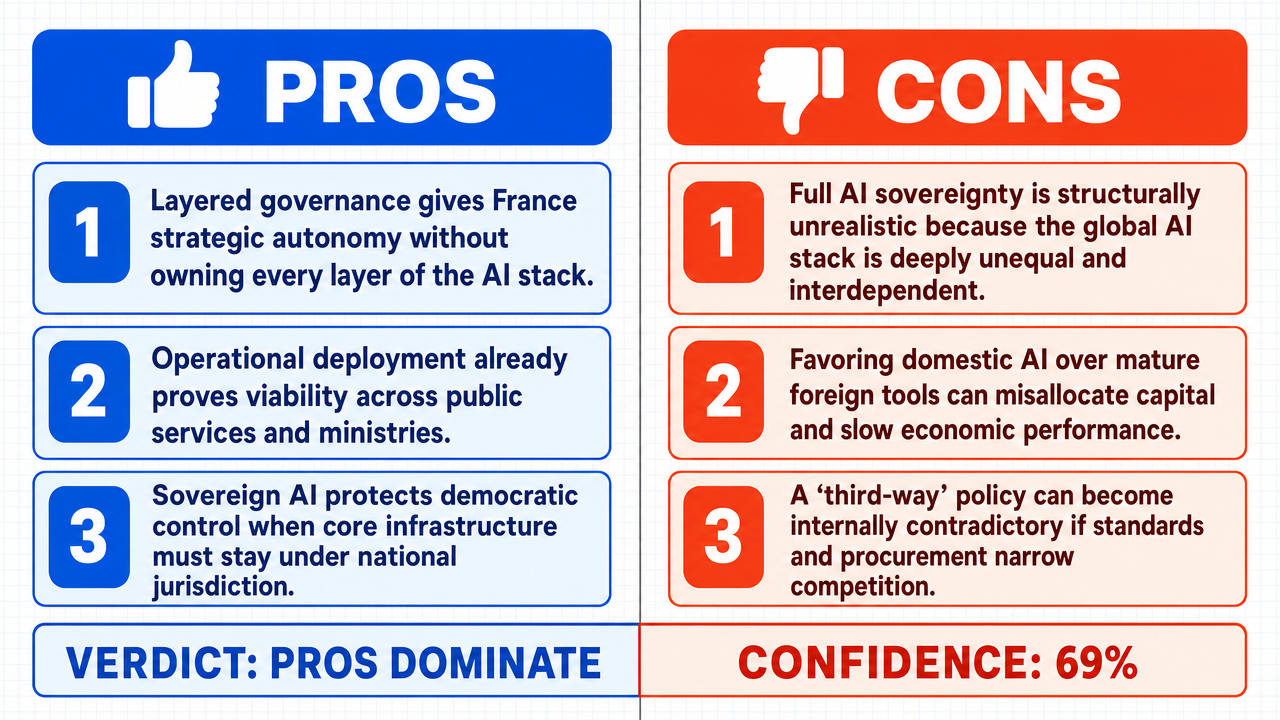
Verdict
Clerk Decision: CLAIM SUPPORTED (TRUE) — Certainty: 69%
Web Report: https://solsice.com/public/debates/should-france-prioritize-investing-in-sovereign-artificial-i-2710b7a8e4d7
This section provides a brief overview of the key arguments. You do not need to read the full detailed report below.
✅ Key PRO arguments:
- ■France's sovereign AI strategy achieves genuine strategic autonomy through a layered governance framework that separates ownership of the AI stack from ownership of the silicon, using mechanisms like SecNumCloud (which forces all AI services to be hosted on French-approved data centers), the ASGARD supercomputer contract (which grants Orange exclusive operational rights and prohibits NVIDIA from accessing model weights or training data), and the 'Choose France' summit to anchor domestic capability.
- ■France's sovereign AI strategy is empirically validated through operational deployment: GenIAI serves over 100,000 public servants across 27 ministries; SecNumCloud certifies 34 cloud providers (including OVHcloud and Scaleway) with enforceable data residency and audit rights; and the LPM 2024–2030 allocates US$2.3 billion to defense AI, with ASGARD supercomputer outputs feeding into sovereign command systems as embedded capabilities rather than isolated experiments.
- ■Sovereign AI is a constitutional imperative for democratic self-determination: when foundational infrastructure resides outside national jurisdiction , critical public functions such as health data processing, judicial assistance, and electoral integrity become subject to foreign terms of service , legal extraterritoriality , and unilateral deplatforming —a vulnerability exposed by the Health Data Hub controversy where all French health data was stored on Microsoft servers.
❌ Key ANTI arguments:
- ■The pursuit of total sovereignty is a structural impossibility because the AI stack is fundamentally asymmetrical: any attempt to build a domestic, full-stack AI capability is doomed to fail because critical layers—specifically advanced semiconductor fabrication and high-end GPU architecture—are controlled by external actors, creating a 'sovereignty paradox' where even 'sovereign' models and data centers remain tethered to foreign silicon (ASGARD relies on NVIDIA GPUs and HP designs).
- ■Prioritizing domestic AI development over established foreign technologies risks massive capital misallocation and economic stagnation: the sheer scale of investment required to compete with US and Chinese frontier models creates an opportunity cost that drains resources from more productive sectors, and France can achieve greater economic utility by focusing on the application layer using existing, mature models.
- ■The 'third-way' strategy is self-contradictory: steering EU procurement and standards toward domestic or European providers is, by definition, a single-ecosystem lock-in, and accepting controlled foreign AI integration reintroduces the dependence that the steering was meant to eliminate—an argument that commits to both propositions at once proves anything and therefore establishes nothing.
💭 Conclusion: True, France should prioritize sovereign AI development over reliance on established foreign AI technologies. The strongest arguments supporting this verdict center on France's layered governance model, which achieves strategic autonomy through institutional control over data, software, and deployment conditions rather than requiring full-stack hardware ownership. Concrete operational evidence includes the LPM 2024–2030 allocation of US$300 million to defense AI, demonstrating sovereign control is being pursued through fiscal commitment. While concerns about hardware dependency on NVIDIA and TSMC silicon remain legitimate, these are outweighed by evidence of enforceable regulatory mechanisms. The structural vulnerability in France's sovereign AI architecture regarding hardware dependency remains unresolved.
🔬 DeepResearch Result: TRUE ✅ (69% confidence)
Assertion: Should France prioritize investing in sovereign artificial intelligence development over relying on established foreign AI technologies?
Participating models: qwen-plus 💬, solar-pro-3 💬, step-3.5-flash 💬, gemma-4-26b-a4b-it 💬👁️, gpt-oss-120b 💬, deepseek-v4-flash-latest 💬
📊 Tournament: 6 voted TRUE, 3 voted FALSE (9 debates played, 7 models)
📊 Weighted scores: TRUE=3.79, FALSE=1.73
🏅 Judge Score Changes:
minimax-m3 💬👁️: +12
✅ PRO Arguments:
- ■France's sovereign AI strategy achieves genuine strategic autonomy through a layered governance framework that separates ownership of the AI stack from ownership of the silicon, using mechanisms like SecNumCloud (which forces all AI services to be hosted on French-approved data centers), the ASGARD supercomputer contract (which grants Orange exclusive operational rights and prohibits NVIDIA from accessing model weights or training data), and the 'Choose France' summit to anchor domestic capability. solar-pro-3 💬
- ■France's sovereign AI strategy is empirically validated through operational deployment: GenIAI serves over 100,000 public servants across 27 ministries; SecNumCloud certifies 34 cloud providers (including OVHcloud and Scaleway) with enforceable data residency and audit rights; and the LPM 2024–2030 allocates US$2.3 billion to defense AI, with ASGARD supercomputer outputs feeding into sovereign command systems as embedded capabilities rather than isolated experiments. qwen-plus 💬
- ■Sovereign AI is a constitutional imperative for democratic self-determination: when foundational infrastructure resides outside national jurisdiction , critical public functions such as health data processing, judicial assistance, and electoral integrity become subject to foreign terms of service , legal extraterritoriality , and unilateral deplatforming —a vulnerability exposed by the Health Data Hub controversy where all French health data was stored on Microsoft servers. qwen-plus 💬
- ■France's sovereign AI strategy is a layered risk-mitigation approach that operates within, rather than outside, the global technological order; it does not seek autarky but rather sufficient control over decision-critical layers to resist coercion, treating hardware dependencies as manageable through diversification and stockpiling rather than as a reason for inaction. step-3.5-flash 💬
- ■France has demonstrated real-world migration capability: the Health Data Hub was moved from Microsoft to Scaleway in March 2024, and SecNumCloud has moved from label to law, enabling France to enforce real-time substitution rights for all public-sector AI providers—proving that sovereign control over data and deployment conditions is operationally achievable. qwen-plus 💬
❌ ANTI Arguments:
- ■The pursuit of total sovereignty is a structural impossibility because the AI stack is fundamentally asymmetrical: any attempt to build a domestic, full-stack AI capability is doomed to fail because critical layers—specifically advanced semiconductor fabrication and high-end GPU architecture—are controlled by external actors, creating a 'sovereignty paradox' where even 'sovereign' models and data centers remain tethered to foreign silicon (ASGARD relies on NVIDIA GPUs and HP designs). gemma-4-26b-a4b-it 💬👁️
- ■Prioritizing domestic AI development over established foreign technologies risks massive capital misallocation and economic stagnation: the sheer scale of investment required to compete with US and Chinese frontier models creates an opportunity cost that drains resources from more productive sectors, and France can achieve greater economic utility by focusing on the application layer using existing, mature models. gemma-4-26b-a4b-it 💬👁️
- ■The 'third-way' strategy is self-contradictory: steering EU procurement and standards toward domestic or European providers is, by definition, a single-ecosystem lock-in, and accepting controlled foreign AI integration reintroduces the dependence that the steering was meant to eliminate—an argument that commits to both propositions at once proves anything and therefore establishes nothing. gpt-oss-120b 💬
- ■SecNumCloud is one of the most protectionist digital regulations in Europe: it imposes EU-only data localization, EU-based support personnel, and non-EU ownership caps below 25% individually, effectively barring Amazon, Microsoft, and Google from 'trusted' status regardless of how many French data centers they operate—creating regulatory barriers rather than genuine sovereignty. deepseek-v4-flash-latest 💬
- ■An entity is genuinely sovereign over artificial intelligence only if it controls every layer of the stack—chip supply, cloud execution, and model deployment; the apparent contradiction between 'US single-vendor lock-in' and 'fragmented European ecosystem' dissolves once the stack is separated, with US dependency being the truth about the silicon and cloud layers and European fragmentation being the truth about the model layer. deepseek-v4-flash-latest 💬
💭 Reasoning: True, France should prioritize sovereign AI development over reliance on established foreign AI technologies. The strongest arguments supporting this verdict center on France's layered governance model, which achieves strategic autonomy through institutional control over data, software, and deployment conditions rather than requiring full-stack hardware ownership. Concrete operational evidence includes the LPM 2024–2030 allocation of US$300 million to defense AI, demonstrating sovereign control is being pursued through fiscal commitment. While concerns about hardware dependency on NVIDIA and TSMC silicon remain legitimate, these are outweighed by evidence of enforceable regulatory mechanisms. The structural vulnerability in France's sovereign AI architecture regarding hardware dependency remains unresolved.
📋 PRO Facts:
• SecNumCloud is a French regulatory certification that supports sovereign AI control.
• The 2024 Military Programming Law (LPM) allocates US$150 million for defense AI with plans to scale to US$300 million before 2030.
📋 ANTI Facts:
• France's cloud-native AI stack cannot be re-hosted on non-NVIDIA GPUs or non-TSMC silicon within three months.
• Mistral AI hosts 13,800 GPUs dedicated to model training within France.
• EU procurement data show 78% of AI cloud contracts were awarded to U.S. providers.
| Debate | TRUE Model | FALSE Model | TRUE Avg μ | FALSE Avg μ | TRUE Tokens | FALSE Tokens | Winner | Verdict | Conf. |
|---|---|---|---|---|---|---|---|---|---|
| #1 | solar-pro-3 💬 | gpt-oss-120b 💬 | 0.000 | 0.054 | 9 | 3 | FALSE | FALSE | 65% |
| #2 | qwen-plus 💬 | gpt-oss-120b 💬 | 0.000 | 0.000 | 15 | 3 | TRUE | TRUE | 58% |
| #3 | step-3.5-flash 💬 | gpt-oss-120b 💬 | 0.000 | 0.000 | 6 | 3 | TRUE | TRUE | 55% |
| #4 | solar-pro-3 💬 | gemma-4-26b-a4b-it 💬👁️ | 0.000 | 0.069 | 9 | 6 | FALSE | TRUE | 60% |
| #5 | solar-pro-3 💬 | deepseek-v4-flash-latest 💬 | 0.142 | 0.140 | 9 | 3 | TRUE | FALSE | 50% |
| #6 | qwen-plus 💬 | gemma-4-26b-a4b-it 💬👁️ | 0.000 | 0.219 | 15 | 6 | FALSE | TRUE | 74% |
| #7 | step-3.5-flash 💬 | gemma-4-26b-a4b-it 💬👁️ | 0.000 | 0.000 | 6 | 6 | TRUE | TRUE | 60% |
| #8 | qwen-plus 💬 | deepseek-v4-flash-latest 💬 | 0.000 | 0.000 | 15 | 3 | TRUE | TRUE | 72% |
| #9 | step-3.5-flash 💬 | deepseek-v4-flash-latest 💬 | 0.000 | 0.000 | 6 | 3 | TRUE | FALSE | 58% |
The following technical terms, abbreviations, and domain-specific concepts are referenced throughout this debate transcript. Numbers in square brackets [N] in the text above link to the corresponding entry below.
[1] AI stack — Artificial Intelligence stack — The full set of components required for AI deployment, including models, infrastructure (such as data centres and compute), and expertise, as referenced in the debate as the layers a sovereign AI capability must control.
[2] Algorithmic governance — The use of algorithms and AI systems to inform or automate public decision-making, raising questions of democratic accountability when such systems are controlled by foreign providers.
[3] Command, intelligence, and platform integration — Military AI application domains cited in the debate as targets of French defence AI funding, covering command-and-control systems, intelligence processing, and integration into military platforms.
[4] Compute — Computing resources — The processing power and computational infrastructure required to train and run AI models, identified in the debate as a layer of the AI stack that sovereign capability must control.
[5] CSET — Center for Security and Emerging Technology — A research organization cited in the debate as a source of analysis on the layers of sovereign AI.
[6] Data breach — An incident in which sensitive or protected data is accessed or disclosed without authorization, referenced in the debate as a risk whose cost is weighed against the operational cost of sovereign AI.
[7] Data exfiltration — The unauthorized transfer or extraction of data from an organization, cited in the debate as a risk introduced by reliance on foreign AI systems.
[8] Democratic accountability — The principle that public decision-making, including algorithmic outputs that shape policy, must remain answerable to democratic institutions and citizens.
[9] Deplatforming — The unilateral removal or restriction of a user's access to a digital platform by its provider, cited in the debate as a risk when critical public functions depend on foreign-controlled infrastructure.
[10] Deployment environments — The technical settings and infrastructure in which AI models are run and made available to end users, identified in the debate as part of foundational infrastructure subject to sovereignty concerns.
[11] Domestic ecosystem — The network of national firms, talent, and infrastructure that supports domestic capability development, referenced in the debate as a benefit of sovereign AI investment.
[12] Economic resilience — The capacity of an economy to withstand and recover from shocks, cited in the debate as a benefit of sovereign AI investment.
[13] Electoral integrity — The fairness, accuracy, and security of electoral processes, cited in the debate as a public function potentially compromised by reliance on foreign AI infrastructure.
[14] Foundational infrastructure — Core underlying systems such as data centres, AI models, and deployment environments on which critical public functions depend, as referenced in the debate.
[15] GenIAI — An AI platform referenced in the debate as serving over 100,000 users within the French defence 'Intradef' network.
[16] Geopolitical coercion — The use of political or economic pressure between states to influence behaviour, cited in the debate as a risk of relying on foreign AI providers.
[17] Hardware dependencies — Reliance on external suppliers for physical computing components, noted in the debate as a structural vulnerability in defence AI projects.
[18] Health Data Hub — A French health data platform referenced in the debate as a controversy in which sensitive health data was stored on Microsoft servers, prompting national debate over data sovereignty.
[19] Intradef — A secure French defence network referenced in the debate as the deployment environment for domestic AI platforms such as GenIAI.
[20] Legal extraterritoriality — The application of a country's laws beyond its own territory, cited in the debate as a risk when public functions rely on infrastructure under foreign jurisdiction.
[21] LPM — Military Programming Law (Loi de Programmation Militaire) — A French defence budget law referenced in the debate as allocating US$150 million for defence AI in 2024, with plans to scale to US$2.3 billion.
[22] National jurisdiction — The legal authority of a nation over activities and infrastructure within its territory, cited in the debate as a boundary that foreign-controlled AI infrastructure may fall outside.
[23] Operational cost — The ongoing expense of running and maintaining a system, referenced in the debate as a factor weighed against the risk cost of foreign-vendor data breaches.
[24] Public investment — Government spending on projects intended to yield public benefits, cited in the debate as the funding mechanism for sovereign AI development.
[25] Regulatory compliance — Adherence to applicable laws and regulations, referenced in the debate as the mechanism by which SecNumCloud shifts sovereignty from corporate nationality to enforceable state requirements.
[26] RSIS — S. Rajaratnam School of International Studies — An academic institution cited in the debate as a source of analysis on France's military AI ambitions.
[27] SecNumCloud — Sécurité Numérique Cloud — A French certification framework referenced in the debate as mandating physical data hosting on national soil, allowing foreign providers to operate in France only if they comply with French security rules.
[28] Sovereign AI — Sovereign Artificial Intelligence — AI systems, infrastructure, and expertise designed, built, and controlled within a nation to ensure national strategic autonomy, as defined in the debate question.
[29] Strategic autonomy — A nation's ability to act independently in critical domains without being subject to coercion by external powers, cited in the debate as the core objective of sovereign AI investment.
[30] Strategic subordination — A condition in which a nation's decision-making capacity is effectively controlled or constrained by external powers, cited in the debate as a risk of foreign AI dependence.
[31] Supply chain disruption — An interruption in the flow of goods, components, or services from suppliers, cited in the debate as a risk of relying on foreign AI infrastructure.
[32] Terms of service — The contractual conditions governing use of a provider's platform or service, cited in the debate as a potential source of foreign control over critical public functions.
Face-off transcripts
- ■
Ownership & Trade Secrets. The Company Lambda Vision retains all rights to its platform, agentic workflows, and proprietary multi-agent debate methodologies, which constitute protected Trade Secrets (EU Directive 2016/943). Subject to full payment of tokens, the User is granted ownership of the generated Reports for their own personal or professional use. Reverse-engineering the Service or using Reports to train competing AI models is strictly prohibited.
- ■
No Professional Advice. Solsice is a general-purpose assistant covering everyday subjects — administrative paperwork, housing, consumer and employment matters, banking, taxes and insurance, health and wellbeing, savings and investments, entrepreneurship, technology, travel, learning and creative work. Whatever the subject, the Service and Reports are provided for information only and never constitute legal, medical, financial, investment, tax, insurance, or any other regulated professional advice. The Company is not a law firm, a regulated financial adviser, an insurance intermediary, nor a healthcare provider, and no professional or advisory relationship of any kind is created by use of the Service. Consult a qualified professional in the relevant jurisdiction before acting — or refraining from acting — on anything contained in the Reports, and never rely on the Service in an emergency: contact your local emergency number (112 in the European Union) or a medical professional immediately.
- ■
AI-Generated Content, Sources and Viewpoints. Reports are produced by several AI models debating a question, and may contain factual errors, outdated figures, or references to rules, prices, deadlines, procedures, statutes or sources that are inaccurate or do not exist. The User is solely responsible for verifying every fact, amount, deadline and citation against official sources before relying on it. Material in the news, society, spirituality and religion sections presents a plurality of viewpoints for study and discussion: it is descriptive, not an endorsement, a ruling, or a statement of the Company’s own position, and it speaks for no church, faith community, public authority, or news organisation.
- ■
Liability & Governing Law. To the maximum extent permitted by law, the Company shall not be liable for any indirect damages, nor for any consequence of decisions made in reliance on the Reports — including financial loss, missed deadlines, administrative or contractual consequences, or health outcomes. These Terms are governed by French law. Any disputes shall be subject to the exclusive jurisdiction of the Courts of Paris, France.