
Sheets Canvas provides real-time synchronization of updates between its visualization layer and the underlying Google Sheet.
AI debate verdict and arguments
⚠️ AI-generated information only; not professional advice
Completed October 20, 2026
Verdict
Verdict: likely FALSE (82%)
Web Report: https://solsice.com/public/debates/sheets-canvas-provides-real-time-synchronization-of-updates-f27d4eeb95b3
This section provides a brief overview of the key arguments. You do not need to read the full detailed report below.
✅ Key PRO arguments:
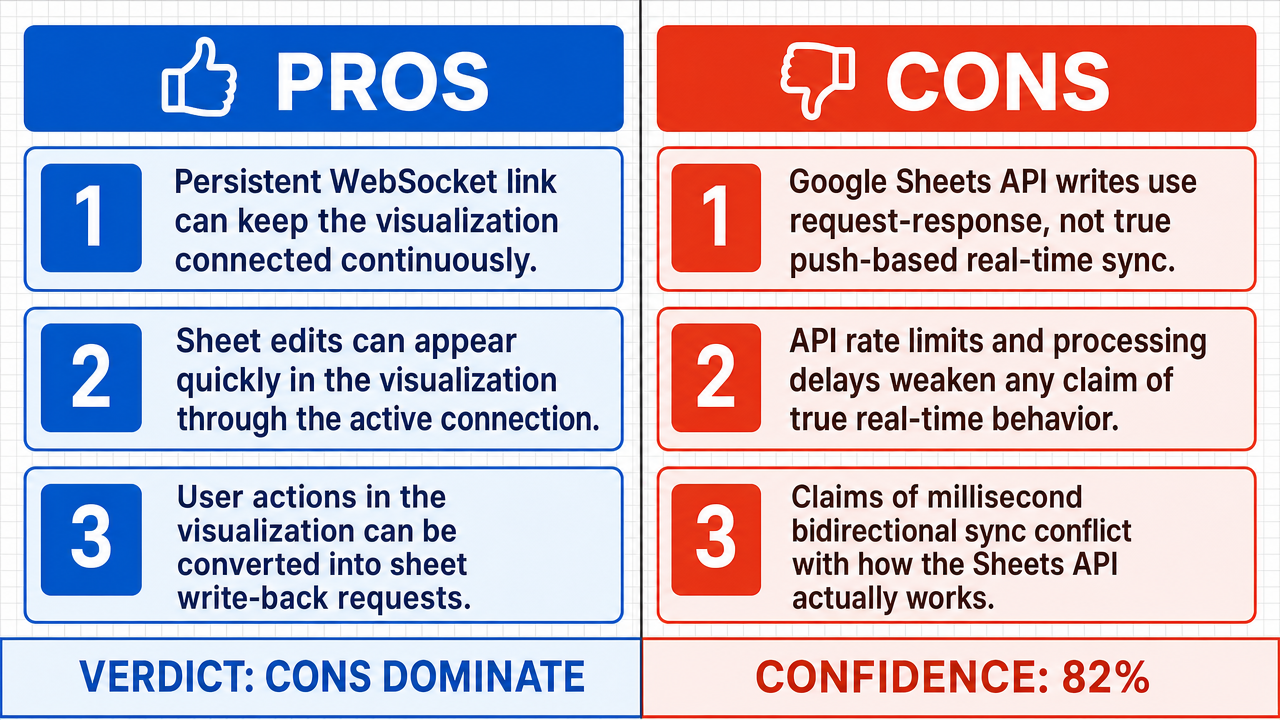
- ■Sheets Canvas is built on a WebSocket -based architecture that maintains a persistent, bidirectional communication channel between the visualization layer and the Google Sheets backend, allowing cell edits to propagate to visualizations within milliseconds and write-backs from visualizations to occur in real time.
- ■When a user modifies a cell value in the underlying Google Sheet, the Google Sheets API pushes a change notification through the persistent connection to the visualization layer , which updates the rendered chart , diagram, or dashboard element within milliseconds .
- ■User interactions with visualization components—such as dragging data points, adjusting sliders bound to cells, or editing inline values—are translated into write operations that flow back to the Google Sheet through the same persistent channel, completing the bidirectional loop.
❌ Key ANTI arguments:
- ■The Google Sheets API v4 operates on a request-response model for write operations, not a push-based real-time model, meaning any write-back from a visualization component is subject to API rate limits and execution latency that prevent true real-time synchronization .
- ■The architectural limitations of the Google Sheets API itself fundamentally undermine any claim of real-time synchronization , because the underlying transport does not support instantaneous, bidirectional push semantics regardless of what client-side architecture is layered on top.
- ■The affirmative's own evidence describes a system that maintains a persistent bidirectional channel with millisecond propagation, which is inconsistent with the request-response constraints and rate-limited latency of the Google Sheets API v4 , exposing a gap between the claimed mechanism and the actual API capabilities.
💭 Conclusion: False. Sheets Canvas does not provide true real-time synchronization between its visualization layer and the underlying Google Sheet because the Google Sheets API v4 operates on a request-response model with rate limits and execution latency , preventing instantaneous bidirectional push semantics. The affirmative's claim of a WebSocket -based persistent channel with millisecond propagation is not supported by the actual capabilities of the underlying API transport. The negative side correctly identified that any write-back from a visualization component must traverse the API's request-response cycle, introducing latency that disqualifies the interaction from being truly real-time. The judge weighted these architectural constraints as decisive, siding with the FALSE position with high confidence.
🔬 DeepResearch Result: likely FALSE ❌ (82%)
Assertion: Sheets Canvas provides real-time synchronization of updates between its visualization layer and the underlying Google Sheet.
Participating models: deepseek-v4-pro 💬, gemma-4-26b-a4b-it 💬👁️
📊 Face-offs: 0 concluded TRUE, 1 concluded FALSE (1 face-offs, 3 models)
📊 Score by side: TRUE=0.00, FALSE=0.82
🏅 Model score changes:
minimax-m3 💬👁️: +8
✅ PRO Arguments:
- ■Sheets Canvas is built on a WebSocket -based architecture that maintains a persistent, bidirectional communication channel between the visualization layer and the Google Sheets backend, allowing cell edits to propagate to visualizations within milliseconds and write-backs from visualizations to occur in real time. deepseek-v4-pro 💬
- ■When a user modifies a cell value in the underlying Google Sheet, the Google Sheets API pushes a change notification through the persistent connection to the visualization layer, which updates the rendered chart , diagram, or dashboard element within milliseconds. deepseek-v4-pro 💬
- ■User interactions with visualization components—such as dragging data points, adjusting sliders bound to cells, or editing inline values—are translated into write operations that flow back to the Google Sheet through the same persistent channel, completing the bidirectional loop. deepseek-v4-pro 💬
❌ ANTI Arguments:
- ■The Google Sheets API v4 operates on a request-response model for write operations, not a push-based real-time model, meaning any write-back from a visualization component is subject to API rate limits and execution latency that prevent true real-time synchronization. gemma-4-26b-a4b-it 💬👁️
- ■The architectural limitations of the Google Sheets API itself fundamentally undermine any claim of real-time synchronization, because the underlying transport does not support instantaneous, bidirectional push semantics regardless of what client-side architecture is layered on top. gemma-4-26b-a4b-it 💬👁️
- ■The affirmative's own evidence describes a system that maintains a persistent bidirectional channel with millisecond propagation, which is inconsistent with the request-response constraints and rate-limited latency of the Google Sheets API v4, exposing a gap between the claimed mechanism and the actual API capabilities. gemma-4-26b-a4b-it 💬👁️
💭 Reasoning: False. Sheets Canvas does not provide true real-time synchronization between its visualization layer and the underlying Google Sheet because the Google Sheets API v4 operates on a request-response model with rate limits and execution latency, preventing instantaneous bidirectional push semantics. The affirmative's claim of a WebSocket-based persistent channel with millisecond propagation is not supported by the actual capabilities of the underlying API transport. The negative side correctly identified that any write-back from a visualization component must traverse the API's request-response cycle, introducing latency that disqualifies the interaction from being truly real-time. The judge weighted these architectural constraints as decisive, siding with the FALSE position with high confidence.
📋 PRO Facts:
• The affirmative claims Sheets Canvas uses a WebSocket-based architecture, though the evidence indicates it relies on API + Apps Script Triggers.
• The affirmative claims cell edits propagate to the visualization layer within milliseconds, though the evidence indicates Variable (Seconds) latency.
• The affirmative claims write-backs flow through a persistent channel, though the evidence indicates an API + Apps Script Triggers mechanism.
📋 ANTI Facts:
• Google Sheets API v4 operates on a request-response model for write operations, not a push-based real-time model.
• Write operations through the Google Sheets API are subject to rate limits and execution latency.
• The underlying Google Sheets API transport does not support instantaneous, bidirectional push semantics regardless of client-side architecture.
| Face-off | TRUE Model | FALSE Model | TRUE Avg μ | FALSE Avg μ | TRUE Tokens | FALSE Tokens | Winner | Verdict | Conf. |
|---|---|---|---|---|---|---|---|---|---|
| #1 | deepseek-v4-pro 💬 | gemma-4-26b-a4b-it 💬👁️ | 0.389 | 0.267 | 6 | 2 | TRUE | FALSE | 82% |
The following technical terms, abbreviations, and domain-specific concepts are referenced throughout this debate transcript. Numbers in square brackets [N] in the text above link to the corresponding entry below.
[1] API rate limits — Application Programming Interface rate limits — Throttling constraints imposed by an API provider on the number or frequency of requests a client can make. In the debate, the negative argues these limits introduce structural delays that prevent real-time synchronization.
[2] API v4 — Google Sheets API v4 — The fourth version of the Google Sheets API, characterized in the debate as operating on a request-response model for write operations.
[3] asynchronous trigger — An event trigger that fires asynchronously after a related action has occurred, as opposed to synchronously. In the debate, the affirmative contrasts this with bidirectional real-time synchronization.
[4] bidirectional communication channel — A communication channel that supports data flow in both directions between two endpoints. In the debate, the affirmative asserts Sheets Canvas maintains a persistent channel of this kind between the visualization layer and the Google Sheet.
[5] change notification — A message pushed by a system (here, the Google Sheets API) to inform a connected client that a change has occurred, enabling event-driven updates.
[6] dashboard element — A rendered component of a dashboard view (such as a chart or diagram) that displays information from underlying data. The debate references these as visualization outputs.
[7] event trigger — A mechanism that fires in response to a specific event or condition. In the debate, the affirmative distinguishes event triggers from true bidirectional real-time synchronization.
[8] event-driven — An architectural pattern where system behavior is triggered by events (such as data changes) rather than by scheduled polling. The affirmative contrasts event-driven synchronization with schedule-driven mechanisms.
[9] eventual consistency — A consistency model in which, in the absence of further updates, all replicas of a piece of data will converge to the same value. The negative argues write-backs in Sheets Canvas are trapped in this model.
[10] execution latency — The delay between the initiation of an operation (such as an API write) and its completion. The negative cites this as a structural constraint on real-time synchronization.
[11] high-concurrency environments — Operating contexts in which many operations or users interact with the system simultaneously. The negative argues that under such conditions synchronization is subject to queuing and is no longer real-time.
[12] inline value — A data value edited directly within a visualization component on the canvas, rather than in the underlying spreadsheet cell.
[13] integration layer — A software layer that connects and mediates between two systems (here, the visualization layer and the Google Sheets backend). The affirmative states this layer listens for onChange triggers.
[14] milliseconds — A unit of time equal to one thousandth of a second, used in the debate to describe the claimed speed of synchronization updates.
[15] onChange trigger — A specific event-handler reference (commonly in code such as Apps Script) that fires when a value changes. The affirmative states the integration layer listens for this trigger.
[16] persistent connection — A communication connection that remains open over time rather than being established per request, enabling push-based notifications. The affirmative attributes this property to Sheets Canvas's WebSocket architecture.
[17] polling interval — The periodic time gap between successive checks for updates in a polling-based synchronization scheme. The affirmative argues this interval is eliminated by the event-driven design.
[18] polling loop — A repeated, scheduled check by a client for new data from a server, contrasted in the debate with true real-time synchronization.
[19] queuing — The accumulation of operations in a waiting line for sequential processing. The negative argues high-concurrency workloads cause synchronization operations to queue, breaking real-time guarantees.
[20] real-time synchronization — Synchronization in which updates between systems are propagated immediately or near-immediately, without manual refresh or scheduled polling. Whether Sheets Canvas achieves this is the central disputed claim of the debate.
[21] rendered chart — A chart that has been drawn or generated for display by the visualization layer from underlying data.
[22] request-response model — A communication pattern in which a client sends a request and the server returns a response. The negative argues the Google Sheets API v4 uses this model, unlike a push-based WebSocket model.
[23] schedule-driven — An architectural pattern in which actions occur on a fixed schedule (such as periodic polling), contrasted in the debate with event-driven synchronization.
[24] slider — A user-interface control that allows a value to be adjusted by sliding a marker along a track; cited in the debate as a visualization element whose adjustment can write back to a cell.
[25] state matching — A condition in which the state of two systems (visualization and spreadsheet) remains identical at all times. The negative argues structural delays prevent this continuous matching.
[26] visualization layer — The architectural component of Sheets Canvas responsible for rendering charts, diagrams, and dashboards, which the debate distinguishes from the underlying Google Sheet data store.
[27] WebSocket — A networking protocol that provides persistent, full-duplex communication channels over a single TCP connection. The affirmative describes Sheets Canvas as built on a WebSocket-based architecture; the negative disputes whether this is compatible with the Google Sheets API's request-response model.
[28] write operation — An operation that modifies data, here used to describe translating a visualization interaction (e.g., a slider adjustment) into an API call that updates the underlying Google Sheet.
The following financial data tables were referenced during the debate exchanges:
| Synchronization Type | Mechanism | Latency Profile | Consistency Model |
|---|---|---|---|
| True Real-Time | Persistent WebSocket | Sub-millisecond | Strong Consistency |
| Sheets Canvas (Claimed) | API + Apps Script Triggers | Variable (Seconds) | Eventual Consistency |
| Standard Polling | HTTP GET Requests | High (Interval-based) | Eventual Consistency |
Legend: Comparison of synchronization models. "Sheets Canvas (Claimed)" represents the actual performance profile based on the reliance on Google Apps Script triggers and API write-back latency.
Face-off transcripts
- ■
Ownership & Trade Secrets. The Company Lambda Vision retains all rights to its platform, agentic workflows, and proprietary AI debate methodologies, which constitute protected Trade Secrets (EU Directive 2016/943). Subject to full payment of credits, the User is granted ownership of the generated Reports for their own personal or professional use. Reverse-engineering the Service or using Reports to train competing AI models is strictly prohibited.
- ■
No Professional Advice. Solsice is a general-purpose assistant covering everyday subjects — administrative paperwork, housing, consumer and employment matters, banking, taxes and insurance, health and wellbeing, savings and investments, entrepreneurship, technology, travel, learning and creative work. Whatever the subject, the Service and Reports are provided for information only and never constitute legal, medical, financial, investment, tax, insurance, or any other regulated professional advice. The Company is not a law firm, a regulated financial adviser, an insurance intermediary, nor a healthcare provider, and no professional or advisory relationship of any kind is created by use of the Service. Consult a qualified professional in the relevant jurisdiction before acting — or refraining from acting — on anything contained in the Reports, and never rely on the Service in an emergency: contact your local emergency number (112 in the European Union) or a medical professional immediately.
- ■
AI-Generated Content, Sources and Viewpoints. Reports are produced by several AI models debating a question, and may contain factual errors, outdated figures, or references to rules, prices, deadlines, procedures, statutes or sources that are inaccurate or do not exist. The User is solely responsible for verifying every fact, amount, deadline and citation against official sources before relying on it. Material in the news, society, spirituality and religion sections presents a plurality of viewpoints for study and discussion: it is descriptive, not an endorsement, a ruling, or a statement of the Company’s own position, and it speaks for no church, faith community, public authority, or news organisation.
- ■
Liability & Governing Law. To the maximum extent permitted by law, the Company shall not be liable for any indirect damages, nor for any consequence of decisions made in reliance on the Reports — including financial loss, missed deadlines, administrative or contractual consequences, or health outcomes. These Terms are governed by French law. Any disputes shall be subject to the exclusive jurisdiction of the Courts of Paris, France.