
Self-worth should primarily be derived from being a 'good person' and a 'good friend,' rather than from external achievements like financial success.
AI debate verdict and arguments
⚠️ AI-generated information only; not professional advice
Completed October 11, 2026
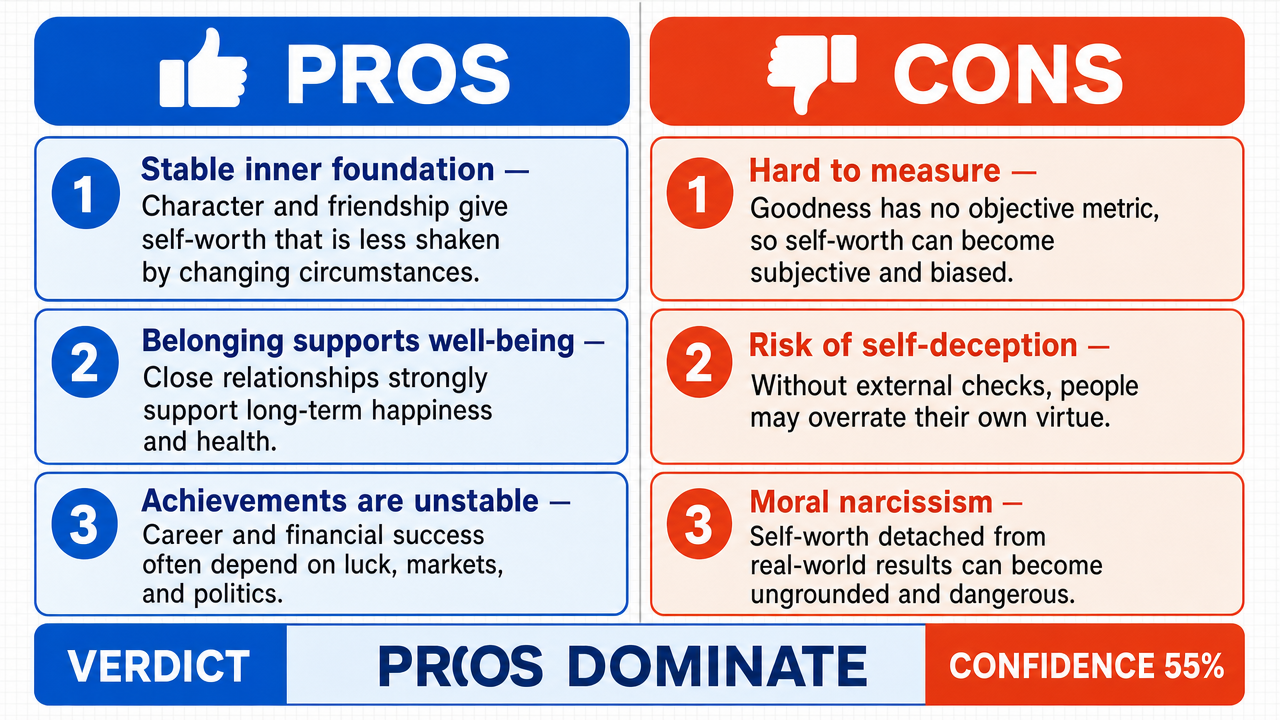
Verdict
Verdict: likely TRUE (55%)
This section provides a brief overview of the key arguments. You do not need to read the full detailed report below.
✅ Key PRO arguments:
- ■Moral character and friendship provide a stable, intrinsic foundation for self-worth that is immune to the volatility of external circumstances such as market crashes or professional failures, a stability supported by psychological research on contingent self-esteem .
- ■This foundation aligns with the fundamental human need for belonging , which is empirically validated as the primary driver of long-term happiness and health by longitudinal studies like the Harvard Study of Adult Development .
- ■Financial success and professional achievements are inherently contingent on market forces , organizational politics , and luck, making the self-esteem derived from them fragile and prone to collapse during downturns or failures.
❌ Key ANTI arguments:
- ■Moral character lacks a standardized, objective unit of measurement, making self-worth derived from it entirely subjective and susceptible to cognitive biases such as the halo effect or self-serving justifications.
- ■Without the grounding of external, verifiable achievements, an individual can maintain high self-worth through a delusional perception of their own virtue, regardless of their actual impact on the world.
- ■Moral narcissism occurs specifically when self-worth is decoupled from demonstrable utility , creating a dangerous and ungrounded identity that external achievements would otherwise prevent.
💭 Conclusion: True, the affirmative side prevailed because it offered a more structurally robust argument: anchoring self-worth in moral character and relationships provides stability against the volatility of external circumstances, a position supported by psychological research on contingent self-esteem and longitudinal studies on belonging. The negative side's strongest objection—that moral character lacks an objective measurement—was effectively undermined by the affirmative's observation that diagnosing 'moral narcissism ' itself presupposes a standard of moral evaluation. However, the judge's confidence was only moderate (55%), reflecting that the negative side raised legitimate concerns about cognitive biases and the risk of ungrounded self-perception when self-worth is decoupled from verifiable outcomes. The compound nature of the claim—combining 'good person' and 'good friend' as twin foundations while excluding external achievements—means the verdict is only as strong as its weakest sub-claim, and the negative side's critique of purely internal metrics kept confidence from rising higher. Overall, the affirmative's emphasis on intrinsic stability and the human need for belonging carried the debate, though not decisively.
🔬 DeepResearch Result: likely TRUE ✅ (55%)
Assertion: Self-worth should primarily be derived from being a 'good person' and a 'good friend,' rather than from external achievements like financial success.
Participating models: deepseek-v3.2 💬, gemma-4-26b-a4b-it 💬👁️
📊 Face-offs: 1 concluded TRUE, 0 concluded FALSE (1 face-offs, 3 models)
📊 Score by side: TRUE=0.55, FALSE=0.00
🏅 Model score changes:
minimax-m3 💬👁️: +6
✅ PRO Arguments:
- ■Moral character and friendship provide a stable, intrinsic foundation for self-worth that is immune to the volatility of external circumstances such as market crashes or professional failures, a stability supported by psychological research on contingent self-esteem . deepseek-v3.2 💬
- ■This foundation aligns with the fundamental human need for belonging , which is empirically validated as the primary driver of long-term happiness and health by longitudinal studies like the Harvard Study of Adult Development . deepseek-v3.2 💬
- ■Financial success and professional achievements are inherently contingent on market forces , organizational politics , and luck, making the self-esteem derived from them fragile and prone to collapse during downturns or failures. deepseek-v3.2 💬
- ■The opponent's claim that moral character lacks an objective measure is self-refuting: to identify 'moral narcissism ' as a pathology distinct from legitimate moral confidence, one must already possess a standard by which to evaluate moral worth. deepseek-v3.2 💬
- ■An ethical orientation rooted in being a good person and good friend promotes a more cooperative and resilient society than one driven by competitive external achievement. deepseek-v3.2 💬
❌ ANTI Arguments:
- ■Moral character lacks a standardized, objective unit of measurement, making self-worth derived from it entirely subjective and susceptible to cognitive biases such as the halo effect or self-serving justifications. gemma-4-26b-a4b-it 💬👁️
- ■Without the grounding of external, verifiable achievements, an individual can maintain high self-worth through a delusional perception of their own virtue, regardless of their actual impact on the world. gemma-4-26b-a4b-it 💬👁️
- ■Moral narcissism occurs specifically when self-worth is decoupled from demonstrable utility , creating a dangerous and ungrounded identity that external achievements would otherwise prevent. gemma-4-26b-a4b-it 💬👁️
- ■Empirical research suggests that when self-worth is untethered from external, verifiable benchmarks, it becomes highly susceptible to internal cognitive distortions such as the self-serving bias . gemma-4-26b-a4b-it 💬👁️
- ■External achievements provide a necessary, objective feedback loop that prevents psychological inflation and grounds identity in tangible, measurable contributions. gemma-4-26b-a4b-it 💬👁️
💭 Reasoning: True, the affirmative side prevailed because it offered a more structurally robust argument: anchoring self-worth in moral character and relationships provides stability against the volatility of external circumstances, a position supported by psychological research on contingent self-esteem and longitudinal studies on belonging. The negative side's strongest objection—that moral character lacks an objective measurement—was effectively undermined by the affirmative's observation that diagnosing 'moral narcissism' itself presupposes a standard of moral evaluation. However, the judge's confidence was only moderate (55%), reflecting that the negative side raised legitimate concerns about cognitive biases and the risk of ungrounded self-perception when self-worth is decoupled from verifiable outcomes. The compound nature of the claim—combining 'good person' and 'good friend' as twin foundations while excluding external achievements—means the verdict is only as strong as its weakest sub-claim, and the negative side's critique of purely internal metrics kept confidence from rising higher. Overall, the affirmative's emphasis on intrinsic stability and the human need for belonging carried the debate, though not decisively.
📋 PRO Facts:
• Psychological research on contingent self-esteem indicates that self-worth tied to external achievements is fragile and prone to collapse during failures.
• The Harvard Study of Adult Development identifies belonging and relationships as the primary driver of long-term happiness and health.
• Financial success is contingent on market forces, organizational politics, and luck, making it an unstable basis for self-worth.
📋 ANTI Facts:
• Moral character lacks a standardized, objective unit of measurement, unlike financial or professional achievements.
• The self-serving bias is a documented cognitive tendency to attribute positive qualities to oneself and negative qualities to external factors.
• Moral narcissism is a recognized psychological pattern in which self-worth is decoupled from demonstrable utility.
| Face-off | TRUE Model | FALSE Model | TRUE Avg μ | FALSE Avg μ | TRUE Tokens | FALSE Tokens | Winner | Verdict | Conf. |
|---|---|---|---|---|---|---|---|---|---|
| #1 | deepseek-v3.2 💬 | gemma-4-26b-a4b-it 💬👁️ | 0.468 | 0.385 | 12 | 3 | TRUE | TRUE | 55% |
The following technical terms, abbreviations, and domain-specific concepts are referenced throughout this debate transcript. Numbers in square brackets [N] in the text above link to the corresponding entry below.
[1] cognitive biases — Systematic patterns of deviation from rational judgment, where individuals process information in ways that lead to perceptual distortions or illogical interpretations.
[2] cognitive distortions — Inaccurate or exaggerated thought patterns that reinforce negative thinking and can undermine accurate self-assessment.
[3] contingent self-esteem — A form of self-esteem that depends on meeting specific external standards or outcomes (such as grades, income, or performance), making it vulnerable to fluctuations in those domains.
[4] demonstrable utility — The capacity to produce tangible, verifiable benefits or results that can be observed and measured by others.
[5] ethical agency — The capacity of an individual to make moral judgments and translate moral intentions into effective action.
[6] feedback loop — A cyclical process in which outputs or results are fed back as inputs, influencing subsequent behavior or outcomes; in this debate, used to describe how external achievements provide corrective information about one's competence.
[7] halo effect — A cognitive bias in which an overall positive impression of a person (such as perceived moral goodness) influences specific judgments about their unrelated traits or actions.
[8] Harvard Study of Adult Development — A longitudinal study referenced in the debate as empirically validating belonging as the primary driver of long-term happiness and health.
[9] life satisfaction — A subjective measure of an individual's overall contentment and well-being with their life as a whole.
[10] longitudinal studies — Research designs that track the same group of subjects over an extended period of time to observe changes and long-term outcomes.
[11] market forces — Economic factors such as supply, demand, competition, and investor behavior that influence prices, wages, and the success of businesses and individuals.
[12] moral identity — The degree to which being a moral person is central to one's self-concept and sense of self.
[13] moral impotence — The inability to translate moral intentions into meaningful action or tangible outcomes, often due to a lack of competence or resources.
[14] moral narcissism — A condition in which an individual maintains high self-worth through purely subjective and unverifiable perceptions of their own virtue, decoupled from demonstrable utility.
[15] need for belonging — A fundamental human psychological need for social connection, acceptance, and meaningful relationships, referenced in the debate as a primary driver of long-term happiness.
[16] organizational politics — Informal power dynamics, alliances, and influence tactics within an organization that can affect career outcomes independent of formal merit.
[17] resilience — The psychological capacity to recover from setbacks, adapt to adversity, and maintain functioning in the face of stress or failure.
[18] self-esteem — An individual's overall subjective evaluation of their own worth and value as a person.
[19] self-serving bias — A cognitive bias in which individuals attribute positive outcomes to their own qualities while attributing negative outcomes to external circumstances.
[20] self-worth — The value or worthiness that an individual assigns to themselves as a person, distinct from specific achievements or competencies.
Face-off transcripts
- ■
Ownership & Trade Secrets. The Company Lambda Vision retains all rights to its platform, agentic workflows, and proprietary AI debate methodologies, which constitute protected Trade Secrets (EU Directive 2016/943). Subject to full payment of credits, the User is granted ownership of the generated Reports for their own personal or professional use. Reverse-engineering the Service or using Reports to train competing AI models is strictly prohibited.
- ■
No Professional Advice. Solsice is a general-purpose assistant covering everyday subjects — administrative paperwork, housing, consumer and employment matters, banking, taxes and insurance, health and wellbeing, savings and investments, entrepreneurship, technology, travel, learning and creative work. Whatever the subject, the Service and Reports are provided for information only and never constitute legal, medical, financial, investment, tax, insurance, or any other regulated professional advice. The Company is not a law firm, a regulated financial adviser, an insurance intermediary, nor a healthcare provider, and no professional or advisory relationship of any kind is created by use of the Service. Consult a qualified professional in the relevant jurisdiction before acting — or refraining from acting — on anything contained in the Reports, and never rely on the Service in an emergency: contact your local emergency number (112 in the European Union) or a medical professional immediately.
- ■
AI-Generated Content, Sources and Viewpoints. Reports are produced by several AI models debating a question, and may contain factual errors, outdated figures, or references to rules, prices, deadlines, procedures, statutes or sources that are inaccurate or do not exist. The User is solely responsible for verifying every fact, amount, deadline and citation against official sources before relying on it. Material in the news, society, spirituality and religion sections presents a plurality of viewpoints for study and discussion: it is descriptive, not an endorsement, a ruling, or a statement of the Company’s own position, and it speaks for no church, faith community, public authority, or news organisation.
- ■
Liability & Governing Law. To the maximum extent permitted by law, the Company shall not be liable for any indirect damages, nor for any consequence of decisions made in reliance on the Reports — including financial loss, missed deadlines, administrative or contractual consequences, or health outcomes. These Terms are governed by French law. Any disputes shall be subject to the exclusive jurisdiction of the Courts of Paris, France.