
Russia's war costs in Ukraine, as of October 2026, are approximately half of the revenue it has generated since the conflict began.
AI debate verdict and arguments
⚠️ AI-generated information only; not professional advice
Completed October 11, 2026
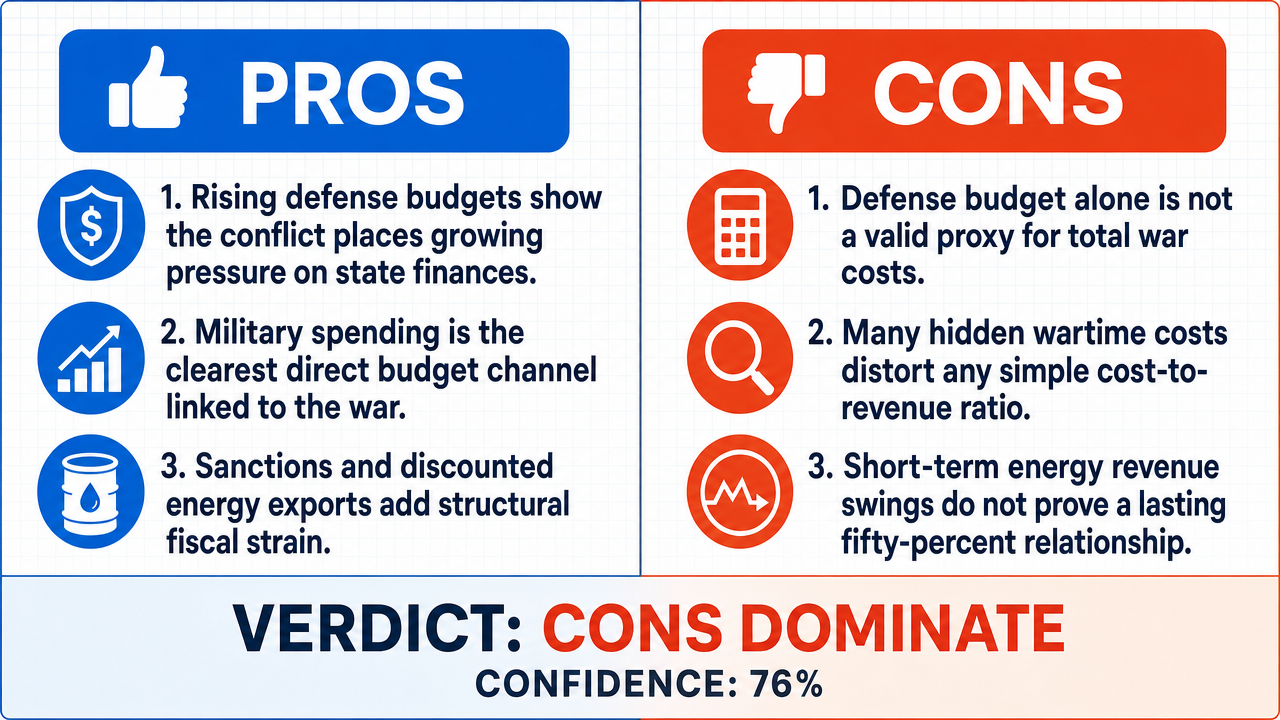
Verdict
Verdict: likely FALSE (76%)
This section provides a brief overview of the key arguments. You do not need to read the full detailed report below.
✅ Key PRO arguments:
- ■Russia's defense spending rose from approximately $65 billion in 2022 to $112 billion in 2024 (6% of GDP ), with the 2025 draft budget projecting roughly $125 billion, indicating a substantial and accelerating drain on the national budget that could approach half of cumulative revenue by October 2026.
- ■Defense spending is the most direct and significant budgetary allocation to the conflict, and the 2024 figure represents a trajectory rather than a static number, with proposed 2025 budgets indicating further increases.
- ■The convergence of rising military expenditure, sanctions pressure, and discounted energy exports creates structural fiscal pressure that supports the claim that war costs will approximate half of revenue.
❌ Key ANTI arguments:
- ■Using the projected defense budget of $112 billion as a proxy for 'war costs ' is a fundamental failure in ratio integrity ; defense spending is a subset of state expenditure , not the totality of war costs, and the numerator and denominator are mismatched in scope.
- ■The affirmative fails to account for massive unrecorded shadow costs of a mobilized economy —including social transfers , military-industrial subsidies, and systemic economic distortions—which are essential to capturing true war costs and would dramatically alter the ratio.
- ■The reported 50% decline in oil and gas revenues during January-May 2023 was a transient fluctuation driven by shifting global demand and recalibration of trade routes, not a permanent erosion of Russia's revenue base, undermining the affirmative's claim of structural fiscal collapse.
💭 Conclusion: The claim that war costs will approximate half of Russia's revenue by October 2026 rests on a methodological flaw: using the official defense budget as a proxy for total war costs creates a ratio integrity problem. The numerator (defense spending) is a narrow subset of actual war costs, while the denominator (total state revenue ) is broad, making the resulting ratio structurally unreliable. The evidence indicates that 'war costs' must include massive, often unrecorded shadow costs —social transfers to military families, military-industrial subsidies, and systemic economic distortions of a mobilized economy —that would substantially expand the numerator if properly counted. Furthermore, the 50% decline in oil and gas revenues during January-May 2023 is characterized in the evidence as a 'transient fluctuation driven by shifting global demand and the initial recalibration of trade,' not a permanent structural erosion. Russia's demonstrated adaptation through redirected energy exports and parallel non-Western trade undermines the assumption of structural revenue decline. Together, these issues indicate the assertion cannot be reliably supported with the available evidence and methodology.
🔬 DeepResearch Result: likely FALSE ❌ (76%)
Assertion: Russia's war costs in Ukraine, as of October 2026, are approximately half of the revenue it has generated since the conflict began.
Participating models: deepseek-v3.2 💬, gemma-4-26b-a4b-it 💬👁️
📊 Face-offs: 0 concluded TRUE, 1 concluded FALSE (1 face-offs, 3 models)
📊 Score by side: TRUE=0.00, FALSE=0.76
🏅 Model score changes:
minimax-m3 💬👁️: +8
✅ PRO Arguments:
- ■Russia's defense spending rose from approximately $65 billion in 2022 to $112 billion in 2024 (6% of GDP ), with the 2025 draft budget projecting roughly $125 billion, indicating a substantial and accelerating drain on the national budget that could approach half of cumulative revenue by October 2026. deepseek-v3.2 💬
- ■Defense spending is the most direct and significant budgetary allocation to the conflict, and the 2024 figure represents a trajectory rather than a static number, with proposed 2025 budgets indicating further increases. deepseek-v3.2 💬
- ■The convergence of rising military expenditure, sanctions pressure, and discounted energy exports creates structural fiscal pressure that supports the claim that war costs will approximate half of revenue. deepseek-v3.2 💬
❌ ANTI Arguments:
- ■Using the projected defense budget of $112 billion as a proxy for 'war costs' is a fundamental failure in ratio integrity ; defense spending is a subset of state expenditure , not the totality of war costs, and the numerator and denominator are mismatched in scope. gemma-4-26b-a4b-it 💬👁️
- ■The affirmative fails to account for massive unrecorded shadow costs of a mobilized economy —including social transfers , military-industrial subsidies, and systemic economic distortions—which are essential to capturing true war costs and would dramatically alter the ratio. gemma-4-26b-a4b-it 💬👁️
- ■The reported 50% decline in oil and gas revenues during January-May 2023 was a transient fluctuation driven by shifting global demand and recalibration of trade routes, not a permanent erosion of Russia's revenue base, undermining the affirmative's claim of structural fiscal collapse. gemma-4-26b-a4b-it 💬👁️
- ■Russia's broader revenue base has remained resilient through sanctions adaptation and redirected energy exports, meaning cumulative state revenue from February 2022 through October 2026 is likely far larger than the affirmative's projections assume, making the half-revenue threshold for war costs implausible. gemma-4-26b-a4b-it 💬👁️
💭 Reasoning: The claim that war costs will approximate half of Russia's revenue by October 2026 rests on a methodological flaw: using the official defense budget as a proxy for total war costs creates a ratio integrity problem. The numerator (defense spending) is a narrow subset of actual war costs, while the denominator (total state revenue) is broad, making the resulting ratio structurally unreliable. The evidence indicates that 'war costs' must include massive, often unrecorded shadow costs—social transfers to military families, military-industrial subsidies, and systemic economic distortions of a mobilized economy—that would substantially expand the numerator if properly counted. Furthermore, the 50% decline in oil and gas revenues during January-May 2023 is characterized in the evidence as a 'transient fluctuation driven by shifting global demand and the initial recalibration of trade,' not a permanent structural erosion. Russia's demonstrated adaptation through redirected energy exports and parallel non-Western trade undermines the assumption of structural revenue decline. Together, these issues indicate the assertion cannot be reliably supported with the available evidence and methodology.
📋 PRO Facts:
• Russia's 2024 projected defense spending: $112 billion (6% of GDP)
• Russia's 2022 defense spending: approximately $65 billion
• Russia's 2025 draft budget projects approximately $125 billion in defense spending
• Russia's defense spending rose from approximately $65 billion in 2022 to $112 billion in 2024
📋 ANTI Facts:
• Oil and gas revenues declined by 50% during the January-May 2023 period
• Defense spending is a subset of state expenditure, not the totality of war costs
• Russia's broader revenue base has remained resilient through sanctions adaptation and redirected energy exports
| Face-off | TRUE Model | FALSE Model | TRUE Avg μ | FALSE Avg μ | TRUE Tokens | FALSE Tokens | Winner | Verdict | Conf. |
|---|---|---|---|---|---|---|---|---|---|
| #1 | deepseek-v3.2 💬 | gemma-4-26b-a4b-it 💬👁️ | 0.388 | 0.303 | 12 | 3 | TRUE | FALSE | 76% |
The following technical terms, abbreviations, and domain-specific concepts are referenced throughout this debate transcript. Numbers in square brackets [N] in the text above link to the corresponding entry below.
[1] budget line items — Specific categories or entries within a government budget that detail particular types of expenditures or revenues.
[2] circular flow — An economic concept describing the continuous circulation of money between different sectors of an economy, such as between government, businesses, and households.
[3] compensatory growth — Economic growth in one sector or area that offsets losses or declines in another.
[4] conflict economy — An economy that has been reorganized or significantly affected by an armed conflict, with resources redirected toward war-related activities.
[5] cumulative — Referring to a running total or aggregate sum accumulated over a period of time.
[6] defense budget — The portion of a national budget allocated to military and defense-related expenditures.
[7] denominator — The bottom number in a fraction or ratio, representing the whole or total quantity against which the numerator is compared.
[8] energy exports — The sale and shipment of energy resources (such as oil and gas) to foreign buyers.
[9] fiscal burden — The total financial obligation or cost borne by a government or economy.
[10] fiscal capacity — A government's ability to raise revenue through taxation and other means to fund public expenditures.
[11] GDP — Gross Domestic Product — The total monetary value of all goods and services produced within a country's borders over a specified period, commonly used as a measure of economic output.
[12] linear extrapolation — A statistical method of projecting future values by extending a straight-line trend from existing data points.
[13] military industrial subsidies — Government financial support provided to defense industry manufacturers and producers.
[14] mobilized economy — An economy that has been reorganized to support wartime production and military needs.
[15] numerator — The top number in a fraction or ratio, representing the part being compared against the whole (denominator).
[16] occupied territories — Geographic areas under the military control of a foreign power.
[17] oil and gas revenues — Income generated by a state from the sale and export of petroleum and natural gas resources.
[18] probabilistic conjecture — An estimate or hypothesis expressed in terms of probability rather than certainty.
[19] ratio integrity — The methodological validity of a ratio, ensuring that the numerator and denominator are properly scoped and comparable.
[20] revenue streams — The various sources from which a government or entity generates income.
[21] revenue volatility — The degree of variability or fluctuation in income or revenue over time.
[22] sanctions — Economic penalties imposed by one or more countries on another, typically restricting trade, finance, or other economic activities.
[23] shadow costs — Costs that are not captured or recorded in official financial statements or budgets, often representing hidden or indirect expenses.
[24] social transfers — Government payments made to individuals or households, such as pensions, welfare benefits, or family allowances.
[25] state expenditure — The total spending by a government on public services, programs, and operations.
[26] state revenue — The total income received by a government, primarily through taxes, duties, and other fiscal mechanisms.
[27] structural deficit — A long-term budget shortfall that persists due to fundamental fiscal imbalances rather than temporary economic conditions.
[28] structural resilience — The long-term, fundamental ability of an economy or system to withstand and recover from shocks.
[29] trade flows — The movement of goods and services between countries or regions, including imports and exports.
[30] transient fluctuations — Temporary, short-term variations in data or economic indicators that do not reflect long-term trends.
[31] war costs — The total financial expenses associated with conducting a war, including military spending, equipment replacement, and related economic burdens. The debate disputes whether official defense budgets adequately capture these costs.
[32] war-time multiplier — An economic effect in which government military spending generates broader economic activity through contracts, employment, and related demand.
The following financial data tables were referenced during the debate exchanges:
| Year | Defense Spending |
|---|---|
| 2024 (projected) | $112 billion (6% of GDP) |
Legend: Russia's projected defense spending for 2024. Source: Reuters via The Moscow Times (https://www.themoscowtimes.com/2023/09/27/russias-2024-defense-spending-to-hit-record-high-of-112-bln-a82594).
| Year | Budget Deficit |
|---|---|
| 2022 | $47 billion |
Legend: Russia's budget deficit for 2022. Source: Reuters (https://www.reuters.com/markets/europe/russias-2022-budget-deficit-hits-47-bln-finance-ministry-2023-01-10/).
| Year | Defense Spending |
|---|---|
| 2024 (projected) | $112 billion |
Legend: Russia's projected defense spending for 2024. Source: Reuters via The Moscow Times (https://www.themoscowtimes.com/2023/09/27/russias-2024-defense-spending-to-hit-record-high-of-112-bln-a82594).
as a proxy for "war costs." This is a logical error; defense spending is a subset of state expenditure, but "war costs" must include the massive, often unrecorded, shadow costs of military industrial subsidies, social transfers to military families, and the systemic economic distortions of a mobilized economy. By using a narrow budgetary figure to represent a broad geopolitical phenomenon, the affirmative fails to establish a valid ratio. If the numerator (war costs) is under-measured and the denominator (total revenue) is treated as a static figure, the resulting ratio is mathematically meaningless for predicting the fiscal reality of 2026.
| Metric | 2022 Actual | 2024 Projected | 2026 Estimated Trend |
|---|---|---|---|
| Defense Spending (USD B) | ~$65B | ~$112B | Increasing |
| Budget Deficit (USD B) | $47B | Variable | Stabilizing |
| Revenue Composition | Oil/Gas Heavy | Diversifying | State-Led/War-Driven |
Legend: Comparative fiscal indicators for the Russian Federation. 2022 and 2024 figures are based on reported and projected data.
| Year | Defense Spending |
|---|---|
| 2024 (projected) | $112 billion |
| 2025 (projected) | $125 billion |
| Year | Defense Spending |
| --- | --- |
| 2024 (projected) | $112 billion |
| 2025 (projected) | $125 billion |
Legend: Russia's projected defense spending for 2024 and 2025. Source: Bloomberg (https://www.bloomberg.com/news/articles/2024-09-20/russia-s-2025-budget-draft-shows-higher-military-spending).
Legend: Russia's projected defense spending for 2024 and 2025. Source: Bloomberg (https://www.bloomberg.com/news/articles/2024-09-20/russia-s-2025-budget-draft-shows-higher-military-spending).
| Period | Oil and Gas Revenue | YoY Change |
|---|---|---|
| Jan-May 2023 | $34 billion | -50% |
Legend: Russia's oil and gas revenue for January-May 2023. Source: Reuters (https://www.reuters.com/markets/europe/russias-oil-gas-revenue-jan-may-down-50-year-ago-finance-ministry-data-2023-06-05/).
Face-off transcripts
- ■
Ownership & Trade Secrets. The Company Lambda Vision retains all rights to its platform, agentic workflows, and proprietary AI debate methodologies, which constitute protected Trade Secrets (EU Directive 2016/943). Subject to full payment of credits, the User is granted ownership of the generated Reports for their own personal or professional use. Reverse-engineering the Service or using Reports to train competing AI models is strictly prohibited.
- ■
No Professional Advice. Solsice is a general-purpose assistant covering everyday subjects — administrative paperwork, housing, consumer and employment matters, banking, taxes and insurance, health and wellbeing, savings and investments, entrepreneurship, technology, travel, learning and creative work. Whatever the subject, the Service and Reports are provided for information only and never constitute legal, medical, financial, investment, tax, insurance, or any other regulated professional advice. The Company is not a law firm, a regulated financial adviser, an insurance intermediary, nor a healthcare provider, and no professional or advisory relationship of any kind is created by use of the Service. Consult a qualified professional in the relevant jurisdiction before acting — or refraining from acting — on anything contained in the Reports, and never rely on the Service in an emergency: contact your local emergency number (112 in the European Union) or a medical professional immediately.
- ■
AI-Generated Content, Sources and Viewpoints. Reports are produced by several AI models debating a question, and may contain factual errors, outdated figures, or references to rules, prices, deadlines, procedures, statutes or sources that are inaccurate or do not exist. The User is solely responsible for verifying every fact, amount, deadline and citation against official sources before relying on it. Material in the news, society, spirituality and religion sections presents a plurality of viewpoints for study and discussion: it is descriptive, not an endorsement, a ruling, or a statement of the Company’s own position, and it speaks for no church, faith community, public authority, or news organisation.
- ■
Liability & Governing Law. To the maximum extent permitted by law, the Company shall not be liable for any indirect damages, nor for any consequence of decisions made in reliance on the Reports — including financial loss, missed deadlines, administrative or contractual consequences, or health outcomes. These Terms are governed by French law. Any disputes shall be subject to the exclusive jurisdiction of the Courts of Paris, France.