
Russia's military strikes on Lviv, Ukraine, despite air defense complexities, demonstrate a deliberate disregard for Ukrainian cultural heritage.
AI debate verdict and arguments
⚠️ AI-generated information only; not professional advice
Completed October 11, 2026
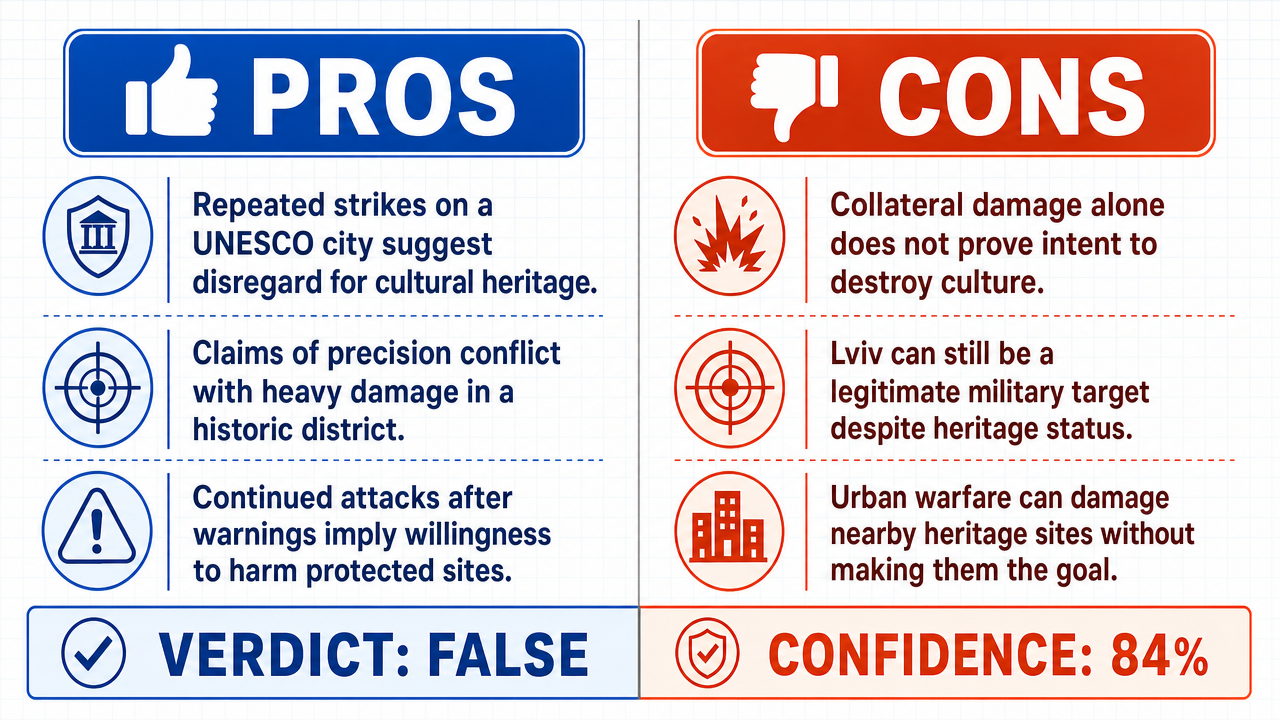
Verdict
Verdict: likely FALSE (84%)
This section provides a brief overview of the key arguments. You do not need to read the full detailed report below.
✅ Key PRO arguments:
- ■Russia's repeated targeting of Lviv, a UNESCO World Heritage site , demonstrates a deliberate disregard for Ukrainian cultural heritage beyond mere military objectives, with strikes hitting residential areas and historic buildings within the protected zone, damaging sites like the Cathedral of the Blessed Virgin Mary and the city's Museum.
- ■The claim that strikes are 'precision strikes on high-value targets ' while simultaneously producing extensive 'collateral damage in a historic zone' is internally contradictory: genuinely precision-guided munitions limit blast radius to the designated target, so repeated, extensive damage to UNESCO -listed heritage fabric is a signature of imprecise or indiscriminate targeting rather than a predictable byproduct of precision.
- ■The consistent nature of the strikes, even after international condemnation and clear identification of Lviv's protected status , indicates an intent to inflict damage on cultural heritage rather than incidental harm from legitimate military operations.
❌ Key ANTI arguments:
- ■The assertion relies on an interpretive leap that treats all collateral damage in a historic zone as evidence of intent to destroy culture; Lviv serves as a critical logistical hub for the Ukrainian military, housing command centers , fuel depots , and railway junctions essential for troop movements , making strikes on transport, energy, and command infrastructure legitimate military objectives.
- ■The opponent's binary framing—either strikes serve legitimate military objectives or they demonstrate deliberate disregard for heritage—is an artificial enclosure that fails to account for the complexities of modern urban warfare , where dual-use infrastructure and dense historic environments inevitably produce tragic but unintended heritage damage.
- ■Damage to nearby heritage sites in a dense urban environment is a predictable, albeit tragic, consequence of urban warfare rather than a primary strategic goal; the presence of collateral damage cannot be equated with a specific intent to destroy culture without direct evidence of such intent.
💭 Conclusion: False. The verdict is FALSE because the affirmative side failed to establish that observed damage to Lviv's cultural sites constitutes deliberate disregard rather than the foreseeable consequences of striking legitimate military targets in a dense urban environment. The negative side effectively demonstrated that Lviv functions as a critical logistical hub for Ukrainian military operations, housing command centers , fuel depots , and railway junctions , making strikes on such dual-use infrastructure legally and operationally justifiable. The affirmative's argument that precision strikes producing extensive heritage damage is internally contradictory was weakened by the negative's point that modern urban warfare inherently produces collateral damage in historic zones regardless of intent. The judge assigned 84% confidence to the FALSE verdict, reflecting strong agreement that the affirmative's interpretive leap from observed damage to proven intent was not adequately supported by the evidence presented.
🔬 DeepResearch Result: likely FALSE ❌ (84%)
Assertion: Russia's military strikes on Lviv, Ukraine, despite air defense complexities, demonstrate a deliberate disregard for Ukrainian cultural heritage.
Participating models: deepseek-v3.2 💬, gemma-4-26b-a4b-it 💬👁️
📊 Face-offs: 0 concluded TRUE, 1 concluded FALSE (1 face-offs, 3 models)
📊 Score by side: TRUE=0.00, FALSE=0.84
🏅 Model score changes:
minimax-m3 💬👁️: +8
✅ PRO Arguments:
- ■Russia's repeated targeting of Lviv, a UNESCO World Heritage site , demonstrates a deliberate disregard for Ukrainian cultural heritage beyond mere military objectives, with strikes hitting residential areas and historic buildings within the protected zone, damaging sites like the Cathedral of the Blessed Virgin Mary and the city's Museum. deepseek-v3.2 💬
- ■The claim that strikes are 'precision strikes on high-value targets ' while simultaneously producing extensive 'collateral damage in a historic zone' is internally contradictory: genuinely precision-guided munitions limit blast radius to the designated target, so repeated, extensive damage to UNESCO-listed heritage fabric is a signature of imprecise or indiscriminate targeting rather than a predictable byproduct of precision. deepseek-v3.2 💬
- ■The consistent nature of the strikes, even after international condemnation and clear identification of Lviv's protected status , indicates an intent to inflict damage on cultural heritage rather than incidental harm from legitimate military operations. deepseek-v3.2 💬
❌ ANTI Arguments:
- ■The assertion relies on an interpretive leap that treats all collateral damage in a historic zone as evidence of intent to destroy culture; Lviv serves as a critical logistical hub for the Ukrainian military, housing command centers , fuel depots , and railway junctions essential for troop movements , making strikes on transport, energy, and command infrastructure legitimate military objectives. gemma-4-26b-a4b-it 💬👁️
- ■The opponent's binary framing—either strikes serve legitimate military objectives or they demonstrate deliberate disregard for heritage—is an artificial enclosure that fails to account for the complexities of modern urban warfare , where dual-use infrastructure and dense historic environments inevitably produce tragic but unintended heritage damage. gemma-4-26b-a4b-it 💬👁️
- ■Damage to nearby heritage sites in a dense urban environment is a predictable, albeit tragic, consequence of urban warfare rather than a primary strategic goal; the presence of collateral damage cannot be equated with a specific intent to destroy culture without direct evidence of such intent. gemma-4-26b-a4b-it 💬👁️
💭 Reasoning: False. The verdict is FALSE because the affirmative side failed to establish that observed damage to Lviv's cultural sites constitutes deliberate disregard rather than the foreseeable consequences of striking legitimate military targets in a dense urban environment. The negative side effectively demonstrated that Lviv functions as a critical logistical hub for Ukrainian military operations, housing command centers, fuel depots, and railway junctions, making strikes on such dual-use infrastructure legally and operationally justifiable. The affirmative's argument that precision strikes producing extensive heritage damage is internally contradictory was weakened by the negative's point that modern urban warfare inherently produces collateral damage in historic zones regardless of intent. The judge assigned 84% confidence to the FALSE verdict, reflecting strong agreement that the affirmative's interpretive leap from observed damage to proven intent was not adequately supported by the evidence presented.
📋 PRO Facts:
• Lviv is designated as a UNESCO World Heritage site.
• Strikes have damaged sites including the Cathedral of the Blessed Virgin Mary and residential buildings in the historic center.
• Russia has claimed the strikes target military infrastructure.
📋 ANTI Facts:
• Lviv serves as a critical logistical hub for the Ukrainian military, housing command centers, fuel depots, and railway junctions essential for troop movements.
• Precision munitions are used in the strikes, limiting blast radius to designated targets.
• Damage to heritage sites in dense urban environments is a predictable consequence of urban warfare rather than evidence of specific intent to destroy culture.
| Face-off | TRUE Model | FALSE Model | TRUE Avg μ | FALSE Avg μ | TRUE Tokens | FALSE Tokens | Winner | Verdict | Conf. |
|---|---|---|---|---|---|---|---|---|---|
| #1 | deepseek-v3.2 💬 | gemma-4-26b-a4b-it 💬👁️ | 0.486 | 0.223 | 12 | 3 | TRUE | FALSE | 84% |
The following technical terms, abbreviations, and domain-specific concepts are referenced throughout this debate transcript. Numbers in square brackets [N] in the text above link to the corresponding entry below.
[1] Air defense — Military systems and measures designed to detect, track, and intercept incoming aerial threats such as missiles and aircraft. The debate references 'air defense complexities' as a contextual factor in evaluating strikes on Lviv.
[2] Blast radius — The area surrounding a detonation within which the explosion causes damage or destruction. The affirmative argues that precision-guided munitions limit blast radius to the designated target, so extensive heritage damage is not a predictable byproduct.
[3] Collateral damage — Unintended damage inflicted on civilian objects or persons during military operations. The debate centers on whether damage to historic buildings in Lviv constitutes collateral damage or evidence of deliberate intent.
[4] Command centers — Military facilities used to direct operations and coordinate forces. The negative cites command centers in Lviv as part of its argument that the city contains legitimate military targets.
[5] Cruise missiles — Self-propelled, guided missiles that fly at low altitudes to evade detection. The negative references 'military-grade cruise missiles' as part of the ordnance used in strikes on Lviv.
[6] Cultural erasure — The deliberate destruction or suppression of a culture's physical manifestations, including heritage sites. The affirmative frames the binary alternative to military necessity as a 'cultural-erasure strategy.'
[7] Drones — Unmanned aerial vehicles used for military reconnaissance or strike missions. The negative references drones alongside cruise missiles as part of the weapons employed against Lviv.
[8] Dual-use infrastructure — Facilities or objects that serve both civilian and military purposes. The negative argues Lviv's infrastructure is dual-use, complicating the distinction between military and civilian targets.
[9] Energy infrastructure — Facilities involved in the production, storage, or distribution of energy. The negative lists energy infrastructure among the legitimate military targets in Lviv.
[10] Exhaustive branches — In logical argumentation, categories that together cover all possibilities without overlap. The negative argues the affirmative's binary fails because it does not present exhaustive branches of possible motives.
[11] False dichotomy — A logical fallacy that presents only two options when more possibilities exist. The negative characterizes the affirmative's framing of strikes as either purely military or purely cultural as a false dichotomy.
[12] Fuel depots — Storage facilities for military fuel supplies. The negative cites fuel depots in Lviv as part of the city's military logistical role.
[13] Heritage fabric — The physical material elements of a cultural heritage site, including buildings, structures, and historic surfaces. The affirmative references damage to 'UNESCO-listed heritage fabric' as evidence of imprecise targeting.
[14] High-value targets — Military objectives of significant strategic importance. The negative describes strikes on Lviv as 'precision strikes on high-value targets' to justify the operation.
[15] Indiscriminate targeting — Attacks that fail to distinguish between military objectives and civilian objects, or that employ means that cannot be directed at a specific target. The affirmative argues that repeated heritage damage is a 'signature of imprecise or indiscriminate targeting.'
[16] International condemnation — Formal criticism expressed by the international community, often through diplomatic or institutional channels. The affirmative notes that strikes continued 'despite international condemnation.'
[17] Interpretive leap — A logical jump in reasoning that draws a conclusion not directly supported by the evidence presented. The negative argues the affirmative makes an interpretive leap by equating observed damage with intent.
[18] List of World Heritage in Danger — A UNESCO-maintained list of World Heritage sites threatened by serious and specific dangers. The transcript cites UNESCO's 2023 inscription of Lviv on this list.
[19] Logistical hub — A central location for the coordination, storage, and distribution of supplies and personnel. The negative characterizes Lviv as a 'critical logistical hub for the Ukrainian military.'
[20] Military-grade — Of a quality, capability, or type associated with use by military forces. The negative references 'military-grade cruise missiles' to characterize the ordnance used in Lviv strikes.
[21] Mixed-motive case — A situation in which an action is driven by more than one motive simultaneously. The affirmative argues the debate should consider the mixed-motive case where a strike serves a military objective while the operator knowingly accepts heritage damage.
[22] Precision munitions — Weapons designed to strike specific targets with minimal unintended damage. The negative argues precision munitions were used against high-value military targets in Lviv.
[23] Precision-guided munition — A weapon that uses onboard guidance systems to home in on a designated target, intended to limit unintended damage. The affirmative argues that by definition such munitions limit blast radius to the designated target.
[24] Protected status — A legal or international designation that affords special protection to a site or group. The affirmative notes Lviv's 'protected status' as a UNESCO World Heritage site.
[25] Railway junctions — Points where railway lines intersect or branch, used for routing and transferring rolling stock. The negative cites railway junctions in Lviv as essential for troop movements.
[26] Strategic necessity — A military requirement deemed essential for achieving operational or strategic objectives. The negative argues that targeting dual-use infrastructure in Lviv reflects strategic necessity rather than disregard for heritage.
[27] Troop movements — The organized relocation of military personnel and their equipment. The negative references troop movements as one of the military functions supported by Lviv's infrastructure.
[28] UNESCO — United Nations Educational, Scientific and Cultural Organization — A United Nations agency that designates World Heritage sites and maintains the List of World Heritage in Danger. The debate cites UNESCO's designation of Lviv's historic centre.
[29] Urban warfare — Military combat operations conducted within built-up areas such as cities and towns. The negative argues that heritage damage in Lviv is a predictable consequence of urban warfare.
[30] World Heritage site — A site designated by UNESCO for outstanding cultural or natural value deserving international protection. The affirmative emphasizes Lviv's status as a UNESCO World Heritage site.
Face-off transcripts
- ■
Ownership & Trade Secrets. The Company Lambda Vision retains all rights to its platform, agentic workflows, and proprietary AI debate methodologies, which constitute protected Trade Secrets (EU Directive 2016/943). Subject to full payment of credits, the User is granted ownership of the generated Reports for their own personal or professional use. Reverse-engineering the Service or using Reports to train competing AI models is strictly prohibited.
- ■
No Professional Advice. Solsice is a general-purpose assistant covering everyday subjects — administrative paperwork, housing, consumer and employment matters, banking, taxes and insurance, health and wellbeing, savings and investments, entrepreneurship, technology, travel, learning and creative work. Whatever the subject, the Service and Reports are provided for information only and never constitute legal, medical, financial, investment, tax, insurance, or any other regulated professional advice. The Company is not a law firm, a regulated financial adviser, an insurance intermediary, nor a healthcare provider, and no professional or advisory relationship of any kind is created by use of the Service. Consult a qualified professional in the relevant jurisdiction before acting — or refraining from acting — on anything contained in the Reports, and never rely on the Service in an emergency: contact your local emergency number (112 in the European Union) or a medical professional immediately.
- ■
AI-Generated Content, Sources and Viewpoints. Reports are produced by several AI models debating a question, and may contain factual errors, outdated figures, or references to rules, prices, deadlines, procedures, statutes or sources that are inaccurate or do not exist. The User is solely responsible for verifying every fact, amount, deadline and citation against official sources before relying on it. Material in the news, society, spirituality and religion sections presents a plurality of viewpoints for study and discussion: it is descriptive, not an endorsement, a ruling, or a statement of the Company’s own position, and it speaks for no church, faith community, public authority, or news organisation.
- ■
Liability & Governing Law. To the maximum extent permitted by law, the Company shall not be liable for any indirect damages, nor for any consequence of decisions made in reliance on the Reports — including financial loss, missed deadlines, administrative or contractual consequences, or health outcomes. These Terms are governed by French law. Any disputes shall be subject to the exclusive jurisdiction of the Courts of Paris, France.