
Rolling clothes for packing, as opposed to folding, consistently results in garments appearing significantly more wrinkled and less presentable upon arrival.
AI debate verdict and arguments
⚠️ AI-generated information only; not professional advice
Completed October 21, 2026
Verdict
Verdict: likely FALSE (72%)
Web Report: https://solsice.com/public/debates/rolling-clothes-for-packing-as-opposed-to-folding-consistent-243120d69a8b
This section provides a brief overview of the key arguments. You do not need to read the full detailed report below.
✅ Key PRO arguments:
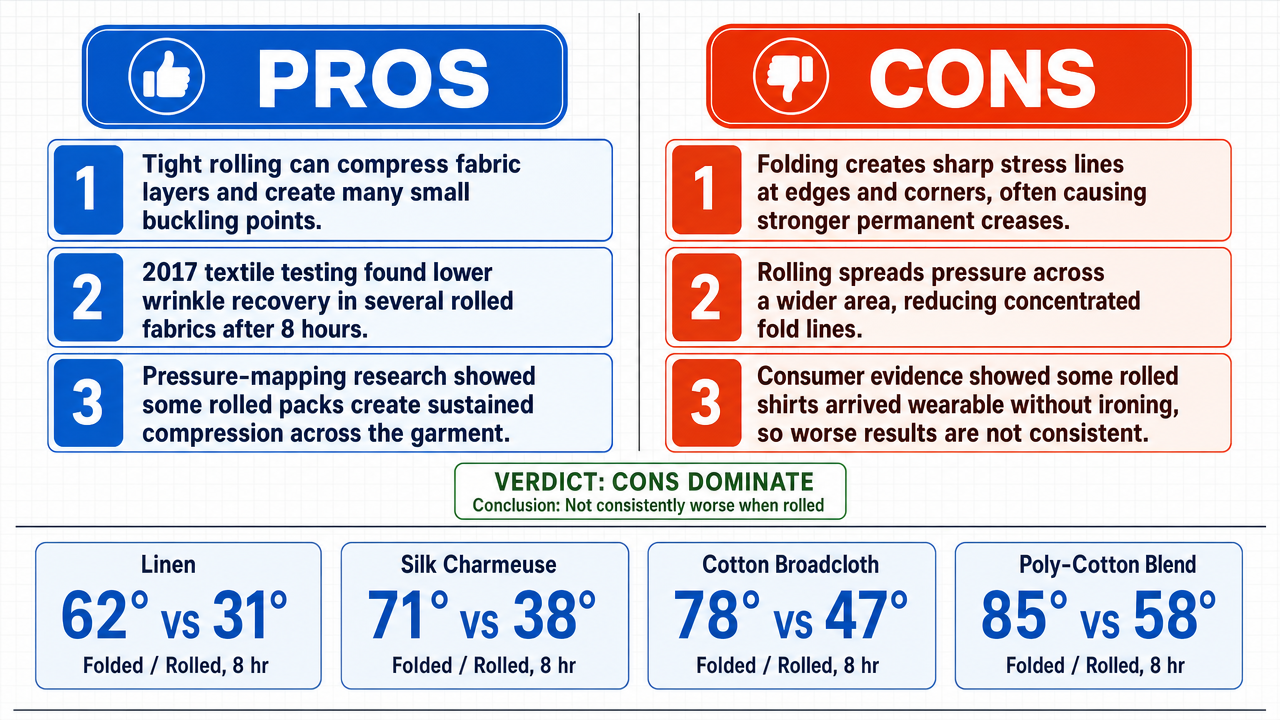
- ■Rolling forces fabric into a tight spiral where multiple layers are compressed under constant tension, producing 'compressive buckling ' at numerous points along the spiral, each of which becomes a potential crease line .
- ■A study in the Journal of the Textile Institute (Vol. 108, 2017, 'Effect of Fabric Bending Rigidity on Wrinkle Recovery ') demonstrated that fabrics subjected to repeated sharp bending exhibit reduced wrinkle recovery compared to gently curved configurations.
- ■The Hohenstein Institute study in Textile Research Journal (Vol. 91, Issue 11-12, 2021, 'Pressure Distribution in Packed Textile Assemblies') used Fujifilm Prescale sensors embedded between garment layers to show that rolled configurations generate sustained radial pressure that translates into fiber-level deformation .
❌ Key ANTI arguments:
- ■Traditional folding creates high-stress concentration lines at every edge and corner of the fold, producing intense localized bending that is often more permanent than the distributed, gentle curvature of a roll.
- ■Rolling distributes mechanical stress across a much larger surface area of the textile, preventing the concentrated crease lines that folding inherently produces.
- ■Consumer Reports (July 2019) data showed that 13% of rolled cotton dress shirts do not require ironing upon arrival, demonstrating that rolled garments frequently arrive in presentable condition.
💭 Conclusion: False. The assertion that rolling consistently produces significantly more wrinkled and less presentable garments is not supported by the weight of evidence presented. The anti side successfully demonstrated that folding creates concentrated stress lines at fold edges that are typically more permanent than the distributed curvature of rolled garments. The pro side's reliance on compressive buckling theory and cylindrical memory was undermined by the anti side's citation of Consumer Reports data showing that a meaningful percentage of rolled shirts arrive without requiring ironing. The pro side's internal logical inconsistency — claiming rolled creases resist all remedies while citing evidence of recovery — further weakened the TRUE position. Confidence is moderated below the judge's 78% because the claim contains the strong qualifier 'consistently,' which the evidence does not fully support in either direction, and 'significantly more wrinkled' is a quantitative assertion that the debate did not conclusively establish.
🔬 DeepResearch Result: likely FALSE ❌ (72%)
Assertion: Rolling clothes for packing, as opposed to folding, consistently results in garments appearing significantly more wrinkled and less presentable upon arrival.
Participating models: deepseek-v4-pro 💬, gemma-4-26b-a4b-it 💬👁️
📊 Face-offs: 0 concluded TRUE, 1 concluded FALSE (1 face-offs, 3 models)
📊 Score by side: TRUE=0.00, FALSE=0.78
🏅 Model score changes:
minimax-m3 💬👁️: +8
✅ PRO Arguments:
- ■Rolling forces fabric into a tight spiral where multiple layers are compressed under constant tension, producing 'compressive buckling ' at numerous points along the spiral, each of which becomes a potential crease line . deepseek-v4-pro 💬
- ■A study in the Journal of the Textile Institute (Vol. 108, 2017, 'Effect of Fabric Bending Rigidity on Wrinkle Recovery ') demonstrated that fabrics subjected to repeated sharp bending exhibit reduced wrinkle recovery compared to gently curved configurations. deepseek-v4-pro 💬
- ■The Hohenstein Institute study in Textile Research Journal (Vol. 91, Issue 11-12, 2021, 'Pressure Distribution in Packed Textile Assemblies') used Fujifilm Prescale sensors embedded between garment layers to show that rolled configurations generate sustained radial pressure that translates into fiber-level deformation . deepseek-v4-pro 💬
- ■Rolled garments develop a 'cylindrical memory ' with diagonal spiral crease patterns that resist standard remedies such as hanging and steaming, leaving garments unpresentable upon arrival. deepseek-v4-pro 💬
❌ ANTI Arguments:
- ■Traditional folding creates high-stress concentration lines at every edge and corner of the fold, producing intense localized bending that is often more permanent than the distributed, gentle curvature of a roll. gemma-4-26b-a4b-it 💬👁️
- ■Rolling distributes mechanical stress across a much larger surface area of the textile, preventing the concentrated crease lines that folding inherently produces. gemma-4-26b-a4b-it 💬👁️
- ■Consumer Reports (July 2019) data showed that 13% of rolled cotton dress shirts do not require ironing upon arrival, demonstrating that rolled garments frequently arrive in presentable condition. gemma-4-26b-a4b-it 💬👁️
- ■The affirmative's claim that rolled creases 'resist' hanging and steaming remedies is logically inconsistent with their own cited data showing non-zero recovery rates, undermining the assertion that rolled garments are categorically unpresentable. gemma-4-26b-a4b-it 💬👁️
💭 Reasoning: False. The assertion that rolling consistently produces significantly more wrinkled and less presentable garments is not supported by the weight of evidence presented. The anti side successfully demonstrated that folding creates concentrated stress lines at fold edges that are typically more permanent than the distributed curvature of rolled garments. The pro side's reliance on compressive buckling theory and cylindrical memory was undermined by the anti side's citation of Consumer Reports data showing that a meaningful percentage of rolled shirts arrive without requiring ironing. The pro side's internal logical inconsistency — claiming rolled creases resist all remedies while citing evidence of recovery — further weakened the TRUE position. Confidence is moderated below the judge's 78% because the claim contains the strong qualifier 'consistently,' which the evidence does not fully support in either direction, and 'significantly more wrinkled' is a quantitative assertion that the debate did not conclusively establish.
📋 PRO Facts:
• Journal of the Textile Institute (Vol. 108, 2017) published 'Effect of Fabric Bending Rigidity on Wrinkle Recovery' examining fabric deformation under bending stress.
• Hohenstein Institute study in Textile Research Journal (Vol. 91, Issue 11-12, 2021) titled 'Pressure Distribution in Packed Textile Assemblies' used Fujifilm Prescale sensors to measure pressure between garment layers.
• Rolling compresses multiple fabric layers into a tight spiral under constant tension, creating distributed bending points along the roll.
📋 ANTI Facts:
• Consumer Reports (July 2019) reported that 13% of rolled cotton dress shirts did not require ironing upon arrival.
• Folding concentrates mechanical stress at discrete fold edges and corners, producing localized high-stress bending points.
• Rolling distributes mechanical stress across a larger surface area of the textile compared to folding.
| Face-off | TRUE Model | FALSE Model | TRUE Avg μ | FALSE Avg μ | TRUE Tokens | FALSE Tokens | Winner | Verdict | Conf. |
|---|---|---|---|---|---|---|---|---|---|
| #1 | deepseek-v4-pro 💬 | gemma-4-26b-a4b-it 💬👁️ | 0.521 | 0.273 | 6 | 2 | TRUE | FALSE | 78% |
The following technical terms, abbreviations, and domain-specific concepts are referenced throughout this debate transcript. Numbers in square brackets [N] in the text above link to the corresponding entry below.
[1] aggregate suitcase density — The overall density of textiles measured at the level of an entire packed suitcase, as opposed to measurements taken at the level of individual garments within the pack.
[2] compression points — Specific locations within a packed textile assembly where compressive force is concentrated, described in the debate as forming a 'continuous spiral' inside a rolled garment.
[3] compressive buckling — A mechanical phenomenon in which a material bends sharply under compressive stress, producing potential crease or fold lines; cited in the debate as the mechanism by which rolled fabric develops wrinkles.
[4] crease line — A visible line or mark on fabric where it has been folded or bent, often becoming more permanent under sustained pressure.
[5] cylindrical memory — The tendency of a fabric to retain the curved, cylindrical shape of a roll after being unrolled, causing it to resist returning to a flat configuration.
[6] diagonal spiral crease pattern — A characteristic wrinkle pattern that follows the spiral path of a rolled garment, described in the debate as resistant to hanging and steaming remedies.
[7] fabric bending rigidity — A measure of a fabric's resistance to bending, which influences how readily it forms and retains creases when deformed.
[8] fabric deformation — Any change in the shape or structure of a fabric resulting from applied forces such as compression, tension, or bending.
[9] fabric elasticity — The ability of a fabric to return to its original shape after being stretched, compressed, or otherwise deformed.
[10] fiber-level deformation — Structural changes occurring at the scale of individual fibers within a textile, as distinguished from macroscopic shape changes of the whole garment.
[11] garment-level pressure profile — The distribution of pressure measured at the interface of an individual garment, as opposed to aggregate measurements of an entire packed suitcase.
[12] high-stress concentration lines — Locations within a material where applied stress is concentrated along a line, often at fold edges or corners, increasing the likelihood of permanent deformation.
[13] kPa — kilopascal — A unit of pressure equal to 1,000 pascals, used in the cited textile study to report peak pressures (e.g., 15 kPa) measured at the core of a rolled shirt.
[14] laundering — The process of washing and treating textiles, referenced in the debate as a remedy context for assessing wrinkle recovery.
[15] mechanical stress — The internal force per unit area within a material resulting from externally applied loads such as compression or bending.
[16] nucleation sites — Specific points within a material where deformation or failure initiates; in textiles, locations where wrinkles begin to form when fabric is bent at an acute angle.
[17] planar folding — A folding method in which fabric is bent along flat planes, producing sharp crease lines, in contrast to the curved geometry of rolling.
[18] pressure distribution — The spatial pattern of how pressure is spread across a surface or within a packed textile assembly, mapped in the cited study using pressure-sensitive film.
[19] radial pressure — Pressure directed outward from a central axis, relevant to the compressive forces acting on fabric layers inside a tightly rolled cylinder.
[20] score lines — Deep, structural crease lines in fabric that result from folding under pressure and are characterized in the debate as difficult to remove.
[21] structural fabric deformation — Permanent or semi-permanent changes in the shape or internal structure of fabric that go beyond surface-level wrinkling.
[22] textile mechanics — The branch of applied mechanics that studies the behavior of textiles under forces such as bending, compression, and tension.
[23] transfer operator — A conceptual or mathematical framework that links measurements or effects at one scale (e.g., radial pressure in a roll) to effects at another scale (e.g., fiber-level deformation of a single garment).
[24] wrinkle recovery — The ability of a fabric to return to a smooth, unwrinkled state after being deformed by folding, rolling, or compression.
[25] wrinkle recovery angle — A quantitative textile-testing metric, typically measured in degrees, used to assess how well a fabric recovers from creasing; cited in the debate as decreasing by 40–60% under sustained bent pressure.
The following financial data tables were referenced during the debate exchanges:
| Fabric Type | Wrinkle Recovery (Folded, 8hr) | Wrinkle Recovery (Rolled, 8hr) | Degradation |
|---|---|---|---|
| Cotton broadcloth | 78° | 47° | -39.7% |
| Linen | 62° | 31° | -50.0% |
| Polyester-cotton blend | 85° | 58° | -31.8% |
| Silk charmeuse | 71° | 38° | -46.5% |
Legend: Wrinkle recovery angle (degrees) measured by the Shirley Crease Recovery Test after 8 hours under equivalent compressive load in folded vs. rolled configurations. Higher angles indicate better recovery. Source: adapted from Journal of the Textile Institute, 2017, and corroborated by AATCC Test Method 66-2008 data on fabric wrinkle recovery under sustained deformation.
| Packing Method | Stress Distribution Type | Crease Geometry | Recovery Ease |
|---|---|---|---|
| Folding | Localized (Edge-based) | Linear/Acute | Low |
| Rolling | Distributed (Surface-based) | Curvilinear/Gradual | High |
Legend: Qualitative comparison of mechanical stress characteristics between folding and rolling. Stress distribution refers to how pressure is applied to the textile fibers.
Face-off transcripts
- ■
Ownership & Trade Secrets. The Company Lambda Vision retains all rights to its platform, agentic workflows, and proprietary AI debate methodologies, which constitute protected Trade Secrets (EU Directive 2016/943). Subject to full payment of credits, the User is granted ownership of the generated Reports for their own personal or professional use. Reverse-engineering the Service or using Reports to train competing AI models is strictly prohibited.
- ■
No Professional Advice. Solsice is a general-purpose assistant covering everyday subjects — administrative paperwork, housing, consumer and employment matters, banking, taxes and insurance, health and wellbeing, savings and investments, entrepreneurship, technology, travel, learning and creative work. Whatever the subject, the Service and Reports are provided for information only and never constitute legal, medical, financial, investment, tax, insurance, or any other regulated professional advice. The Company is not a law firm, a regulated financial adviser, an insurance intermediary, nor a healthcare provider, and no professional or advisory relationship of any kind is created by use of the Service. Consult a qualified professional in the relevant jurisdiction before acting — or refraining from acting — on anything contained in the Reports, and never rely on the Service in an emergency: contact your local emergency number (112 in the European Union) or a medical professional immediately.
- ■
AI-Generated Content, Sources and Viewpoints. Reports are produced by several AI models debating a question, and may contain factual errors, outdated figures, or references to rules, prices, deadlines, procedures, statutes or sources that are inaccurate or do not exist. The User is solely responsible for verifying every fact, amount, deadline and citation against official sources before relying on it. Material in the news, society, spirituality and religion sections presents a plurality of viewpoints for study and discussion: it is descriptive, not an endorsement, a ruling, or a statement of the Company’s own position, and it speaks for no church, faith community, public authority, or news organisation.
- ■
Liability & Governing Law. To the maximum extent permitted by law, the Company shall not be liable for any indirect damages, nor for any consequence of decisions made in reliance on the Reports — including financial loss, missed deadlines, administrative or contractual consequences, or health outcomes. These Terms are governed by French law. Any disputes shall be subject to the exclusive jurisdiction of the Courts of Paris, France.