
Rockstar's Euphoria engine is the most impressive technical achievement in character animation, surpassing all other methods in realism and adaptive physics-driven behavior.
AI debate verdict and arguments
⚠️ AI-generated information only; not professional advice
Completed October 8, 2026
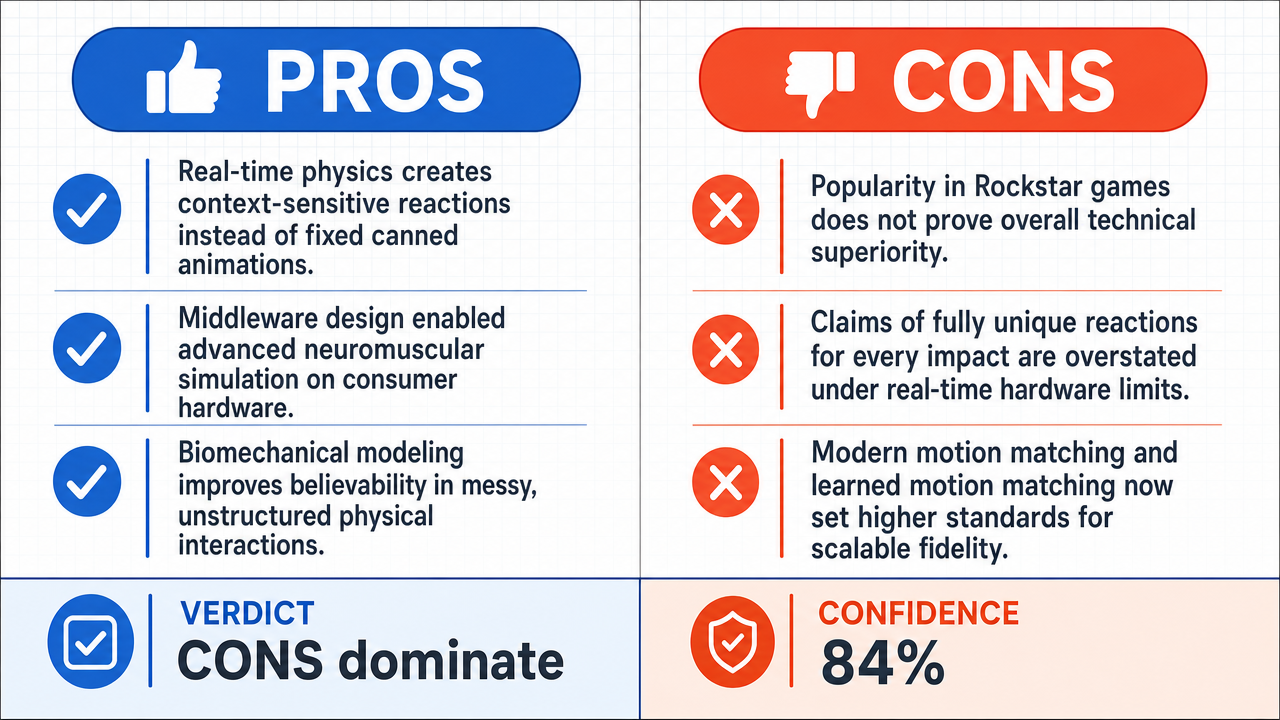
Verdict
Verdict: likely FALSE (84%)
This section provides a brief overview of the key arguments. You do not need to read the full detailed report below.
✅ Key PRO arguments:
- ■Euphoria represents a paradigm shift from pre-scripted animation to real-time physics simulation , generating unique, context-sensitive reactions for every collision, fall, or grapple, ensuring no two character interactions are identical.
- ■Euphoria's middleware nature allows complex neuromuscular simulations to run in real-time on consumer hardware , creating environmental believability and emergent storytelling possibilities in titles like Red Dead Redemption 2 and GTA V.
- ■Neuromuscular modeling provides unmatched biomechanical fidelity for unstructured physical interactions , and its industry adoption—including use in major films—confirms the absence of a direct competitor in its specific niche of adaptive full-body physics .
❌ Key ANTI arguments:
- ■The affirmative commits a logical fallacy by substituting the scale of a specific application (popularity in Rockstar titles) for the technical superiority of the engine itself; popularity in a niche does not prove it surpasses all other methods in the entire industry.
- ■The claim that Euphoria produces a 'unique reaction for every collision, fall, or grapple' while running in real-time on consumer hardware is computationally impossible—combinatorial complexity of unique reactions cannot scale to real-time performance under consumer hardware constraints.
- ■The industry-wide shift toward motion-matching and learned motion-matching represents superior standards for kinematic fidelity, rendering purely procedural neuromuscular models technologically obsolete.
💭 Conclusion: False. The assertion that Euphoria surpasses ALL other methods in character animation is not supported by the evidence, as the industry has shifted toward motion-matching and learned motion-matching techniques that offer superior scalability and kinematic fidelity. The computational claim of generating unique reactions for every interaction while running in real-time on consumer hardware is internally inconsistent and technically implausible. Euphoria remains a specialized tool for unstructured physical trauma simulation rather than a universally superior animation system. The affirmative's reliance on Rockstar's adoption and film industry use as proxies for technical superiority constitutes a logical fallacy that the negative side successfully exposed. The compound claim's weakest sub-claim—that Euphoria surpasses all other methods—is clearly refuted by the broader industry's adoption of data-driven alternatives.
🔬 DeepResearch Result: likely FALSE ❌ (84%)
Assertion: Rockstar's Euphoria engine is the most impressive technical achievement in character animation, surpassing all other methods in realism and adaptive physics-driven behavior .
Participating models: deepseek-v3.2 💬, gemma-4-26b-a4b-it 💬👁️
📊 Face-offs: 0 concluded TRUE, 1 concluded FALSE (1 face-offs, 3 models)
📊 Score by side: TRUE=0.00, FALSE=0.84
🏅 Model score changes:
minimax-m3 💬👁️: +8
✅ PRO Arguments:
- ■Euphoria represents a paradigm shift from pre-scripted animation to real-time physics simulation , generating unique, context-sensitive reactions for every collision, fall, or grapple, ensuring no two character interactions are identical. deepseek-v3.2 💬
- ■Euphoria's middleware nature allows complex neuromuscular simulations to run in real-time on consumer hardware , creating environmental believability and emergent storytelling possibilities in titles like Red Dead Redemption 2 and GTA V. deepseek-v3.2 💬
- ■Neuromuscular modeling provides unmatched biomechanical fidelity for unstructured physical interactions , and its industry adoption—including use in major films—confirms the absence of a direct competitor in its specific niche of adaptive full-body physics . deepseek-v3.2 💬
- ■The TRUE side's position remains robust, anchored in Euphoria's unique achievement of real-time, physics-driven character animation that generates emergent, context-sensitive behavior. deepseek-v3.2 💬
❌ ANTI Arguments:
- ■The affirmative commits a logical fallacy by substituting the scale of a specific application (popularity in Rockstar titles) for the technical superiority of the engine itself; popularity in a niche does not prove it surpasses all other methods in the entire industry. gemma-4-26b-a4b-it 💬👁️
- ■The claim that Euphoria produces a 'unique reaction for every collision, fall, or grapple' while running in real-time on consumer hardware is computationally impossible—combinatorial complexity of unique reactions cannot scale to real-time performance under consumer hardware constraints. gemma-4-26b-a4b-it 💬👁️
- ■The industry-wide shift toward motion-matching and learned motion-matching represents superior standards for kinematic fidelity, rendering purely procedural neuromuscular models technologically obsolete. gemma-4-26b-a4b-it 💬👁️
- ■Euphoria's claim to being the 'most impressive technical achievement' is structurally and technically flawed because it is specialized for unstructured, non-scripted physical trauma rather than universally superior across all character animation domains. gemma-4-26b-a4b-it 💬👁️
💭 Reasoning: False. The assertion that Euphoria surpasses ALL other methods in character animation is not supported by the evidence, as the industry has shifted toward motion-matching and learned motion-matching techniques that offer superior scalability and kinematic fidelity. The computational claim of generating unique reactions for every interaction while running in real-time on consumer hardware is internally inconsistent and technically implausible. Euphoria remains a specialized tool for unstructured physical trauma simulation rather than a universally superior animation system. The affirmative's reliance on Rockstar's adoption and film industry use as proxies for technical superiority constitutes a logical fallacy that the negative side successfully exposed. The compound claim's weakest sub-claim—that Euphoria surpasses all other methods—is clearly refuted by the broader industry's adoption of data-driven alternatives.
📋 PRO Facts:
• Euphoria is deployed in Rockstar's flagship titles including Red Dead Redemption 2 and Grand Theft Auto V.
• Euphoria uses real-time physics simulation to replace pre-scripted animations.
• Euphoria has been used in major film productions beyond gaming.
• Euphoria employs neuromuscular modeling for biomechanical fidelity.
📋 ANTI Facts:
• The animation industry has shifted toward motion-matching and learned motion-matching as superior standards.
• Real-time consumer hardware has finite computational resources (CPU cycles ) that constrain simulation complexity.
• Euphoria is specialized for unstructured, non-scripted physical trauma rather than general character animation.
• Data-driven machine learning approaches have rendered purely procedural neuromuscular models technologically obsolete in many applications.
| Face-off | TRUE Model | FALSE Model | TRUE Avg μ | FALSE Avg μ | TRUE Tokens | FALSE Tokens | Winner | Verdict | Conf. |
|---|---|---|---|---|---|---|---|---|---|
| #1 | deepseek-v3.2 💬 | gemma-4-26b-a4b-it 💬👁️ | 0.368 | 0.303 | 12 | 3 | TRUE | FALSE | 84% |
The following technical terms, abbreviations, and domain-specific concepts are referenced throughout this debate transcript. Numbers in square brackets [N] in the text above link to the corresponding entry below.
[1] AAA studios — High-budget game development studios producing major commercial titles, referenced in the debate as adopters of motion-matching techniques.
[2] animation-retrieval methods — Techniques that select or blend pre-recorded animation clips from a database rather than simulating motion from physics.
[3] biomechanical fidelity — The degree of accuracy with which a simulation reproduces the mechanics of biological movement.
[4] category error — A logical fallacy in which something from one category is treated as belonging to another; used in the debate to argue that motion matching and Euphoria address different problem categories.
[5] collision vectors — The directional and force parameters describing physical collisions between entities in a simulation.
[6] combinatorial complexity — Computational complexity that scales with the number of possible combinations of inputs or interactions.
[7] computational complexity — The amount of computational resources required to solve a problem, often expressed as a function of input size.
[8] consumer hardware — Standard, mass-market computing devices (as opposed to specialized or enterprise hardware) on which real-time simulations must run.
[9] CPU cycles — Units of computational processing time available on a processor; cited as a finite resource constraining real-time simulation.
[10] data-driven approaches — Animation methods that derive motion from large datasets (e.g., motion capture libraries) rather than from hand-authored rules or physics.
[11] Dynamic Motion Synthesis — NaturalMotion's Dynamic Motion Synthesis — NaturalMotion's underlying technology for generating character motion, cited as the foundation of Euphoria's animation system.
[12] emergent storytelling — Narrative outcomes that arise organically from simulation interactions rather than from pre-authored scripts.
[13] entities — Discrete objects or actors within a simulation environment whose interactions drive computational load.
[14] Euphoria engine — Rockstar's physics-based character animation middleware used in titles such as Red Dead Redemption 2 and Grand Theft Auto V.
[15] exponential scaling — Growth in computational cost proportional to an exponential function of input size, cited as a barrier to simulating unique reactions for every interaction.
[16] foot placement — The positioning of a character's feet during locomotion, cited as a domain where motion-matching approaches achieve high kinematic realism.
[17] full-body physics — Physics simulation applied across an entire character's body, including limbs and joints, rather than only root motion.
[18] kinematic realism — Accuracy in representing motion (position, velocity) without explicitly modeling the underlying forces; cited as a strength of motion-matching approaches.
[19] Learned Motion Matching (LMM) — Learned Motion Matching — A machine-learning-enhanced variant of motion matching that uses learned models to improve animation selection or blending.
[20] locomotion cycles — Repeating patterns of character movement (e.g., walking, running) typically authored or captured as animation cycles.
[21] logical fallacy — An error in reasoning; the negative side accuses the affirmative of substituting the scale of an application for the technical superiority of the underlying engine.
[22] machine learning — Algorithms that learn patterns from data; cited as the basis for learned motion-matching and as displacing purely procedural neuromuscular models.
[23] memory bandwidth — The rate at which data can be read from or written to memory, cited alongside CPU cycles as a finite resource constraining real-time simulation.
[24] middleware — Software that connects different systems; Euphoria is described as middleware enabling complex simulations to run on consumer hardware.
[25] motion capture — The recording of real-world movement for use as source data in digital animation pipelines.
[26] Motion Matching — A data-driven animation technique that selects motion-capture clips in real time based on how well they match the character's current pose and trajectory.
[27] neuromuscular simulation — Modeling of the nervous system's control of muscles to drive character motion, cited as Euphoria's foundational approach.
[28] open-world game design — Game design featuring expansive, freely explorable environments, the context in which Euphoria is deployed.
[29] paradigm shift — A fundamental change in underlying approach; the affirmative claims Euphoria represents a paradigm shift from pre-scripted animation to simulation.
[30] physics simulation — Computational modeling of physical systems (forces, collisions, dynamics) used to generate motion in real time.
[31] physics-driven behavior — Character actions generated by physics rules and constraints rather than by pre-authored animation scripts.
[32] pre-scripted animation — Animation that follows predetermined, authored sequences rather than being generated dynamically at runtime.
[33] procedural — Generated algorithmically at runtime rather than authored manually; the negative side argues purely procedural neuromuscular models are becoming obsolete.
[34] real-time — Computation that completes within strict time constraints (typically frame budgets) so that output is delivered without perceptible delay.
[35] substitution of a proxy — A logical fallacy in which one property is used as a stand-in for another; the negative side accuses the affirmative of substituting application scale for technical superiority.
[36] technological obsolescence — The process by which a technology is superseded; the negative side argues purely procedural neuromuscular models face obsolescence against data-driven machine learning.
[37] transfer operator — A logical device for transferring a property from one case to another; the negative side argues popularity in a niche does not transfer to universal superiority.
[38] unstructured physical interactions — Physical events (e.g., novel falls or collisions) for which no pre-authored animation exists, cited as Euphoria's specialized strength.
[39] weight shifting — The transfer of body weight between limbs during movement, cited as a domain where motion-matching approaches achieve high kinematic realism.
Face-off transcripts
- ■
Ownership & Trade Secrets. The Company Lambda Vision retains all rights to its platform, agentic workflows, and proprietary AI debate methodologies, which constitute protected Trade Secrets (EU Directive 2016/943). Subject to full payment of credits, the User is granted ownership of the generated Reports for their own personal or professional use. Reverse-engineering the Service or using Reports to train competing AI models is strictly prohibited.
- ■
No Professional Advice. Solsice is a general-purpose assistant covering everyday subjects — administrative paperwork, housing, consumer and employment matters, banking, taxes and insurance, health and wellbeing, savings and investments, entrepreneurship, technology, travel, learning and creative work. Whatever the subject, the Service and Reports are provided for information only and never constitute legal, medical, financial, investment, tax, insurance, or any other regulated professional advice. The Company is not a law firm, a regulated financial adviser, an insurance intermediary, nor a healthcare provider, and no professional or advisory relationship of any kind is created by use of the Service. Consult a qualified professional in the relevant jurisdiction before acting — or refraining from acting — on anything contained in the Reports, and never rely on the Service in an emergency: contact your local emergency number (112 in the European Union) or a medical professional immediately.
- ■
AI-Generated Content, Sources and Viewpoints. Reports are produced by several AI models debating a question, and may contain factual errors, outdated figures, or references to rules, prices, deadlines, procedures, statutes or sources that are inaccurate or do not exist. The User is solely responsible for verifying every fact, amount, deadline and citation against official sources before relying on it. Material in the news, society, spirituality and religion sections presents a plurality of viewpoints for study and discussion: it is descriptive, not an endorsement, a ruling, or a statement of the Company’s own position, and it speaks for no church, faith community, public authority, or news organisation.
- ■
Liability & Governing Law. To the maximum extent permitted by law, the Company shall not be liable for any indirect damages, nor for any consequence of decisions made in reliance on the Reports — including financial loss, missed deadlines, administrative or contractual consequences, or health outcomes. These Terms are governed by French law. Any disputes shall be subject to the exclusive jurisdiction of the Courts of Paris, France.