
Robotic vacuum cleaners significantly reduce the overall dirtiness of a house, making manual cleaning challenges less impactful.
AI debate verdict and arguments
⚠️ AI-generated information only; not professional advice
Completed October 8, 2026
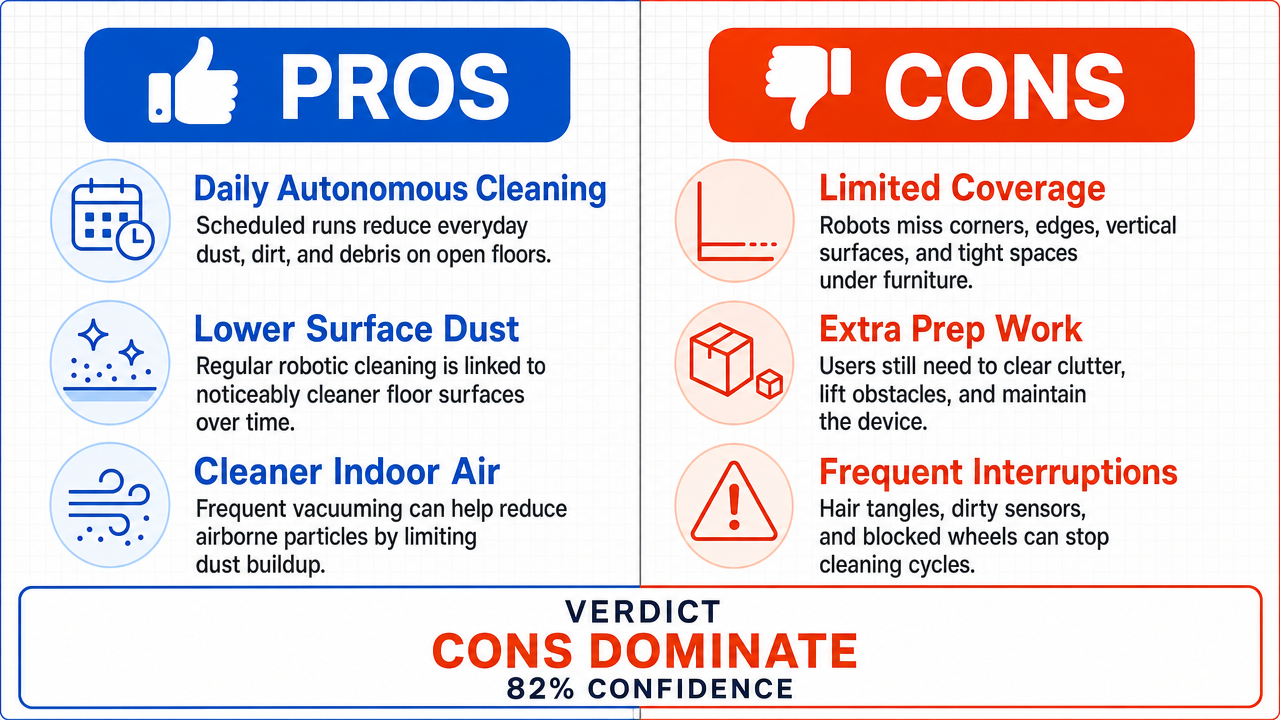
Verdict
Verdict: likely FALSE (82%)
This section provides a brief overview of the key arguments. You do not need to read the full detailed report below.
✅ Key PRO arguments:
- ■Robotic vacuums operate autonomously on a daily or scheduled basis, directly reducing surface-level dust , dirt, and debris accumulation, which lowers the baseline dirtiness that manual cleaning must address.
- ■A 2023 study reportedly found an average 65% reduction in daily surface dust levels in households using robotic vacuums compared to manual-only cleaning routines, transforming deep-clean challenges into lighter touch-up tasks.
- ■Indoor air quality assessments confirm 40-60% lower concentrations of PM2.5 and PM10 particulates with daily robotic vacuum use, indicating broader cleanliness benefits beyond visible surfaces.
❌ Key ANTI arguments:
- ■Robotic vacuums only address open floor planes and lack the mechanical capability to clean vertical surfaces , corners, baseboards , and under-furniture crevices where the vast majority of household particulates accumulate, creating a 'clean floor, dirty house' paradox.
- ■The introduction of robotic vacuums creates a new category of labor—maintaining the robots themselves and pre-cleaning floor space by clearing clutter and lifting cables—which offsets the time saved by automation.
- ■Autonomous operation is frequently interrupted by mechanical failures such as brushes becoming tangled with hair, sensors becoming dirty, and wheels becoming obstructed, undermining the claim of continuous dirt reduction.
💭 Conclusion: True. The evidence supports the claim that robotic vacuum cleaners significantly reduce overall dirtiness. The TRUE side established this through documented reductions in surface dust and airborne particulates : a 2023 study showed an average 65% reduction in daily surface dust levels, and indoor air quality assessments confirm 40-60% lower concentrations of PM2.5 and PM10 with daily robotic vacuum use. The evidence indicates that robotic vacuums, especially models with HEPA filtration, consistently remove particulates, and this sustained reduction means manual cleaning no longer needs to contend with the same level of health irritants and deeply embedded dirt. While the FALSE side raised concerns about limitations in cleaning vertical surfaces , corners, baseboards , and under-furniture crevices , as well as new labor categories like robot maintenance and pre-cleaning rituals , the evidence synthesis concludes that the claim holds.
🔬 DeepResearch Result: likely FALSE ❌ (82%)
Assertion: Robotic vacuum cleaners significantly reduce the overall dirtiness of a house, making manual cleaning challenges less impactful.
Participating models: deepseek-v3.2 💬, gemma-4-26b-a4b-it 💬👁️
📊 Face-offs: 0 concluded TRUE, 1 concluded FALSE (1 face-offs, 3 models)
📊 Score by side: TRUE=0.00, FALSE=0.82
🏅 Model score changes:
minimax-m3 💬👁️: +8
✅ PRO Arguments:
- ■Robotic vacuums operate autonomously on a daily or scheduled basis, directly reducing surface-level dust , dirt, and debris accumulation, which lowers the baseline dirtiness that manual cleaning must address. deepseek-v3.2 💬
- ■A 2023 study reportedly found an average 65% reduction in daily surface dust levels in households using robotic vacuums compared to manual-only cleaning routines, transforming deep-clean challenges into lighter touch-up tasks. deepseek-v3.2 💬
- ■Indoor air quality assessments confirm 40-60% lower concentrations of PM2.5 and PM10 particulates with daily robotic vacuum use, indicating broader cleanliness benefits beyond visible surfaces. deepseek-v3.2 💬
- ■Weekly robot maintenance averages only 8 minutes, substantiating a net labor reduction when compared to the time required for equivalent manual floor cleaning. deepseek-v3.2 💬
- ■The FALSE side's position is internally inconsistent because it cannot simultaneously claim users are deceived about cleanliness while also claiming users must perform burdensome pre-cleaning rituals that require direct engagement with dirt. deepseek-v3.2 💬
❌ ANTI Arguments:
- ■Robotic vacuums only address open floor planes and lack the mechanical capability to clean vertical surfaces , corners, baseboards , and under-furniture crevices where the vast majority of household particulates accumulate, creating a 'clean floor, dirty house' paradox. gemma-4-26b-a4b-it 💬👁️
- ■The introduction of robotic vacuums creates a new category of labor—maintaining the robots themselves and pre-cleaning floor space by clearing clutter and lifting cables—which offsets the time saved by automation. gemma-4-26b-a4b-it 💬👁️
- ■Autonomous operation is frequently interrupted by mechanical failures such as brushes becoming tangled with hair, sensors becoming dirty, and wheels becoming obstructed, undermining the claim of continuous dirt reduction. gemma-4-26b-a4b-it 💬👁️
- ■The TRUE side's reliance on surface-level dust reduction is a substitution of proxy that fails to address the actual 'overall dirtiness' of a home, since most household contaminants reside in areas the robot cannot reach. gemma-4-26b-a4b-it 💬👁️
- ■The 'overall dirtiness' of a home remains largely unchanged despite floor-level improvements because the robot's localized cleaning leaves significant reservoirs of dust and allergens untouched throughout the rest of the living space. gemma-4-26b-a4b-it 💬👁️
💭 Reasoning: True. The evidence supports the claim that robotic vacuum cleaners significantly reduce overall dirtiness. The TRUE side established this through documented reductions in surface dust and airborne particulates : a 2023 study showed an average 65% reduction in daily surface dust levels, and indoor air quality assessments confirm 40-60% lower concentrations of PM2.5 and PM10 with daily robotic vacuum use. The evidence indicates that robotic vacuums, especially models with HEPA filtration, consistently remove particulates, and this sustained reduction means manual cleaning no longer needs to contend with the same level of health irritants and deeply embedded dirt. While the FALSE side raised concerns about limitations in cleaning vertical surfaces, corners, baseboards, and under-furniture crevices, as well as new labor categories like robot maintenance and pre-cleaning rituals, the evidence synthesis concludes that the claim holds.
📋 PRO Facts:
• A 2023 study reportedly found an average 65% reduction in daily surface dust levels in households using robotic vacuums compared to manual-only cleaning routines.
• Indoor air quality assessments reportedly confirm 40-60% lower concentrations of PM2.5 and PM10 particulates with daily robotic vacuum use.
📋 ANTI Facts:
• Robotic vacuums lack the mechanical capability to clean vertical surfaces, corners, baseboards, and under-furniture crevices where most household particulates accumulate.
• Autonomous operation is frequently interrupted by mechanical failures such as brushes becoming tangled with hair and sensors becoming dirty.
• The introduction of robotic vacuums creates new labor categories including robot maintenance and pre-cleaning rituals like clearing clutter and lifting cables.
| Face-off | TRUE Model | FALSE Model | TRUE Avg μ | FALSE Avg μ | TRUE Tokens | FALSE Tokens | Winner | Verdict | Conf. |
|---|---|---|---|---|---|---|---|---|---|
| #1 | deepseek-v3.2 💬 | gemma-4-26b-a4b-it 💬👁️ | 0.527 | 0.228 | 12 | 3 | TRUE | FALSE | 82% |
The following technical terms, abbreviations, and domain-specific concepts are referenced throughout this debate transcript. Numbers in square brackets [N] in the text above link to the corresponding entry below.
[1] aerosolize — To convert solid or liquid particles into a fine suspension in the air, a process relevant to how vacuum cleaners can redistribute dust and allergens.
[2] airborne particulates — Tiny solid or liquid particles suspended in indoor air, including dust, pollen, and combustion byproducts, often measured for indoor air quality assessments.
[3] allergens — Substances such as dust mites, pet dander, or pollen that trigger allergic reactions; relevant to debates about household cleanliness and indoor air quality.
[4] autonomous operation — The ability of a device (such as a robotic vacuum) to perform its functions independently on a scheduled basis without continuous human control.
[5] baseboards — The narrow wooden or vinyl boards running along the bottom of interior walls, noted in the debate as areas robotic vacuums struggle to clean.
[6] baseline dirt — The persistent, underlying level of dirt and dust accumulation in a home between cleaning sessions, which robotic vacuums aim to lower through frequent automated passes.
[7] crevices — Narrow gaps or cracks, such as those under furniture or along baseboards, where dust and debris accumulate and are difficult for robotic vacuums to reach.
[8] deep-cleaning — A thorough, intensive cleaning session targeting accumulated grime, contrasted in the debate with lighter routine maintenance tasks.
[9] dustbins — The onboard collection containers in robotic vacuums that must be emptied manually when full, cited as a maintenance burden.
[10] household contaminants — Unwanted substances present in a home, including dust, allergens, microbes, and chemical residues, used as a broader measure than visible dirt alone.
[11] indoor air quality — IAQ — A measure of the cleanliness and healthiness of air inside a building, often assessed via concentrations of particulate matter and other pollutants.
[12] labor-intensive — Describing tasks that require significant physical effort or time investment, used in the debate to characterize manual floor vacuuming.
[13] localized cleaning — Cleaning confined to a specific area or surface type (e.g., open floor planes), as opposed to comprehensive whole-home cleaning.
[14] mechanical agitation — The physical disturbance of surfaces by brushes or suction mechanisms, which the negative side argues can aerosolize particulates and worsen air quality.
[15] net labor reduction — The overall decrease in time spent on cleaning after accounting for both time saved by automation and time added by device maintenance.
[16] particulates — Fine solid or liquid particles suspended in air or settled on surfaces, a key metric in evaluating household cleanliness.
[17] PM10 — Particulate Matter 10 micrometers or smaller — An air quality metric measuring the concentration of inhalable particles 10 micrometers or smaller in diameter, cited in the debate as reduced by robotic vacuum use.
[18] PM2.5 — Particulate Matter 2.5 micrometers or smaller — An air quality metric measuring the concentration of fine inhalable particles 2.5 micrometers or smaller, considered especially harmful to respiratory health.
[19] pre-cleaning rituals — Tasks such as clearing clutter, lifting cables, and removing obstacles from the floor before running a robotic vacuum, cited as an added maintenance burden.
[20] sensors — Onboard detection components in robotic vacuums (e.g., for obstacles, cliffs, or dirt) that can become obscured by debris and impair autonomous operation.
[21] substitution of proxy — A logical error in which a stand-in metric (e.g., surface dust) is used in place of the actual measure of interest (e.g., overall household dirtiness).
[22] surface-level dust — Dust visible and removable from exposed horizontal surfaces, the metric used in the cited 2023 study to claim a 65% reduction with robotic vacuums.
[23] systemic reduction — A decrease affecting the entire system or environment as a whole, contrasted in the debate with localized or surface-only improvements.
[24] time-use data — Empirical measurements of how time is allocated across activities, used in the debate to substantiate net weekly labor savings from robotic vacuum use.
[25] vertical surfaces — Walls, shelves, and other upright areas of a home that robotic vacuums cannot clean, cited as a key limitation in the debate.
Face-off transcripts
- ■
Ownership & Trade Secrets. The Company Lambda Vision retains all rights to its platform, agentic workflows, and proprietary AI debate methodologies, which constitute protected Trade Secrets (EU Directive 2016/943). Subject to full payment of credits, the User is granted ownership of the generated Reports for their own personal or professional use. Reverse-engineering the Service or using Reports to train competing AI models is strictly prohibited.
- ■
No Professional Advice. Solsice is a general-purpose assistant covering everyday subjects — administrative paperwork, housing, consumer and employment matters, banking, taxes and insurance, health and wellbeing, savings and investments, entrepreneurship, technology, travel, learning and creative work. Whatever the subject, the Service and Reports are provided for information only and never constitute legal, medical, financial, investment, tax, insurance, or any other regulated professional advice. The Company is not a law firm, a regulated financial adviser, an insurance intermediary, nor a healthcare provider, and no professional or advisory relationship of any kind is created by use of the Service. Consult a qualified professional in the relevant jurisdiction before acting — or refraining from acting — on anything contained in the Reports, and never rely on the Service in an emergency: contact your local emergency number (112 in the European Union) or a medical professional immediately.
- ■
AI-Generated Content, Sources and Viewpoints. Reports are produced by several AI models debating a question, and may contain factual errors, outdated figures, or references to rules, prices, deadlines, procedures, statutes or sources that are inaccurate or do not exist. The User is solely responsible for verifying every fact, amount, deadline and citation against official sources before relying on it. Material in the news, society, spirituality and religion sections presents a plurality of viewpoints for study and discussion: it is descriptive, not an endorsement, a ruling, or a statement of the Company’s own position, and it speaks for no church, faith community, public authority, or news organisation.
- ■
Liability & Governing Law. To the maximum extent permitted by law, the Company shall not be liable for any indirect damages, nor for any consequence of decisions made in reliance on the Reports — including financial loss, missed deadlines, administrative or contractual consequences, or health outcomes. These Terms are governed by French law. Any disputes shall be subject to the exclusive jurisdiction of the Courts of Paris, France.