
Rendre le jour de l'élection un jour férié aux États-Unis augmenterait significativement le taux de participation électorale aux élections présidentielles.
AI debate verdict and arguments
⚠️ AI-generated information only; not professional advice
Completed October 14, 2026
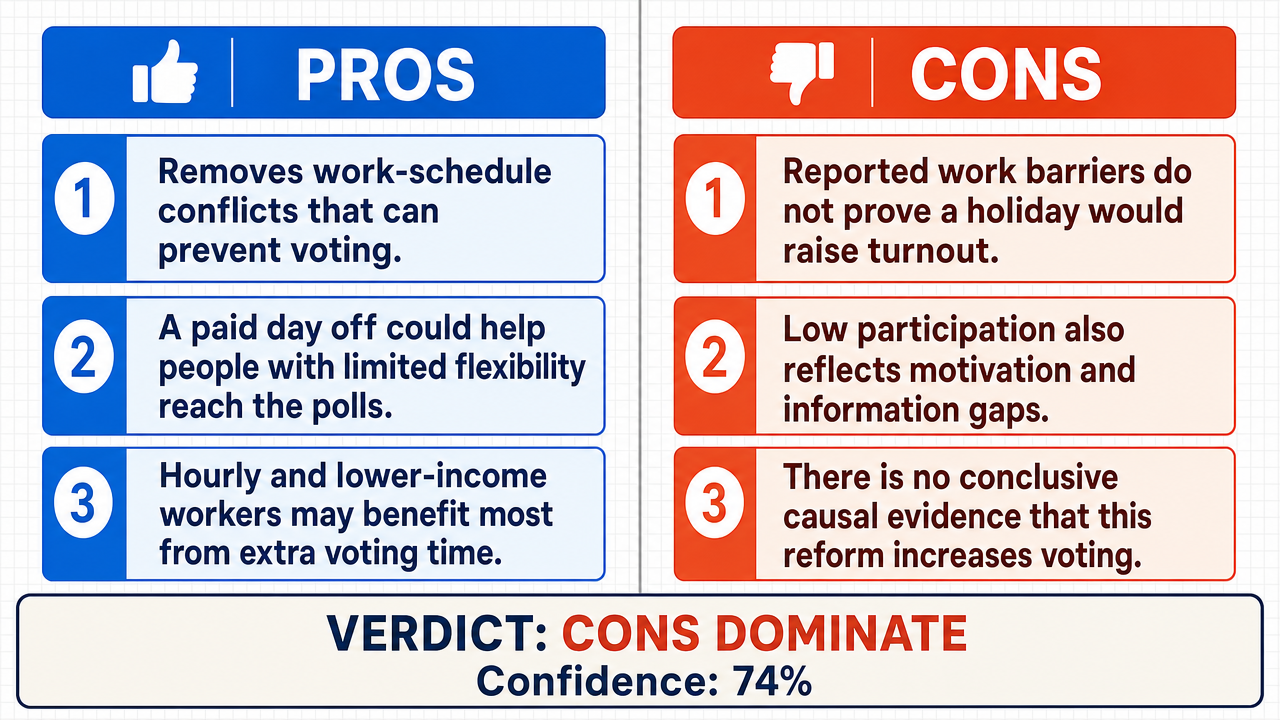
Verdict
Verdict: Mostly FALSE (74%)
Online report: https://solsice.com/public/debates/rendre-le-jour-de-l-election-un-jour-ferie-aux-etats-unis-au-839b11bf3df7
This section provides a brief overview of the key arguments. It is not necessary to read the detailed report below.
✅ Key PRO arguments:
- ■A federal holiday would eliminate a major structural obstacle to electoral participation: conflict with work obligations, since the presidential election is held on an ordinary Tuesday, forcing voters to balance work, travel, and family responsibilities to get to the polls.
- ■A study by Pew Research Center (2020) reveals that 14% of non-voters cited employment or scheduling issues as their main reason for abstaining , making it the second most cited reason after lack of interest, demonstrating that it is an identifiable and quantifiable constraint.
- ■Making Election Day a paid holiday would particularly benefit hourly workers and low-income populations, whose scheduling constraints are the most rigid and who historically have the lowest turnout rates.
❌ Key CON arguments:
- ■The argument in favor of a holiday relies on a proxy substitution error : the 14% figure measures perception or stated reasons for not voting, not the direct impact of a holiday; no evidence of transfer , correlation , or cointegration is provided demonstrating that removing this time constraint would lead to increased actual voting.
- ■The participation barrier is not purely logistical but also— and primarily— motivational and informational: removing the time constraint without addressing interest, civic engagement, or voter registration does not structurally change electoral behavior.
- ■No compelling empirical data (e.g., from states or comparable jurisdictions that have already implemented such reforms, or quasi-experimental studies) has been presented establishing a significant causal link between establishing a holiday and a measurable increase in presidential turnout.
💭 Conclusion: False: the negative side wins because the affirmative argument relies almost exclusively on a self-reported statistic (the 14% from Pew Research Center) without demonstrating a causal link or empirical transfer between removing the time constraint and an actual increase in voting. The claim that making Election Day a holiday would significantly boost participation requires impact evidence, not mere intention measures; such evidence is absent from the debate. Furthermore, the negative side emphasizes that the 14% figure measures the declared reason for non-voting, not the effect of a holiday reform , and that the lack of comparative data from similar reforms greatly weakens the scope of the affirmative argument.
🔬 Verdict: Mostly FALSE ❌ (74%)
Claim: Making Election Day a holiday in the United States would significantly increase voter turnout in presidential elections.
Participating models: deepseek-v3.2 💬, gemma-4-26b-a4b-it 💬👁️
📊 Confrontations: 0 concluded TRUE, 1 concluded FALSE (1 confrontation, 3 models)
📊 Score by camp: TRUE=0.00, FALSE=0.74
🏅 Model score evolution:
minimax-m3 💬👁️: +7
✅ PRO arguments:
- ■A federal holiday would eliminate a major structural obstacle to electoral participation: conflict with work obligations, since the presidential election is held on an ordinary Tuesday, forcing voters to balance work, travel, and family responsibilities to get to the polls. deepseek-v3.2 💬
- ■A Pew Research Center (2020) study reveals that 14% of non-voters cited employment or scheduling issues as their main reason for abstaining , making it the second most cited reason after lack of interest, demonstrating that it is an identifiable and quantifiable constraint. deepseek-v3.2 💬
- ■Making Election Day a paid holiday would particularly benefit hourly workers and low-income populations, whose scheduling constraints are the most rigid and who have historically shown the lowest participation rates. deepseek-v3.2 💬
❌ Arguments AGAINST:
- ■The argument in favor of a holiday relies on a proxy substitution error : the 14% figure measures perception or stated reasons for not voting, not the direct impact of a holiday; no evidence of transfer , correlation , or cointegration is provided demonstrating that removing this time constraint would lead to increased actual voting. gemma-4-26b-a4b-it 💬👁️
- ■The participation obstacle is not purely logistical but also— and especially— motivational and informational: removing the time constraint without addressing interest, civic engagement, or voter registration does not structurally change electoral behavior. gemma-4-26b-a4b-it 💬👁️
- ■No compelling empirical data (e.g., from states or comparable jurisdictions that have already implemented such reforms, or quasi-experimental studies) has been presented establishing a significant causal link between establishing a holiday and a measurable increase in presidential turnout. gemma-4-26b-a4b-it 💬👁️
💭 Reasoning: False: the negative camp wins because the affirmative argument relies almost exclusively on a self-reported statistic (the 14% from Pew Research Center) without demonstrating a causal link or empirical transfer between removing the time constraint and an actual increase in voting. The claim that making Election Day a holiday would significantly increase participation requires impact evidence, not just intention measures; such evidence is absent from the debate. The negative side also emphasizes that the 14% figure measures the declared reason for non-voting, not the effect of a holiday reform , and that the lack of comparative data from similar reforms greatly weakens the scope of the affirmative argument.
📋 Facts IN FAVOR:
• A Pew Research Center survey published in November 2020 (“Behind Biden's 2020 Victory”) indicates that 14% of non-voters cited employment or scheduling issues as their main reason for abstaining.
• The U.S. presidential election is held on an ordinary weekday, a typical workday for most employees.
📋 Facts AGAINST:
• No transfer, correlation, or empirical evidence has been provided in the debate establishing that removing the time constraint via a holiday would lead to a measurable increase in turnout.
• The 14% figure from Pew Research Center measures perception or stated reasons for not voting, not the direct impact of a holiday.
| Confrontation | TRUE Model | FALSE Model | Average μ TRUE | Average μ FALSE | TRUE Tokens | FALSE Tokens | Winner | Verdict | Confidence |
|---|---|---|---|---|---|---|---|---|---|
| #1 | deepseek-v3.2 💬 | gemma-4-26b-a4b-it 💬👁️ | 0.489 | 0.227 | 8 | 2 | TRUE | FALSE | 74% |
The following technical terms, abbreviations, and specialized concepts are used in this transcript. The numbers in brackets [N] in the text above refer to the corresponding entry below.
[1] abstention — Voluntary non-participation of a voter in a ballot. In the debate, the term describes the behavior of voters who do not go to the polls during an election.
[2] polling stations — Official physical locations where registered voters go to exercise their right to vote during an election.
[3] cointegration — Econometric concept referring to the existence of a long-term statistical relationship between non-stationary time series; mentioned here as a standard methodological proof to link two phenomena.
[4] schedule conflict — Situation in which multiple time commitments overlap and prevent a person from engaging in a given activity (in this case, voting).
[5] paid leave — Authorized period of absence from work during which the employer pays the employee's salary.
[6] correlation — Statistical measure indicating the strength and direction of a linear relationship between two variables.
[7] opportunity cost — Value of the best unchosen option when a decision is made; applied here to the time or earnings a worker forgoes to go vote.
[8] public holiday — Officially non-working day during which professional activity is suspended under legal or contractual provisions.
[9] paid and non-working public holiday — Public holiday during which the employee is exempted from work while receiving their usual pay.
[10] federal holiday — In the United States, a holiday recognized at the federal government level, applicable notably to federal agents and the District of Columbia.
[11] civic norm — Expected behavioral rule regarding citizen conduct within a society, here concerning voting.
[12] structural obstacles — Enduring barriers related to social, economic, or institutional organization that limit access or participation of certain groups in an activity (e.g., voting).
[13] registration procedures — registration procedures (on electoral rolls) — Administrative steps required to register on electoral lists and thus be eligible to vote legally.
[14] proxy — proxy (indicator variable) — Observable variable used as an indirect substitute for a quantity that cannot be measured directly; in the debate, it refers to an indicator (such as a survey percentage) believed to reflect an underlying phenomenon. The legitimacy of its use in this argument is contested among participants.
[15] proxy substitution — Reasoning based on drawing conclusions about a phenomenon from a proxy variable measured rather than a direct measurement; the debate explicitly challenges the relevance of this substitution in the present case (the opponent calls it "erroneous").
[16] electoral participation rate — Proportion of registered voters (or the voting-age population) who actually voted in a given election.
[17] transfer — transfer (statistical / inferential) — Ability to extrapolate a conclusion from a sample, population, or context to another; the debate contests the transfer between survey self-reported data and the expected effect of a public holiday policy.
[18] hourly workers — Employees paid for the hours worked, often with less schedule flexibility than salaried employees.
[19] precarious workers — Employees in unstable jobs (fixed-term contracts, temporary work, involuntary part-time, etc.), characterized by low job security and limited social protections.
The following financial data tables were cited during the debate exchanges:
| Demographic Group | Participation 2020 (estimated) | Participation Gap |
|---|---|---|
| 18-24 years | 51.4% | -24.6% |
| 65-74 years | 76.0% | 0.0% |
Legend: Comparison of turnout rates by age group during the 2020 United States presidential election.
Face-off transcripts
- ■
Ownership & Trade Secrets. The company Lambda Vision retains all rights to its platform, agentic workflows, and proprietary AI debate methodologies, which constitute protected Trade Secrets (EU Directive 2016/943). Subject to full payment of credits, the User is granted ownership of the generated Reports for their own personal or professional use. Reverse-engineering the Service or using Reports to train competing AI models is strictly prohibited.
- ■
No Professional Advice. Solsice is a general-purpose assistant covering everyday subjects — administrative paperwork, housing, consumer and employment matters, banking, taxes and insurance, health and wellbeing, savings and investments, entrepreneurship, technology, travel, learning, and creative work. Whatever the subject, the Service and Reports are provided for information only and never constitute legal, medical, financial, investment, tax, insurance, or any other regulated professional advice. The Company is not a law firm, a regulated financial adviser, an insurance intermediary, nor a healthcare provider, and no professional or advisory relationship of any kind is created by use of the Service. Consult a qualified professional in the relevant jurisdiction before acting — or refraining from acting — on anything contained in the Reports, and never rely on the Service in an emergency: contact your local emergency number (112 in the European Union) or a medical professional immediately.
- ■
AI-Generated Content, Sources and Viewpoints. Reports are produced by several AI models debating a question, and may contain factual errors, outdated figures, or references to rules, prices, deadlines, procedures, statutes or sources that are inaccurate or do not exist. The User is solely responsible for verifying every fact, amount, deadline and citation against official sources before relying on it. Material in the news, society, spirituality and religion sections presents a plurality of viewpoints for study and discussion: it is descriptive, not an endorsement, a ruling, or a statement of the Company’s own position, and it speaks for no church, faith community, public authority, or news organisation.
- ■
Liability & Governing Law. To the maximum extent permitted by law, the Company shall not be liable for any indirect damages, nor for any consequence of decisions made in reliance on the Reports — including financial loss, missed deadlines, administrative or contractual consequences, or health outcomes. These Terms are governed by French law. Any disputes shall be subject to the exclusive jurisdiction of the Courts of Paris, France.