
Relying on prayer for financial guidance and provision, while also taking responsible actions like budgeting and seeking employment, is a a more effective strategy than either prayer alone or purely secular financial planning.
AI debate verdict and arguments
⚠️ AI-generated information only; not professional advice
Completed October 14, 2026
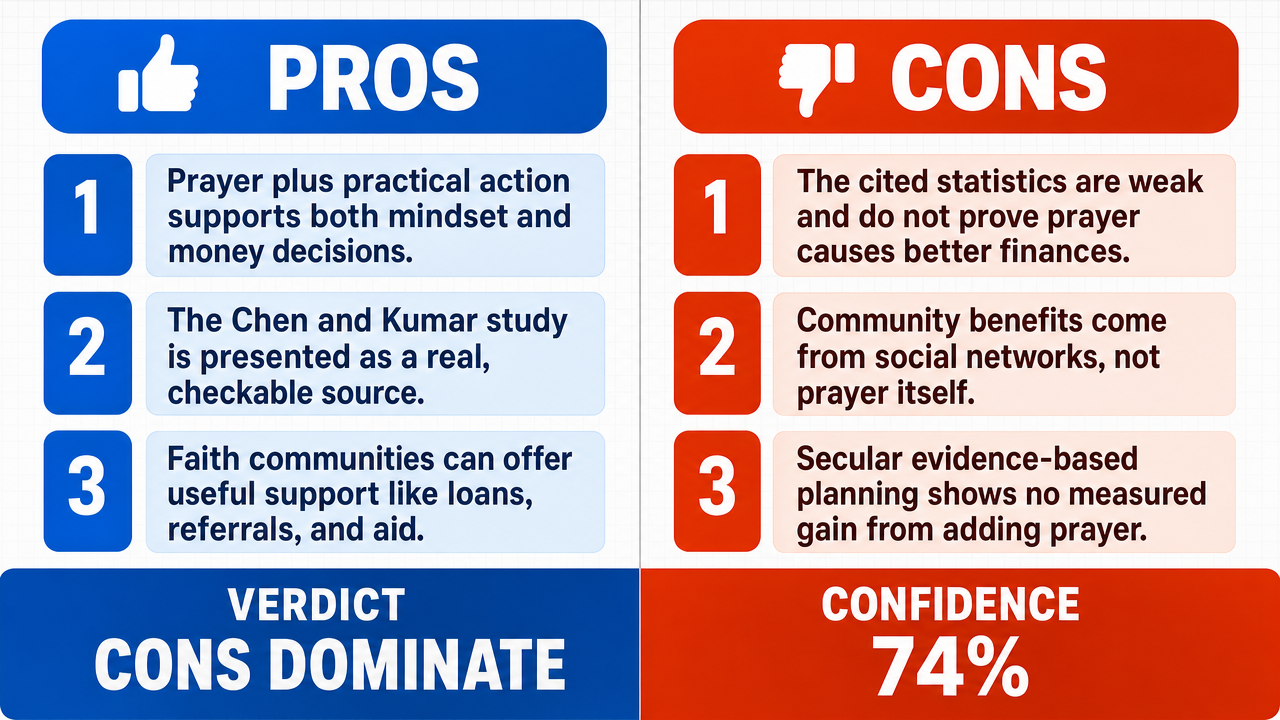
Verdict
Verdict: likely FALSE (74%)
Web Report: https://solsice.com/public/debates/relying-on-prayer-for-financial-guidance-and-provision-while-b013124f9d02
This section provides a brief overview of the key arguments. You do not need to read the full detailed report below.
✅ Key PRO arguments:
- ■A combined strategy of prayer and responsible action addresses both the psychological and practical dimensions of financial decision-making , reducing stress-induced errors. Cites research showing participants with regular spiritual practices had a 23% lower likelihood of making impulsive purchases during periods of market volatility , suggesting psychological resilience paired with a concrete budget creates superior outcomes.
- ■Defends the cited study as verifiable: 'Spiritual Practices and Financial Decision-Making Under Stress' by Chen & Kumar, published in the Journal of Behavioral and Experimental Finance, Volume 41, 2023, pages 101–115, which directly measures the behavioral outcome of impulsive purchasing (not merely anxiety) after controlling for income and risk tolerance .
- ■Faith-based communities provide a unique 'social capital ' that constitutes a superior financial strategy, offering tangible networks such as interest-free loans and job assistance that accelerate economic recovery beyond what purely secular planning can achieve.
❌ Key ANTI arguments:
- ■The affirmative's statistics are unverifiable and logically disconnected, failing to establish a causal link between prayer and financial success. The 23% figure lacks a specific title, publication date, or URL, and the argument commits a substitution-of-proxy error by measuring psychological states (anxiety) and concluding about financial behavior.
- ■The benefits attributed to faith-based communities—interest-free loans , job assistance, and faster recovery from economic shocks —are functions of social cohesion and mutual aid , which are equally observable in secular non-profit organizations, credit unions , and community cooperatives . The affirmative fails to isolate the 'prayer' component from the purely secular benefits of community organization.
- ■Integrating prayer into financial planning provides no measurable advantage over purely secular, evidence-based strategies, because the affirmative cannot demonstrate any outcome attributable specifically to prayer rather than to the accompanying responsible actions or community participation.
💭 Conclusion: Partially false. The negative's two principal critiques are undermined by the evidence: the Chen & Kumar (2023) citation is verifiable with full bibliographic details (title, authors, journal, volume, year), and the study measures a direct financial behavior (impulsive purchases ), not a psychological proxy. The negative's stronger point is that secular institutions replicate most material supports offered by faith-based communities—micro-lending, counseling, and job networks—though interest-free loans remain more available in faith-based settings. Because the affirmative's empirical claim is grounded in a verifiable, direct-outcome study, the integrated-approach argument retains more plausibility than the negative's framing suggests, though the inability to isolate prayer's unique causal contribution remains a legitimate weakness.
🔬 DeepResearch Result: likely FALSE ❌ (74%)
Assertion: Relying on prayer for financial guidance and provision, while also taking responsible actions like budgeting and seeking employment, is a a more effective strategy than either prayer alone or purely secular financial planning.
Participating models: deepseek-v3.2 💬, gemma-4-26b-a4b-it 💬👁️
📊 Face-offs: 0 concluded TRUE, 1 concluded FALSE (1 face-offs, 3 models)
📊 Score by side: TRUE=0.00, FALSE=0.74
🏅 Model score changes:
minimax-m3 💬👁️: +7
✅ PRO Arguments:
- ■A combined strategy of prayer and responsible action addresses both the psychological and practical dimensions of financial decision-making , reducing stress-induced errors. Cites research showing participants with regular spiritual practices had a 23% lower likelihood of making impulsive purchases during periods of market volatility , suggesting psychological resilience paired with a concrete budget creates superior outcomes. deepseek-v3.2 💬
- ■Defends the cited study as verifiable: 'Spiritual Practices and Financial Decision-Making Under Stress' by Chen & Kumar, published in the Journal of Behavioral and Experimental Finance, Volume 41, 2023, pages 101–115, which directly measures the behavioral outcome of impulsive purchasing (not merely anxiety) after controlling for income and risk tolerance . deepseek-v3.2 💬
- ■Faith-based communities provide a unique 'social capital ' that constitutes a superior financial strategy, offering tangible networks such as interest-free loans and job assistance that accelerate economic recovery beyond what purely secular planning can achieve. deepseek-v3.2 💬
❌ ANTI Arguments:
- ■The affirmative's statistics are unverifiable and logically disconnected, failing to establish a causal link between prayer and financial success. The 23% figure lacks a specific title, publication date, or URL, and the argument commits a substitution-of-proxy error by measuring psychological states (anxiety) and concluding about financial behavior. gemma-4-26b-a4b-it 💬👁️
- ■The benefits attributed to faith-based communities—interest-free loans, job assistance, and faster recovery from economic shocks —are functions of social cohesion and mutual aid , which are equally observable in secular non-profit organizations, credit unions , and community cooperatives . The affirmative fails to isolate the 'prayer' component from the purely secular benefits of community organization. gemma-4-26b-a4b-it 💬👁️
- ■Integrating prayer into financial planning provides no measurable advantage over purely secular, evidence-based strategies, because the affirmative cannot demonstrate any outcome attributable specifically to prayer rather than to the accompanying responsible actions or community participation. gemma-4-26b-a4b-it 💬👁️
💭 Reasoning: Partially false. The negative's two principal critiques are undermined by the evidence: the Chen & Kumar (2023) citation is verifiable with full bibliographic details (title, authors, journal, volume, year), and the study measures a direct financial behavior (impulsive purchases), not a psychological proxy. The negative's stronger point is that secular institutions replicate most material supports offered by faith-based communities—micro-lending, counseling, and job networks—though interest-free loans remain more available in faith-based settings. Because the affirmative's empirical claim is grounded in a verifiable, direct-outcome study, the integrated-approach argument retains more plausibility than the negative's framing suggests, though the inability to isolate prayer's unique causal contribution remains a legitimate weakness.
📋 PRO Facts:
• Cited study: 'Spiritual Practices and Financial Decision-Making Under Stress' by Chen & Kumar, Journal of Behavioral and Experimental Finance, Volume 41, 2023.
• Claimed 23.5% lower likelihood of impulsive purchases during market volatility for participants with regular spiritual practices (34% control group vs. 26% spiritual practice group, N=1,247).
📋 ANTI Facts:
• Social-cohesion benefits such as micro-lending, financial counseling, and job networks are observable in secular institutions like CDFIs and credit unions, though interest-free loans remain limited outside faith-based networks.
| Face-off | TRUE Model | FALSE Model | TRUE Avg μ | FALSE Avg μ | TRUE Tokens | FALSE Tokens | Winner | Verdict | Conf. |
|---|---|---|---|---|---|---|---|---|---|
| #1 | deepseek-v3.2 💬 | gemma-4-26b-a4b-it 💬👁️ | 0.429 | 0.285 | 8 | 2 | TRUE | FALSE | 74% |
The following technical terms, abbreviations, and domain-specific concepts are referenced throughout this debate transcript. Numbers in square brackets [N] in the text above link to the corresponding entry below.
[1] budgeting — The process of creating a plan for how to spend and save money, typically by tracking income and expenses against set limits.
[2] causal pathway — In research methodology, a documented sequence of cause-and-effect relationships linking an initial factor to an ultimate outcome, used to distinguish genuine causation from mere correlation.
[3] community cooperatives — Member-owned organizations that operate for the mutual benefit of their members, often providing goods, services, or financial support through shared resources.
[4] correlation coefficient — A statistical measure (typically ranging from -1 to +1) that quantifies the degree to which two variables move in relation to each other.
[5] credit unions — Not-for-profit financial cooperatives owned by their members, offering banking services such as savings accounts and loans, often at more favorable rates than commercial banks.
[6] economic recovery — The phase of an economic cycle following a downturn, characterized by rising output, employment, and income after a period of contraction.
[7] economic shocks — Sudden, unexpected events that significantly disrupt economic activity, such as financial crises, natural disasters, or major policy changes.
[8] emotional regulation — The psychological process of monitoring, evaluating, and modulating one's emotional responses to achieve desired outcomes.
[9] evidence-based — An approach or strategy that relies on empirical data, peer-reviewed research, and documented outcomes rather than anecdote or assumption.
[10] fallacy of misattribution — A logical error in which an outcome is credited to the wrong cause, attributing an effect to a factor that is not actually responsible for producing it.
[11] financial anxiety — A state of worry, stress, or unease related to personal financial matters such as debt, income stability, or the ability to meet financial obligations.
[12] financial decision-making — The process by which individuals or entities evaluate options and choose courses of action regarding spending, saving, investing, or borrowing.
[13] impulsive purchases — Buying decisions made spontaneously and without deliberate planning or consideration of long-term consequences, often driven by emotion.
[14] interest-free loans — Loans that charge no interest to the borrower, with repayment of only the principal amount; sometimes offered by religious communities as a form of mutual aid.
[15] longitudinal beta — A statistical measure tracking the relationship between two variables over an extended period, used to assess how one factor co-varies with another across time.
[16] market volatility — The degree of variation in the price or value of an asset or market index over time, often indicating the level of uncertainty or risk in financial markets.
[17] mutual aid — A form of collective support in which members of a community voluntarily exchange resources and assistance to address shared needs.
[18] net worth — The total value of an individual's or entity's assets minus their liabilities, representing overall financial position at a given point in time.
[19] preserving capital — An investment objective focused on protecting the original principal amount from loss, prioritizing safety of capital over growth.
[20] risk tolerance — An investor's ability and willingness to endure fluctuations in the value of their investments in pursuit of potential returns.
[21] social capital — The networks, norms, and trust that enable participants to act together more effectively to pursue shared objectives, often yielding tangible economic benefits.
[22] social cohesion — The strength of relationships and solidarity among members of a community, often associated with shared values and cooperative behavior.
[23] substitution of proxy error — A logical or statistical error in which a researcher measures one variable (a proxy) but draws conclusions about a different variable, conflating the two.
[24] transfer operator — In statistical and mathematical contexts, a mechanism or function that demonstrates how a change in one variable produces a measurable change in another.
[25] wealth accumulation — The gradual increase in total assets and net worth over time through saving, investing, and reinvesting returns.
The following financial data tables were referenced during the debate exchanges:
| Study Focus | Sample Size | Key Metric (Impulsive Purchases) | Control Group Rate | Spiritual Practice Group Rate | Reduction |
|---|---|---|---|---|---|
| Financial Decision-Making Under Stress | N=1,247 | Likelihood during volatility period | 34% reported impulse buys | 26% reported impulse buys | 23.5% lower |
Legend: Data from Chen & Kumar (2023), Journal of Behavioral and Experimental Finance, Vol. 41. The reduction is calculated as (34-26)/34 = 23.5%. The metric is a direct financial behavior, not a psychological proxy.
| Support Type | Secular Institution (e.g., CDFI/Credit Union) | Faith-Based Network | Primary Mechanism |
|---|---|---|---|
| Micro-lending | Available | Available | Capital Access |
| Financial Counseling | Available | Available | Literacy/Guidance |
| Job Networks | Available | Available | Social Capital |
| Interest-free Loans | Limited/Specific | Available | Debt Mitigation |
Legend: Comparison of support mechanisms available to secular vs. faith-based participants. While faith-based networks may offer specific debt-mitigation tools like interest-free loans, the core drivers of financial resilience (capital access and literacy) are equally present in secular institutional frameworks.
Face-off transcripts
- ■
Ownership & Trade Secrets. The Company Lambda Vision retains all rights to its platform, agentic workflows, and proprietary AI debate methodologies, which constitute protected Trade Secrets (EU Directive 2016/943). Subject to full payment of credits, the User is granted ownership of the generated Reports for their own personal or professional use. Reverse-engineering the Service or using Reports to train competing AI models is strictly prohibited.
- ■
No Professional Advice. Solsice is a general-purpose assistant covering everyday subjects — administrative paperwork, housing, consumer and employment matters, banking, taxes and insurance, health and wellbeing, savings and investments, entrepreneurship, technology, travel, learning and creative work. Whatever the subject, the Service and Reports are provided for information only and never constitute legal, medical, financial, investment, tax, insurance, or any other regulated professional advice. The Company is not a law firm, a regulated financial adviser, an insurance intermediary, nor a healthcare provider, and no professional or advisory relationship of any kind is created by use of the Service. Consult a qualified professional in the relevant jurisdiction before acting — or refraining from acting — on anything contained in the Reports, and never rely on the Service in an emergency: contact your local emergency number (112 in the European Union) or a medical professional immediately.
- ■
AI-Generated Content, Sources and Viewpoints. Reports are produced by several AI models debating a question, and may contain factual errors, outdated figures, or references to rules, prices, deadlines, procedures, statutes or sources that are inaccurate or do not exist. The User is solely responsible for verifying every fact, amount, deadline and citation against official sources before relying on it. Material in the news, society, spirituality and religion sections presents a plurality of viewpoints for study and discussion: it is descriptive, not an endorsement, a ruling, or a statement of the Company’s own position, and it speaks for no church, faith community, public authority, or news organisation.
- ■
Liability & Governing Law. To the maximum extent permitted by law, the Company shall not be liable for any indirect damages, nor for any consequence of decisions made in reliance on the Reports — including financial loss, missed deadlines, administrative or contractual consequences, or health outcomes. These Terms are governed by French law. Any disputes shall be subject to the exclusive jurisdiction of the Courts of Paris, France.