
Regularly vacuuming fire alarms is a necessary step to prevent false alarms.
AI debate verdict and arguments
⚠️ AI-generated information only; not professional advice
Completed October 8, 2026
Verdict
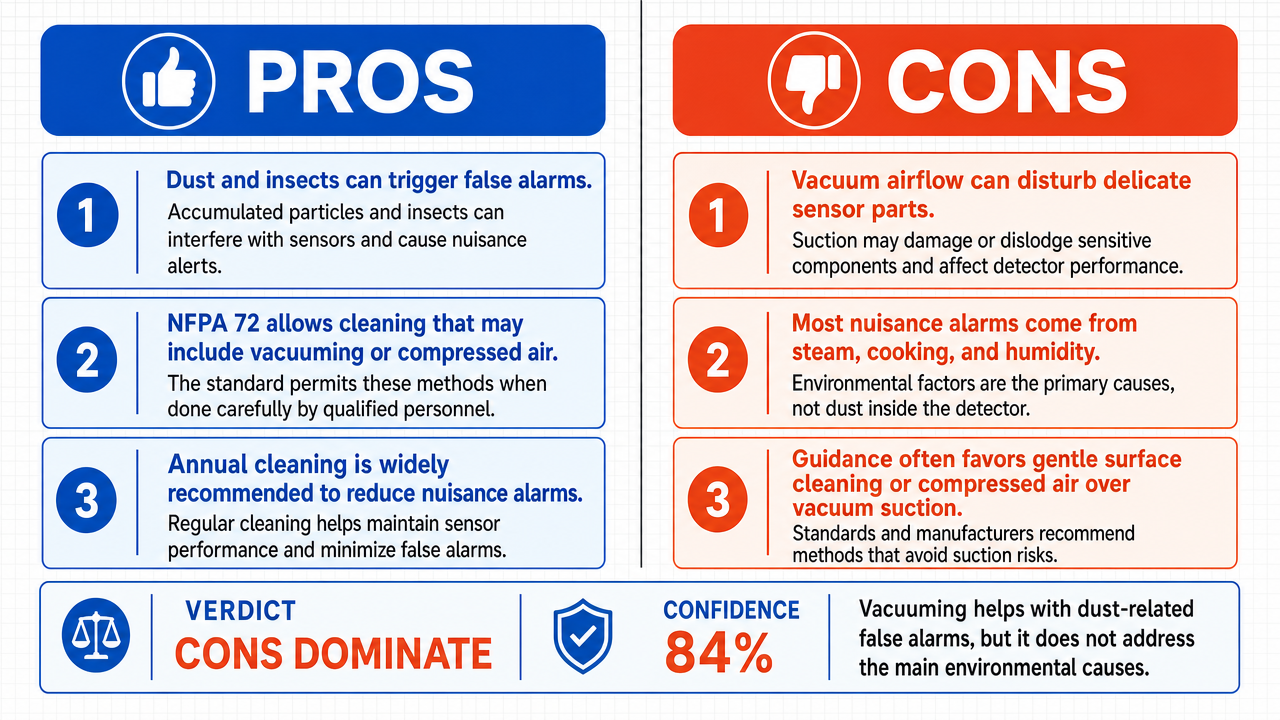
Verdict: likely FALSE (84%)
This section provides a brief overview of the key arguments. You do not need to read the full detailed report below.
✅ Key PRO arguments:
- ■Dust and insect accumulation inside the sensor chamber is a primary preventable trigger for false alarms in both photoelectric and ionization smoke detectors , and vacuuming with a brush attachment directly removes this particulate contamination.
- ■NFPA 72 (Section 14.4.3.2, 2022 Edition) explicitly states that smoke detector cleaning 'may include vacuuming or using compressed air ,' directly supporting vacuuming as an accepted maintenance method.
- ■Leading manufacturers and the National Fire Protection Association recommend annual cleaning of smoke detectors to prevent nuisance alarms caused by dust accumulation.
❌ Key ANTI arguments:
- ■Vacuuming introduces high-velocity airflow and mechanical friction into the sensitive sensing chamber, which can dislodge internal components, strip delicate coatings from the ionization source, or force particulate matter deeper into crevices, causing permanent sensor damage.
- ■The majority of false alarms are driven by environmental factors such as steam, cooking aerosols , and humidity—none of which vacuuming can address—making it logically inconsistent to characterize vacuuming as a 'necessary' step.
- ■Professional fire safety standards emphasize gentle removal of surface dust with a soft cloth or compressed air rather than the aggressive suction of a vacuum, undermining the claim that vacuuming is the recommended approach.
💭 Conclusion: False. The opposition demonstrated that vacuuming addresses only a subset of false alarm causes—particulate contamination from dust and insects—while the majority of nuisance alarms are triggered by environmental factors like steam, cooking aerosols , and humidity that vacuuming cannot mitigate. The affirmative's claim of 'necessity' was undermined by its own concession that dust is merely a contributing factor among many. The compound claim requires both that vacuuming prevents false alarms AND that it is necessary; the first part is partially supported, but the necessity claim is not established given the broader range of false alarm causes.
🔬 DeepResearch Result: likely FALSE ❌ (84%)
Assertion: Regularly vacuuming fire alarms is a necessary step to prevent false alarms .
Participating models: deepseek-v3.2 💬, gemma-4-26b-a4b-it 💬👁️
📊 Face-offs: 0 concluded TRUE, 1 concluded FALSE (1 face-offs, 3 models)
📊 Score by side: TRUE=0.00, FALSE=0.84
🏅 Model score changes:
minimax-m3 💬👁️: +8
✅ PRO Arguments:
- ■Dust and insect accumulation inside the sensor chamber is a primary preventable trigger for false alarms in both photoelectric and ionization smoke detectors , and vacuuming with a brush attachment directly removes this particulate contamination. deepseek-v3.2 💬
- ■NFPA 72 (Section 14.4.3.2, 2022 Edition) explicitly states that smoke detector cleaning 'may include vacuuming or using compressed air ,' directly supporting vacuuming as an accepted maintenance method. deepseek-v3.2 💬
- ■Leading manufacturers and the National Fire Protection Association recommend annual cleaning of smoke detectors to prevent nuisance alarms caused by dust accumulation. deepseek-v3.2 💬
- ■Vacuuming addresses the most common preventable trigger of false alarms, making it a necessary component of routine fire alarm maintenance. deepseek-v3.2 💬
❌ ANTI Arguments:
- ■Vacuuming introduces high-velocity airflow and mechanical friction into the sensitive sensing chamber, which can dislodge internal components, strip delicate coatings from the ionization source, or force particulate matter deeper into crevices, causing permanent sensor damage. gemma-4-26b-a4b-it 💬👁️
- ■The majority of false alarms are driven by environmental factors such as steam, cooking aerosols , and humidity—none of which vacuuming can address—making it logically inconsistent to characterize vacuuming as a 'necessary' step. gemma-4-26b-a4b-it 💬👁️
- ■Professional fire safety standards emphasize gentle removal of surface dust with a soft cloth or compressed air rather than the aggressive suction of a vacuum, undermining the claim that vacuuming is the recommended approach. gemma-4-26b-a4b-it 💬👁️
- ■The affirmative's position is internally contradictory: it calls vacuuming 'essential' while simultaneously acknowledging dust is only 'a contributing factor' in a subset of cases, meaning vacuuming cannot be truly necessary for reducing false alarms overall. gemma-4-26b-a4b-it 💬👁️
💭 Reasoning: False. The opposition demonstrated that vacuuming addresses only a subset of false alarm causes—particulate contamination from dust and insects—while the majority of nuisance alarms are triggered by environmental factors like steam, cooking aerosols, and humidity that vacuuming cannot mitigate. The affirmative's claim of 'necessity' was undermined by its own concession that dust is merely a contributing factor among many. The compound claim requires both that vacuuming prevents false alarms AND that it is necessary; the first part is partially supported, but the necessity claim is not established given the broader range of false alarm causes.
📋 PRO Facts:
• Dust and debris accumulation is a contributing factor in approximately 30% of investigated residential false alarm cases.
• Poor maintenance of smoke detectors is linked to detector malfunctions and non-emergency responses.
📋 ANTI Facts:
• The majority of false alarms are triggered by environmental factors such as steam from bathrooms, cooking aerosols, and humidity, not particulate contamination.
• The affirmative's 30% statistic lacks traceability—no specific locator, title, or publication date was provided.
| Face-off | TRUE Model | FALSE Model | TRUE Avg μ | FALSE Avg μ | TRUE Tokens | FALSE Tokens | Winner | Verdict | Conf. |
|---|---|---|---|---|---|---|---|---|---|
| #1 | deepseek-v3.2 💬 | gemma-4-26b-a4b-it 💬👁️ | 0.531 | 0.242 | 12 | 3 | TRUE | FALSE | 84% |
The following technical terms, abbreviations, and domain-specific concepts are referenced throughout this debate transcript. Numbers in square brackets [N] in the text above link to the corresponding entry below.
[1] battery degradation — The gradual loss of a battery's capacity or reliability over time, cited in the debate as a non-particulate cause of false alarms in smoke detectors.
[2] brush attachment — A vacuum cleaner accessory with bristles used to dislodge dust; the debate discusses its use (and risks) when cleaning smoke detector sensor chambers.
[3] compressed air — Air stored under pressure and released as a stream, mentioned as an alternative cleaning method to vacuuming for smoke detectors.
[4] cooking aerosols — Fine airborne particles produced during cooking, cited as an environmental trigger of false alarms that vacuuming cannot address.
[5] detection mechanisms — The internal physical or chemical processes by which a smoke detector senses smoke, including light scattering (photoelectric) and ion flow interruption (ionization).
[6] false alarms — Smoke detector activations that occur in the absence of an actual fire; the central phenomenon the debate seeks to prevent.
[7] ionization smoke detectors — A type of smoke detector that uses a small radioactive source to create an ion flow between two plates; smoke disrupts this flow and triggers the alarm.
[8] National Fire Alarm and Signaling Code — NFPA 72 — A standard published by the National Fire Protection Association governing the installation, maintenance, and testing of fire alarm systems; cited in the debate regarding smoke detector cleaning.
[9] NFPA — National Fire Protection Association — A U.S. organization that develops fire safety codes and standards, including NFPA 72 referenced in the debate.
[10] NFPA 72 — National Fire Alarm and Signaling Code — The NFPA standard covering fire alarm and signaling systems; the debate cites Chapter 14 and Section 14.4.3.2 regarding periodic cleaning of smoke detectors.
[11] nuisance alarms — False or unwanted alarm activations, often caused by non-fire stimuli such as dust, steam, or cooking; the debate uses this term interchangeably with false alarms.
[12] particulate matter — Small solid particles suspended in air (e.g., dust, insect debris) that can accumulate inside a smoke detector's sensor chamber and trigger false alarms.
[13] photoelectric sensors — A type of smoke detector that uses a light beam and a photosensor; smoke or dust particles scattering the light into the sensor trigger the alarm.
[14] radioactive ion flow — The electrical current between charged plates maintained by a radioactive source inside an ionization smoke detector; disruption of this flow signals the presence of smoke.
[15] sensor chamber — The internal compartment of a smoke detector where the sensing element is housed and where dust or insect accumulation can interfere with detection.
[16] sensor misalignment — Displacement of internal components within a smoke detector, cited in the debate as a potential damage outcome from improper vacuuming.
[17] smoke detectors — Devices that sense smoke, typically as an indicator of fire, and issue an alarm; the debate distinguishes between photoelectric and ionization types.
Face-off transcripts
- ■
Ownership & Trade Secrets. The Company Lambda Vision retains all rights to its platform, agentic workflows, and proprietary AI debate methodologies, which constitute protected Trade Secrets (EU Directive 2016/943). Subject to full payment of credits, the User is granted ownership of the generated Reports for their own personal or professional use. Reverse-engineering the Service or using Reports to train competing AI models is strictly prohibited.
- ■
No Professional Advice. Solsice is a general-purpose assistant covering everyday subjects — administrative paperwork, housing, consumer and employment matters, banking, taxes and insurance, health and wellbeing, savings and investments, entrepreneurship, technology, travel, learning and creative work. Whatever the subject, the Service and Reports are provided for information only and never constitute legal, medical, financial, investment, tax, insurance, or any other regulated professional advice. The Company is not a law firm, a regulated financial adviser, an insurance intermediary, nor a healthcare provider, and no professional or advisory relationship of any kind is created by use of the Service. Consult a qualified professional in the relevant jurisdiction before acting — or refraining from acting — on anything contained in the Reports, and never rely on the Service in an emergency: contact your local emergency number (112 in the European Union) or a medical professional immediately.
- ■
AI-Generated Content, Sources and Viewpoints. Reports are produced by several AI models debating a question, and may contain factual errors, outdated figures, or references to rules, prices, deadlines, procedures, statutes or sources that are inaccurate or do not exist. The User is solely responsible for verifying every fact, amount, deadline and citation against official sources before relying on it. Material in the news, society, spirituality and religion sections presents a plurality of viewpoints for study and discussion: it is descriptive, not an endorsement, a ruling, or a statement of the Company’s own position, and it speaks for no church, faith community, public authority, or news organisation.
- ■
Liability & Governing Law. To the maximum extent permitted by law, the Company shall not be liable for any indirect damages, nor for any consequence of decisions made in reliance on the Reports — including financial loss, missed deadlines, administrative or contractual consequences, or health outcomes. These Terms are governed by French law. Any disputes shall be subject to the exclusive jurisdiction of the Courts of Paris, France.