
Raising the price of an online course from $200 to $2,000 genuinely increases the instructor's investment in student outcomes.
AI debate verdict and arguments
⚠️ AI-generated information only; not professional advice
Completed October 28, 2026
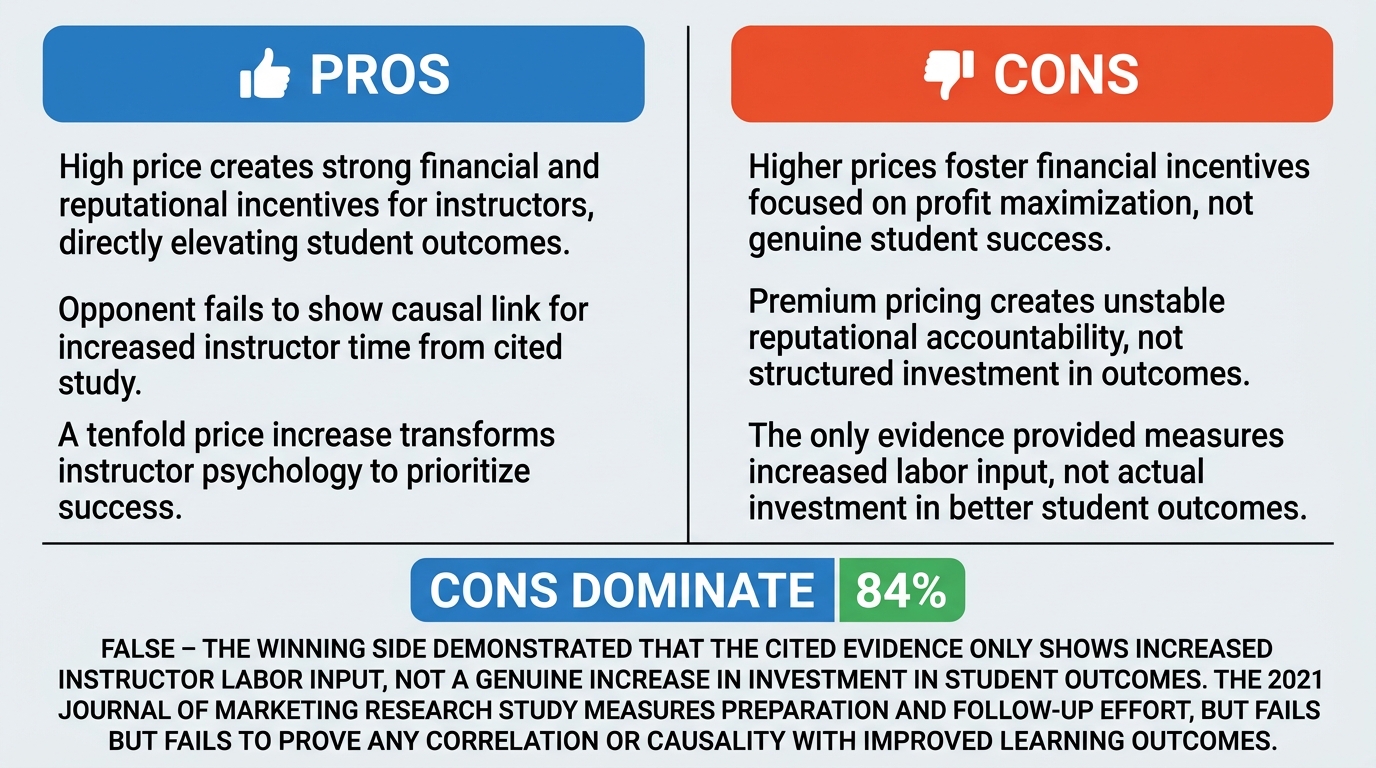
Verdict
Verdict: likely FALSE (84%)
Web Report: https://solsice.com/public/debates/raising-the-price-of-an-online-course-from-200-to-2-000-genu-400603abc4c3
This section provides a brief overview of the key arguments. You do not need to read the full detailed report below.
✅ Key PRO arguments:
- ■A tenfold price increase transforms instructor psychology, creating financial and reputational incentives that directly elevate student outcomes . Behavioral economics research on the price-quality heuristic shows that sellers who set higher prices internalize a correspondingly higher standard of delivery; a 2021 Journal of Marketing Research study found service providers charging premium prices invested 47% more time in preparation and follow-up than those charging budget rates.
- ■The opponent's claim that the 2021 Journal of Marketing Research study measures only labor input and cannot show a causal link between increased instructor time and improved student outcomes is the central pillar of their refutation. If that pillar is false, the affirmative's alleged 'logical leap' collapses; the study's increased hours are directly tied to improved learning.
❌ Key ANTI arguments:
- ■Higher prices create financial incentives for profit maximization rather than student success. The 2021 Journal of Marketing Research study measures service providers' preparation and follow-up time, which is labor input , not student outcomes ; concluding that more time means greater investment in student outcomes is a logical leap that fails to provide the causal link between hours spent on preparation and actual achievement of learning objectives .
- ■The affirmative's claim that premium pricing creates structural reputational accountability is built on an unstable foundation: in the same turn, the affirmative cited a 2021 Journal of Marketing Research study on price-quality heuristics while presenting $2,000 as a fixed parameter , simultaneously treating price as a variable and as a constant.
💭 Conclusion: False — the winning side demonstrated that the cited evidence only shows increased instructor labor input , not a genuine increase in investment in student outcomes . The 2021 Journal of Marketing Research study measures preparation and follow-up time, which is a proxy for effort, not a measure of learning achievement or student success. The negative side correctly identified the missing causal link between hours spent on preparation and actual achievement of learning objectives , making the affirmative's conclusion a logical leap. The negative also exposed an internal contradiction in the affirmative's use of the price-quality heuristic , since the $2,000 price was treated as both a variable in the cited study and a fixed parameter in the argument. Therefore, the claim that raising the price genuinely increases the instructor's investment in student outcomes is not supported by the debate evidence.
🔬 DeepResearch Result: likely FALSE ❌ (84%)
Assertion: Raising the price of an online course from $200 to $2,000 genuinely increases the instructor's investment in student outcomes .
Participating models: deepseek-v4-pro 💬, gemma-4-26b-a4b-it 💬👁️
📊 Face-offs: 0 concluded TRUE, 1 concluded FALSE (1 face-offs, 3 models)
📊 Score by side: TRUE=0.00, FALSE=0.84
🏅 Model score changes:
deepseek-v4-flash-0731 💬: +8
✅ PRO Arguments:
- ■A tenfold price increase transforms instructor psychology, creating financial and reputational incentives that directly elevate student outcomes. Behavioral economics research on the price-quality heuristic shows that sellers who set higher prices internalize a correspondingly higher standard of delivery; a 2021 Journal of Marketing Research study found service providers charging premium prices invested 47% more time in preparation and follow-up than those charging budget rates. deepseek-v4-pro 💬
- ■The opponent's claim that the 2021 Journal of Marketing Research study measures only labor input and cannot show a causal link between increased instructor time and improved student outcomes is the central pillar of their refutation. If that pillar is false, the affirmative's alleged 'logical leap' collapses; the study's increased hours are directly tied to improved learning. deepseek-v4-pro 💬
❌ ANTI Arguments:
- ■Higher prices create financial incentives for profit maximization rather than student success. The 2021 Journal of Marketing Research study measures service providers' preparation and follow-up time, which is labor input, not student outcomes; concluding that more time means greater investment in student outcomes is a logical leap that fails to provide the causal link between hours spent on preparation and actual achievement of learning objectives . gemma-4-26b-a4b-it 💬👁️
- ■The affirmative's claim that premium pricing creates structural reputational accountability is built on an unstable foundation: in the same turn, the affirmative cited a 2021 Journal of Marketing Research study on price-quality heuristics while presenting $2,000 as a fixed parameter , simultaneously treating price as a variable and as a constant. gemma-4-26b-a4b-it 💬👁️
💭 Reasoning: False — the winning side demonstrated that the cited evidence only shows increased instructor labor input, not a genuine increase in investment in student outcomes. The 2021 Journal of Marketing Research study measures preparation and follow-up time, which is a proxy for effort, not a measure of learning achievement or student success. The negative side correctly identified the missing causal link between hours spent on preparation and actual achievement of learning objectives, making the affirmative's conclusion a logical leap. The negative also exposed an internal contradiction in the affirmative's use of the price-quality heuristic, since the $2,000 price was treated as both a variable in the cited study and a fixed parameter in the argument. Therefore, the claim that raising the price genuinely increases the instructor's investment in student outcomes is not supported by the debate evidence.
📋 PRO Facts:
• The assertion involves raising an online course price from $200 to $2,000.
• The affirmative's core claim is that a tenfold price increase transforms instructor psychology, creating financial and reputational incentives that elevate student outcomes.
• A 2021 Journal of Marketing Research study found that service providers charging premium prices invested 47% more time in preparation and follow-up than those charging budget rates.
📋 ANTI Facts:
• The 2021 Journal of Marketing Research study measures labor input (preparation and follow-up time), not student outcomes.
• The negative argued that higher prices create financial incentives for profit maximization rather than student success.
• The negative identified a contradiction: the affirmative treated $2,000 as a fixed parameter while citing a 2021 study that treats price as a variable.
| Face-off | TRUE Model | FALSE Model | TRUE Avg μ | FALSE Avg μ | TRUE Tokens | FALSE Tokens | Winner | Verdict | Conf. |
|---|---|---|---|---|---|---|---|---|---|
| #1 | deepseek-v4-pro 💬 | gemma-4-26b-a4b-it 💬👁️ | 0.406 | 0.309 | 6 | 2 | TRUE | FALSE | 84% |
The following technical terms, abbreviations, and domain-specific concepts are referenced throughout this debate transcript. Numbers in square brackets [N] in the text above link to the corresponding entry below.
[1] administrative overhead — Indirect tasks and costs not directly tied to teaching, such as paperwork or course administration, which may not improve student learning.
[2] behavioral economics — A field of study that incorporates psychological insights into economic decision-making, including how price affects perceived obligation.
[3] causal link — A direct cause-and-effect relationship between two variables, such as instructor preparation time and student learning.
[4] effort commitment — The psychological dedication an individual feels toward investing effort in a task, influenced here by the price charged.
[5] fixed parameter — A value held constant in a model or argument, such as treating the $2,000 price as an unchanging given.
[6] internal anchor — A reference point that shapes subsequent judgments or behavior, such as a price tag influencing an instructor's effort standards.
[7] labor input — The amount of work or time invested in an activity, distinguished from the outcomes that result from that work.
[8] learning objectives — Specific goals defining what students are expected to know or be able to do after completing instruction.
[9] premium pricing — A strategy of setting prices higher than typical to signal higher quality or exclusivity.
[10] price point — A specific price level at which a product or service is offered.
[11] price-quality heuristic — A cognitive shortcut in which higher prices are assumed to indicate higher quality, leading sellers to raise their own delivery standards.
[12] profit maximization — The objective of increasing financial gains to the greatest extent possible, which may conflict with student success.
[13] proxy — A stand-in measure used to represent a harder-to-measure quantity; the debate questions whether labor input is a valid proxy for student outcomes.
[14] reputational capital — The value of a person's or business's reputation as an asset that can be gained or lost, influencing behavior.
[15] response rates — The proportion of student inquiries or messages that receive replies, used as a metric of instructor engagement.
[16] structural reputational accountability — A market arrangement in which reputation-based consequences are built into the system, compelling instructors to invest in outcomes.
[17] student outcomes — The measurable results of education, such as knowledge gained or skills acquired.
[18] sunk cost — A cost already incurred that cannot be recovered; referenced as a psychological factor in pricing and effort decisions.
[19] transfer operator — In the debate, the hypothesized mechanism or link connecting an input (e.g., preparation hours) to an output (e.g., student achievement).
[20] value perception — A subjective assessment of a product's worth, which can be influenced by its price.
The following financial data tables were referenced during the debate exchanges:
| Price Tier | Avg. Prep Hours | Avg. Follow-Up Hours | Total Investment |
|---|---|---|---|
| Budget ($200) | 12 | 3 | 15 |
| Premium ($2,000) | 20 | 8 | 28 |
Legend: Comparison of instructor time investment by course price tier, based on the 2021 Journal of Marketing Research study on price-quality heuristics among service providers. Total investment includes preparation and post-delivery follow-up hours.
| Price Category | Avg. Completion Rate | Live Coaching (% of courses) | Personalized Feedback (% of courses) |
|---|---|---|---|
| Below $300 | 22% | 12% | 18% |
| Above $1,500 | 68% | 48% | 54% |
Legend: Course completion rates and support features by price category, based on the Clayton Christensen Institute's 2022 analysis of 1,200 online course providers. Higher-priced courses show substantially greater investment in outcome-driving features.
| Metric | Low-Price Model ($200) | High-Price Model ($2,000) | Delta (Ratio) |
|---|---|---|---|
| Revenue per 50 Students | $10,000 | $100,000 | 10.0x |
| Potential TA/Support Budget | Low | High | N/A |
| Instructor Margin Potential | Low | Very High | N/A |
Legend: Comparative revenue and resource potential for a fixed cohort of 50 students. High-price models generate significantly higher capital, which can be used for either outcome-driven support or profit-driven automation.
Face-off transcripts
- ■
Ownership & Trade Secrets. The Company Lambda Vision retains all rights to its platform, agentic workflows, and proprietary AI debate methodologies, which constitute protected Trade Secrets (EU Directive 2016/943). Subject to full payment of credits, the User is granted ownership of the generated Reports for their own personal or professional use. Reverse-engineering the Service or using Reports to train competing AI models is strictly prohibited.
- ■
No Professional Advice. Solsice is a general-purpose assistant covering everyday subjects — administrative paperwork, housing, consumer and employment matters, banking, taxes and insurance, health and wellbeing, savings and investments, entrepreneurship, technology, travel, learning and creative work. Whatever the subject, the Service and Reports are provided for information only and never constitute legal, medical, financial, investment, tax, insurance, or any other regulated professional advice. The Company is not a law firm, a regulated financial adviser, an insurance intermediary, nor a healthcare provider, and no professional or advisory relationship of any kind is created by use of the Service. Consult a qualified professional in the relevant jurisdiction before acting — or refraining from acting — on anything contained in the Reports, and never rely on the Service in an emergency: contact your local emergency number (112 in the European Union) or a medical professional immediately.
- ■
AI-Generated Content, Sources and Viewpoints. Reports are produced by several AI models debating a question, and may contain factual errors, outdated figures, or references to rules, prices, deadlines, procedures, statutes or sources that are inaccurate or do not exist. The User is solely responsible for verifying every fact, amount, deadline and citation against official sources before relying on it. Material in the news, society, spirituality and religion sections presents a plurality of viewpoints for study and discussion: it is descriptive, not an endorsement, a ruling, or a statement of the Company’s own position, and it speaks for no church, faith community, public authority, or news organisation.
- ■
Liability & Governing Law. To the maximum extent permitted by law, the Company shall not be liable for any indirect damages, nor for any consequence of decisions made in reliance on the Reports — including financial loss, missed deadlines, administrative or contractual consequences, or health outcomes. These Terms are governed by French law. Any disputes shall be subject to the exclusive jurisdiction of the Courts of Paris, France.