
Processing repressed emotions requires engaging in practices like breathwork and dance to bring subconscious issues to the surface and release emotional 'sludge'.
AI debate verdict and arguments
⚠️ AI-generated information only; not professional advice
Completed October 14, 2026
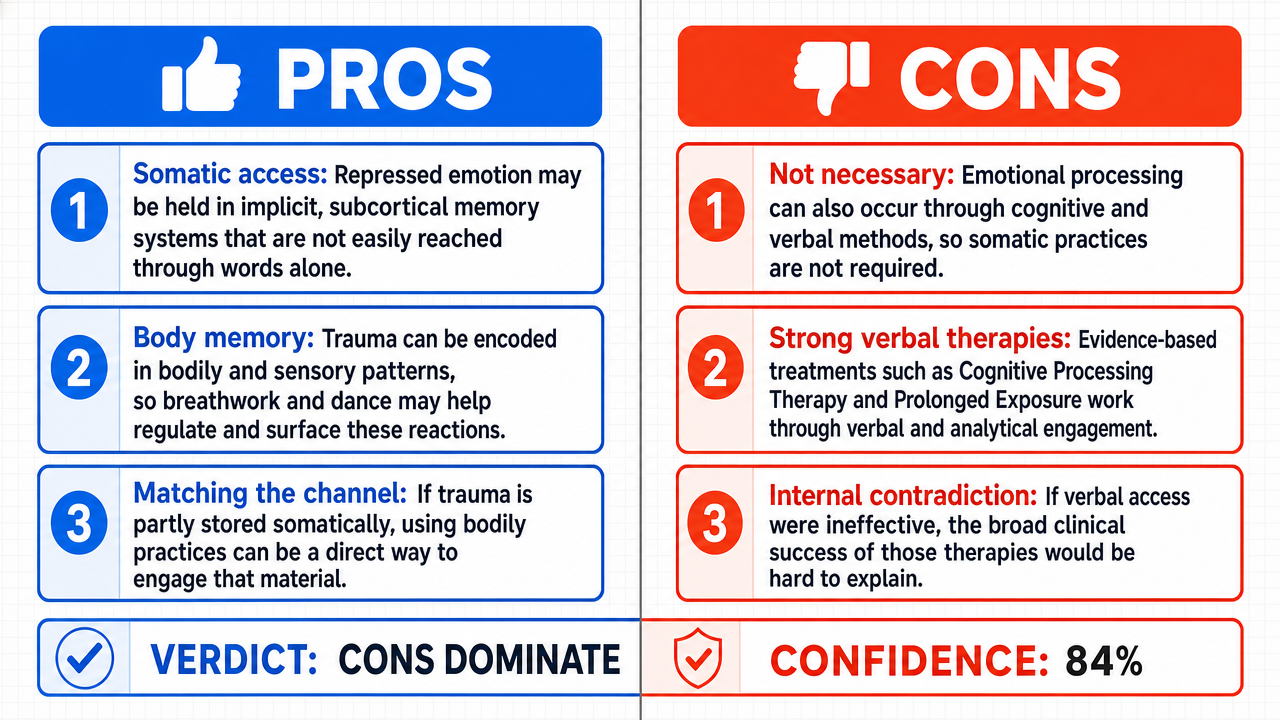
Verdict
Verdict: likely FALSE (84%)
Web Report: https://solsice.com/public/debates/processing-repressed-emotions-requires-engaging-in-practices-1b756746040f
This section provides a brief overview of the key arguments. You do not need to read the full detailed report below.
✅ Key PRO arguments:
- ■Repressed emotions are stored in subcortical implicit memory systems (amygdala , hippocampus ) that are not directly accessible through verbal cognition, so somatic practices are necessary to access them.
- ■Traumatic memories are encoded somatosensorily , creating 'body memory ' that is triggered without conscious recall, and breathwork /dance directly modulate the autonomic nervous system to enable safe discharge of stored emotional energy.
- ■Because encoding of trauma is fundamentally somatic, accessing those memories through the same somatic channel is a direct and logical inference rather than a non-sequitur .
❌ Key ANTI arguments:
- ■The assertion commits a logical fallacy of necessity because emotional processing is achievable through diverse cognitive and verbal modalities, not solely somatic practices .
- ■Cognitive Processing Therapy (CPT) and Prolonged Exposure (PE) are gold-standard trauma treatments that rely on verbal and analytical engagement, demonstrating that verbal approaches can effectively integrate traumatic memories.
- ■The pro position is internally inconsistent: it claims subcortical encoding is inaccessible to verbal cognition, yet the widespread clinical success of CPT and PE—which reduce PTSD symptoms through cognitive restructuring —proves that verbal modalities can in fact access and process those memories.
💭 Conclusion: False. The assertion that somatic practices like breathwork and dance are required for processing repressed emotions overstates the evidence and contains an internal logical contradiction. While somatic encoding of trauma memories is supported by neuroscience, the existence of well-established gold-standard verbal therapies such as Cognitive Processing Therapy and Prolonged Exposure demonstrates that cognitive restructuring alone can effectively integrate traumatic memories and reduce PTSD symptoms. The clinical efficacy of these purely verbal/analytical modalities directly refutes the 'necessity' claim by showing alternative pathways exist. Consequently, somatic practices are best understood as one useful tool among several rather than a required mechanism for emotional processing.
🔬 DeepResearch Result: likely FALSE ❌ (84%)
Assertion: Processing repressed emotions requires engaging in practices like breathwork and dance to bring subconscious issues to the surface and release emotional 'sludge'.
Participating models: deepseek-v3.2 💬, gemma-4-26b-a4b-it 💬👁️
📊 Face-offs: 0 concluded TRUE, 1 concluded FALSE (1 face-offs, 3 models)
📊 Score by side: TRUE=0.00, FALSE=0.84
🏅 Model score changes:
minimax-m3 💬👁️: +8
✅ PRO Arguments:
- ■Repressed emotions are stored in subcortical implicit memory systems (amygdala , hippocampus ) that are not directly accessible through verbal cognition, so somatic practices are necessary to access them. deepseek-v3.2 💬
- ■Traumatic memories are encoded somatosensorily , creating 'body memory ' that is triggered without conscious recall, and breathwork/dance directly modulate the autonomic nervous system to enable safe discharge of stored emotional energy. deepseek-v3.2 💬
- ■Because encoding of trauma is fundamentally somatic, accessing those memories through the same somatic channel is a direct and logical inference rather than a non-sequitur . deepseek-v3.2 💬
❌ ANTI Arguments:
- ■The assertion commits a logical fallacy of necessity because emotional processing is achievable through diverse cognitive and verbal modalities, not solely somatic practices. gemma-4-26b-a4b-it 💬👁️
- ■Cognitive Processing Therapy (CPT) and Prolonged Exposure (PE) are gold-standard trauma treatments that rely on verbal and analytical engagement, demonstrating that verbal approaches can effectively integrate traumatic memories. gemma-4-26b-a4b-it 💬👁️
- ■The pro position is internally inconsistent: it claims subcortical encoding is inaccessible to verbal cognition, yet the widespread clinical success of CPT and PE—which reduce PTSD symptoms through cognitive restructuring —proves that verbal modalities can in fact access and process those memories. gemma-4-26b-a4b-it 💬👁️
💭 Reasoning: False. The assertion that somatic practices like breathwork and dance are required for processing repressed emotions overstates the evidence and contains an internal logical contradiction. While somatic encoding of trauma memories is supported by neuroscience, the existence of well-established gold-standard verbal therapies such as Cognitive Processing Therapy and Prolonged Exposure demonstrates that cognitive restructuring alone can effectively integrate traumatic memories and reduce PTSD symptoms. The clinical efficacy of these purely verbal/analytical modalities directly refutes the 'necessity' claim by showing alternative pathways exist. Consequently, somatic practices are best understood as one useful tool among several rather than a required mechanism for emotional processing.
📋 PRO Facts:
• Repressed emotions and trauma memories can be encoded in subcortical regions such as the amygdala and hippocampus.
• Somatic practices can modulate the autonomic nervous system, shifting states between sympathetic and parasympathetic dominance.
• Traumatic memories may be encoded somatosensorily and triggered without conscious recall.
📋 ANTI Facts:
• Cognitive Processing Therapy (CPT) and Prolonged Exposure (PE) are gold-standard evidence-based treatments for trauma.
• CPT and PE effectively reduce PTSD symptoms and integrate traumatic memories through verbal and cognitive engagement.
• The clinical success of verbal-based modalities is inconsistent with the claim that subcortical memories are inaccessible to verbal cognition.
| Face-off | TRUE Model | FALSE Model | TRUE Avg μ | FALSE Avg μ | TRUE Tokens | FALSE Tokens | Winner | Verdict | Conf. |
|---|---|---|---|---|---|---|---|---|---|
| #1 | deepseek-v3.2 💬 | gemma-4-26b-a4b-it 💬👁️ | 0.544 | 0.356 | 8 | 2 | TRUE | FALSE | 84% |
The following technical terms, abbreviations, and domain-specific concepts are referenced throughout this debate transcript. Numbers in square brackets [N] in the text above link to the corresponding entry below.
[1] amygdala — A subcortical brain structure involved in processing emotions, particularly fear and threat detection, and relevant to implicit/emotional memory storage discussed in the transcript.
[2] autonomic nervous system — autonomic nervous system (ANS) — The part of the nervous system that regulates involuntary bodily functions, divided into the sympathetic (fight/flight) and parasympathetic (rest/digest) branches mentioned in the debate.
[3] body memory — The concept, referenced in the debate, that traumatic experiences are encoded somatosensorily and can be triggered without conscious verbal recall.
[4] breathwork — A somatic practice involving controlled breathing techniques, cited in the debate as a method to modulate the autonomic nervous system and release stored emotional material.
[5] Cognitive Processing Therapy — Cognitive Processing Therapy (CPT) — A cognitive-behavioral treatment for trauma and PTSD referenced in the debate as a 'gold-standard' verbal therapy.
[6] cognitive restructuring — A therapeutic technique used to identify and change maladaptive thought patterns, cited as the mechanism by which verbal therapies process trauma.
[7] cognitive-behavioral frameworks — Therapeutic approaches (including CBT and related modalities) that focus on restructuring maladaptive thoughts and cognitions, referenced as alternatives to somatic practices in the debate.
[8] dropout and non-response rates — Clinical trial/therapy metrics indicating the proportion of patients who discontinue treatment or do not show improvement, cited in the debate regarding limitations of cognitive therapies.
[9] fallacy of necessity — logical fallacy of necessity — A logical error where a condition is claimed to be strictly required when it is in fact optional, as asserted in the negative's argument.
[10] hippocampus — A subcortical brain region involved in memory consolidation and contextualization, mentioned alongside the amygdala as a site of implicit emotional memory.
[11] implicit memory — Unconscious memory systems that operate without deliberate recall, referenced in the debate as the type of memory system that stores repressed emotional material.
[12] Journal of Traumatic Stress — An academic publication cited in the debate as the source of a 2015 study on trauma-sensitive yoga for veterans with PTSD.
[13] non-sequitur — A logical term used in the debate to describe a conclusion that does not logically follow from its premises.
[14] parasympathetic — parasympathetic nervous system — The 'rest and digest' branch of the autonomic nervous system, whose activation is described in the debate as a prerequisite for safe discharge of stored emotional energy.
[15] Prolonged Exposure — Prolonged Exposure (PE) — A trauma-focused cognitive-behavioral therapy cited in the debate as a 'gold-standard' treatment that processes traumatic memories through verbal engagement.
[16] PTSD — Post-Traumatic Stress Disorder — A mental health condition triggered by traumatic experiences, referenced as the clinical target of both somatic and cognitive therapies discussed in the debate.
[17] somatic dysregulation — Disruption of the body's physiological and emotional regulation systems, cited in the debate as a factor in non-response to purely cognitive therapies.
[18] somatic practices — Body-oriented practices such as breathwork, dance, and trauma-sensitive yoga that engage physical sensation to process emotional material, central to the affirmative's claim.
[19] somatosensorily — somatosensorily encoded — Refers to memories stored through bodily/sensory experience rather than verbal narrative, a premise used in the debate about how trauma is encoded.
[20] subcortical regions — subcortical brain regions — Brain structures located beneath the cerebral cortex (e.g., amygdala, hippocampus) involved in implicit memory and emotional processing, cited as inaccessible to verbal cognition alone.
[21] substitution of proxy — fallacy of substitution of proxy — A logical error referenced in the debate where a secondary measure or correlate is substituted for the actual construct being argued.
[22] sympathetic — sympathetic nervous system — The 'fight or flight' branch of the autonomic nervous system, mentioned in the debate as the state from which somatic practices help shift individuals.
[23] top-down cognitive regulation — Cognitive control originating from higher cortical regions that regulates lower (subcortical) emotional processes, cited as the mechanism by which verbal therapies integrate implicit memories.
[24] trauma-sensitive yoga — A somatic therapeutic modality mentioned in the debate, studied in a 2015 trial cited as evidence that somatic practices uniquely address PTSD where talk therapy plateaus.
Face-off transcripts
- ■
Ownership & Trade Secrets. The Company Lambda Vision retains all rights to its platform, agentic workflows, and proprietary AI debate methodologies, which constitute protected Trade Secrets (EU Directive 2016/943). Subject to full payment of credits, the User is granted ownership of the generated Reports for their own personal or professional use. Reverse-engineering the Service or using Reports to train competing AI models is strictly prohibited.
- ■
No Professional Advice. Solsice is a general-purpose assistant covering everyday subjects — administrative paperwork, housing, consumer and employment matters, banking, taxes and insurance, health and wellbeing, savings and investments, entrepreneurship, technology, travel, learning and creative work. Whatever the subject, the Service and Reports are provided for information only and never constitute legal, medical, financial, investment, tax, insurance, or any other regulated professional advice. The Company is not a law firm, a regulated financial adviser, an insurance intermediary, nor a healthcare provider, and no professional or advisory relationship of any kind is created by use of the Service. Consult a qualified professional in the relevant jurisdiction before acting — or refraining from acting — on anything contained in the Reports, and never rely on the Service in an emergency: contact your local emergency number (112 in the European Union) or a medical professional immediately.
- ■
AI-Generated Content, Sources and Viewpoints. Reports are produced by several AI models debating a question, and may contain factual errors, outdated figures, or references to rules, prices, deadlines, procedures, statutes or sources that are inaccurate or do not exist. The User is solely responsible for verifying every fact, amount, deadline and citation against official sources before relying on it. Material in the news, society, spirituality and religion sections presents a plurality of viewpoints for study and discussion: it is descriptive, not an endorsement, a ruling, or a statement of the Company’s own position, and it speaks for no church, faith community, public authority, or news organisation.
- ■
Liability & Governing Law. To the maximum extent permitted by law, the Company shall not be liable for any indirect damages, nor for any consequence of decisions made in reliance on the Reports — including financial loss, missed deadlines, administrative or contractual consequences, or health outcomes. These Terms are governed by French law. Any disputes shall be subject to the exclusive jurisdiction of the Courts of Paris, France.