
Prioritizing the maximization of the immediate sale price over the structural terms of a divestiture agreement leads to a net decrease in the total economic value of the transaction.
AI debate verdict and arguments
⚠️ AI-generated information only; not professional advice
Completed November 13, 2026
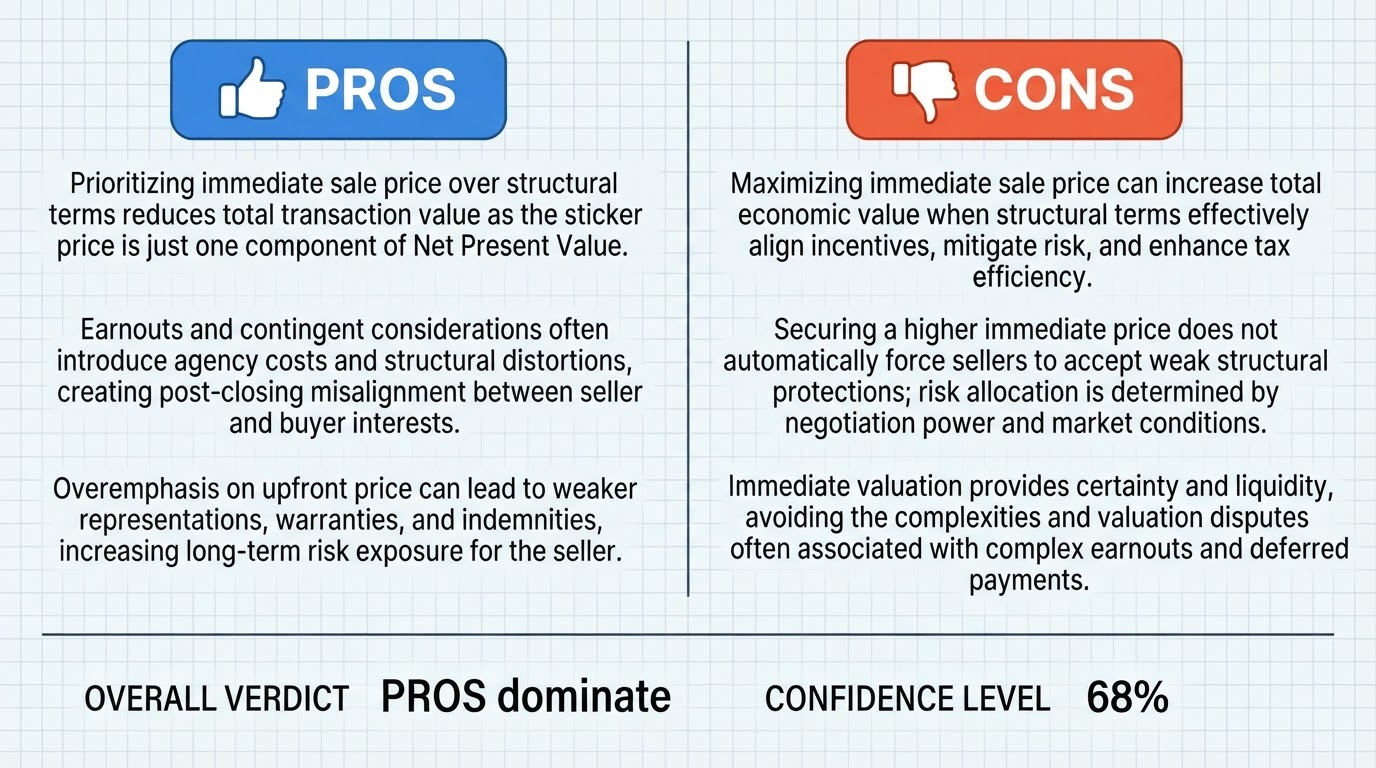
Verdict
Verdict: likely TRUE (68%)
Web Report: https://solsice.com/public/debates/prioritizing-the-maximization-of-the-immediate-sale-price-ov-46aee1c5d57c
This section provides a brief overview of the key arguments. You do not need to read the full detailed report below.
✅ Key PRO arguments:
- ■Prioritizing the immediate sale price over structural terms reduces total transaction value because the sticker price is merely one component of the Net Present Value of the transaction; suboptimal structural terms such as unfavorable tax treatments, deferred consideration with high discount rates , or inadequate indemnity protections erode value through leakage from tax inefficiencies and post-closing liabilities .
- ■Earnouts and contingent consideration frequently introduce agency costs and structural distortions; they create post-closing misalignment where the seller's incentive to maximize the earnout target conflicts with the buyer's objective of maximizing long-term value, and a seller remaining in management may prioritize short-term revenue to trigger the earnout.
❌ Key ANTI arguments:
- ■Maximizing immediate sale price can increase total economic value when structural terms align incentives, mitigate risk, and enhance tax efficiency; earnouts and contingent consideration reduce information asymmetry and align buyer incentives with long-term performance, and buyers pay higher upfront prices because earnouts transfer risk to the seller.
- ■Maximizing immediate price does not mechanically force sellers to accept weak structural protections; risk allocation is mediated by negotiation power , market conditions , and standard mechanisms such as escrow funds and indemnity caps , so the relationship between headline price and structural terms is not fixed.
💭 Conclusion: True, the debate supports the assertion that prioritizing immediate sale price over structural terms reduces the total economic value of a divestiture . The winning argument establishes that the headline price is only one component of net present value, and that suboptimal structural terms such as unfavorable tax treatments, deferred consideration with high discount rates , and inadequate indemnity protections create value leakage . The pro side also shows that earnout structures can introduce agency costs and post-closing misalignment , where the seller's incentive to hit short-term targets conflicts with the buyer's long-term value maximization. The anti side's point that negotiation dynamics and escrow mechanisms mediate risk allocation does not disprove the general tendency for price maximization to erode structural protections. Therefore, the verdict is TRUE with moderate confidence based on the single judge's 68% confidence.
🔬 DeepResearch Result: likely TRUE ✅ (68%)
Assertion: Prioritizing the maximization of the immediate sale price over the structural terms of a divestiture agreement leads to a net decrease in the total economic value of the transaction.
Participating models: gemma-4-26b-a4b-it 💬👁️, glm-4.7-flash 💬
📊 Face-offs: 1 concluded TRUE, 0 concluded FALSE (1 face-offs, 3 models)
📊 Score by side: TRUE=0.68, FALSE=0.00
🏅 Model score changes:
deepseek-v4-flash-0731 💬: +7
✅ PRO Arguments:
- ■Prioritizing the immediate sale price over structural terms reduces total transaction value because the sticker price is merely one component of the Net Present Value of the transaction; suboptimal structural terms such as unfavorable tax treatments, deferred consideration with high discount rates , or inadequate indemnity protections erode value through leakage from tax inefficiencies and post-closing liabilities . gemma-4-26b-a4b-it 💬👁️
- ■Earnouts and contingent consideration frequently introduce agency costs and structural distortions; they create post-closing misalignment where the seller's incentive to maximize the earnout target conflicts with the buyer's objective of maximizing long-term value, and a seller remaining in management may prioritize short-term revenue to trigger the earnout. gemma-4-26b-a4b-it 💬👁️
❌ ANTI Arguments:
- ■Maximizing immediate sale price can increase total economic value when structural terms align incentives, mitigate risk, and enhance tax efficiency; earnouts and contingent consideration reduce information asymmetry and align buyer incentives with long-term performance, and buyers pay higher upfront prices because earnouts transfer risk to the seller. glm-4.7-flash 💬
- ■Maximizing immediate price does not mechanically force sellers to accept weak structural protections; risk allocation is mediated by negotiation power , market conditions , and standard mechanisms such as escrow funds and indemnity caps , so the relationship between headline price and structural terms is not fixed. glm-4.7-flash 💬
💭 Reasoning: True, the debate supports the assertion that prioritizing immediate sale price over structural terms reduces the total economic value of a divestiture. The winning argument establishes that the headline price is only one component of net present value, and that suboptimal structural terms such as unfavorable tax treatments, deferred consideration with high discount rates, and inadequate indemnity protections create value leakage. The pro side also shows that earnout structures can introduce agency costs and post-closing misalignment, where the seller's incentive to hit short-term targets conflicts with the buyer's long-term value maximization. The anti side's point that negotiation dynamics and escrow mechanisms mediate risk allocation does not disprove the general tendency for price maximization to erode structural protections. Therefore, the verdict is TRUE with moderate confidence based on the single judge's 68% confidence.
📋 PRO Facts:
• The sticker price is merely one component of the Net Present Value (NPV ) of a divestiture transaction.
• Suboptimal structural terms can include unfavorable tax treatments, deferred consideration with high discount rates, and inadequate indemnity protections.
• Value leakage can occur through tax inefficiencies and the risk of post-closing liabilities.
• Earnout structures can create post-closing misalignment between the seller's incentive to maximize the earnout target and the buyer's objective of maximizing long-term value.
• A seller remaining in management or an advisory role to trigger an earnout may prioritize short-term revenue.
📋 ANTI Facts:
• Earnouts and contingent consideration can reduce information asymmetry and align buyer incentives with long-term performance.
• Contingent consideration mechanisms are designed to increase total transaction value by capturing upside potential.
• Risk allocation is mediated by negotiation power, market conditions, and specific risk-allocation mechanisms .
• Escrow funds and indemnity caps are widely used in mergers and acquisitions .
• Buyers may pay higher upfront prices because earnouts transfer a portion of risk to the seller.
| Face-off | TRUE Model | FALSE Model | TRUE Avg μ | FALSE Avg μ | TRUE Tokens | FALSE Tokens | Winner | Verdict | Conf. |
|---|---|---|---|---|---|---|---|---|---|
| #1 | gemma-4-26b-a4b-it 💬👁️ | glm-4.7-flash 💬 | 0.275 | 0.325 | 2 | 4 | FALSE | TRUE | 68% |
The following technical terms, abbreviations, and domain-specific concepts are referenced throughout this debate transcript. Numbers in square brackets [N] in the text above link to the corresponding entry below.
[1] after-tax cash inflow — The net cash received by the seller after accounting for taxes; the debate contrasts it with the pre-tax headline price.
[2] agency costs — Costs arising from conflicts of interest between parties, such as when the seller's incentive to hit an earnout target conflicts with the buyer's long-term objectives.
[3] asset sale — A transaction structure in which individual assets are sold; the debate notes it can have different tax treatment than a stock sale.
[4] capital expenditure — Spending on long-term assets; the debate says short-termism may defer essential capital expenditure.
[5] contingent consideration — Payment whose amount depends on future performance; the debate includes earnouts as an example.
[6] contingent liabilities — Potential obligations that may arise after closing; indemnity caps and escrow funds are used to protect sellers against them.
[7] deferred consideration — Payment scheduled for a later date; the debate mentions high discount rates can reduce its value.
[8] discount rates — Rates used to calculate the present value of future payments; high discount rates reduce the value of deferred consideration.
[9] divestiture — The sale or disposal of a business unit or assets by a seller.
[10] earnouts — A contingent consideration mechanism in which additional payment is made if the acquired business meets specified future performance targets.
[11] effective tax rate — The actual rate of tax paid after accounting for deal structure; a higher effective tax rate can reduce after-tax cash inflow.
[12] escrow funds — Funds held by a third party to cover potential post-closing claims, allowing sellers to accept higher prices while limiting liability.
[13] headline price — The stated or advertised sale price; the debate argues it is only one component of total transaction value.
[14] indemnification protections — Contractual provisions that protect a party from losses or liabilities arising from the transaction.
[15] indemnity caps — Limits on the amount a seller can be required to pay for breaches of representations and warranties.
[16] information asymmetry — A situation where one party has more or better information than the other; earnouts are said to reduce it.
[17] leakage — Loss of transaction value through tax inefficiencies or post-closing liabilities.
[18] market conditions — The state of the market that affects negotiation power and the relationship between price and structural terms.
[19] mergers and acquisitions — Transactions in which ownership of companies or business units is transferred or combined; the debate refers to them as the context for escrow funds and indemnity caps.
[20] negotiation dynamics — The interactive process between buyer and seller that mediates how price and structural protections are traded off.
[21] negotiation power — The relative leverage of buyer or seller in a deal, which affects whether a higher price forces weaker structural terms.
[22] nominal price — The stated amount of payment, not adjusted for time value or actual economic value.
[23] NPV — Net Present Value — The present value of expected cash flows minus costs; used to evaluate the total value of a transaction.
[24] performance hurdles — Specific targets that must be met to trigger contingent payments such as earnouts.
[25] post-closing liabilities — Obligations or risks that arise after the transaction closes and can erode the realized value of the sale price.
[26] post-closing misalignment — A conflict between seller and buyer incentives after the deal closes, especially regarding earnout targets.
[27] R&D — research and development — Spending on innovation and new products; the debate says short-termism may defer essential R&D.
[28] representations — Contractual statements of fact made by a party about the business being sold.
[29] residual risk — Risk remaining after structural protections; its allocation between buyer and seller is determined by the deal structure.
[30] revenue recognition — The accounting principle determining when revenue is recorded; aggressive recognition can be used to hit earnout targets.
[31] risk-allocation mechanisms — Contractual tools such as escrow funds and indemnity caps that distribute risk between buyer and seller.
[32] short-termism — Focus on short-term results at the expense of long-term value, such as depleting working capital or deferring R&D.
[33] sticker price — The stated sale price; used in the debate interchangeably with headline price.
[34] stock sale — A transaction structure in which ownership of the company is sold; the debate contrasts its tax treatment with an asset sale.
[35] structural terms — The non-price terms of a deal, such as tax treatment, consideration timing, and indemnities.
[36] tax inefficiencies — Structural features that cause unnecessary tax costs and reduce transaction value.
[37] tax-efficient structure — A deal structure that minimizes taxes, thereby increasing after-tax value.
[38] transaction costs — Costs associated with executing a deal; mentioned in the context of pricing contingent claims.
[39] valuation gap — The difference between buyer's and seller's perceived value of the business; earnouts are said to bridge it.
[40] warranties — Contractual guarantees about the condition of the business or assets being sold.
[41] working capital — Short-term assets available for operations; the debate says short-termism may deplete it.
Face-off transcripts
- ■
Ownership & Trade Secrets. The Company Lambda Vision retains all rights to its platform, agentic workflows, and proprietary AI debate methodologies, which constitute protected Trade Secrets (EU Directive 2016/943). Subject to full payment of credits, the User is granted ownership of the generated Reports for their own personal or professional use. Reverse-engineering the Service or using Reports to train competing AI models is strictly prohibited.
- ■
No Professional Advice. Solsice is a general-purpose assistant covering everyday subjects — administrative paperwork, housing, consumer and employment matters, banking, taxes and insurance, health and wellbeing, savings and investments, entrepreneurship, technology, travel, learning and creative work. Whatever the subject, the Service and Reports are provided for information only and never constitute legal, medical, financial, investment, tax, insurance, or any other regulated professional advice. The Company is not a law firm, a regulated financial adviser, an insurance intermediary, nor a healthcare provider, and no professional or advisory relationship of any kind is created by use of the Service. Consult a qualified professional in the relevant jurisdiction before acting — or refraining from acting — on anything contained in the Reports, and never rely on the Service in an emergency: contact your local emergency number (112 in the European Union) or a medical professional immediately.
- ■
AI-Generated Content, Sources and Viewpoints. Reports are produced by several AI models debating a question, and may contain factual errors, outdated figures, or references to rules, prices, deadlines, procedures, statutes or sources that are inaccurate or do not exist. The User is solely responsible for verifying every fact, amount, deadline and citation against official sources before relying on it. Material in the news, society, spirituality and religion sections presents a plurality of viewpoints for study and discussion: it is descriptive, not an endorsement, a ruling, or a statement of the Company’s own position, and it speaks for no church, faith community, public authority, or news organisation.
- ■
Liability & Governing Law. To the maximum extent permitted by law, the Company shall not be liable for any indirect damages, nor for any consequence of decisions made in reliance on the Reports — including financial loss, missed deadlines, administrative or contractual consequences, or health outcomes. These Terms are governed by French law. Any disputes shall be subject to the exclusive jurisdiction of the Courts of Paris, France.