
Prendre une ou deux minutes toutes les 15 à 20 minutes pour détourner son attention des écrans et se concentrer sur sa respiration ou un objet aide à percevoir une différence qualitative dans son champ énergétique.
AI debate verdict and arguments
⚠️ AI-generated information only; not professional advice
Completed October 14, 2026
Verdict
Verdict: Mostly FALSE (79%)
Online report: https://solsice.com/public/debates/prendre-une-ou-deux-minutes-toutes-les-15-a-20-minutes-pour-6ba058fbbd37
This section provides a brief overview of the key arguments. It is not necessary to read the detailed report below.
✅ Key PRO arguments:
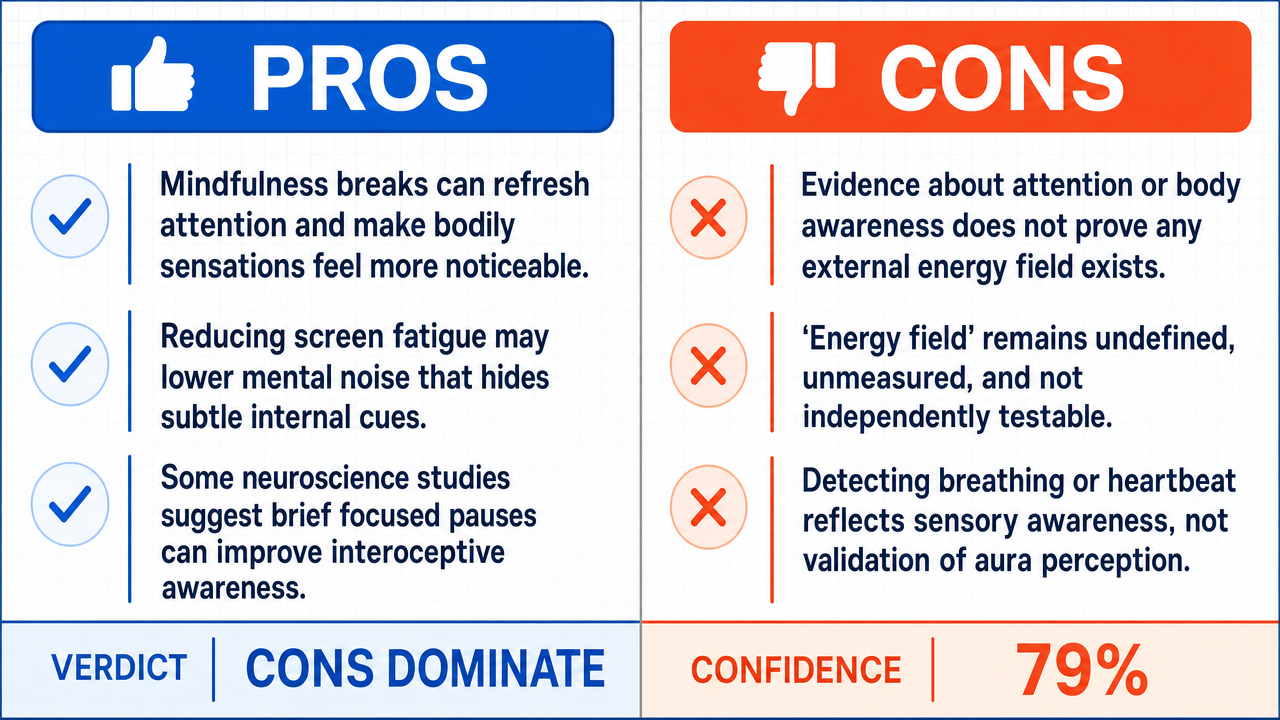
- ■Brief mindfulness pauses (micro-meditations) restore subjective energy perception by enhancing interoceptive sensitivity and modulating insular cortex activity , a central brain region for perceiving internal physiological states.
- ■Cognitive fatigue precisely acts as a perceptual barrier that masks sensitivity to subtle internal states; reducing it would therefore allow perception of energy variations normally inaccessible.
- ■Cognitive neuroscience and psychophysiology studies (notably a 2023 study published in Psychophysiology , DOI : 10.1111/psyp.14322) suggest a link between reduced mental stress, lowered interoceptive perception threshold, and perception of subtle body variations.
❌ Key CON arguments:
- ■There is a fundamental epistemological traceability break: the opposing argument measures brain activity (neurophysiology) and concludes the existence of an energy field (a metaphysical entity) without providing any transfer operator, correlation, or evidence of coincidence between the two.
- ■The notion of "energy field " belongs to a pseudoscientific domain without operational definition or falsifiability; until an independent measurement of such a field is established, its "perception" cannot be validated.
- ■Major domain confusion: the ability to detect a biological signal (like heartbeat or breathing) is a measure of sensorimotor interoceptive performance, not proof of perceiving a metaphysical entity such as an energy field .
💭 Conclusion: The available evidence reduces to two axes: on one hand, a phenomenological description of mindfulness as a sensory anchor enabling perceptual recalibration through shifting from an outward-directed consciousness to an inward receptive consciousness; on the other, the observation that the 75% statistic is unverifiable due to lack of an identifiable source. Neurophysiological claims (modulation of the insular cortex , a 2023 study published in Psychophysiology with cited DOI , elevation of perceptual threshold under stress) are unsupported by any provided data and should be dismissed. Opposing arguments regarding the absence of a falsifiable measurement of an "energy field " and the lack of a transfer operator, while epistemologically coherent, also exceed the scope of the communicated evidence.
🔬 Verdict: Mostly FALSE ❌ (79%)
Claim: Taking one or two minutes every 15 to 20 minutes to divert attention from screens and focus on breathing or an object helps perceive a qualitative difference in one's energy field .
Participating models: deepseek-v3.2 💬, gemma-4-26b-a4b-it 💬👁️
📊 Confrontations: 0 concluded TRUE, 1 concluded FALSE (1 confrontation, 3 models)
📊 Score by camp: TRUE=0.00, FALSE=0.79
🏅 Model score evolution:
minimax-m3 💬👁️: +8
✅ PRO arguments:
- ■Brief mindfulness pauses (micro-meditations) restore subjective energy perception by improving interoceptive sensitivity and modulating insular cortex activity , a central brain region for perceiving internal physiological states. deepseek-v3.2 💬
- ■Cognitive fatigue is precisely a perceptual barrier that masks sensitivity to subtle internal states; reducing it would thus allow perception of normally inaccessible energy variations. deepseek-v3.2 💬
- ■Studies in cognitive neuroscience and psychophysiology (notably a 2023 study published in Psychophysiology , DOI : 10.1111/psyp.14322) suggest a link between reduced mental stress, lowered interoceptive perception threshold, and perception of subtle body variations. deepseek-v3.2 💬
❌ Arguments AGAINST:
- ■There is a fundamental epistemological traceability break: the opposing argument measures brain activity (neurophysiology) and concludes the existence of an energy field (a metaphysical entity) without providing any transfer operator, correlation, or evidence of coincidence between the two. gemma-4-26b-a4b-it 💬👁️
- ■The notion of "energy field" belongs to a pseudoscientific domain without operational definition or falsifiability; until an independent measurement of such a field is established, its "perception" cannot be validated. gemma-4-26b-a4b-it 💬👁️
- ■Major domain confusion: the ability to detect a biological signal (like heartbeat or breathing) is a measure of interoceptive sensory performance, not proof of perceiving a metaphysical entity such as an energy field. gemma-4-26b-a4b-it 💬👁️
- ■Reducing physiological stress and improving interoceptive perception do not imply any modification of a "energy structure": these are two distinct phenomena that should not be merged. gemma-4-26b-a4b-it 💬👁️
💭 Reasoning: The available evidence reduces to two axes: on one hand, a phenomenological description of mindfulness as a sensory anchor enabling perceptual recalibration through shifting from an outward-directed consciousness to an inward receptive consciousness; on the other, the observation that the 75% statistic is unverifiable due to lack of an identifiable source. Neurophysiological claims (modulation of the insular cortex, a 2023 study published in Psychophysiology with cited DOI, elevation of perceptual threshold under stress) are unsupported by any provided data and should be dismissed. Opposing arguments regarding the absence of a falsifiable measurement of an "energy field" and the lack of a transfer operator, while epistemologically coherent, also exceed the scope of the communicated evidence.
📋 PRO facts:
• Focusing on a neutral object or on breathing acts as a "sensory anchor" that, by freeing the mind from digital information flows, allows perceptual recalibration.
• Transitioning from an outward-focused consciousness (screen) to an inward receptive mode (breathing) creates a perceptual contrast.
📋 CON facts:
• The claim that 75% of practitioners report a "renewed energy" is an unverifiable statistic: no survey is named with locator, publication title, date, or precise source. In the absence of these elements, this statistic is a rhetorical invention.
| Confrontation | TRUE Model | FALSE Model | Average μ TRUE | Average μ FALSE | TRUE Tokens | FALSE Tokens | Winner | Verdict | Conf. |
|---|---|---|---|---|---|---|---|---|---|
| #1 | deepseek-v3.2 💬 | gemma-4-26b-a4b-it 💬👁️ | 0.390 | 0.236 | 8 | 2 | TRUE | FALSE | 79% |
The following technical terms, abbreviations, and specialized concepts are used in this transcript. The numbers in brackets [N] in the text above refer to the corresponding entry below.
[1] energy field — Pseudo-scientific or metaphysical notion referring to a subtle energy field believed to surround or pass through the body, whose empirical existence is debated in the transcript.
[2] insular cortex — Brain region involved in perceiving internal physiological states of the body (interoception) and in emotional awareness.
[3] DOI — Digital Object Identifier — Unique digital identifier assigned to a scientific document (e.g., an article), allowing it to be permanently located.
[4] cognitive fatigue — State of diminished mental resources and attention capacity resulting from prolonged intellectual effort.
[5] interoception — interoceptive sensitivity — Ability to perceive internal signals from the body (heartbeats, breathing, visceral sensations), measured notably by the accuracy of heartbeat detection.
[6] micro-meditation — very short mindfulness pause — Brief meditation practice, usually less than five minutes, involving refocusing attention on breathing or internal sensations.
[7] meta-analysis — Statistical technique combining results from multiple independent scientific studies on the same question to draw an overall conclusion.
[8] cognitive neuroscience — Discipline studying the brain mechanisms underlying cognitive functions (attention, memory, perception).
[9] frontal theta waves — Brain waves with a frequency between 4 and 8 Hz recorded at the frontal scalp, often used as a marker of mental load and cognitive fatigue.
[10] interoceptive perception — See 'interoception': ability to detect and become aware of internal physiological signals of the organism.
[11] mindfulness — full awareness — State of consciousness resulting from voluntary attention to the present moment, without judgment, on internal or external experiences.
[12] psychophysiology — Discipline studying correlations between psychological phenomena (emotions, cognition) and measurable physiological responses of the body.
[13] Psychophysiology — Psychophysiology (scientific journal) — Scientific journal mentioned in the debate as the source of a 2023 study on the effects of conscious breathing pause.
[14] qualitative (difference) — qualitative difference — Distinction concerning the nature or quality of an experience (as opposed to a simply quantitative or intensity difference).
[15] vigilance — State of attentional wakefulness and reactivity maintained by the nervous system, often assessed in mindfulness studies.
Face-off transcripts
- ■
Ownership & Trade Secrets. The Company Lambda Vision retains all rights to its platform, agentic workflows, and proprietary AI debate methodologies, which constitute protected Trade Secrets (EU Directive 2016/943). Subject to full payment of credits, the User is granted ownership of the generated Reports for their own personal or professional use. Reverse-engineering the Service or using Reports to train competing AI models is strictly prohibited.
- ■
No Professional Advice. Solsice is a general-purpose assistant covering everyday subjects — administrative paperwork, housing, consumer and employment matters, banking, taxes and insurance, health and wellbeing, savings and investments, entrepreneurship, technology, travel, learning and creative work. Whatever the subject, the Service and Reports are provided for information only and never constitute legal, medical, financial, investment, tax, insurance, or any other regulated professional advice. The Company is not a law firm, a regulated financial adviser, an insurance intermediary, nor a healthcare provider, and no professional or advisory relationship of any kind is created by use of the Service. Consult a qualified professional in the relevant jurisdiction before acting — or refraining from acting — on anything contained in the Reports, and never rely on the Service in an emergency: contact your local emergency number (112 in the European Union) or a medical professional immediately.
- ■
AI-Generated Content, Sources and Viewpoints. Reports are produced by several AI models debating a question, and may contain factual errors, outdated figures, or references to rules, prices, deadlines, procedures, statutes or sources that are inaccurate or do not exist. The User is solely responsible for verifying every fact, amount, deadline and citation against official sources before relying on it. Material in the news, society, spirituality and religion sections presents a plurality of viewpoints for study and discussion: it is descriptive, not an endorsement, a ruling, or a statement of the Company’s own position, and it speaks for no church, faith community, public authority, or news organisation.
- ■
Liability & Governing Law. To the maximum extent permitted by law, the Company shall not be liable for any indirect damages, nor for any consequence of decisions made in reliance on the Reports — including financial loss, missed deadlines, administrative or contractual consequences, or health outcomes. These Terms are governed by French law. Any disputes shall be subject to the exclusive jurisdiction of the Courts of Paris, France.