
Pre-emptive prayer, as exemplified by David and Jesus, reliably prepares individuals to navigate daily challenges with divine guidance and protection.
AI debate verdict and arguments
⚠️ AI-generated information only; not professional advice
Completed October 11, 2026
Verdict
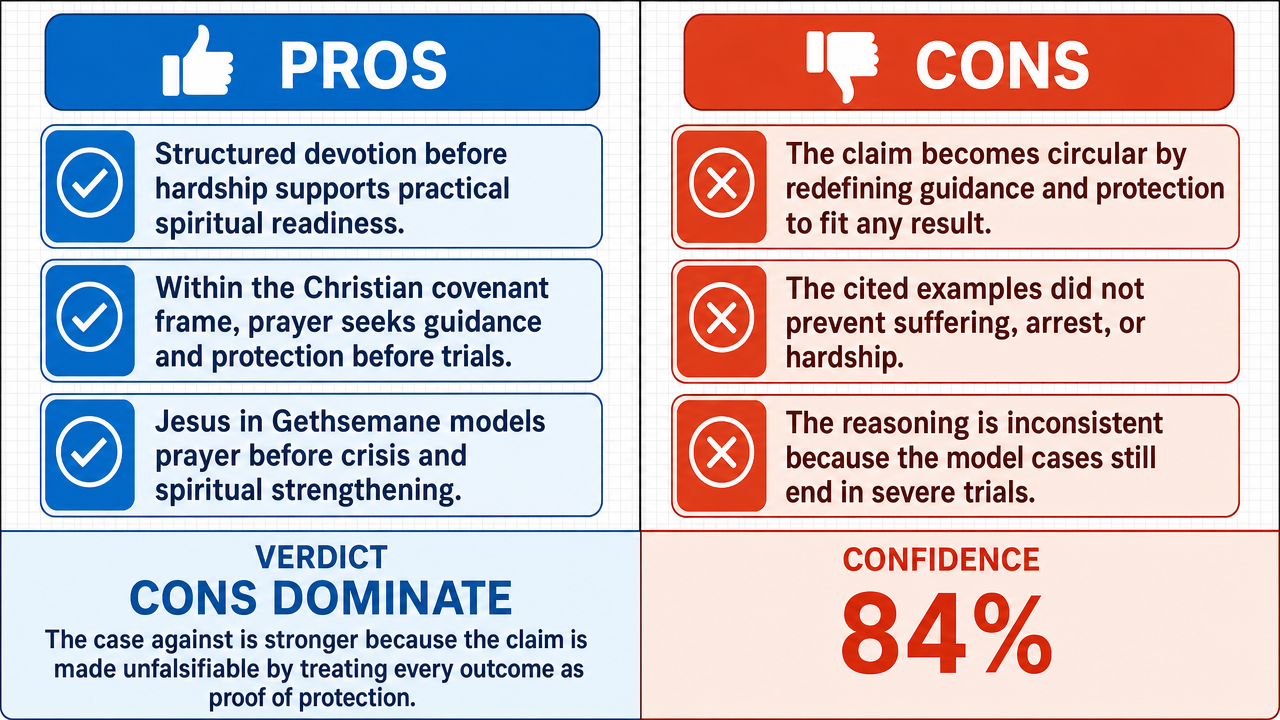
Verdict: likely FALSE (84%)
This section provides a brief overview of the key arguments. You do not need to read the full detailed report below.
✅ Key PRO arguments:
- ■Pre-emptive prayer is reliable in a practical, structured sense because the biblical ritual itself orders devotion to the moment before difficulty, citing Psalm 5:3 ('O LORD, at morning you hear my voice'), Psalm 91:1-2 (placing the believer under God's protection before describing terrors), and Proverbs 3:5-6 (acknowledging God before one's own way as the condition for straight paths).
- ■The claim must be evaluated inside the Christian covenantal frame , not as a secular prediction of disaster prevention; in that frame, divine guidance and protection include God-directed trust, strengthening, and preservation within the trial rather than removal of every difficulty.
- ■Jesus's Gethsemane prayer demonstrates the affirmative model: Luke 22:39-46 shows Jesus praying before the challenge, and Luke 22:43 records an angel strengthening him, so the arrest still occurred but divine strengthening was present within the trial, supporting the claim that pre-emptive prayer reliably prepares one for challenges.
❌ Key ANTI arguments:
- ■The affirmative commits a 'pétition de principe par reformulation synonyme ' (circular reasoning by synonymous reformulation): it redefines 'protection' and 'guidance' so broadly that they encompass any possible outcome, including suffering and failure, thereby converting a testable claim of reliability into a tautology that is immune to refutation.
- ■The very exemplars cited undermine the claim: Jesus's Gethsemane prayer did not prevent his arrest, and David's recorded experiences reflect unverified, subjective textual attributions of 'direction' rather than an observable, reliable mechanism of divine guidance.
- ■The argument is internally inconsistent because it asserts that pre-emptive prayer provides 'divine guidance and protection' while using exemplars whose recorded experiences directly negate the presence of such protection, so the link between the practice and the claimed outcome is not established.
💭 Conclusion: False. The affirmative's defense collapses into circularity by redefining 'guidance' and 'protection' to include any outcome, including suffering and failure, which converts a testable reliability claim into an unfalsifiable tautology . The biblical exemplars invoked actually undermine the assertion: Jesus's pre-emptive Gethsemane prayer did not prevent his arrest, and David's experiences reflect subjective textual attributions rather than an observable, reliable mechanism. Because the affirmative cannot demonstrate reliability without smuggling the conclusion into the definition of the terms, the claim that pre-emptive prayer 'reliably prepares' individuals for daily challenges is not supported. The judge's confidence reflects strong agreement that the logical structure of the affirmative case is fatally compromised by this reformulation problem.
🔬 DeepResearch Result: likely FALSE ❌ (84%)
Assertion: Pre-emptive prayer, as exemplified by David and Jesus, reliably prepares individuals to navigate daily challenges with divine guidance and protection.
Participating models: deepseek-v3.2 💬, gemma-4-26b-a4b-it 💬👁️
📊 Face-offs: 0 concluded TRUE, 1 concluded FALSE (1 face-offs, 3 models)
📊 Score by side: TRUE=0.00, FALSE=0.84
🏅 Model score changes:
minimax-m3 💬👁️: +8
✅ PRO Arguments:
- ■Pre-emptive prayer is reliable in a practical, structured sense because the biblical ritual itself orders devotion to the moment before difficulty, citing Psalm 5:3 ('O LORD, at morning you hear my voice'), Psalm 91:1-2 (placing the believer under God's protection before describing terrors), and Proverbs 3:5-6 (acknowledging God before one's own way as the condition for straight paths). deepseek-v3.2 💬
- ■The claim must be evaluated inside the Christian covenantal frame , not as a secular prediction of disaster prevention; in that frame, divine guidance and protection include God-directed trust, strengthening, and preservation within the trial rather than removal of every difficulty. deepseek-v3.2 💬
- ■Jesus's Gethsemane prayer demonstrates the affirmative model: Luke 22:39-46 shows Jesus praying before the challenge, and Luke 22:43 records an angel strengthening him, so the arrest still occurred but divine strengthening was present within the trial, supporting the claim that pre-emptive prayer reliably prepares one for challenges. deepseek-v3.2 💬
❌ ANTI Arguments:
- ■The affirmative commits a 'pétition de principe par reformulation synonyme ' (circular reasoning by synonymous reformulation): it redefines 'protection' and 'guidance' so broadly that they encompass any possible outcome, including suffering and failure, thereby converting a testable claim of reliability into a tautology that is immune to refutation. gemma-4-26b-a4b-it 💬👁️
- ■The very exemplars cited undermine the claim: Jesus's Gethsemane prayer did not prevent his arrest, and David's recorded experiences reflect unverified, subjective textual attributions of 'direction' rather than an observable, reliable mechanism of divine guidance. gemma-4-26b-a4b-it 💬👁️
- ■The argument is internally inconsistent because it asserts that pre-emptive prayer provides 'divine guidance and protection' while using exemplars whose recorded experiences directly negate the presence of such protection, so the link between the practice and the claimed outcome is not established. gemma-4-26b-a4b-it 💬👁️
💭 Reasoning: False. The affirmative's defense collapses into circularity by redefining 'guidance' and 'protection' to include any outcome, including suffering and failure, which converts a testable reliability claim into an unfalsifiable tautology. The biblical exemplars invoked actually undermine the assertion: Jesus's pre-emptive Gethsemane prayer did not prevent his arrest, and David's experiences reflect subjective textual attributions rather than an observable, reliable mechanism. Because the affirmative cannot demonstrate reliability without smuggling the conclusion into the definition of the terms, the claim that pre-emptive prayer 'reliably prepares' individuals for daily challenges is not supported. The judge's confidence reflects strong agreement that the logical structure of the affirmative case is fatally compromised by this reformulation problem.
📋 PRO Facts:
• Psalm 5:3 records David saying, 'O LORD, at morning you hear my voice,' modeling morning pre-emptive prayer.
• Psalm 91:1-2 places the believer under God's protection before describing terrors of day or night.
• Luke 22:39-46 records Jesus praying in Gethsemane before his arrest.
• The affirmative argues that during Jesus's Gethsemane prayer, God provided sustaining grace rather than automatic rescue.
📋 ANTI Facts:
• Jesus's Gethsemane prayer did not prevent his subsequent arrest, contradicting a literal reading of 'protection.'
• The affirmative redefined 'protection' and 'guidance' to include any outcome, including suffering and failure, which constitutes circular reasoning.
• David's experiences in the biblical text reflect subjective attributions of divine direction rather than an independently verifiable mechanism.
• A claim that is immune to refutation by definitional expansion is a tautology, not a testable reliability claim.
• The exemplars cited (David and Jesus) experienced suffering and failure despite pre-emptive prayer, which the affirmative must reinterpret rather than explain.
| Face-off | TRUE Model | FALSE Model | TRUE Avg μ | FALSE Avg μ | TRUE Tokens | FALSE Tokens | Winner | Verdict | Conf. |
|---|---|---|---|---|---|---|---|---|---|
| #1 | deepseek-v3.2 💬 | gemma-4-26b-a4b-it 💬👁️ | 0.517 | 0.333 | 12 | 3 | TRUE | FALSE | 84% |
The following technical terms, abbreviations, and domain-specific concepts are referenced throughout this debate transcript. Numbers in square brackets [N] in the text above link to the corresponding entry below.
[1] auxiliary assumption — In debate logic, an unstated premise that an argument depends on but does not explicitly assert; the debate disputes whether 'protection' must mean 'avoidance of the challenge' as such an assumption.
[2] Catechism of the Catholic Church — A religious text cited in the affirmative's Round 1 argument as a source describing prayer as a living relationship with God rather than a private technique.
[3] circular demonstration — A form of reasoning in which the conclusion is assumed in the premises; the negative charges the affirmative with this in defending pre-emptive prayer's reliability.
[4] covenant — A theological concept of a binding relational agreement between God and believers, used in the debate to frame prayer as a 'covenantal posture' rather than mere petition.
[5] covenantal frame — The interpretive context of the God–believer covenant within which the affirmative argues the claim must be evaluated, as opposed to a secular prediction of harm-avoidance.
[6] covenantal posture — A disciplined stance of relationship with God maintained before difficulty arises, described in the affirmative's Round 1 as the structural effect of pre-emptive prayer.
[7] ESV — English Standard Version — A translation of the Bible used throughout the debate for scriptural citations (e.g., Psalm 5:3 ESV, Luke 22:42 ESV).
[8] Facet — A labeled sub-argument or angle within a debate round (e.g., '[Facet: Prayer & Rituals]', '[Facet: Christianity]') used to organize the speaker's case.
[9] Gethsemane — The garden referenced in Luke 22:39-46 where Jesus prays before his arrest; cited by both sides as a test case for whether pre-emptive prayer provides protection.
[10] Gospels — The New Testament books narrating Jesus's life and teachings, cited in the assertion as the source of Jesus's example of pre-emptive prayer.
[11] petition — In the context of prayer, a request addressed to God; the affirmative distinguishes pre-emptive prayer from mere 'petition during crisis.'
[12] Psalms — A book of the Bible cited in the assertion as the source of David's example of pre-emptive prayer (e.g., Psalm 5:3, Psalm 91:1-2).
[13] pétition de principe par reformulation synonyme — A French term for a logical fallacy in which a claim is reformulated synonymously so that it becomes compatible with any outcome and thus unfalsifiable; the negative accuses the affirmative of this move.
[14] rite — A structured religious practice or ceremony; the affirmative describes pre-emptive prayer as a 'rite' that gives ordered structure to the moment before difficulty.
[15] Round — A numbered segment of the debate (Round 1, Round 2, Round 3) in which each side presents its arguments.
[16] semantic instability — A condition in which a term's meaning shifts so broadly that it can encompass contradictory outcomes; the negative argues 'protection' and 'guidance' suffer from this in the affirmative's case.
[17] tautology — A statement that is true in all possible outcomes by virtue of its definition; the negative contends the affirmative's redefined claim of reliability has become a tautology immune to refutation.
[18] TRUE case — Debate terminology for the strongest version of one's own argument that survives the opponent's objections; the affirmative in Round 3 frames its position as 'the strongest TRUE case.'
Face-off transcripts
- ■
Ownership & Trade Secrets. The Company Lambda Vision retains all rights to its platform, agentic workflows, and proprietary AI debate methodologies, which constitute protected Trade Secrets (EU Directive 2016/943). Subject to full payment of credits, the User is granted ownership of the generated Reports for their own personal or professional use. Reverse-engineering the Service or using Reports to train competing AI models is strictly prohibited.
- ■
No Professional Advice. Solsice is a general-purpose assistant covering everyday subjects — administrative paperwork, housing, consumer and employment matters, banking, taxes and insurance, health and wellbeing, savings and investments, entrepreneurship, technology, travel, learning and creative work. Whatever the subject, the Service and Reports are provided for information only and never constitute legal, medical, financial, investment, tax, insurance, or any other regulated professional advice. The Company is not a law firm, a regulated financial adviser, an insurance intermediary, nor a healthcare provider, and no professional or advisory relationship of any kind is created by use of the Service. Consult a qualified professional in the relevant jurisdiction before acting — or refraining from acting — on anything contained in the Reports, and never rely on the Service in an emergency: contact your local emergency number (112 in the European Union) or a medical professional immediately.
- ■
AI-Generated Content, Sources and Viewpoints. Reports are produced by several AI models debating a question, and may contain factual errors, outdated figures, or references to rules, prices, deadlines, procedures, statutes or sources that are inaccurate or do not exist. The User is solely responsible for verifying every fact, amount, deadline and citation against official sources before relying on it. Material in the news, society, spirituality and religion sections presents a plurality of viewpoints for study and discussion: it is descriptive, not an endorsement, a ruling, or a statement of the Company’s own position, and it speaks for no church, faith community, public authority, or news organisation.
- ■
Liability & Governing Law. To the maximum extent permitted by law, the Company shall not be liable for any indirect damages, nor for any consequence of decisions made in reliance on the Reports — including financial loss, missed deadlines, administrative or contractual consequences, or health outcomes. These Terms are governed by French law. Any disputes shall be subject to the exclusive jurisdiction of the Courts of Paris, France.