
Prayer for family members should focus on entrusting them to God without dwelling on potential negatives or attempting to control outcomes.
AI debate verdict and arguments
⚠️ AI-generated information only; not professional advice
Completed October 8, 2026
Verdict
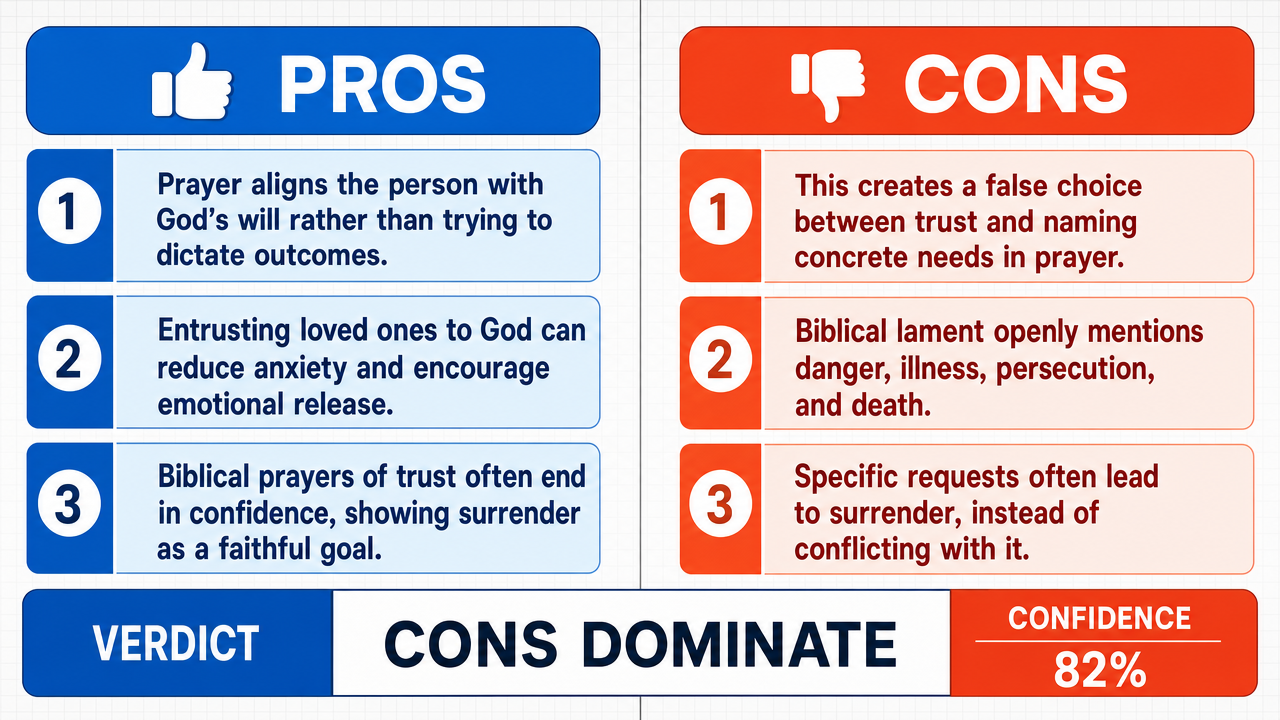
Verdict: likely FALSE (82%)
This section provides a brief overview of the key arguments. You do not need to read the full detailed report below.
✅ Key PRO arguments:
- ■The primary function of intercessory prayer within many spiritual traditions is to align the petitioner 's will with a higher, benevolent power, not to dictate specific results; a focus on potential negatives often stems from and reinforces anxiety, transforming prayer into a ritual of worry rather than faith.
- ■Prayers of entrustment , such as the Christian 'Into your hands I commend my spirit,' model a release of control that correlates with improved psychological outcomes like reduced stress and increased resilience .
- ■Even biblical lament , such as Psalm 13, consistently concludes with a declaration of trust ('But I trust in your unfailing love'), demonstrating that the ultimate posture of trust frames even the most urgent petitions rather than being contradicted by them.
❌ Key ANTI arguments:
- ■The affirmative's attempt to bifurcate prayer into 'trustful surrender' versus 'anxious control' relies on a false dichotomy that ignores the fundamental biblical practice of specific, urgent petition ; to 'present requests' without naming the 'potential negatives' renders the petition hollow and intellectually dishonest.
- ■The Psalms are frequently characterized by lament , a liturgical form that explicitly names specific dangers such as sickness, persecution, or death, demonstrating that naming negatives is a structurally legitimate and theologically grounded practice.
- ■Surrender is often the RESULT of naming specific concerns in intercession , not mutually exclusive with it; the theological and liturgical reality shows that trustful entrustment frequently emerges from, rather than avoids, the articulation of particular fears and needs.
💭 Conclusion: False. The assertion is rejected because the dichotomy between 'trustful surrender' and 'anxious control' is theologically and liturgically false, as biblical intercession routinely names specific dangers and requests concrete interventions. The Psalms of lament and the broader scriptural practice of petition demonstrate that entrustment often emerges from, rather than excludes, the articulation of particular concerns. Furthermore, sanitizing prayer by removing all reference to potential negatives strips petition of its substance and ignores lament's structural role in spiritual life. The winning side's strongest arguments showed that surrender and specific petition are complementary rather than mutually exclusive, undermining the compound claim's restrictive framing.
🔬 DeepResearch Result: likely FALSE ❌ (82%)
Assertion: Prayer for family members should focus on entrusting them to God without dwelling on potential negatives or attempting to control outcomes.
Participating models: deepseek-v3.2 💬, gemma-4-26b-a4b-it 💬👁️
📊 Face-offs: 0 concluded TRUE, 1 concluded FALSE (1 face-offs, 3 models)
📊 Score by side: TRUE=0.00, FALSE=0.82
🏅 Model score changes:
minimax-m3 💬👁️: +8
✅ PRO Arguments:
- ■The primary function of intercessory prayer within many spiritual traditions is to align the petitioner 's will with a higher, benevolent power, not to dictate specific results; a focus on potential negatives often stems from and reinforces anxiety, transforming prayer into a ritual of worry rather than faith. deepseek-v3.2 💬
- ■Prayers of entrustment , such as the Christian 'Into your hands I commend my spirit,' model a release of control that correlates with improved psychological outcomes like reduced stress and increased resilience . deepseek-v3.2 💬
- ■Even biblical lament , such as Psalm 13, consistently concludes with a declaration of trust ('But I trust in your unfailing love'), demonstrating that the ultimate posture of trust frames even the most urgent petitions rather than being contradicted by them. deepseek-v3.2 💬
- ■Scripture explicitly models surrender and thanksgiving as the proper framing of prayer, as seen in Philippians 4:6 and the Lord's Prayer , supporting entrustment over outcome-control. deepseek-v3.2 💬
- ■From a secular psychological perspective, the practice of entrusting without ruminating on potential negatives aligns with validated techniques for reducing anxiety and improving emotional regulation . deepseek-v3.2 💬
❌ ANTI Arguments:
- ■The affirmative's attempt to bifurcate prayer into 'trustful surrender' versus 'anxious control' relies on a false dichotomy that ignores the fundamental biblical practice of specific, urgent petition ; to 'present requests' without naming the 'potential negatives' renders the petition hollow and intellectually dishonest. gemma-4-26b-a4b-it 💬👁️
- ■The Psalms are frequently characterized by lament, a liturgical form that explicitly names specific dangers such as sickness, persecution, or death, demonstrating that naming negatives is a structurally legitimate and theologically grounded practice. gemma-4-26b-a4b-it 💬👁️
- ■Surrender is often the RESULT of naming specific concerns in intercession , not mutually exclusive with it; the theological and liturgical reality shows that trustful entrustment frequently emerges from, rather than avoids, the articulation of particular fears and needs. gemma-4-26b-a4b-it 💬👁️
- ■Excluding 'potential negatives' from prayer constitutes a category error —mistaking the subject of petition for a psychological symptom of anxiety—and a theological error that ignores the structural role of lament in spiritual life. gemma-4-26b-a4b-it 💬👁️
- ■Effective prayer fundamentally requires addressing specific concerns and requesting interventions in outcomes, grounded in the theological reality of lament and the biblical precedent for urgent, detailed petition on behalf of others. gemma-4-26b-a4b-it 💬👁️
💭 Reasoning: False. The assertion is rejected because the dichotomy between 'trustful surrender' and 'anxious control' is theologically and liturgically false, as biblical intercession routinely names specific dangers and requests concrete interventions. The Psalms of lament and the broader scriptural practice of petition demonstrate that entrustment often emerges from, rather than excludes, the articulation of particular concerns. Furthermore, sanitizing prayer by removing all reference to potential negatives strips petition of its substance and ignores lament's structural role in spiritual life. The winning side's strongest arguments showed that surrender and specific petition are complementary rather than mutually exclusive, undermining the compound claim's restrictive framing.
📋 PRO Facts:
• Philippians 4:6 frames prayer with thanksgiving and supplication rather than anxious outcome-control.
• Psalm 13:5 concludes a lament with the declaration 'But I trust in your unfailing love,' modeling trust after naming anguish.
• The Lord's Prayer models surrender ('Thy will be done') as a framing posture for petition.
• Psychological research correlates entrustment-oriented prayer with reduced stress and increased resilience.
📋 ANTI Facts:
• The Psalms include extensive lament literature that explicitly names dangers such as sickness, persecution, and death.
• Biblical 'presentation of requests' (Philippians 4:6) involves specifying concerns, not merely generic entrustment.
• Liturgical traditions across Christianity include structured lament as a legitimate form of prayer.
• Theological literature treats intercession as inherently petitionary, involving specific requests for divine action.
| Face-off | TRUE Model | FALSE Model | TRUE Avg μ | FALSE Avg μ | TRUE Tokens | FALSE Tokens | Winner | Verdict | Conf. |
|---|---|---|---|---|---|---|---|---|---|
| #1 | deepseek-v3.2 💬 | gemma-4-26b-a4b-it 💬👁️ | 0.577 | 0.460 | 12 | 3 | TRUE | FALSE | 82% |
The following technical terms, abbreviations, and domain-specific concepts are referenced throughout this debate transcript. Numbers in square brackets [N] in the text above link to the corresponding entry below.
[1] Category error — A logical or philosophical error in which something is assigned to a category it does not belong to; in the debate, used to argue that the affirmative conflates the expression of present suffering with dwelling on potential future negatives.
[2] Doctrine — A set of religious beliefs, principles, or teachings held and promoted by a faith tradition or church.
[3] Emotional regulation — The psychological process of monitoring, managing, and responding to one's emotional experiences.
[4] Entrustment — The act of committing someone or something to the care or protection of another; in the debate, refers to entrusting family members to God.
[5] Epistles — Letters contained in the New Testament, such as those addressed to the Philippians and the Romans, cited in the debate as sources on prayer.
[6] False dichotomy — A logical fallacy that presents two opposing options as mutually exclusive or exhaustive when they are not.
[7] Intercession — The act of intervening or praying on behalf of another person.
[8] Intercessory prayer — Prayer offered on behalf of another person, such as a family member.
[9] Lament — A liturgical form in the Christian tradition that expresses grief, suffering, injustice, or complaint before God, characterized in the debate as dwelling intensely on negative realities.
[10] Liturgical — Relating to liturgy, the formal public worship practices of a religious tradition.
[11] Lord's Prayer — A specific Christian prayer taught by Jesus, cited in the debate as a model of trustful surrender and thanksgiving.
[12] Petition — A formal request or supplication, particularly in the context of prayer addressed to God.
[13] Petitionary prayer — Prayer that makes specific requests to God for particular outcomes or interventions.
[14] Petitioner — One who offers a petition or prayer request.
[15] Philippians — A book of the New Testament; Philippians 4:6 is cited in the debate regarding anxiety and prayer.
[16] Psalms — A book of the Hebrew Bible and Christian Old Testament containing hymns and prayers, including lament psalms cited in the debate.
[17] Psychological dissociation — A psychological concept referenced in the debate as a 'psychological dissociation' that the negative argues would result from refusing to dwell on potential negatives in prayer.
[18] Resilience — The psychological capacity to adapt to and recover from stress, adversity, or difficult circumstances.
[19] Romans — A book of the New Testament; Romans 8:26 is cited in the debate regarding 'groanings too deep for words.'
[20] Rumination — Repetitive thinking or dwelling on negative thoughts, concerns, or potential harms.
[21] Theology — The study of religious faith, practice, and experience; the debate engages in theological analysis of prayer.
Face-off transcripts
- ■
Ownership & Trade Secrets. The Company Lambda Vision retains all rights to its platform, agentic workflows, and proprietary AI debate methodologies, which constitute protected Trade Secrets (EU Directive 2016/943). Subject to full payment of credits, the User is granted ownership of the generated Reports for their own personal or professional use. Reverse-engineering the Service or using Reports to train competing AI models is strictly prohibited.
- ■
No Professional Advice. Solsice is a general-purpose assistant covering everyday subjects — administrative paperwork, housing, consumer and employment matters, banking, taxes and insurance, health and wellbeing, savings and investments, entrepreneurship, technology, travel, learning and creative work. Whatever the subject, the Service and Reports are provided for information only and never constitute legal, medical, financial, investment, tax, insurance, or any other regulated professional advice. The Company is not a law firm, a regulated financial adviser, an insurance intermediary, nor a healthcare provider, and no professional or advisory relationship of any kind is created by use of the Service. Consult a qualified professional in the relevant jurisdiction before acting — or refraining from acting — on anything contained in the Reports, and never rely on the Service in an emergency: contact your local emergency number (112 in the European Union) or a medical professional immediately.
- ■
AI-Generated Content, Sources and Viewpoints. Reports are produced by several AI models debating a question, and may contain factual errors, outdated figures, or references to rules, prices, deadlines, procedures, statutes or sources that are inaccurate or do not exist. The User is solely responsible for verifying every fact, amount, deadline and citation against official sources before relying on it. Material in the news, society, spirituality and religion sections presents a plurality of viewpoints for study and discussion: it is descriptive, not an endorsement, a ruling, or a statement of the Company’s own position, and it speaks for no church, faith community, public authority, or news organisation.
- ■
Liability & Governing Law. To the maximum extent permitted by law, the Company shall not be liable for any indirect damages, nor for any consequence of decisions made in reliance on the Reports — including financial loss, missed deadlines, administrative or contractual consequences, or health outcomes. These Terms are governed by French law. Any disputes shall be subject to the exclusive jurisdiction of the Courts of Paris, France.